Artident
Ukraine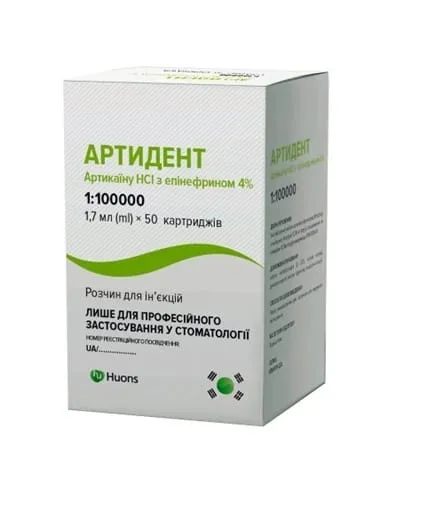
Table of Contents
INSTRUCTIONS FOR MEDICAL USE OF THE MEDICINAL PRODUCT ARTIDENT
Composition:
Active substances:
1 ml of solution contains articaine hydrochloride 40 mg, epinephrine bitartrate 4% (diluted to 1/100,000), calculated as epinephrine 0.01 mg;
Excipients: sodium metabisulfite (E 223), sodium chloride, disodium edetate, sodium hydroxide, water for injections.
Pharmaceutical form. Injection solution.
Main physicochemical properties: clear, colorless liquid, free from visible particles.
Pharmacotherapeutic group.
Local anesthetics. Amides. Articaine, combinations. ATC code N01BB58.
Pharmacological properties.
Pharmacodynamics.
The medicinal product contains articaine, which is an amide-type local anesthetic for use in dentistry. It causes reversible inhibition of sensitivity of autonomic, sensory, and motor nerve fibers. The mechanism of action of articaine is believed to be blockade of voltage-dependent sodium channels in the nerve fiber membrane.
Characteristic features include rapid onset of analgesia (onset time – from 1 to 3 minutes), reliable strong analgesic effect, and good local tolerance.
Adrenaline (diluted to 1/100,000), added to the articaine solution, slows the entry of articaine into systemic circulation, thereby ensuring a longer active concentration in tissues. This, in turn, allows achieving a surgical field with reduced bleeding.
Onset of action: 1.5–1.8 minutes for infiltration, and 1.4–3.6 minutes for nerve block.
Duration of anesthesia: pulpal anesthesia lasts from 45 to 75 minutes, soft tissue anesthesia lasts from 120 to 360 minutes, depending on the administered dose.
Pharmacokinetics.
The product is rapidly and almost completely absorbed.
Maximum plasma concentration of articaine after intraoral injection is reached approximately within 10–15 minutes. The volume of distribution is 1.67 L/kg, elimination half-life is approximately 20 minutes, and time to reach maximum plasma concentration is 10–15 minutes.
Protein binding of articaine in plasma is up to 95%. It is rapidly hydrolyzed by plasma cholinesterases to its primary metabolites, articainic acid, which are further metabolized to glucuronide of articainic acid. Articaine and its metabolites are mainly excreted by the kidneys. Adrenaline is rapidly metabolized in the liver and other tissues. It and its metabolites are excreted by the kidneys.
Clinical characteristics.
Indications.
Local (infiltration and conduction) anesthesia in dentistry.
"Artident" is indicated for complex procedures requiring deep analgesia.
Contraindications.
- Hypersensitivity to articaine or to other local anesthetics, epinephrine (adrenaline), sulfites [metabisulfite (E 223)], or to any of the excipients of the medicinal product;
- Paroxysmal tachycardia and other tachyarrhythmias;
- Acute decompensated heart failure (acute congestive heart failure), severe/unstable angina pectoris, recent myocardial infarction (within 3 to 6 months), recent coronary artery bypass surgery (within 3 months), refractory arrhythmia and paroxysmal tachycardia or prolonged high-frequency arrhythmia (absolute arrhythmia with tachycardia), untreated or uncontrolled congestive heart failure, cardiac conduction disorders not supported by a cardiac pacemaker (atrioventricular block II–III degree, documented bradycardia), uncontrolled/severe arterial hypertension, severe arterial hypotension;
- Closed-angle glaucoma;
- Severe hepatic insufficiency (porphyria);
- Hemorrhagic diatheses (increased risk of bleeding), especially when conduction anesthesia is applied;
- History of abnormal plasma cholinesterase activity (including drug-induced forms);
- Hyperthyroidism;
- Pheochromocytoma;
- Methemoglobinemia, hypoxia, sulfonamide intolerance (especially in bronchial asthma);
- Severe diabetes mellitus;
- Simultaneous terminal anesthesia;
- Injection into inflamed areas (reduces the effectiveness of local anesthesia);
- Uncontrolled epilepsy;
- Concomitant use of non-selective β-blockers, e.g., propranolol (risk of hypertensive crisis or severe bradycardia);
- Concomitant use with tricyclic antidepressants or monoamine oxidase inhibitors (MAOIs) and within 14 days after discontinuation of MAOI therapy;
- Children under 4 years of age (body weight below 20 kg).
Intravenous administration of the drug is contraindicated.
Due to the presence of epinephrine in the formulation, the drug should not be used for anesthesia of extremities (e.g., fingers), as there is a risk of ischemia.
The medicinal product must not be administered to patients with bronchial asthma who are hypersensitive to sulfites. In such individuals, administration may provoke an acute allergic reaction with symptoms of anaphylaxis, such as bronchospasm.
This medicinal product is generally not recommended for co-administration with certain drugs, such as guanethidine and related substances (see section "Interaction with other medicinal products and other forms of interaction").
Special safety precautions.
Before administering this medicinal product, it is necessary to:
- Inquire about any history of allergy and current or previous treatments, including concomitant use of other medicinal products;
- Have resuscitation equipment readily available.
Skin testing with local anesthetics should be performed in patients with confirmed previous reactions to these agents. Special attention is required when testing local anesthetics containing adrenaline due to an increased frequency of false-negative results. Provocation tests are recommended if skin tests yield negative results. Testing of patients with proven allergic reactions to local anesthetics should only be performed by allergologists experienced in local anesthesia.
Risk associated with accidental intravascular injection
Accidental intravascular injection (e.g., unintentional intravenous injection into systemic circulation, unintentional intravenous or intra-arterial injection in the head or neck region) may lead to serious adverse reactions, such as seizures followed by central nervous system or cardiorespiratory depression and coma, progressing to respiratory arrest due to a sudden high level of adrenaline and articaine in systemic circulation.
An aspiration test should be performed to ensure the needle is not within a blood vessel, especially during nerve block.
The injection should be administered slowly, with aspiration tested in at least two planes (needle rotation – 180º) to avoid intravascular administration.
However, the absence of blood in the syringe does not guarantee prevention of intravascular injection.
Risk associated with intra-neural injection
Accidental intra-neural injection may result in retrograde movement of the drug along the nerve.
To prevent intra-neural injection and avoid nerve injury during nerve block, the needle should be slightly withdrawn if the patient experiences an electric shock sensation or if the injection is particularly painful.
If nerve injury occurs, the neurotoxic effect may be enhanced by the potential chemical neurotoxicity of articaine, which may impair perineural blood supply and prevent drug clearance from the injection site.
Concomitant use of other medicinal products requires careful monitoring.
After anesthesia onset, there is a risk of unintentional trauma due to biting the mucosa of the lip, cheek, or tongue. The patient should be warned not to chew during the anesthetic effect.
Injections into infected or inflamed tissues should be avoided (reduces the effectiveness of local anesthesia).
Interaction with other medicinal products and other forms of interaction.
Combinations not recommended
Postganglionic adrenergic blockers (e.g., guanadrel, guanethidine, and rauwolfia alkaloids). If this combination cannot be avoided, the dose of the medicinal product should be reduced. Caution is required due to possible increased response to adrenergic vasoconstrictors: risk of arterial hypertension and other cardiovascular effects (hyperreactivity due to reduced sympathetic tone and/or slowed uptake of adrenaline into sympathetic fibers).
Non-selective β-blockers (propranolol, nadolol). The drug should not be administered during treatment with non-selective β-blockers, as this increases the risk of hypertensive crisis and severe bradycardia (see section "Contraindications").
Tricyclic (imipramine-type) antidepressants (amitriptyline, desipramine, imipramine, nortriptyline, maprotiline, and protriptyline) and MAO inhibitors, both selective (brofaramine, moclobemide, toloxatone) and non-selective (phenelzine, tranylcypromine, linezolid). The hypertensive effects of sympathomimetic vasoconstrictors (e.g., epinephrine) may be enhanced by tricyclic antidepressants or MAO inhibitors. Therefore, such combinations are contraindicated (see section "Contraindications"). Administration of anesthetic should be limited, e.g., less than 0.1 mg adrenaline within 10 minutes or 0.3 mg within 1 hour in adults.
Guanethidine and related drugs (anti-glaucoma agents). Significant increase in blood pressure (hyperreactivity due to reduced sympathetic tone and/or slowed uptake of adrenaline into sympathetic fibers). If this combination cannot be avoided, smaller doses of sympathomimetic agents (adrenaline) should be used cautiously.
Combinations requiring precautions
Anesthetics. Combinations of different anesthetics have additive effects and produce more pronounced effects on the cardiovascular system and CNS.
Halogenated volatile anesthetics (e.g., halothane). The dose of the drug should be reduced due to increased myocardial sensitivity to catecholamines, predisposing to arrhythmias (increased cardiac excitability): risk of severe ventricular extrasystoles or serious ventricular arrhythmia.
Hemodynamic parameters should be carefully monitored, and anesthetic administration limited, e.g., less than 0.1 mg adrenaline within 10 minutes or 0.3 mg within 1 hour in adults.
Catechol-O-methyltransferase inhibitors (entacapone, tolcapone). Possible increase in heart rate and changes in blood pressure.
Cardiovascular monitoring is recommended.
Serotonin-noradrenaline reuptake inhibitor antidepressants (selective serotonin and norepinephrine reuptake inhibitors – venlafaxine, milnacipran, sertraline). The dose and rate of administration should be reduced due to cumulative or synergistic effects on blood pressure and heart rate. Paroxysmal hypertension with arrhythmias may occur (inhibition of adrenaline uptake into sympathetic fibers). Administration of anesthetic should be limited, e.g., less than 0.1 mg adrenaline within 10 minutes or 0.3 mg within 1 hour in adults. Vasoconstrictive agents enhance and prolong the local anesthetic effect of articaine.
Cardiovascular monitoring (ECG) is recommended.
Drugs causing arrhythmias (antiarrhythmics such as digitalis, quinidine). The drug dose should be reduced due to cumulative or synergistic effects on heart rhythm.
Careful aspiration before injection and cardiovascular monitoring (ECG) are recommended.
Oxytocin. The drug should be administered under strict medical supervision due to possible cumulative or synergistic increase in blood pressure and/or ischemic reaction.
Sympathomimetic vasopressors (mainly cocaine, but also amphetamine, phenylephrine, pseudoephedrine, oxymetazoline). Risk of adrenergic toxicity. If cocaine has been used within 24 hours, planned dental treatment should be postponed.
Other sympathomimetics (e.g., isoproterenol, levothyroxine, methyldopa, antihistamines such as chlorpheniramine, diphenylhydramine). The smallest possible doses of the drug should be used.
Phenothiazines (and other neuroleptics). Phenothiazines may reduce or abolish the pressor effect of adrenaline. The drug should be administered under strict medical supervision and careful cardiovascular monitoring in patients with arterial hypotension due to possible inhibition of adrenaline's effect.
Oral antidiabetic agents. Adrenaline may block insulin release from the pancreas, thereby reducing the effectiveness of oral antidiabetic agents.
Antithrombotic agents. Concomitant use of antithrombotic agents (heparin, acetylsalicylic acid) increases the risk of bleeding. Accidental puncture of a blood vessel during local anesthesia may cause serious hemorrhage.
The medicinal product should be used with caution in combination with hypoglycemic agents, antiarrhythmics (procainamide, mexiletine, disopyramide, quinidine, amiodarone), antiepileptics, cardiac glycosides, thyroid hormones.
Non-selective MAO inhibitors (iproniazid). Enhanced pressor effect of adrenaline, often of moderate degree.
Administration requires careful medical monitoring.
Selective MAO inhibitors (moclobemide, toloxatone) – extrapolating data from non-selective MAO inhibitors, a risk of enhanced pressor effect is expected.
Administration requires careful medical monitoring.
Special precautions for use.
The medicinal product should be used with special caution:
- in patients with cardiovascular disorders (e.g., peripheral arterial disease, heart failure, ischemic heart disease, angina pectoris, history of myocardial infarction, cardiac arrhythmia, arterial hypertension, atherosclerosis, arteriosclerosis), as these patients have a reduced ability to compensate for functional changes associated with the prolongation of atrioventricular conduction caused by these medicinal products;
- in patients with pulmonary diseases, especially allergic asthma, as bronchospasm may occur in these patients; all local anaesthesia should be administered with particular caution due to possible effects on the bronchi;
- in patients with epilepsy, as seizures may occur in these patients; all local anaesthesia should be administered with particular caution, and particularly high doses should be avoided;
- in patients with impaired liver function, since amide-type local anaesthetics are also metabolized in the liver. Patients with acute liver disease have an increased risk of developing toxic plasma concentrations of articaine. The lowest effective dose for anaesthesia should be used in such patients;
- in patients with impaired renal function – use the lowest effective dose for anaesthesia;
- in patients with myasthenia gravis – use the lowest effective dose for anaesthesia;
- in patients receiving anticoagulant/antiplatelet therapy – it should be noted that during treatment with blood coagulation inhibitors [e.g., heparin or acetylsalicylic acid (aspirin)], the risk of severe bleeding and haemorrhage increases in the case of accidental vascular puncture and during maxillofacial surgical procedures. Careful monitoring of the international normalized ratio (INR) is required in patients taking anticoagulants;
- in patients with uncontrolled diabetes – due to the hyperglycaemic effect of adrenaline;
- in elderly patients (over 70 years of age) – due to the lack of clinical data, the dose should be reduced;
- in patients with pronounced anxiety – particularly high doses should be avoided;
- in patients with cerebrovascular disorders – particularly high doses should be avoided;
- in patients with a history of stroke – particularly high doses should be avoided.
For safe and effective use, "Artident" must be administered under appropriate conditions.
Accidental intravascular injection should be avoided (see section "Method of administration and dosage"). Accidental intravascular injection or unintentional overdose may cause seizures and central nervous system (CNS) depression or cardiorespiratory failure. Resuscitation equipment, oxygen, and medicinal products for emergency treatment must be available for immediate use.
When treating a tooth cavity or preparing a tooth for a crown, it should be considered that due to the adrenaline content of the preparation, blood flow in pulp tissue is reduced, thus creating a risk of failing to detect an accidentally exposed pulp.
Adrenaline may impair blood flow in the gums, potentially causing local tissue necrosis.
There have been reports of prolonged or irreversible nerve damage and loss of taste following mandibular anaesthesia.
Local anaesthetic effects may be reduced if the preparation is administered into inflamed or infected tissue.
There is a risk of unintentional injury due to biting, especially in children (lips, cheeks, mucous membranes, and tongue); patients should be warned not to chew anything during the duration of anaesthesia.
"Artident" contains sodium metabisulfite, which may rarely cause allergic reactions and bronchospasm.
One cartridge of the preparation contains less than 1 mmol (23 mg) of sodium, i.e., the preparation is practically sodium-free.
The medicinal product should be used with special caution in patients taking phenothiazines or cardioselective β-adrenoblockers (see section "Interaction with other medicinal products and other forms of interaction").
Athletes should be informed that this preparation contains an active substance that may result in a positive doping test.
Precautionary measures
Each time a local anaesthetic is used, the following medicinal products/treatment measures must be available:
- anticonvulsants (medicinal products for treating seizures, e.g., benzodiazepines or barbiturates), muscle relaxants (medicinal products that reduce tension in voluntary muscles), atropine, vasoconstrictors (medicinal products for treating low blood pressure), or adrenaline for acute allergic or anaphylactic reactions;
- resuscitation equipment (especially oxygen sources) for artificial ventilation if necessary;
- careful and continuous monitoring of cardiovascular and respiratory parameters (adequacy of respiration) and the patient's level of consciousness after each local anaesthetic injection.
Restlessness, anxiety, tinnitus, dizziness, blurred vision, tremor, depression, or drowsiness are the first signs of CNS toxicity (see section "Overdose").
Use in children
Caregivers of young children should be warned about the possibility of soft tissue injury (lips, cheeks, mucous membranes, and tongue) due to biting, resulting from prolonged soft tissue numbness after anaesthesia. The medicinal product should not be used in children under 4 years of age due to the impossibility of performing this type of anaesthesia in such patients.
Use during pregnancy or breastfeeding.
Fertility
No adverse effects on fertility were observed in studies.
Pregnancy
There is no experience with the use of articaine in pregnant women, except during childbirth. Adrenaline and articaine cross the placental barrier, although articaine crosses to a significantly lesser extent compared to other local anaesthetics. Articaine concentrations in newborn serum are approximately 30% of maternal concentrations. In the case of accidental intravascular injection in the mother, adrenaline may reduce uterine blood flow.
The safety of local anaesthetics during pregnancy regarding effects on fetal development has not been established.
Animal studies on the use of articaine do not indicate a direct or indirect adverse effect on pregnancy and delivery, or on embryonic/foetal or postnatal development.
Animal studies have revealed reproductive toxicity of adrenaline.
The potential risk for humans is unknown.
Therefore, as a precautionary measure, it is advisable to avoid using the product during pregnancy.
Breastfeeding
No clinical studies have been conducted in breastfeeding women.
It is unknown whether articaine and its metabolites pass into breast milk. However, preclinical safety data suggest that articaine concentrations in breast milk do not reach clinically significant levels. Adrenaline passes into breast milk but is rapidly degraded.
Therefore, breastfeeding women are advised to express and discard the first milk and refrain from breastfeeding for 10 hours after anaesthesia.
Ability to affect reaction speed when driving or operating machinery.
The medicinal product may have a minor effect on the ability to drive or operate machinery. Dizziness, visual disturbances, and fatigue may occur after administration of the product. Therefore, after injection, the patient should remain in the dentist's office for at least 30 minutes.
Method of Administration and Dosage
FOR PROFESSIONAL DENTAL USE ONLY.
The medicinal product is intended for adults and children aged 4 years and older (body weight ≥20 kg), as this type of anesthesia is inappropriate for children under 4 years of age.
Prior to administration, a hypersensitivity test must be performed.
As with other local anesthetics, dosage should be individualized and adjusted according to the area to be anesthetized, tissue vascularity, number of nerve segments to be blocked, individual tolerance, and the anesthesia technique used.
To ensure effective anesthesia, the lowest effective doses should be used.
The required dose must be determined individually by the physician. Doses must not exceed the maximum recommended levels.
The maximum dose for adults is 7 mg of articaine hydrochloride per kg of body weight. The maximum total dose must not exceed 500 mg.
For children, the maximum dose is 5 mg of articaine hydrochloride (0.125 mL of anesthetic solution) per kg of body weight.
The average dose of articaine hydrochloride (mg) that may be administered to children can be calculated as follows: child’s body weight (kg) × 1.33.
Special Populations
Due to the lack of clinical data, particular caution should be exercised when administering the lowest effective dose of the drug to elderly patients (over 70 years of age), and to patients with impaired hepatic or renal function. For elderly patients, a dose equal to half the adult dose should be administered.
Method of Administration
Intraoral infiltration and perineural administration.
Prior to injection, aspiration is recommended to avoid intravascular injection.
Systemic reactions resulting from accidental intravascular injection can usually be avoided in most cases by proper injection technique following aspiration—administer the injection slowly: the injection rate should not exceed 1 mL of solution per minute.
To prevent the risk of infection (e.g., transmission of hepatitis), syringes and needles used for injections must always be sterile.
For single use only. Any remaining solution must be discarded.
Do not use cloudy or non-transparent solutions.
Children
The medicinal product may only be used in children aged 4 years and older (body weight >20 kg), as the efficacy and safety of the drug have not been established in children under 4 years of age.
The medicinal product should be administered to children in the minimal effective amount required to achieve adequate anesthesia. The administered amount must be individually adjusted based on the child’s age and body weight. The maximum dose of 5 mg of articaine per kg of body weight must not be exceeded.
The safety profile in children aged 4 to 18 years was similar to that in adults. However, accidental soft tissue injury occurs more frequently, particularly in children aged 3 to 7 years, due to prolonged soft tissue anesthesia.
Overdose
The most commonly described cases of overdose with local anesthetics include:
- Absolute overdose;
- Relative overdose, such as accidental intravascular injection, abnormally rapid absorption into systemic circulation, or delayed metabolism and elimination of the drug.
The most serious manifestations of articaine intoxication involve effects on the central nervous and cardiovascular systems.
Symptoms that may be caused by articaine
Cardiovascular system: arterial hypertension, arterial hypotension, facial flushing, agitation, palpitations, angina pectoris, generalized vasoconstriction, conduction disturbances, arrhythmia, bradycardia, vasomotor paralysis, cyanosis, cardiovascular collapse, cardiac arrest.
Central nervous system: headache, nervousness, anxiety, confusion, restlessness, motor agitation, stupor, loss of speech, muscular atony, coma, dizziness, hearing loss, tinnitus, taste disturbances, nausea, vomiting, tremor, involuntary muscle contractions, dyspnea, tachypnea, restlessness, drowsiness, loss of consciousness, tonic-clonic seizures, respiratory arrest.
The most dangerous symptoms include: arterial hypotension, cardiac arrest, conduction disturbances, tonic-clonic epileptic seizures, respiratory paralysis, and drowsiness/coma.
Symptoms that may be caused by adrenaline
Circulatory disorders: increased systolic blood pressure, increased diastolic blood pressure, increased venous pressure, increased pulmonary artery pressure, arterial hypotension.
Cardiac disorders: bradycardia, tachycardia, arrhythmias (e.g., atrial tachycardia, AV block, ventricular tachycardia, ventricular extrasystoles, ventricular fibrillation).
These symptoms, as well as pulmonary edema, cardiac arrest, renal failure, and metabolic acidosis, may lead to life-threatening consequences. Fatal outcomes may result from respiratory center paralysis.
Treatment
Resuscitation equipment must be available before initiating dental anesthesia with local anesthetics.
If early signs of adverse or toxic reactions occur during administration, the injection must be stopped immediately and the patient placed in a supine position. Airway patency must be ensured, and pulse and blood pressure monitored. Initiation of intravenous infusion of symptomatic agents is recommended, even if symptoms do not appear severe, to ensure reliable intravenous access. In case of respiratory impairment, oxygen should be administered depending on the severity of the condition; if necessary, artificial respiration (mouth-to-nose) or endotracheal intubation combined with controlled ventilation should be applied. In case of cardiac arrest, immediate cardiopulmonary resuscitation measures must be initiated.
Central-acting analeptics are contraindicated.
Involuntary muscle contractions or generalized muscle seizures require intravenous administration of short-acting anticonvulsants (e.g., succinylcholine chloride, diazepam) or short- or ultra-short-acting barbiturates.
Barbiturates should be administered slowly, depending on the observed effect, while continuing oxygen administration and cardiac monitoring to avoid the risk of circulatory disturbances and respiratory depression. Barbiturate administration should be accompanied by intravenous infusion of fluids through a previously placed cannula. Tachycardia and hypotension can often be counteracted simply by placing the patient in a supine position with legs slightly elevated above the head.
In cases of severe circulatory disturbances or shock, regardless of cause, the following measures should be taken after stopping the injection: place the patient in a supine position with slightly elevated lower limbs, ensure airway patency, administer oxygen by insufflation. Additionally, establish intravenous infusion of balanced electrolyte solution. Intravenous administration of glucocorticoids (e.g., 250–1000 mg methylprednisolone), fluid replacement (if necessary, also plasma substitutes and human albumin) should be initiated. In case of life-threatening circulatory collapse and increasing bradycardia, immediate intravenous injection of adrenaline is required. To prepare the solution, dilute 1 mL of 1:1000 adrenaline solution to 10 mL, and initially administer slowly 0.25–1 mL of this solution (0.025–0.1 mg of adrenaline). Pulse rate and blood pressure must be monitored. Do not administer more than 1 mL of this solution (0.1 mg adrenaline) at once. If this dose is insufficient, add adrenaline to the infusion solution (infusion rate adjusted according to pulse rate and blood pressure).
Severe tachycardia or tachyarrhythmias may also be managed with antiarrhythmic agents (but not non-selective β-adrenergic blockers).
Oxygen administration and hemodynamic monitoring are mandatory in all such cases. In patients with arterial hypertension and elevated blood pressure, peripheral vasodilators should be used.
Adverse Reactions
Adverse reactions following administration of the medicinal product are similar to those observed with other amide-type local anesthetics combined with vasoconstrictors.
As with all anesthetics used in dental practice, collapse may occur.
There is a risk of allergic reactions, including anaphylactic reactions and bronchospasm, due to the presence of sodium metabisulfite.
Overall, the use of the medicinal product is considered very safe. However, establishing a causal relationship (exact differentiation is not possible) is difficult, as adverse reactions may be related not only to the underlying dental disease or dental intervention but also to the use of local anesthesia.
These adverse reactions are dose-dependent and may occur due to elevated plasma levels of the drug resulting from overdose, rapid absorption, or unintentional intravascular injection. They may also arise due to allergy, idiosyncrasy, or reduced patient tolerance to medicinal products. The most common adverse reactions affect the nervous and cardiovascular systems.
Generally, adverse reactions are systemic.
The presence of adrenaline enhances the safety profile of the product due to its sympathomimetic effect.
The most frequently observed adverse reactions include: nervous disorders, pain, procedural pain, sensitivity, headache, swelling, sensory disturbances (e.g., hypoesthesia, paresthesia, taste disturbances). In case of suspected hypersensitivity reactions, appropriate allergy testing is recommended.
The product is generally well tolerated by patients; however, the following adverse reactions may occur.
Immune system disorders: hypersensitivity reactions (allergic and pseudoallergic), in severe cases – anaphylactic/anaphylactoid reactions, anaphylactic shock, angioedema of varying severity (including facial swelling, tongue, cheeks, upper and/or lower lip and/or neck, laryngeal edema causing sensation of lump in the throat and difficulty swallowing, periorbital swelling, breathing difficulties), bronchospasm/asthma, urticaria.
Psychiatric disorders: restlessness, anxiety, euphoria.
Nervous system disorders: neuropathy (including peripheral neuropathies), neuralgia (neuropathic pain), hypoesthesia (oral and perioral numbness), dysesthesia (oral and perioral), including dysgeusia (e.g., metallic taste in mouth, distorted taste sensations), hypergeusia, loss of taste, allodynia, hyperesthesia, thermohyperesthesia, pre-syncopal state, syncope, headache, excitement/agitation, nervousness, insomnia, confusion, disorientation, dizziness (vertigo), stupor, tremor, burning sensation, profound CNS depression: loss of consciousness, altered mental status, decreased muscle tone, coma, respiratory paralysis, seizures (including clonic-tonic seizures), involuntary muscle contractions, facial nerve damage (paresis, paralysis, incomplete paralysis), speech disorders (dysarthria, logorrhea), balance disturbances (disequilibrium), somnolence (drowsiness), nystagmus, paresthesia (persistent hypoesthesia) after inferior alveolar nerve block or mandibular nerve block, paralysis of the 6th cranial nerve.
Respiratory, thoracic and mediastinal disorders: nasal congestion, dysphonia (hoarseness), dyspnea, yawning, laryngeal edema, pharyngeal edema, pulmonary edema, rhinitis, hypoxia, hypercapnia, tachypnea, bradypnea, respiratory disturbances, respiratory depression, which may progress to apnea (respiratory arrest).
Cardiac disorders: bradycardia/bradyarrhythmia, tachycardia/tachyarrhythmia (including ventricular extrasystoles and ventricular fibrillation), cardiac arrest, myocardial depression, angina pectoris, palpitations, arterial hypotension (possibly with heart failure), pallor of the skin (local, regional, generalized), arterial hypertension, flushing, conduction disturbances (atrioventricular block), vasodilation, vasoconstriction, bleeding, heart failure, collapse and shock (which may be life-threatening).
Eye disorders: Bernard-Horner syndrome (ptosis, enophthalmos, miosis), diplopia (paralysis of extraocular muscles), mydriasis, ptosis, visual disturbances, transient blindness, decreased visual acuity, blurred vision, unsharp vision, visual clouding, accommodation disturbances, conjunctivitis.
Ear and labyrinth disorders: vertigo, ear pain, tinnitus, increased auditory acuity.
Skin and subcutaneous tissue disorders: skin redness, urticaria, pruritus, hyperhidrosis, rash, erythema, angioedema.
Musculoskeletal and connective tissue disorders: neck pain, back pain, muscle spasms, chills (shivering), muscle tension, osteonecrosis, worsening of neuromuscular symptoms in Kearns-Sayre syndrome.
Gastrointestinal disorders: gingivitis, nausea, vomiting, diarrhea, abdominal pain, cheilitis, constipation, dry mouth, dyspepsia, oral ulcers, tooth loss, hypersalivation, increased tooth sensitivity, stomatitis, glossitis, hypoesthesia of the oral cavity, swelling in the oral cavity (tongue, lips, gums), paresthesia of the oral cavity, exfoliation of necrotic material from the oral mucosa, dysphagia.
Other: chills; with high doses – methemoglobinemia.
General disorders and administration site conditions: asthenia (weakness), chills, increased fatigue, malaise, thirst, increased sweating, sensation of heat/cold, pain, tenderness on pressure, swelling or inflammation at injection site, hematoma at injection site, necrosis at injection site, mucosal inflammation, mucosal swelling; nerve damage (up to paralysis) due to improper injection technique.
Accidental intravascular injection may lead to ischemic areas at the injection site, which sometimes progress to tissue necrosis.
Investigations: decreased blood pressure, increased heart rate, increased blood pressure, signs of myocardial ischemia (on ECG), vital function disturbances, positive allergy test, unmeasurable blood pressure, decreased heart rate.
Injury, poisoning and procedural complications: procedural pain, oral injuries, incorrect route of administration, nerve damage, gingival trauma, wound complications.
Description of selected adverse reactions
Nerve function disorders
Nerve function disorders in dentistry may arise from various causes. They may be caused by the underlying dental condition, dental treatment, or direct adverse reactions related to the use of local anesthetics. Given the frequency of these adverse reactions, the risk of such disorders is low. Most of these adverse effects are reversible.
Hypersensitivity reactions
Most hypersensitivity reactions were not serious; however, life-threatening reactions cannot be completely excluded.
In case of suspected hypersensitivity reactions, appropriate allergy testing is recommended, including testing for individual components of the product.
Children
Studies have not revealed any differences in safety profile between children and adults.
In children, accidental soft tissue injuries due to prolonged soft tissue anesthesia were more frequently observed.
Special warnings
In rare cases, particularly in patients with bronchial asthma, the product may cause hypersensitivity reactions due to the presence of sodium metabisulfite in its composition. These reactions may clinically manifest as vomiting, diarrhea, stridorous breathing, acute asthma attack, disturbances of consciousness, or shock.
Reporting of suspected adverse reactions associated with the use of the product.
Reporting of suspected adverse reactions occurring after administration of the medicinal product is of great importance. This allows continuous monitoring of the benefit-risk balance of the product. Healthcare professionals are requested to report any adverse reactions.
Shelf life. 2 years.
Storage conditions.
Store at temperatures not exceeding 25 °C in the original packaging.
Do not freeze.
Keep out of reach of children.
Incompatibilities.
Due to the lack of appropriate studies, the product must not be mixed with other medicinal products.
Packaging.
No. 50 (5 blisters of 10 cartridges each),
1.7 ml colorless glass cartridges, sealed at one end with a rubber stopper and aluminum cap, and with a rubber plunger at the other end; 10 cartridges per blister; 5 blisters per cardboard box.
Prescription status.
Prescription only.
Manufacturer.
Huons Co., Ltd.
Manufacturer's address and location of operations.
100 Bio Valley-ro, Jecheon-si, Chungcheongbuk-do, Republic of Korea.