Arstifen®
Ukraine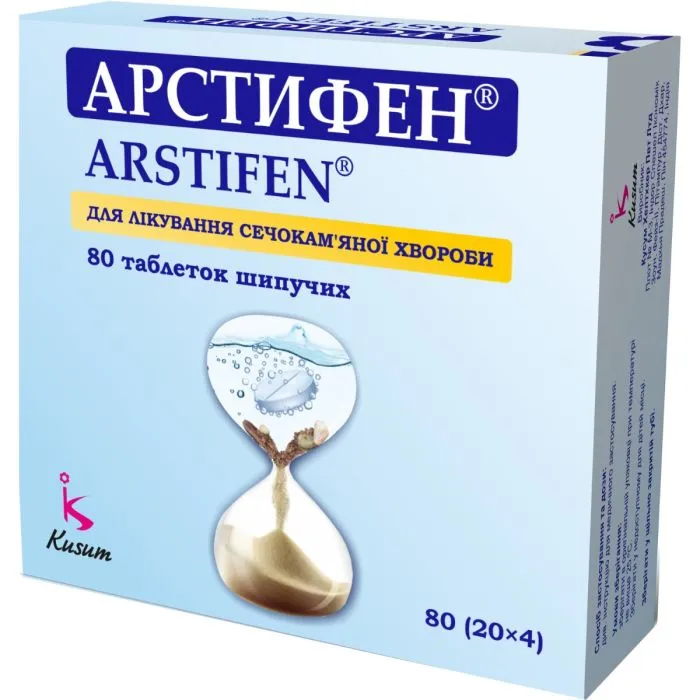
Table of Contents
INSTRUCTIONS FOR MEDICAL USE OF THE MEDICINAL PRODUCT ARSTIFEN® (ARSTIFEN®)
Composition:
Active substances: anhydrous citric acid, anhydrous sodium citrate, potassium hydrogencarbonate;
One tablet contains: anhydrous citric acid 1197 mg, anhydrous sodium citrate 835.5 mg, potassium hydrogencarbonate 967.5 mg;
Excipients: lactose monohydrate, mannitol (E 421), sodium saccharin, flavoring agent "Powdarome Lemon Premium", adipic acid, polyethylene glycol.
Pharmaceutical form. Effervescent tablets.
Main physicochemical properties: round, flat tablets with a bevel, white to almost white in color, with smooth surface on both sides.
Pharmacotherapeutic group. Agents used for dissolution of urinary calculi. ATC code G04BC.
Pharmacological properties.
Pharmacodynamics.
After dissolving the effervescent tablets Arstifen**®** in water, potassium-sodium hydrocitrate is formed and carbon dioxide is released.
Residual alkaline ions are thereby generated, which are excreted by the kidneys. Thus, the pH level of urine increases (depending on the dosage, urine is either neutralized or alkalized).
This increases the degree of dissociation and simultaneously enhances the solubility of uric acid/cystine. Radiographic evidence confirms the litholytic effect on uric acid and cystine stones.
Administration of the drug enhances excretion of citrates and reduces calcium excretion in urine. Alkalinization of urine, increased citrate excretion, and reduced calcium excretion contribute to a decrease in urinary calcium oxalate levels, since in a weakly alkaline environment citrate forms stable complex compounds with calcium. Furthermore, the citrate ion should be considered the most effective physiological inhibitor of crystal formation and of calcium oxalate and calcium phosphate accumulation.
Pharmacokinetics.
After single-day administration of Arstifen**®** effervescent tablets, the administered amounts of sodium and potassium are excreted from the body via the kidneys within 24–48 hours. With prolonged use of the drug, daily excretion of potassium and sodium corresponds to their daily intake. In blood or serum, no significant changes in blood gases or electrolytes are observed. This indicates that, due to renal regulation, acid-base balance in the body is maintained, and accumulation of sodium and potassium does not occur with normal kidney function.
Clinical characteristics.
Indications.
Arstifen**®** is used for the treatment of urolithiasis with the aim of:
- alkalinization of urine in patients with urate stones, with or without concomitant calcium stones;
- metaphylaxis of calcium stones (prevention of recurrence of new stones and/or growth of residual fragments).
Contraindications.
- Hypersensitivity to the components of the medicinal product.
- Renal insufficiency.
- Urinary tract infections caused by urea-splitting bacteria (risk of struvite stone formation).
- Metabolic alkalosis.
- Episodic hereditary adynamia.
Interaction with other medicinal products and other types of interactions.
Interaction studies have been conducted only in adults.
Concomitant administration of substances containing citrate and aluminum may lead to increased absorption of aluminum; therefore, a two-hour interval between administration of such products and the medicinal product Arstifen**®** is recommended.
The drug enhances the therapeutic effect of allopurinol.
Some medicinal products used to lower blood pressure (aldosterone antagonists and other low-potassium diuretics such as triamterene, spironolactone, and amiloride), ACE inhibitors, sartans, as well as analgesics and anti-inflammatory drugs (nonsteroidal anti-inflammatory agents and peripheral analgesics) may reduce potassium excretion. This should be taken into account when prescribing these drugs concomitantly with Arstifen**®** (increased risk of hyperkalemia). Increased extracellular potassium concentration reduces the effect of cardiac glycosides, whereas decreased potassium concentration enhances the arrhythmogenic effect of cardiac glycosides.
With prolonged use of Arstifen**®**, accumulation of quinidine in the body is possible if taken concomitantly, as well as reduced efficacy of nitrofurantoin (due to alkaline environment), salicylates, and lithium preparations (accelerated excretion).
Special precautions for use.
In conditions predisposing to urinary stone formation (e.g., hyperparathyroidism, uric acid stones associated with malignancy), etiological therapy should be applied.
When dissolving uric acid stones, prolonged excessive alkalinization of urine (pH above 7.8) should be avoided due to the possible precipitation of phosphate salts on the surface of uric acid stones, which may hinder further dissolution. In addition, prolonged and pronounced alkaline state of metabolism is undesirable.
Before administration, serum electrolyte levels should be determined and renal function assessed. In suspected renal tubular acidosis, additional monitoring of acid-base balance parameters is required.
During treatment, regular monitoring of urine and blood parameters is necessary. Special attention should be paid to acid-base balance.
In patients with heart failure, the effect of potassium on myocardial excitability should be considered: 1 tablet of the medicinal product Arstifen® contains 380 mg of potassium ions, or 9.7 mmol of potassium, which may influence the effect of cardiac glycosides (elevated extracellular potassium concentration reduces glycoside activity, while decreased potassium levels enhance their arrhythmogenic effect).
In patients with impaired uric acid metabolism, concomitant use of allopurinol is recommended.
Patients on sodium-restricted diets, particularly those with hypertension, should take into account the high sodium content of this medicinal product (1 tablet contains 220 mg of sodium ions, or 9.7 mmol sodium, equivalent to 0.57 g of salt).
One effervescent tablet contains 9.7 mmol (380 mg) of potassium. This should be considered when treating patients with impaired renal function or those on potassium-restricted diets.
During treatment with this drug, a low-protein diet is recommended, i.e., limiting intake of foods rich in purines (e.g., meat, sausages, animal offal, sardines), as well as limiting salt consumption.
Daily fluid intake of 2–3 liters in the form of tea, fruit juice, or alkaline mineral water is recommended.
The drug contains no carbohydrates and therefore may be used in the treatment of patients with diabetes mellitus.
Arstifen**®** should be administered to patients with severe hepatic insufficiency only under strict medical supervision.
The formulation contains lactose monohydrate. Therefore, in patients with known sugar intolerance, consultation with a physician is necessary before taking this medicinal product.
Use during pregnancy or breastfeeding.
When used according to instructions, no adverse effects during pregnancy or breastfeeding have been observed.
Ability to influence reaction rate while driving or operating machinery.
No influence.
Dosage and Administration.
The optimal daily dose of the medicinal product Arstifen**®** is determined individually according to the pH value of urine.
For urinary alkalinization in patients with uric acid (urate) stones
To prevent recurrences, the pH of fresh urine should be maintained within the range of 6.2 to 6.8. The required daily dose of Arstifen**®** is individual for each patient. Usually, the daily dose is 3 effervescent tablets. The daily dose should be divided into three equal single doses taken throughout the day. If the urine pH is below 6.2, the dose should be increased. This adjustment should be achieved by increasing the evening dose to 2, and in exceptional cases up to 3 effervescent tablets. If the pH exceeds 6.8, the dose should be reduced. Dose adjustments are preferably made by modifying the evening dose.
For dissolution (chemolytic treatment) of uric acid (urate) stones, the urine pH should be maintained between 7.0 and 7.2.
For prophylaxis of calcium stones and urinary alkalinization in patients with uric acid stones, particularly in the presence of concomitant calcium stones
The pH of fresh urine should be adjusted to 6.8–7.4. The dose must be individually determined in each case to achieve this pH range. Usually, this corresponds to 3 effervescent tablets. If necessary, the dose may be increased, but in most cases 5 effervescent tablets are sufficient to achieve the desired pH range.
A daily dose of 3 effervescent tablets may be taken as a single evening dose or divided into three equal doses taken throughout the day. With higher doses, it is advisable to take 1 effervescent tablet in the morning, 1 at noon, and 2–3 tablets in the evening.
Arstifen**®** is contraindicated in children (under 18 years of age) — see section "Children".
Administration method
Arstifen**®** effervescent tablets should be dissolved in a glass of water, stirred, and taken immediately.
The resulting solution may appear slightly cloudy and may contain some undissolved particles.
The effectiveness is usually monitored three times daily by measuring urine pH. Standard indicator strips provided in each package are used for this purpose. The indicator area of the test strip should be briefly immersed into the urine. The color of the test strip should then be compared with the color scale within 2 minutes, and the pH value should be read and recorded in the monitoring calendar.
Children
The efficacy and safety of Arstifen**®** in children have not been sufficiently studied; therefore, the use of Arstifen**®** is not recommended in children (under 18 years of age).
Overdose
With normal kidney function, no adverse effects of the medicinal product on physiological metabolic parameters are observed, neither at the usual recommended dose nor at higher doses, since the excretion of excess alkali via the kidneys is a natural mechanism for regulating acid-base balance in the body.
The upper limit of the urine pH range specified above should not be exceeded for several days, as an elevated pH (>7.8) increases the risk of phosphate crystallization. Furthermore, a pronounced alkaline metabolic state is not considered sustainable in the long term.
Potential overdose can be managed by reducing the dose of the drug. If necessary, measures for the treatment of metabolic alkalosis may be applied.
Adverse Reactions
Hypersensitivity reactions are possible in individuals with individual intolerance to any component of the medicinal product. In some cases, tablet intake may cause gastrointestinal disturbances in predisposed patients. Reports include belching, heartburn, abdominal pain, flatulence, diarrhea, nausea, and vomiting.
Reporting of Adverse Reactions
Reporting of adverse reactions following registration of the medicinal product is of great importance. It enables ongoing monitoring of the benefit-risk balance of the medicinal product. Medical and pharmaceutical personnel, as well as patients or their legal representatives, should report all suspected adverse reactions and lack of efficacy via the Automated Information System for Pharmacovigilance at the following link: https://aisf.dec.gov.ua
Shelf Life
2 years.
Storage Conditions
Store in the original packaging at a temperature not exceeding 25 °C.
Keep out of reach and sight of children.
Packaging
20 effervescent tablets in a tube, 4 tubes in a cardboard pack with indicator paper and control calendar.
Supply Category
Over-the-counter (without prescription).
Manufacturer
Kusum Healthcare Pvt Ltd /
Kusum Healthcare Pvt Ltd.
Manufacturer's Address and Location of Business Activity
Plot No. M-3, Indore Special Economic Zone, Phase-II, Pithampur, Distt. Dhar, Madhya Pradesh, Pin 454774, India /
Plot No. M-3, Indore Special Economic Zone, Phase-II, Pithampur, Distt. Dhar, Madhya Pradesh, Pin 454774, India.