Arcuron
Ukraine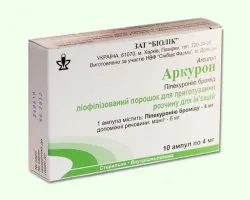
Table of Contents
INSTRUCTION FOR MEDICAL USE OF THE MEDICINAL PRODUCT ARKURON (ARCURON)
Composition:
Active substance: 1 ampoule contains 4 mg of pipecuronium bromide;
Excipient: mannite (E 421).
Pharmaceutical form. Lyophilisate for solution for injection.
Main physicochemical properties: white or almost white lyophilized powder.
Pharmacotherapeutic group. Peripheral-acting muscle relaxants.
ATC code M03AC06.
Pharmacological properties.
Pharmacodynamics.
Pipecuronium bromide is a long-acting non-depolarizing neuromuscular blocker. By competitively binding to nicotinic acetylcholine receptors located at motor endplates of striated muscle fibers, it blocks signal transmission from nerve endings to muscle fibers. Its antidotes are acetylcholinesterase inhibitors (e.g., neostigmine, pyridostigmine, edrophonium). Unlike depolarizing muscle relaxants (e.g., succinylcholine), pipecuronium bromide does not cause muscle fasciculations. Pipecuronium bromide has no hormonal activity.
Even at doses several times higher than its effective dose required for 90% reduction in muscle contractility (ED90), it has no ganglion-blocking, vagolytic, or sympathomimetic activity.
According to study data, under balanced anesthesia, the ED50 and ED90 doses of pipecuronium bromide are 0.03 and 0.05 mg/kg body weight, respectively.
A dose of 0.05 mg/kg provides 40–50 minutes of muscle relaxation during various surgical procedures.
The maximum effect of pipecuronium bromide is dose-dependent and occurs within 1.5–5 minutes. The onset of action is fastest at doses of 0.07–0.08 mg/kg body weight. Further dose increases shorten the onset time and significantly prolong the duration of action.
Pharmacokinetics.
After intravenous administration, the initial volume of distribution (Vdc) is 110 mL/kg body weight; the steady-state volume of distribution (Vdss) is 300 ± 78 mL/kg; plasma clearance (Cl) is 2.4 ± 0.5 mL/min/kg; mean elimination half-life (t1/2) is 121 ± 45 minutes; mean residence time (MRT) is 140 minutes.
With repeated administration of maintenance doses, cumulative effects are negligible if doses of 0.01–0.02 mg/kg are administered at the time when 25% of initial contractility has returned.
Approximately 75% of the drug is excreted unchanged, primarily via the kidneys—56% within the first 24 hours—with the remainder excreted as 3-desacetyl-pipecuronium. The liver also participates in the elimination of pipecuronium.
Clinical characteristics. Indications.
Muscle relaxation during general anesthesia to facilitate endotracheal intubation and surgical procedures requiring more than 20–30 minutes of muscle relaxation.
Contraindications.
Known hypersensitivity to the active substance (pipecuronium or bromide) or to any excipient. Myasthenia gravis.
Interaction with other medicinal products and other forms of interaction.
The following medicinal products may affect Arduan.
- Enhance or prolong the effect:
- inhalational anesthetics (halothane, methoxyflurane, diethyl ether, enflurane, isoflurane, cyclopropane);
- intravenous anesthetics (ketamine, fentanyl, propanidid, barbiturates, etomidate, γ-hydroxybutyric acid);
- other non-depolarizing muscle relaxants, prior administration of succinylcholine;
- certain antibiotics and chemotherapeutic agents (aminoglycosides, polypeptides, imidazoles, metronidazole);
- diuretics, α- and β-blockers, thiamine, MAO inhibitors, guanidine, protamine, phenytoin, calcium channel blockers, magnesium salts, intravenous lidocaine.
- Reduce the effect:
- prolonged prior use of glucocorticoids, neostigmine, edrophonium, pyridostigmine, norepinephrine, azathioprine, theophylline, potassium chloride, sodium chloride, calcium chloride.
- Enhance or reduce the effect:
- prior administration of depolarizing muscle relaxants (depending on dose, duration of administration, and individual patient sensitivity).
Special precautions for use.
Arkuron must be administered exclusively in specialized inpatient settings under the supervision of an experienced physician, and only when equipment for endotracheal intubation, artificial ventilation of the lungs, oxygen therapy, and antagonist drugs is available.
Anaphylactic and anaphylactoid reactions to muscle relaxants have been reported in medical literature. Such reactions may occasionally occur with non-depolarizing muscle relaxants. Although there have been no reports of similar effects with Arkuron, the drug should be used only under conditions allowing immediate treatment of such conditions. The drug should be administered with particular caution in patients with a history of allergic reactions to other muscle relaxants, since cross-allergies may develop among non-depolarizing muscle relaxants.
Histamine release and histamine-like reactions: Pipecuronium bromide does not release histamine.
Pipecuronium bromide has a mild hemodynamic effect, possibly due to its weakly expressed cardiostimulant, vagolytic effect. When doses up to 0.1 mg/kg body weight are administered, no ganglion-blocking or vagolytic effects are observed, and only mild cardiovascular side effects (reduction in arterial pressure, bradycardia) may occur, particularly when halothane or fentanyl are used concomitantly during anesthesia induction.
Doses of Arkuron causing muscle relaxation have no significant cardiovascular effects and, unlike some anesthetics, do not cause vagus reflex-induced bradycardia.
In view of the above, the use and dosage of vagolytic drugs for premedication should be carefully evaluated beforehand; the vagus-stimulating effects of other concurrently administered drugs and the type of surgery should also be considered.
To prevent relative overdosing and to ensure adequate monitoring of muscle function recovery, peripheral nerve stimulation is recommended.
The drug must be administered with particular caution in patients with a history of allergy to other muscle relaxants due to the possibility of cross-allergy.
The following factors may affect the pharmacokinetics and/or muscle relaxant effect of Arkuron:
Renal insufficiency prolongs the duration of action and the so-called "recovery time" of the patient.
Neuromuscular disorders: Arkuron should be administered with caution, as the drug's effect may be either enhanced or diminished in such cases.
Liver disease: Arkuron may be used only if the expected benefit outweighs the potential risks.
Malignant hyperthermia: Malignant hyperthermia has not been observed during Arkuron studies or in clinical practice. Since muscle relaxants are never used without other drugs, and because this syndrome may develop even in the absence of known triggering factors, physicians should be familiar with its early signs, diagnostic methods, and treatment.
Other: Any existing water-electrolyte imbalances and blood pH disturbances must be corrected before anesthesia induction.
Hypothermia may prolong the drug's effect.
Hypokalemia, digitalization, diuretic use, hypermagnesemia, hypocalcemia (transfusion), dehydration, acidosis, hypoproteinemia, hypercapnia, and cachexia may enhance and prolong the effect of Arkuron.
In patients with cardiovascular diseases, edema, and in elderly individuals with reduced blood circulation velocity, the onset of the drug's action may be delayed compared to normal.
Like other muscle relaxants, Arkuron may partially reduce thromboplastin time and prothrombin time.
Only freshly prepared solutions should be used.
Use during pregnancy or breastfeeding.
There are insufficient data to confirm the safety of Arkuron for pregnant women or the fetus. It is unknown whether the drug is excreted in breast milk. Therefore, the use of Arkuron in these patient groups is not recommended.
Cesarean section.
The use of Arkuron during cesarean section does not alter Apgar scores, muscle tone, or cardiovascular adaptation in the newborn. Only a minimal amount of the active substance passes through the placenta and is detectable in umbilical cord blood.
In pregnant women treated with magnesium salts for toxemia—which enhance neuromuscular blockade—pharmacological reversal of the muscle relaxant effect may be insufficient. In such cases, peripheral nerve stimulation must be used.
Ability to affect reaction speed when driving or operating machinery.
For the first 24 hours after termination of Arkuron's muscle relaxant effect, driving vehicles or operating machinery is not recommended.
Method of Administration and Dosage.
As with other neuromuscular blockers, the dose of Arduan should be individually adjusted for each patient, taking into account the type of anesthesia, expected duration of surgery, possible interactions with other medicinal products administered before or during anesthesia, concomitant diseases, and the patient's general condition. It is recommended to use a peripheral nerve stimulator to monitor neuromuscular blockade.
Administer the drug intravenously. Immediately before administration, dissolve 4 mg of the dry substance in 2 mL of 0.9% sodium chloride solution.
Adults:
- Initial dose for intubation and subsequent surgery: 0.06–0.08 mg/kg body weight, providing conditions for intubation within 150–180 seconds, with muscle relaxation lasting 60–90 minutes;
- Initial dose for muscle relaxation during intubation using succinylcholine: 0.05 mg/kg body weight, providing 30–60 minutes of muscle relaxation;
- Maintenance dose: 0.01–0.02 mg/kg body weight, providing 30–60 minutes of muscle relaxation during surgical procedure;
- In patients with impaired renal function, doses exceeding 0.04 mg/kg body weight are not recommended.
Children:
In combined anesthesia, the initial dose of Arduan for children aged 1 to 14 years is 0.08–0.09 mg/kg.
For newborns and children under 1 year of age, lower doses are recommended – 0.04–0.06 mg/kg.
The indicated doses provide relaxation during a 25–35 minute surgical procedure. If prolonged muscle relaxation is required for an additional 25–35 minutes, the drug should be re-administered at a dose equal to one-third of the initial dose.
Possible prolongation of drug effect in the following cases:
- Excessive body weight, obesity (dose should be based on ideal body weight);
- Concomitant use of inhalational anesthetics (the dose of Arduan may be reduced);
- During intubation with succinylcholine (Arduan should be administered after the disappearance of clinical signs of succinylcholine action). As with other non-depolarizing muscle relaxants, administration of Arduan after a depolarizing muscle relaxant may shorten the time required to achieve muscle relaxation and increase the duration of maximum effect.
Reversal of effect: When 80–85% blockade is measured using a peripheral nerve stimulator, or partial blockade is determined by clinical signs, the muscle relaxant effect of Arduan can be reversed by administering atropine (0.5–1.25 mg for adults) in combination with neostigmine (1–3 mg for adults) or galantamine (10–30 mg for adults).
Children.
The drug may be administered to children from birth (see section "Method of Administration and Dosage").
Overdose.
In case of overdose or prolonged neuromuscular blockade, artificial ventilation of the lungs should be continued until spontaneous respiration returns. At the onset of recovery of spontaneous respiration, an acetylcholinesterase inhibitor (e.g., neostigmine, pyridostigmine, edrophonium) should be administered as an antidote in an appropriate dose. Until satisfactory spontaneous respiration is restored, careful monitoring of respiratory function should be maintained.
Adverse reactions.
The most common adverse effect of non-depolarizing blockers as a class is prolonged pharmacological action beyond the duration of surgery and anesthesia. Clinical manifestations may range from skeletal muscle weakness to profound and prolonged skeletal muscle paralysis, which may lead to respiratory insufficiency or apnea.
Vascular system: arterial hypotension, arterial hypertension, stroke, thrombosis, vasodilation.
Cardiac disorders: arrhythmia, bradycardia, cardiac depression, tachycardia and ventricular fibrillation, myocardial ischemia, atrial fibrillation, ventricular extrasystole.
Metabolism and nutrition disorders: increased creatinine levels, hypoglycemia, hyperkalemia, tetany.
Psychiatric disorders: somnolence.
Musculoskeletal and connective tissue disorders: muscle atrophy, difficult intubation, muscle weakness.
Nervous system disorders: hypesthesia, central nervous system depression, paralysis.
Eye disorders: blepharitis.
Respiratory, thoracic and mediastinal disorders: apnea, dyspnea (shortness of breath), respiratory depression, pulmonary hypoventilation, bronchospasm, laryngospasm, atelectasis, cough.
Skin and subcutaneous tissue disorders: rash, urticaria.
Renal and urinary disorders: anuria.
Immune system disorders: allergic reactions; in isolated cases – anaphylactic and anaphylactoid reactions.
Laboratory test abnormalities: slight decrease in plasma levels of potassium, magnesium, and calcium; increased glucose levels; elevated blood urea concentration; decreased heart rate.
Shelf life. 2 years.
Storage conditions.
Store in a light-protected place at a temperature between 2 °C and 8 °C. Keep out of reach of children.
Incompatibilities.
Atracurium should not be mixed with other infusion solutions in the same container.
Packaging. 4 mg in vials, pack of 10.
Prescription status. Prescription only.
Manufacturer.
LLC "BIOLIK PHARMA".
Manufacturer's address and location of business activity.
Legal entity address:
70 Pomirky Street, Kharkiv, Kharkiv Oblast, 61070, Ukraine.
Address of business activity:
Pomirky-70, building without number, Kharkiv, Kharkiv Oblast, 61070, Ukraine.