Argosulfan®
Ukraine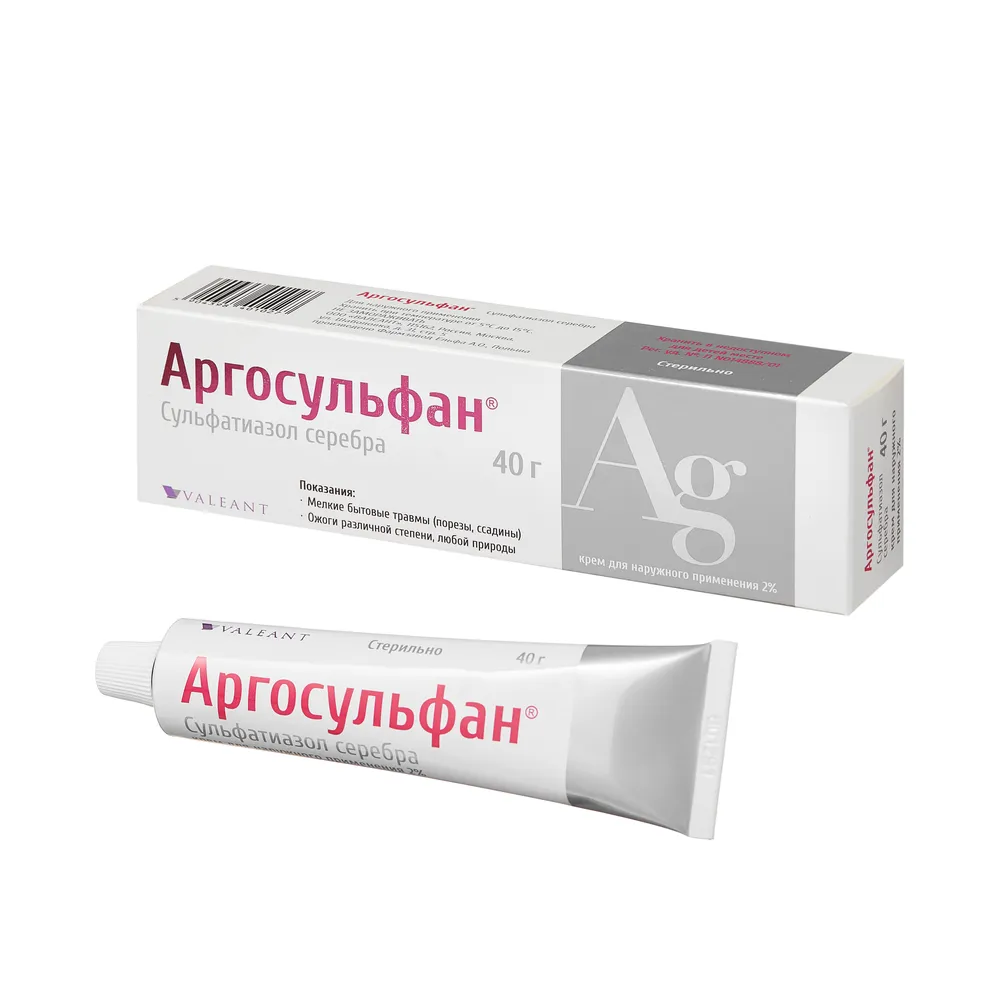
Table of Contents
INSTRUCTIONS FOR MEDICAL USE OF THE MEDICINAL PRODUCT AРГОСУЛЬФАН® (ARGOSULFAN)
Composition:
Active substance: silver sulfathiazole;
1 g of the preparation contains 20 mg of silver sulfathiazole;
Excipients: liquid paraffin, cetylstearyl alcohol, white soft paraffin, sodium lauryl sulfate, glycerin, propylparahydroxybenzoate (E 216), methylparahydroxybenzoate (E 218), potassium dihydrogen phosphate, disodium hydrogen phosphate dodecahydrate, water for injections.
Pharmaceutical form.
Cream.
Main physicochemical properties: homogeneous emulsion mass, white or white with a shade ranging from pinkish to light grey.
Pharmacotherapeutic group.
Chemotherapeutic agents for topical use. Sulfonamides. ATC code D06B A02.
Pharmacological Properties.
Pharmacodynamics.
The antimicrobial mechanism of action of sulfathiazole involves inhibition of microbial growth and reproduction. This is related to competitive antagonism with para-aminobenzoic acid and inhibition of dihydropteroate synthetase, resulting in disruption of the synthesis process of dihydrofolic acid and, ultimately, its active metabolite – tetrahydrofolic acid, which is essential for the synthesis of purines and pyrimidines in the microbial cell.
Silver sulfathiazole has a broad spectrum of antibacterial activity against mixed flora (Gram-positive and Gram-negative microorganisms), including Pseudomonas aeruginosa.
It inactivates and significantly reduces the infectivity of extracellular herpes simplex viruses and varicella-zoster virus.
The drug effectively protects the wound from infection, forms a protective layer on the wound surface, maintains adequate moisture, and promotes wound healing.
Pharmacokinetics.
Silver sulfathiazole has the lowest degree of solubility among other silver salts of sulfonamide group, as well as high stability. The low solubility and high stability of silver sulfathiazole allow it to remain on the surface of the affected skin area and reduce absorption into the bloodstream. Absorbed sulfathiazole is acetylated in the liver and subsequently excreted in the urine as inactive metabolites and partially in unchanged form. Absorption of sulfathiazole increases when the drug is applied to large areas of damaged skin.
Clinical characteristics.
Indications.
Argosulfan® is used topically for the treatment of infections in the following conditions:
- Burns of all degrees (including radiation burns);
- Pressure ulcers;
- Leg trophic ulcers.
Contraindications.
Hypersensitivity to sulfathiazole, to other sulfonamides, or to excipients.
Argosulfan® should not be used:
- In breastfeeding women;
- In premature newborns and infants under two months of age due to the risk of kernicterus;
- In patients with congenital glucose-6-phosphate dehydrogenase deficiency due to the risk of hemolytic anemia.
Special precautions.
Cross-sensitivity to sulfonamide derivatives, benzothiazine, and para-aminosalicylic acid may occur. In each case, a detailed allergic history, especially regarding sulfonamides, should be carefully obtained. Avoid contact of the medicinal product with eyes and mucous membranes. In case of accidental exposure, rinse thoroughly with plenty of water. Development of undesirable and systemic adverse effects typical of sulfonamides is also possible.
Use with caution in patients in shock following extensive burns and in patients after burns who are difficult to monitor. Drug accumulation and occurrence of adverse reactions may occur in patients with impaired liver or kidney function. During prolonged application over large skin areas, serum levels of sulfathiazole should be monitored, especially in patients with kidney or liver disease, as well as leukocyte counts, due to the possibility of agranulocytosis or anemia.
Do not use other topical medications.
Prolonged use should be avoided.
Argosulfan® contains excipients including cetylstearyl alcohol, propyl parahydroxybenzoate, methyl parahydroxybenzoate, and sodium lauryl sulfate. Due to the presence of cetylstearyl alcohol, the medicinal product may cause local skin reactions (e.g., contact dermatitis). Due to the presence of propyl parahydroxybenzoate and methyl parahydroxybenzoate, the medicinal product may cause allergic reactions (including delayed-type reactions). Sodium lauryl sulfate may cause local skin reactions at application sites such as irritation, burning, or stinging sensations, or may worsen skin reactions caused by other topical medications applied to the same skin area.
Patients with skin disorders, for example atopic dermatitis, are more sensitive to the irritant properties of sodium lauryl sulfate.
Interaction with other medicinal products and other types of interactions.
The product is not recommended for simultaneous use with other topical medicinal products to prevent potential interactions.
When administered systemically, folic acid or derivatives of para-aminosalicylic acid (e.g., procaine) may reduce the antibacterial effect of silver sulfathiazole.
Such interactions are possible but unlikely, since silver sulfonamide salts primarily act on the cell membrane rather than on metabolic processes (although this effect cannot be entirely excluded).
Leukopenia may occur during concomitant treatment with cimetidine (leukopenia is observed 20 times more frequently when cimetidine is used with sulfadiazine).
Instructions for Use
Use during pregnancy or breastfeeding
The safety of using the medicinal product Argosulfan® during pregnancy has not been studied.
Animal studies on the effect of silver sulfadiazine on fetal development have not been conducted. Controlled studies on the effect of topical application of the drug on fetal development have not been carried out. The use of the medicinal product during pregnancy is not recommended, except when the expected benefit to the woman outweighs the potential risk to the fetus.
Lactation (breastfeeding)
It is unknown whether silver sulfadiazine or its metabolites are excreted in breast milk. It is known that orally administered sulfonamides may pass into breast milk and may cause jaundice in infants.
The use of the drug is not recommended during breastfeeding.
Fertility
Data are lacking.
Ability to influence reaction rate while driving or operating machinery
Argosulfan® does not affect the ability to drive or operate machinery.
Method of Administration and Dosage
Application in burns.
The product is intended for topical use, either in an open manner or with the use of occlusive dressings. Argosulfan® does not cause skin darkening or pigmentation.
After wound cleansing and surgical debridement, apply the cream in a 2–3 mm layer, maintaining sterile conditions. All affected skin areas must remain covered with the cream throughout the entire treatment period. If any part of the wound becomes uncovered for any reason, a thin additional layer of the product should always be applied. It is not necessary to apply an occlusive dressing to the wound, except when there is a specific indication for dressing use. Apply the cream until complete wound healing or until the wound surface is prepared for skin grafting (surgical procedures).
Treatment of pressure ulcers and leg trophic ulcers.
Apply the product in a thin layer to affected skin areas 2–3 times daily.
When applying the product to infected wounds, exudate may appear. In such cases, the wound should be rinsed prior to cream application with a 0.1% aqueous solution of chlorhexidine, a 3% aqueous solution of boric acid, or another antiseptic. Dosage monitoring is not required for adults.
Patients with renal impairment
Due to the lack of clinical trials, caution should be exercised when using Argosulfan® in patients with renal impairment. In patients with severe renal function disorders, serum sulfonamide concentrations should be monitored.
Patients with hepatic impairment
Due to the lack of clinical trials, the medicinal product should be used with caution in patients with impaired liver function.
Application method
The product is intended for skin application, either in an open manner or with the use of occlusive dressings.
Children
The product can be used in children aged 3 months and older.
Overdose.
The product may be absorbed through damaged skin. There are no data on overdose.
Side effects.
The very low solubility and poor absorption of silver sulfadiazine through damaged skin reduce the potential for adverse effects when using the medicinal product.
With prolonged use, there is a risk of developing systemic adverse reactions typical of sulfonamides, including kidney or liver damage, agranulocytosis, hemorrhagic diathesis, aplastic and hemolytic anemia, leukopenia, dermatological reactions and hypersensitivity, such as Stevens-Johnson syndrome, exfoliative dermatitis.
Shelf life.
Shelf life – 2 years.
Shelf life after first opening – 6 months.
Storage conditions.
Store at a temperature not exceeding 25 °C. Do not freeze.
Packaging.
Cream, 15 g or 40 g in tubes.
Availability category.
Over-the-counter.
Manufacturer.
Pharmaceutical Factory Jelfa A.T.
Manufacturer's location and address of the place of business.
58-500 Jelenia Góra, ul. Wincentego Paula 21, Poland.