Ap-biolik
Ukraine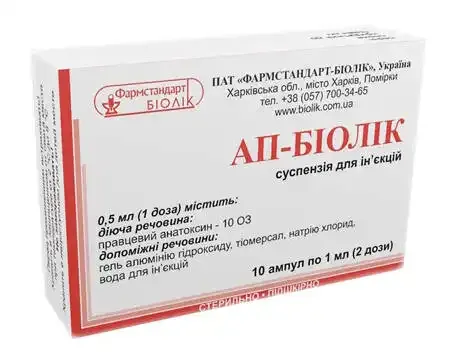
Table of Contents
INSTRUCTIONS FOR MEDICAL USE OF THE MEDICINAL PRODUCT AP-Biolik
Composition:
Active substance: tetanus toxoid;
1 dose (0.5 mL) contains: tetanus toxoid – 10 binding units (BU);
Excipients: aluminum hydroxide gel (calculated as aluminum) – 0.5 mg, thiomersal (preservative) – 0.05 mg, sodium chloride – 4.5 mg, water for injections – up to 0.5 mL.
Pharmaceutical form. Injectable suspension.
Main physicochemical properties: the product consists of purified tetanus toxoid adsorbed onto aluminum hydroxide gel. The preparation is a yellowish-white suspension which, upon standing, separates into a clear supernatant liquid and a fluffy sediment that completely disperses upon shaking.
Pharmacotherapeutic group. ATC Code: Bacterial vaccines. Tetanus toxoid. J07AM01.
Immunological and biological properties.
Pharmacodynamics.
Administration of the medicinal product AP-Biolik according to the approved vaccination schedule induces the formation of specific immunity against tetanus.
Pharmacokinetics. Assessment of pharmacokinetic data is not required for vaccines.
Clinical characteristics.
Indications.
Active immunization against tetanus as part of routine vaccination schedule; emergency specific prophylaxis of tetanus.
When administering immunization in Ukraine, the immunization schedule, contraindications, and interactions with other medicinal products should be in accordance with current regulatory documents of the Ministry of Health of Ukraine.
Contraindications.
Planned active immunization against tetanus:
- severe complications after previous administration of ADS, ADS-M, or tetanus toxoid, such as anaphylactic reaction or toxic erythema;
- allergic reaction to any component of the toxoid;
- progressive organic diseases of the nervous system, decompensated hydrocephalus or hydrocephalic syndrome, epilepsy, epileptic syndrome with seizures occurring more than once every 6 months;
- prolonged and severe diseases (viral hepatitis, tuberculosis, meningitis, myocarditis, diffuse connective tissue diseases, etc.) – vaccination should be performed individually 6–12 months after recovery;
- cerebrovascular disorders, seizures occurring more than once every 6 months;
- anemias: contraindication for vaccination is hemoglobin level below 80 g/L;
- oncological diseases;
- acute illness or exacerbation of a chronic disease. Routine vaccinations with toxoid are postponed until acute symptoms subside and exacerbations of chronic diseases have resolved, and are conducted after recovery or during remission of a chronic condition;
- congenital combined immunodeficiencies, primary hypogammaglobulinemia;
- immunosuppressive therapy (see section "Special precautions").
Emergency specific prophylaxis of tetanus:
- hypersensitivity to any component of the drug.
Use of specific emergency prophylactic agents for tetanus:
- history of hypersensitivity to the respective medicinal product;
- during the first trimester of pregnancy, administration of tetanus toxoid and antitetanus serum (ATS) is contraindicated; during the second trimester of pregnancy, administration of ATS is contraindicated.
Special safety measures.
Before administration, the ampoule contents should be shaken well until a homogeneous suspension is obtained, and the vaccine should then be administered immediately. Unused medicinal product or waste material must be disposed of in accordance with the requirements of current regulatory documents of the Ministry of Health of Ukraine.
Interaction with other medicinal products and other types of interactions.
AP-Biolik may be administered simultaneously with human tetanus immunoglobulin or tetanus antitoxin serum, but at different body sites and using separate needles and syringes.
If immunosuppressive therapy is being administered, please refer to the section "Special precautions".
Special precautions for use
According to general medical practice guidelines, prior to vaccination, a patient's medical history and previous vaccination record (particularly regarding prior vaccinations and possible adverse reactions) should be reviewed. Laboratory tests (complete blood count and urinalysis) are also recommended. To detect contraindications, a physician must perform a medical examination on the day of vaccination, including mandatory body temperature measurement.
A syncopal episode (fainting) may occur during or prior to vaccination as a psychogenic reaction to needle injection. To prevent patient injury, vaccination should be administered while the patient is seated or lying down, and the patient should remain in this position for at least 15 minutes afterward.
Due to the possibility of immediate-type allergic reactions, medical observation of vaccinated individuals is required for 30 minutes post-vaccination. In the event of anaphylactic shock, follow the medical protocol for management of anaphylactic shock. Vaccination sites must be equipped with emergency anti-shock treatment supplies.
If severe systemic reactions (high fever, severe malaise, itching, rash, swelling) or local reactions (swelling and redness with a diameter exceeding 50 mm) occur after antitoxin administration, the patient must seek immediate medical attention.
Administering a higher number of doses than prescribed during revaccination may increase the risk of more frequent and more severe adverse reactions.
Immunosuppressive therapy — treatment with cytostatic agents, including monotherapy with cyclosporine A, corticosteroids at immunosuppressive doses, or radiation therapy. Corticosteroid therapy is considered immunosuppressive if, calculated as prednisolone equivalent, it exceeds 2 mg/kg/day for more than 14 consecutive days under systemic administration. Scheduled vaccinations with AP-Biolik should be performed after completion of such therapy (see section "Contraindications"). If corticosteroid therapy duration is less than 14 days regardless of dose, or longer than 14 days but at a prednisolone-equivalent dose of less than 2 mg/kg/day, or if corticosteroids are used as replacement therapy or administered locally, such therapy is not considered immunosuppressive and does not constitute a contraindication to planned vaccination.
Emergency active-passive prophylaxis in previously unvaccinated individuals does not guarantee tetanus prevention in all cases. Moreover, it carries a risk of immediate and delayed reactions and complications following administration of equine antitoxin (PAS). To prevent repeated PAS administration following new injuries, all individuals who have received active-passive prophylaxis must complete the active immunization course by receiving a single booster dose of AP-anatoxin.
Individuals with allergic disorders or known allergic reactions to various allergens, as well as those previously administered equine serum-containing products (PAS, rabies immunoglobulin, etc.), should be pre-treated with antihistamines prior to receiving the main dose of PAS. PAS administration is contraindicated in individuals with a positive skin test reaction to 0.1 ml of 1:100 diluted equine serum or in those who previously experienced a reaction after subcutaneous injection of 0.1 ml of PAS.
Due to the use of formaldehyde in the manufacturing process of AP-Biolik, residual amounts of this substance may be present in the final product. Therefore, AP-Biolik should be used with caution in individuals with hypersensitivity to formaldehyde.
This medicinal product contains thiomersal (an organic mercury compound) as a preservative and may cause allergic reactions. Patients must inform their physician if they have a history of or experience allergic reactions.
AP-Biolik contains less than 1 mmol (23 mg)/dose of sodium, i.e., it is practically sodium-free.
Use during pregnancy or breastfeeding
Data are unavailable. The use of this medicinal product during pregnancy and breastfeeding is not recommended.
Ability to influence the speed of reactions while driving or operating machinery
Data are unavailable.
Method of administration and dosage.
Method of administration.
AP-Biolik is administered subcutaneously in the subscapular region of the body.
Dosage.
The single dose of vaccine is 0.5 mL and is the same for both children and adults.
Active scheduled immunization against tetanus.
The full course of vaccination with AP-Biolik for adults consists of two doses of 0.5 mL each, administered at an interval of 30–40 days, followed by a booster dose after 6–12 months with the same dose. According to the accelerated schedule, the full immunization course includes a single vaccination with AP-Biolik at a double dose (1.0 mL), a booster dose after 1–2 years with 0.5 mL, and subsequent booster doses every 10 years with standard doses (0.5 mL).
Booster vaccinations in adults previously fully immunized with combined vaccines containing tetanus toxoid should be performed every 10 years using AP- or ADP-M-toxoids at a dose of 0.5 mL.
Emergency prophylaxis of tetanus does not interfere with the administration of scheduled immunization.
Emergency prophylaxis of tetanus.
Emergency prophylaxis of tetanus is indicated in cases of:
- Injuries involving disruption of skin or mucous membranes;
- Frostbite and burns (thermal, chemical, radiation) of second, third, or fourth degree;
- Unsanctioned abortions;
- Childbirth outside medical facilities;
- Gangrene or tissue necrosis of any type, abscesses;
- Animal bites;
- Penetrating injuries of the gastrointestinal tract.
Emergency prophylaxis of tetanus includes primary surgical wound management and simultaneous specific immunoprophylaxis (see the "Guidelines for Specific Prophylaxis of Tetanus" approved by the Order of the Ministry of Health of Ukraine).
Emergency immunoprophylaxis against tetanus should be administered within 20 days from the time of injury, considering the possible incubation period of tetanus.
In severe open injuries, to ensure adequate immune response to tetanus toxoid, the vaccine should be administered no earlier than day 3 and no later than day 12 after injury.
For emergency specific prophylaxis of tetanus, the following are used:
- Tetanus toxoid (AP-toxoid); ADP-toxoid; ADP-M-toxoid;
- Human tetanus immunoglobulin (HTIG), prepared from blood of immunized individuals. One prophylactic dose of HTIG contains 250 international units (IU);
- Tetanus antitoxin serum (TATS), derived from blood of hyperimmunized horses. One prophylactic dose of TATS is 3000 IU.
The table below presents the algorithm for selecting prophylactic agents in emergency tetanus prophylaxis.
Algorithm for selection of prophylactic agents in emergency tetanus prophylaxis
| Previous vaccinations against tetanus with any preparation containing tetanus toxoid |
Age group |
Time elapsed since the last vaccination |
Preparations used |
||
| Tetanus toxoid 1 |
HTIG 2 |
TTIG 2 |
|||
| 1 |
2 |
3 |
4 |
5 |
6 |
| Documented evidence available |
|||||
| Complete course of routine vaccinations according to age |
Children and adolescents |
Regardless of time |
Not administered3 |
Not administered |
Not administered |
| Course of routine vaccinations without the final age-related booster |
Children and adolescents |
Regardless of time |
0.5 mL |
Not administered |
Not administered |
| Complete immunization course4 |
Adults |
No more than 5 years |
Not administered |
Not administered |
Not administered |
| More than 5 years |
0.5 mL |
Not administered |
Not administered |
||
| Two vaccinations5 |
All age categories |
No more than 5 years |
0.5 mL |
Not administered6 |
Not administered6 |
| More than 5 years |
1.0 mL |
250 IU |
3000 IU7 |
||
| 1 |
2 |
3 |
4 |
5 |
6 |
| Single vaccination |
All age categories |
No more than 2 years |
0.5 mL |
Not administered6 |
Not administered6 |
| More than 2 years |
1.0 mL |
250 IU |
3000 IU7 |
||
| Unvaccinated |
Children under 5 months of age |
|
Not administered |
250 IU |
3000 IU7 |
| Other age groups |
|
1.0 mL |
250 IU |
3000 IU7 |
|
| No documented evidence available |
|||||
| No history of contraindications to vaccination |
Children under 5 months of age |
|
Not administered |
250 IU |
3000 IU7 |
| Children from 5 months of age, adolescents, military personnel |
|
0.5 mL |
Not administered6 |
Not administered6 |
|
| Other groups |
All age groups |
|
1.0 mL |
250 IU |
3000 IU7 |
1 For emergency tetanus prophylaxis, ADP-M-anatoxin may be used if scheduled vaccination against diphtheria with this preparation is required.
2 Use one of the specified preparations PIL or PPS; it is preferable to administer PIL.
3 For wounds susceptible to infection ("infected wound"), if more than 5 years have passed since the last booster vaccination, administer 0.5 mL of AP-anatoxin.
4 The full course of immunization with AP-anatoxin for adults consists of two doses of 0.5 mL each, administered at an interval of 30–40 days, and a booster vaccination after 6–12 months with the same dose. According to the accelerated schedule, the full course of immunization includes a single vaccination with AP-anatoxin at a double dose (1 mL), a booster dose of 0.5 mL after 1–2 years, and subsequent boosters every 10 years.
5 Two doses according to the standard immunization schedule (for adults and children) and one dose according to the accelerated immunization schedule for adults.
6 For wounds susceptible to infection ("infected wound"), administer PIL or PPS.
7 All individuals who have received active-passive prophylaxis should be revaccinated with 0.5 mL of AP-anatoxin 6–12 months later to complete the immunization course and prevent repeated administration of PPS.
If the wound location permits, AP-anatoxin is preferably administered near the site of the wound.
PIL is administered intramuscularly at a dose of 250 IU into the upper outer quadrant of the buttock.
PPS is administered subcutaneously at a dose of 3000 IU.
Prior to administration of PPS, a mandatory intradermal test with horse serum diluted 1:100 must be performed to determine sensitivity to horse serum proteins (vial marked with red color).
For performing the intradermal test, use an individual vial and a sterile syringe graduated in 0.1 mL increments with a fine needle.
The diluted serum is administered intradermally in a volume of 0.1 mL into the flexor surface of the forearm. The reaction is evaluated after 20 minutes. The test is considered negative if the diameter of swelling or redness at the injection site is less than 1.0 cm. The test is considered positive if swelling or redness reaches or exceeds 1.0 cm in diameter.
If the skin test is negative, PPS (from a vial marked with blue color) is administered subcutaneously in a volume of 0.1 mL. If no reaction occurs after 30 minutes, the remaining dose of serum is administered with a sterile syringe; the vial must remain covered with a sterile gauze during this time. For more detailed information, refer to the instructions for medical use of the following preparations: tetanus human immunoglobulin (PIL) or tetanus antitoxin equine serum (PPS). AP-Biolik should be administered at a site opposite to the site of PPS or PIL administration.
Instructions for use.
When using the medicinal product AP-Biolik, the following rules must be observed:
- Before use, carefully inspect the vial containing the preparation.
- The preparation is unsuitable for use if the vial is damaged, unmarked, shows changes in physical properties (change in color, presence of an insoluble precipitate upon shaking), has passed its expiration date, or has been stored under inappropriate conditions.
- Immediately before administration, shake the vial of AP-Biolik until a homogeneous suspension is obtained.
- Before opening, wipe the vial twice with a cotton ball moistened with 70% ethyl alcohol, before and after scoring with a file. The preparation in an opened vial must not be stored.
- Draw the preparation into a syringe using a long needle with a wide lumen. A new needle must be used for injection.
- Wipe the injection site twice with cotton balls moistened with 70% ethyl alcohol. After injection, press the injection site with a cotton ball moistened with 70% ethyl alcohol.
The use of the preparation must be recorded in the established documentation forms, indicating the dose, batch number, expiration date, manufacturer, date of administration, and nature of the reaction to the administered preparation (the same data must be recorded in case of PIL or PPS administration).
Children.
See section "Method of administration and dosage."
The medicinal product may be administered to children from the age of 5 months.
Active scheduled immunization of children against tetanus should be carried out with combined vaccines containing tetanus anatoxin, according to the vaccination calendar approved by the order of the Ministry of Health of Ukraine and the instructions for their use.
Overdose.
No cases of overdose have been reported.
Side effects
Following administration of the AP-Biolik vaccine, both general and local reactions may occur, which usually resolve within 24–48 hours.
General disorders: malaise, fever.
Injection site reactions: pain, redness, swelling.
Immune system disorders: allergic reactions (in rare cases, systemic reactions such as anaphylactic shock).
According to post-marketing surveillance data, when using tetanus toxoid or vaccines containing tetanus toxoid from other manufacturers, the following adverse events have been reported:
Skin and subcutaneous tissue disorders: urticaria, polymorphic rash, pruritus.
Musculoskeletal and connective tissue disorders: myalgia, arthralgia.
Cardiovascular disorders: arterial hypotension.
Blood and lymphatic system disorders: lymphadenopathy, thrombocytopenia.
Gastrointestinal disorders: nausea.
Nervous system disorders: headache, development of brachial neuritis, and Guillain–Barré syndrome.
Respiratory, thoracic and mediastinal disorders: potential risk of apnea in prematurely born infants (≤28 weeks of gestation), particularly in those with a history of respiratory immaturity.
After administration of PPS, complications such as serum sickness and anaphylactic shock may develop. Individuals who have received PPS should be warned to seek immediate medical attention if they develop fever, itching, skin rash, joint pain, or any other symptoms characteristic of serum sickness.
Reporting of side effects
Reporting of adverse reactions during the post-marketing period is an important step. It allows continuous monitoring of the benefit-risk balance of the medicinal product. Healthcare professionals are required to report any cases of adverse reactions through the adverse reaction reporting system in Ukraine.
Shelf life
2 years.
Storage conditions
Store in a place protected from light, at a temperature between 2 °C and 8 °C. Do not freeze!
Keep out of reach of children.
Incompatibilities
Do not mix with other medicinal products!
Packaging
0.5 mL (1 dose) or 1 mL (2 doses) in ampoules; 10 ampoules per pack, or 5 ampoules per blister, 2 blisters per pack.
Prescription status
Prescription only.
Manufacturer
LLC "BIOLIK PHARMA".
Manufacturer's location and address of the place of business activity
Legal entity location:
70 Pomirky, Kharkiv, Kharkiv Oblast, 61070, Ukraine.
Place of business activity address:
Pomirky-70, building without number, Kharkiv, Kharkiv Oblast, 61070, Ukraine.