Antihistin
Ukraine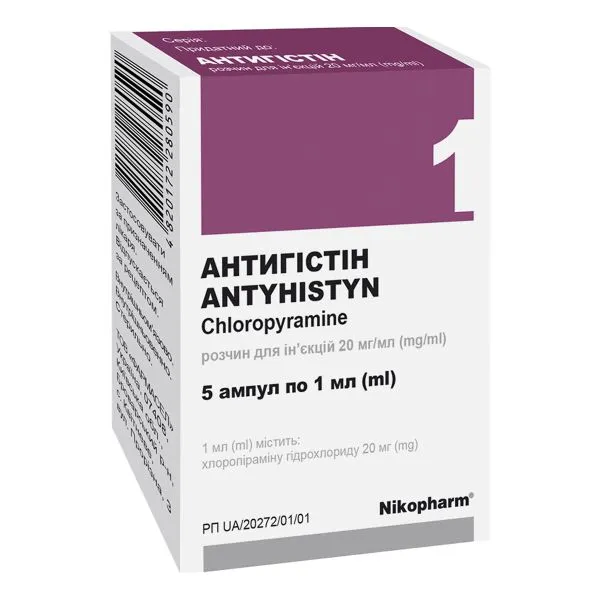
Table of Contents
INSTRUCTIONS FOR MEDICAL USE OF THE MEDICINAL PRODUCT ANTYHISTYN (ANTYHISTYN)
Composition:
Active substance: chloropyramine;
1 ml of solution contains 20 mg of chloropyramine hydrochloride;
Excipient: water for injections.
Pharmaceutical form. Injection solution.
Main physicochemical properties: Clear, colorless or slightly yellowish liquid.
Pharmacotherapeutic group. Antihistamines for systemic use.
ATC code R06A C03.
Pharmacological properties.
Pharmacodynamics.
Chloropyramine, a chlorinated analogue of tripelennamine (pyribenzamine), is a first-generation antihistamine belonging to the ethylenediamine group.
The mechanism of action of the drug consists in blocking histamine H1-receptors.
The drug relieves the general symptoms of allergic diseases and, in addition to its antiallergic effect, exerts sedative, hypnotic, and antipruritic actions.
Pharmacokinetics.
Chloropyramine is metabolized in the liver. It is excreted mainly in the urine as metabolites. In children, the drug may be eliminated faster than in adult patients. In renal impairment, excretion of the active substance may be reduced.
In hepatic insufficiency, metabolism of chloropyramine is slowed, which requires dose adjustment of the drug.
Clinical characteristics.
Indications.
- Allergic diseases – seasonal allergic rhinitis; conjunctivitis; urticaria; contact dermatitis; food allergy; allergic reactions caused by drugs; allergies due to insect bites.
- As an adjunctive agent in the treatment of systemic anaphylactic reactions and angioneurotic edema.
Contraindications.
- Hypersensitivity to any component of the drug;
- acute attacks of bronchial asthma;
- closed-angle glaucoma;
- peptic ulcer disease;
- acute myocardial infarction;
- arrhythmia;
- concomitant use of monoamine oxidase inhibitors (MAOIs);
- urinary retention, benign prostatic hyperplasia;
- hypersensitivity to other ethylenediamine derivatives;
- pregnancy and breastfeeding.
Interaction with other medicinal products and other forms of interaction.
MAO inhibitors increase and prolong the anticholinergic effect of the drug. Particular caution should be exercised when prescribing the drug concomitantly with sedatives, barbiturates, hypnotics, tranquilizers, opioid analgesics, tricyclic antidepressants, atropine, muscarinic parasympatholytics, due to possible mutual potentiation of effects.
Alcohol enhances the CNS depressant effects of the drug; therefore, alcoholic beverages should be avoided during treatment with this drug.
When used concomitantly with ototoxic drugs, signs of ototoxicity may be masked.
Antihistamines may suppress skin reactions during allergy testing; therefore, such medicinal products should be discontinued several days before planned skin allergy testing.
Special precautions for use
Geriatric and debilitated patients
Chloropyramine should be prescribed with particular caution to these patient groups, as they are more sensitive to certain adverse effects of antihistamines (dizziness, drowsiness, decreased arterial pressure).
Due to the anticholinergic and sedative effects of the drug, particular caution should be exercised when administering it to elderly patients, as well as to patients with hepatic function impairment or cardiovascular disorders.
If the drug is administered late in the evening, symptoms of gastroesophageal reflux may be intensified.
When chloropyramine is used in combination with ototoxic agents, symptoms of ototoxicity may be masked.
Alcohol may enhance the CNS depressant effects of antihistamines.
Prolonged use of antihistamines rarely may lead to hematopoietic system disorders (leukopenia, agranulocytosis, thrombocytopenia, hemolytic anemia). If adverse effects occur during prolonged treatment (fever, laryngitis, development of oral mucosal ulcers, pallor, jaundice, ecchymoses, bleeding), therapy must be discontinued and blood parameters monitored.
Use during pregnancy or breastfeeding
No preclinical studies have been conducted.
Adequate and well-controlled clinical trials involving pregnant women have not been performed, although cases have been reported in which retrolental fibroplasia developed in newborns whose mothers received antihistamines during the last months of pregnancy.
Therefore, use of the medicinal product during pregnancy or breastfeeding is contraindicated.
Ability to affect driving or operating machinery
During treatment with the medicinal product, particularly at the beginning of therapy, somnolence and impaired psychomotor function may occur (see section "Special precautions for use"). Therefore, considering the possible adverse reactions affecting the nervous system, driving vehicles or operating machinery should be prohibited at the beginning of therapy for a period individually determined in each specific case. Later, the extent of restriction or prohibition should be individually determined by the physician.
Method of Administration and Dosage
Chloropyramine hydrochloride injection solution must be administered only by a physician or a nurse. The solution is administered intramuscularly. In cases of anaphylactic shock or acute, severe allergic reactions, treatment should be initiated with intravenous administration of chloropyramine hydrochloride, followed by transition to intramuscular injections or oral administration of tablets. The duration of treatment is determined by the physician.
Adults
The usual daily dose for adults is 1–2 mL (1–2 ampoules) administered intramuscularly.
Children
Recommended initial dose:
- Children aged 1–12 months: 1/4 ampoule (0.25 mL) intramuscularly;
- Children aged 1–6 years: 1/2 ampoule (0.5 mL) intramuscularly;
- Children aged 6–14 years: 1/2–1 ampoule (0.5–1 mL) intramuscularly.
In these cases, an insulin syringe with a needle suitable for intramuscular injection should be used.
The daily dose for a child must not exceed 2 mg/kg body weight.
Elderly and debilitated patients
Use with particular caution in these patient groups, as they are more sensitive to certain adverse effects of antihistamines (dizziness, drowsiness, decreased arterial pressure) (see section "Special Warnings and Precautions for Use").
Hepatic impairment
Dosage reduction may be necessary, as liver disease reduces the metabolism of the active substance.
Renal impairment
Dosage reduction is required in patients with impaired renal function, since the active substance is predominantly excreted by the kidneys.
Children
Chloropyramine hydrochloride may be used in children from the age of 1 month. It is contraindicated in newborns and premature infants.
Overdose
Intentional or accidental overdose of antihistamines may be fatal, especially in infants and children. Overdose of chloropyramine hydrochloride produces symptoms similar to atropine poisoning: hallucinations, restlessness, ataxia, impaired motor coordination, athetosis, and convulsions. In children, excitation predominates. Dry mouth, pupil dilation, flushing, sinus tachycardia, urinary retention, and fever may also occur. In adults, fever and flushing are not always present; the excitation phase is accompanied by convulsions and postictal depression. Additionally, coma and cardiorespiratory collapse may develop, potentially leading to death within 2–18 hours.
Cardiorespiratory monitoring is recommended. Treatment is symptomatic.
No antidote is known.
Adverse Reactions
The following adverse reactions may occur during administration of chloropyramine hydrochloride.
Cardiovascular system: arterial hypotension, tachycardia, arrhythmia.
Blood and lymphatic system disorders: leukopenia, agranulocytosis, thrombocytopenia, hemolytic anemia, other pathological blood changes.
Nervous system disorders: sedation, increased fatigue, dizziness (vertigo), ataxia, nervousness, tremor, seizures, headache, euphoria, encephalopathy, blurred vision, somnolence, impaired psychomotor performance.
Eye disorders: increased intraocular pressure, glaucoma.
Gastrointestinal disorders: epigastric pain and discomfort, dry mouth, nausea, vomiting, diarrhea, constipation, anorexia, increased or decreased appetite, exacerbation of gastroesophageal reflux symptoms.
Renal and urinary disorders: dysuria, urinary retention.
Skin and subcutaneous tissue disorders: photosensitivity, allergic reactions.
Musculoskeletal and connective tissue disorders: myopathy.
Immune system disorders: allergic reactions including skin hyperemia, rash, pruritus, urticaria, angioneurotic edema.
Other: injection site reactions.
Reporting of suspected adverse reactions
Reporting suspected adverse reactions after drug registration is important. It allows ongoing monitoring of the benefit-risk balance of the medicinal product. Healthcare professionals and patients, as well as their legal representatives, are encouraged to report all suspected adverse reactions and lack of efficacy via the Automated Pharmacovigilance Information System at the following link: https://aisf.dec.gov.ua.
Shelf life. 2 years.
Storage conditions. Store in the original packaging at a temperature not exceeding 25 °C. Keep out of reach of children.
Packaging. 1 ml in a polyethylene ampoule. 5 ampoules per cardboard pack.
Prescription status. Prescription only.
Manufacturer. LLC "FARMASEL".
Manufacturer's address and location of business activity.
3, Prorizna Street, Kvitneve, Brovary District, Kyiv Region, 07408, Ukraine.