Antifront
Ukraine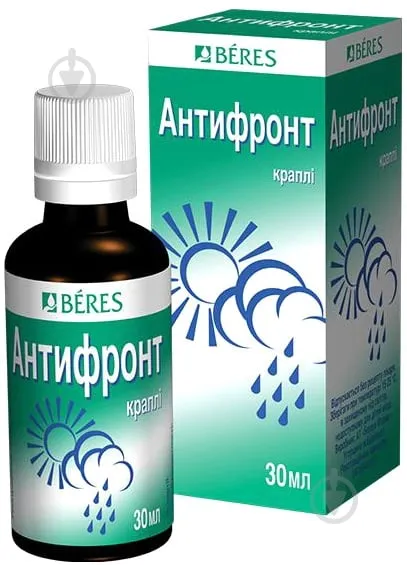
Table of Contents
INSTRUCTION for medical use of the medicinal product ANTI FRONT (ANTIFRONT)
Composition:
Active ingredients: 1 ml of oral solution contains: ethanolic extract of a mixture of medicinal plants (1:9.75) (extraction solvent – 60 % ethanol): Zingiberis rhizoma (ginger rhizome) 40 mg, Liquiritiae radix (liquorice root) 20 mg, Melissae folium (leaves of lemon balm) 20 mg, Theae viridis folium (green tea leaves) 15 mg, Curcumae xanthorrhizae rhizoma (turmeric rhizome) 5 mg.
Each 1 ml of the solution contains at least 0.25 mg of caffeine and at least 0.50 mg of glycyrrhizic acid.
Pharmaceutical form. Oral drops, solution.
Main physicochemical properties: aromatic, clear or slightly cloudy or opalescent alcoholic solution of brownish-yellow color.
Pharmacotherapeutic group. Agents acting on the nervous system.
ATC code N07XX.
Pharmacological properties.
Pharmacodynamics.
Antifront is a phytotherapeutic agent intended for the prevention and treatment of meteorotropic reactions and autonomic disturbances.
Ginger rhizome extract, due to its antagonistic action on dopamine (D2 receptors) and serotonin (5-HT3 receptors), reduces nausea and vomiting urges. Triterpenoid compounds present in licorice root extract possess calming and spasmolytic properties. Lemon balm leaf extract has sedative and spasmolytic effects, prevents headache (migraine), and alleviates its symptoms. Green tea leaf extract contains 5-N-ethylglutamic acid, which reduces spasms and complements the effects of caffeine and theophylline, exerts a stimulating action, promotes improved attention concentration, and provides mild spasmolytic activity. Turmeric rhizome extract, containing the active alkaloid curcumin, inhibits platelet aggregation, acts as a spasmolytic, has sedative properties, relieves nausea, improves digestion, and reduces joint pain.
Pharmacokinetics.
Not studied.
Clinical characteristics.
Indications.
Prevention and symptomatic treatment of conditions associated with weather changes, passage of atmospheric fronts, as well as motion sickness (kinetosis), manifesting as drowsiness, dizziness, changes in arterial pressure, nausea, headache, reduced concentration, general weakness, and joint pain.
Contraindications.
Hypersensitivity to the components of the drug.
Diseases accompanied by impaired bile secretion (gallstone disease and obstruction of bile ducts).
Organic heart diseases (myocarditis, pericarditis, myocardial infarction), severe arterial hypertension, pronounced arterial hypotension.
Impaired liver or kidney function; hypokalemia.
Severe obesity.
Treatment of alcoholism.
Interaction with other medicinal products and other types of interactions.
Concomitant use of this drug with medications incompatible with alcohol intake is not recommended.
Interactions due to curcuma rhizome extract: use with caution together with warfarin due to possible risk of bleeding.
Interactions due to ginger rhizome extract: may enhance the absorption of sulfoguanidine.
Interactions due to licorice root: licorice root may reduce antihypertensive effects and increase hypokalemia when used concomitantly with thiazide diuretics. Hypokalemia (resulting from excessive use of licorice root) may be potentiated when interacting with cardiac glycosides, antiarrhythmic agents, and drugs affecting cardiac rhythm (e.g., quinidine). Concomitant use with drugs causing hypokalemia (thiazide and loop diuretics, adrenocorticosteroids, and laxatives) may lead to electrolyte imbalance. Therefore, licorice root should not be used long-term concomitantly with the above-mentioned medicinal products.
Concomitant use may enhance the effects of other sedatives and hypnotics.
Special precautions for use
Shake the bottle well before use. Slight cloudiness or opalescence of the solution may occasionally occur; this does not affect the quality of the medicinal product.
It should be noted that the preparation contains 54–60 vol% ethanol. Typically, one dose (10–15 drops) contains 0.12–0.17 g of ethanol.
This medicinal product may be harmful when administered to patients with liver disease, alcoholism, epilepsy, brain damage, or other disorders of the central nervous system.
Medicinal products containing liquorice should be used with caution in patients with arterial hypertension.
If hypersensitivity reactions occur, treatment should be discontinued.
The preparation should not be used for longer than 4–6 weeks without medical supervision. If symptoms do not improve or worsen, the patient should consult a physician.
Use during pregnancy or breastfeeding
The use of this medicinal product is contraindicated during pregnancy and breastfeeding.
Ability to affect reaction speed when driving or operating machinery
It should be taken into account that the preparation contains ethanol; therefore, caution is advised when driving or operating machinery.
Method of administration and dosage.
The medicine should be taken in case of travel-related dizziness (immediately before travel), at the first signs of worsening well-being prior to changes in weather conditions and during the passage of a meteorological front, but no later than the onset of the first symptoms.
Adults should take 10–15 drops, previously diluted in ½ glass of water or on a piece of sugar, not more than 6 times a day, preferably during meals.
10 drops of the solution correspond to approximately 0.26 ml. 15 drops of the solution correspond to approximately 0.39 ml.
If necessary, the drops may be taken every 30 minutes, but not more than 6 times a day.
Consult a physician if symptoms do not improve or worsen.
The duration of treatment is determined individually by a physician, depending on the nature and course of the disease.
Children.
The medicine is contraindicated in children.
Overdose.
Overdose and prolonged use (more than 2 months) may cause disturbances in water-electrolyte balance, potentially leading to hypokalemic myopathy and myoglobinuria; an increase in adverse effects, as well as dizziness, lethargy, and reduced concentration may occur.
The medicine contains ethyl alcohol, whose physiological effects may manifest when several doses are administered.
Side effects
In some cases, hypersensitivity reactions are possible in individuals with increased sensitivity to the components of the drug, including rash, exanthema, urticaria, pruritus, hyperemia, and skin edema.
Concomitant use of several drugs containing licorice may cause serious adverse reactions such as fluid retention, hypokalemia, arterial hypertension, and cardiac arrhythmias.
Reporting of suspected adverse reactions
Reporting suspected adverse reactions after drug registration is of great importance. It enables ongoing monitoring of the benefit-risk balance of the medicinal product. Healthcare professionals should report any suspected adverse reactions through the national reporting system.
Shelf life.
3 years.
Storage conditions.
Store at a temperature not exceeding 25 °C, in the original packaging, in a place inaccessible to children.
Packaging.
30 ml of the preparation in a dropper bottle. One dropper bottle per cardboard box.
Availability category. Over-the-counter (without prescription).
Manufacturer.
ZAO “Beresh Pharma”.
Manufacturer's address and location of operations.
39 Nadshandor Yozhef Street, Solnok, 5000, Hungary.