Anoro ellipta
Ukraine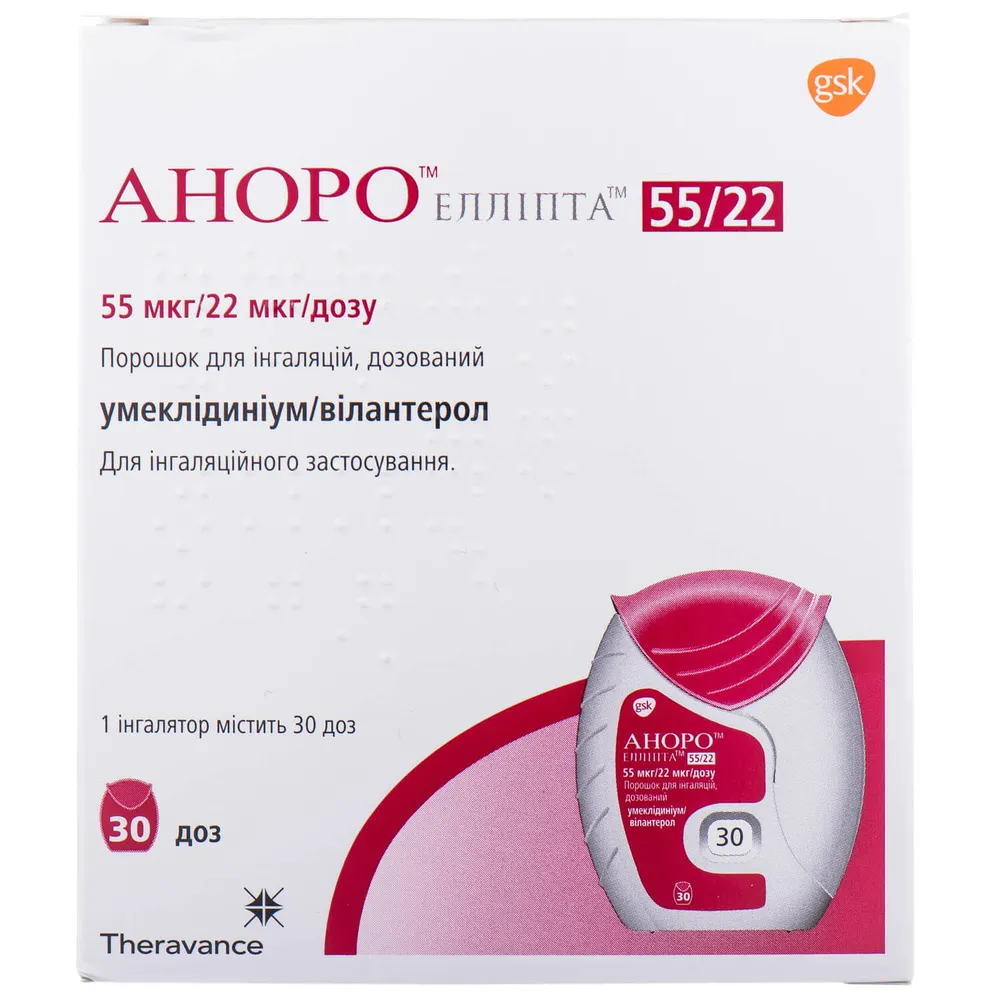
Table of Contents
INSTRUCTIONS for medical use of the medicinal product ANORO ELLIPTA (ANORO ELLIPTA)
Composition:
Active substances: umeclidinium, vilanterol;
1 delivered dose contains 55 mcg of umeclidinium (as bromide) and 22 mcg of vilanterol (as trifenatate);
this corresponds to a pre-dispensed dose of 74.2 mcg of umeclidinium bromide and 25 mcg of vilanterol (as trifenatate);
Excipients: lactose monohydrate; magnesium stearate.
Pharmaceutical form. Powder for inhalation.
Main physicochemical properties: a plastic inhaler with a light-grey body, red actuator cap, and dose counter, packed in a foil tray containing a desiccant pouch. The tray is sealed with a peelable lid. The inhaler contains two strips of 30 evenly spaced blisters, each containing a white powder.
Pharmacotherapeutic group. Medicinal products used in obstructive airway diseases. Adrenergic agents in combination with anticholinergic agents, including triple combinations with corticosteroids. Vilanterol and umeclidinium bromide.
ATC code R03AL03.
Pharmacological Properties
Pharmacodynamics
Mechanism of action
Umeclidinium/vilanterol is a combination of a long-acting inhaled muscarinic receptor antagonist and a long-acting beta2-adrenergic agonist. After oral inhalation, both compounds act locally on the airways, resulting in bronchodilation through different mechanisms of action.
Umeclidinium
Umeclid游戏副本
| Comparison of treatment with Anoro Ellipta at a dose of 55/22 mcg |
Difference in treatment outcomes1 (95% confidence interval, p-value) |
|||
| Baseline FEV1 (mL) |
TDI score |
SGRQ score |
Use of medications for symptom relief3 |
|
| Anoro Ellipta (N = 413) placebo (N = 280) |
167 |
1.2 |
|
|
| Anoro Ellipta (N = 413) compared with umeclidinium at a dose of 55 mcg (N = 418) |
52 (17, 87) 0.004 |
0.3 (–0.2, 0.7) 0.244 |
(–2.90, 1.27) 0.441 |
(–1.0, –0.1) 0.014∗ |
| Anoro Ellipta (N = 413) compared with vilanterol at a dose of 22 mcg (N = 421) |
95 (60, 130) < 0.001 |
0.4 0.117 |
(–2.41, 1.78) 0.767 |
–0.1 (–0.3, 0.5) 0.675 |
| Anoro Ellipta (N = 454) compared with tiotropium at a dose of 18 mcg (study ZEP117115) |
112 (81, 144) < 0.001 |
NA |
(–3.61,
0.006 |
(–0.7, –0.2) < 0.001 |
| Anoro Ellipta (N = 207) compared with tiotropium at a dose of 18 mcg (study DB2113360) |
90 (39, 141) < 0.001 |
0.12 (–0.4, 0.5) 0.817 |
–0.75 (–2.12, 3.63) 0.607 |
(–1.2, –0.1) 0.022 |
| Anoro Ellipta (N = 217) compared with tiotropium at a dose of 18 mcg (study DB2113374) |
60 (10, 109) 0.018∗ |
(–2.85, 2.52) 0.904 |
(–1.2, 0.0) 0.069 |
|
N — ITT population size (ITT — population of all patients randomized for treatment)
mcg – microgram
n/o — not assessed
1 Least squares mean.
2 Pooled data from study DB2113360 and study DB2113374.
3 Difference in mean daily use of medication over weeks 1–24.
A higher dose of umeclidinium/vilanterol (113/22 mcg) was also studied in a 24-week placebo-controlled clinical trial and in two out of three 24-week active-controlled trials. Results were similar to those observed with Anoro Ellipta 55/22 mcg and further confirmed the efficacy of Anoro Ellipta.
Exacerbations of COPD
In a 24-week placebo-controlled trial in patients with symptomatic COPD, treatment with Anoro Ellipta reduced the risk of moderate/severe COPD exacerbations by 50% compared to placebo (based on time-to-first-exacerbation analysis: hazard ratio (HR) 0.5; 95% CI 0.3, 0.8; p = 0.004*), by 20% compared to umeclidinium (HR 0.8; 95% CI 0.5, 1.3; p = 0.391), and by 30% compared to vilanterol (HR 0.7; 95% CI 0.4, 1.1; p = 0.121).
In one of the three trials in patients with symptomatic COPD, treatment with Anoro Ellipta reduced the risk of moderate/severe COPD exacerbations by 50% compared to tiotropium (HR 0.5; 95% CI 0.3, 1.0; p = 0.044). In the other two trials, the risk of moderate/severe COPD exacerbations in patients with symptomatic COPD was 20% and 90% higher, respectively (HR 1.2; 95% CI 0.5, 2.6; p = 0.709 and HR 1.9; 95% CI 1.0, 3.6; p = 0.062, respectively). The design of these trials was not intended to assess the effect of treatment on COPD exacerbations, and patients were withdrawn from the study after experiencing an exacerbation.
Studies Confirming Efficacy
In a randomized, double-blind, 52-week trial (CTT116855, IMPACT), 10,355 adult patients with symptomatic COPD who had experienced one or more moderate or severe exacerbations in the previous 12 months were randomized to receive once-daily treatment with umeclidinium/vilanterol (UMEC/VI 55/22 mcg), fluticasone furoate/umeclidinium/vilanterol (FF/UMEC/VI 99/55/22 mcg), or fluticasone furoate/vilanterol (FF/VI 99/22 mcg) via a single inhaler. The primary endpoint was annual rate of moderate or severe exacerbations in patients receiving FF/UMEC/VI compared to FF/VI or UMEC/VI. The mean annual exacerbation rates were 0.91, 1.07, and 1.21 for FF/UMEC/VI, FF/VI, and UMEC/VI, respectively.
Comparison of FF/UMEC/VI with FF/VI and UMEC/VI showed a statistically significant reduction in the risk of moderate/severe exacerbations by 14.8% (based on time-to-first-exacerbation analysis) (HR 0.85; 95% CI 0.80, 0.91; p < 0.001) and by 16%, respectively (based on time-to-first-exacerbation analysis) (HR 0.84; 95% CI 0.78, 0.91; p < 0.001).
Endurance and Lung Volume
In one of two trials, Anoro Ellipta 55/22 mcg improved endurance time compared to placebo, as assessed by the incremental shuttle walk test (ISWT). In both trials, improvements in lung volume were observed compared to placebo in adult patients with COPD and hyperinflation (functional residual capacity (FRC) > 120%). In the first trial, Anoro Ellipta 55/22 mcg demonstrated a statistically significant and clinically meaningful improvement in endurance time (69.4 seconds, p = 0.003) compared to placebo at Week 12, measured 3 hours post-dose (minimal clinically important difference (MCID) for ISWT is 45–85 seconds). Improvement in endurance time compared to placebo was observed on Day 2 and sustained at Weeks 6 and 12. In the second trial, the difference in endurance time between the Anoro Ellipta 55/22 mcg and placebo groups at Week 12 was 21.9 seconds (p = 0.234).
Anoro Ellipta 55/22 mcg also demonstrated statistically significant improvements in baseline lung volumes compared to placebo. In the first trial, measurements were taken at Week 12 pre-dose and 3 hours post-dose: inspiratory capacity was 237 mL and 316 mL, respectively; residual volume was –466 mL and –643 mL, respectively; and functional residual capacity was –351 mL and –522 mL, respectively (all p < 0.001). In the second trial, measurements were also taken at Week 12 pre-dose and 3 hours post-dose: inspiratory capacity was 198 mL and 238 mL, respectively; residual volume was –295 mL and –351 mL, respectively; and functional residual capacity was –238 mL and –302 mL, respectively (all p < 0.001*).
Pharmacokinetics
When umeclidinium and vilanterol were administered by inhalation, the pharmacokinetics of each component were similar to those observed when each active substance was administered separately. Therefore, from a pharmacokinetic perspective, each component can be considered independently.
Absorption
Umeclidinium
After administration of umeclidinium by inhalation to healthy volunteers, Cmax was reached within 5–15 minutes. The absolute bioavailability of inhaled umeclidinium was on average 13% of the dose, with negligible contribution from oral absorption. Following repeated dosing of inhaled umeclidinium, steady state was achieved within 7–10 days with 1.5–1.8-fold accumulation.
Vilanterol
After administration of vilanterol by inhalation to healthy volunteers, Cmax was reached within 5–15 minutes. The absolute bioavailability of inhaled vilanterol was 27%, with negligible contribution from oral absorption. Following repeated dosing of inhaled vilanterol, steady state was achieved within 6 days with 2.4-fold accumulation.
Distribution
Umeclidinium
After intravenous administration to healthy volunteers, the mean volume of distribution was 86 liters. In vitro, binding to human plasma proteins averaged 89%.
Vilanterol
After intravenous administration to healthy volunteers, the mean volume of distribution at steady state was 165 liters. In vitro, binding to human plasma proteins averaged 94%.
Metabolism
Umeclidinium
In vitro studies showed that umeclidinium is primarily metabolized by cytochrome P450 2D6 (CYP2D6) and is a substrate for the P-glycoprotein (P-gp) transporter. The primary metabolic pathways for umeclidinium are oxidative (hydroxylation, O-dealkylation) followed by conjugation (glucuronidation, etc.), resulting in a number of metabolites with either reduced or unknown pharmacological activity. Systemic exposure to metabolites is low.
Vilanterol
In vitro studies showed that vilanterol is primarily metabolized by cytochrome P450 3A4 (CYP3A4) and is a substrate for the P-gp transporter. The main metabolic pathways for vilanterol are O-dealkylation, leading to several metabolites with substantially reduced activity at beta1- and beta2-adrenergic receptors. The plasma metabolic profile after oral administration of vilanterol in a human radiolabeled study indicates extensive first-pass metabolism. Systemic exposure to metabolites is low.
Elimination
Umeclidinium
Plasma clearance after intravenous administration was 151 liters/hour. After intravenous administration, approximately 58% of the administered radiolabeled dose (or 73% of detected radioactivity) was excreted in feces within 192 hours after dose administration. Urinary excretion accounted for 22% of the administered radiolabeled dose within 168 hours (27% of detected radioactivity). Excretion of drug-related material in feces after intravenous administration indicates biliary secretion. Following oral administration in healthy male volunteers, total radioactivity was primarily excreted in feces (92% of administered radiolabeled dose or 99% of detected radioactivity) within 168 hours after dose intake. Less than 1% of the orally administered dose (1% of detected radioactivity) was excreted in urine, indicating minimal absorption after oral administration. The terminal half-life of umeclidinium after 10 days of inhaled administration averaged 19 hours in healthy volunteers, with 3–4% excreted unchanged in urine at steady state.
Vilanterol
Plasma clearance of vilanterol after intravenous administration was 108 liters/hour. After oral administration of radiolabeled vilanterol, 70% of the dose was recovered in urine and 30% in feces. The primary route of elimination of vilanterol is metabolism, followed by excretion of metabolites in urine and feces. The terminal half-life of vilanterol after 10 days of inhaled administration averaged 11 hours.
Special Patient Populations
Elderly patients (>65 years). Population pharmacokinetic analysis showed that the pharmacokinetics of umeclidinium and vilanterol were similar in COPD patients aged 65 years and older compared to those under 65 years.
Renal impairment. In patients with severe renal impairment, no increase in systemic exposure (Cmax and AUC) to umeclidinium or vilanterol was observed after administration of umeclidinium/vilanterol, where the umeclidinium dose was twice the recommended dose and the vilanterol dose was at the recommended level. Plasma protein binding remained unchanged compared to healthy volunteers.
Hepatic impairment. In patients with moderate hepatic impairment (Child-Pugh class B), no increase in systemic exposure (Cmax and AUC) to umeclidinium or vilanterol was observed after administration of umeclidinium/vilanterol, where the umeclidinium dose was twice the recommended dose and the vilanterol dose was at the recommended level. Plasma protein binding remained unchanged compared to healthy volunteers. The use of umeclidinium/vilanterol has not been studied in patients with severe hepatic impairment.
Other Special Populations
Population pharmacokinetic analysis showed that no dose adjustment of umeclidinium or vilanterol is required based on age, race, gender, use of inhaled corticosteroids, or patient body weight. A study conducted in CYP2D6 poor metabolizers showed no evidence of clinically relevant effect of CYP2D6 genetic polymorphism on systemic exposure to umeclidinium.
Clinical characteristics
Indications. For maintenance bronchodilator therapy to relieve symptoms in adult patients with chronic obstructive pulmonary disease (COPD).
Contraindications. Hypersensitivity to the active substances or to any of the excipients.
Interaction with other medicinal products and other forms of interaction
Clinically significant interactions with other concurrently administered medicinal products are considered unlikely due to the low plasma concentrations of umeclidinium/vilanterol following the inhaled dose.
Beta-blockers
Medicinal products containing beta-blockers may attenuate or antagonize the effects of beta2-adrenergic agonists such as vilanterol. Concomitant use of both non-selective and selective beta-blockers should be avoided unless there are compelling reasons for their use.
Interactions based on metabolism and transport
Vilanterol is a substrate of cytochrome P450 3A4 (CYP3A4). Concomitant use of strong CYP3A4 inhibitors (such as ketoconazole, clarithromycin, itraconazole, ritonavir, telithromycin) may inhibit metabolism and increase systemic exposure to vilanterol. Concomitant administration with ketoconazole (400 mg) in healthy volunteers increased mean AUC(0–t) and Cmax of vilanterol by 65% and 22%, respectively. The enhanced effect of vilanterol was not associated with increased systemic beta-adrenergic effects, had no effect on heart rate, serum potassium levels, or QT interval (corrected by Fredericia's formula). Caution is advised when co-administering umeclidinium/vilanterol with ketoconazole and other known strong CYP3A4 inhibitors, as there is potential for increased systemic exposure to vilanterol, which may increase the risk of adverse reactions. Verapamil, a moderate CYP3A4 inhibitor, does not significantly affect the pharmacokinetics of vilanterol.
Umeclidinium is a substrate of cytochrome P450 2D6 (CYP2D6). The pharmacokinetics of umeclidinium at steady state were evaluated in healthy volunteers who are CYP2D6 deficient (poor metabolizers). No effect on AUC or Cmax of umeclidinium was observed at a dose 8 times higher than the recommended dose. Approximately a 1.3-fold increase in AUC of umeclidinium was observed at a dose 16 times higher than the recommended dose, without affecting Cmax of umeclidinium. Given the magnitude of these changes, clinically significant drug interactions are not expected when umeclidinium/vilanterol is co-administered with CYP2D6 inhibitors or administered to patients with genetically deficient CYP2D6 activity (poor metabolizers).
Both umeclidinium and vilanterol are substrates of the P-glycoprotein (P-gp) transporter. The effect of the moderate P-gp inhibitor verapamil (240 mg once daily) on the steady-state pharmacokinetics of umeclidinium and vilanterol was evaluated in healthy volunteers. No effect of verapamil on Cmax of umeclidinium or vilanterol was observed. Approximately a 1.4-fold increase in AUC of umeclidinium was observed in the absence of an effect on AUC of vilanterol. Given the magnitude of these changes, clinically significant drug interactions are not expected when umeclidinium/vilanterol is co-administered with P-gp inhibitors.
Other antimuscarinic agents and sympathomimetics
Concomitant use of umeclidinium/vilanterol with other long-acting muscarinic antagonists, long-acting beta2-adrenergic agonists, or medicinal products containing either of these agents has not been studied. Such use is not recommended, as it may potentiate known adverse reactions of inhaled muscarinic antagonists or beta2-adrenergic agonists (see sections "Special precautions for use" and "Overdose").
Hypokalaemia
Concomitant treatment with methylxanthine derivatives, steroids, or non-potassium-sparing diuretics that may cause hypokalaemia can potentiate the potential hypokalaemic effect of beta2-adrenergic agonists; therefore, umeclidinium/vilanterol should be used with caution (see section "Dosage and administration").
Other medicinal products for the treatment of COPD
Although no traditional in vivo drug interaction studies have been conducted, the inhaled product umeclidinium/vilanterol has been used concomitantly with other medicinal products for COPD, including short-acting sympathomimetic bronchodilators and inhaled corticosteroids, without clinical evidence of drug interactions.
Special precautions for use
Asthma
Umeclidinium/vilanterol should not be used in patients with asthma, as this medicinal product has not been studied in this patient group.
Paradoxical bronchospasm
As with other types of inhaled therapy, administration of umeclidinium/vilanterol may result in paradoxical bronchospasm, which can be life-threatening. Umeclidinium/vilanterol therapy should be discontinued immediately if paradoxical bronchospasm occurs, and alternative therapy should be initiated, if necessary.
Not for use during acute episodes
Umeclidinium/vilanterol is not indicated for the treatment of acute episodes of bronchospasm.
Deterioration of disease
An increased frequency of using short-acting bronchodilators to relieve symptoms indicates worsening disease control. If chronic obstructive pulmonary disease (COPD) worsens during treatment with umeclidinium/vilanterol, the patient's condition and treatment strategy should be reassessed.
Cardiovascular effects
Cardiovascular effects such as cardiac arrhythmias, for example atrial fibrillation and tachycardia, may occur after administration of muscarinic receptor antagonists and sympathomimetics, including umeclidinium/vilanterol. Patients with clinically significant uncontrolled cardiovascular disease were excluded from clinical trials. Therefore, umeclidinium/vilanterol should be prescribed with caution in patients with severe cardiovascular disease.
Antimuscarinic activity
Due to the antimuscarinic activity, umeclidinium/vilanterol should be used with caution in patients with urinary retention or closed-angle glaucoma.
Hypokalaemia
Beta2-adrenergic agonists may cause significant hypokalaemia in some patients, which may lead to cardiovascular adverse reactions. Reduction in serum potassium levels is usually transient.
No clinically significant effects of hypokalaemia were observed in clinical trials using umeclidinium/vilanterol at the recommended therapeutic dose. Caution should be exercised when umeclidinium/vilanterol is used concomitantly with other medicinal products that may also lead to hypokalaemia (see section "Interaction with other medicinal products and other forms of interaction").
Hyperglycaemia
Beta2-adrenergic agonists may cause transient hyperglycaemia in some patients.
No clinically significant effects on plasma glucose levels were observed in clinical trials using umeclidinium/vilanterol at the recommended therapeutic dose. However, plasma glucose levels should be monitored more closely in patients with diabetes mellitus after initiating umeclidinium/vilanterol therapy.
Concomitant diseases
Umeclidinium/vilanterol should be used with caution in patients with seizure disorders or thyrotoxicosis, as well as in patients who are unusually responsive to beta2-adrenergic agonists.
Excipients
This medicinal product contains lactose. Patients with rare hereditary problems of galactose intolerance, lactase deficiency or glucose-galactose malabsorption should not take this medicinal product.
Use during pregnancy or breastfeeding
Pregnancy. There are currently no data on the use of umeclidinium/vilanterol in pregnant women.
Umeclidinium/vilanterol should be used during pregnancy only if the expected benefit to the pregnant woman outweighs the potential risk to the fetus.
Breastfeeding. It is unknown whether umeclidinium or vilanterol is excreted in human breast milk. However, other beta2-adrenergic agonists have been detected in breast milk. A risk to newborns/infants cannot be excluded. A decision should be made whether to discontinue breastfeeding or to discontinue umeclidinium/vilanterol therapy, taking into account the benefit of breastfeeding for the child and the benefit of therapy for the woman.
Fertility
There are no data on the effect of umeclidinium/vilanterol on human fertility.
Ability to influence reaction rate when driving or operating machinery. Umeclidinium/vilanterol has no effect or has a negligible effect on the ability to drive and use machines.
Method of Administration and Dosage
Dosage
Adults
The recommended dose is one inhalation of Anoro Ellipta 55/22 mcg once daily.
Anoro Ellipta should be used once daily at the same time each day to maintain bronchodilation. If a dose is missed, the next dose should be taken at the usual time the following day. The maximum dose is one inhalation of Anoro Ellipta 55/22 mcg once daily.
Special Patient Groups
Elderly Patients
Dose adjustment is not required for patients over 65 years of age.
Patients with Renal Impairment
Dose adjustment is not required for patients with renal impairment.
Patients with Hepatic Impairment
Dose adjustment is not required for patients with mild to moderate hepatic impairment. The use of Anoro Ellipta in patients with severe hepatic impairment has not been studied; therefore, it should be used with caution in these patients.
Children
Anoro Ellipta has not been studied in children (under 18 years of age) for the treatment of COPD.
Method of Administration
Anoro Ellipta is intended for inhalation only.
Instructions for Use
The Ellipta inhaler contains pre-measured doses and is ready for use.
The inhaler is packaged in a tray containing a desiccant packet. The desiccant packet should be discarded; its contents must not be swallowed or inhaled. Patients should be advised to open the tray only when they are ready to inhale a dose.
The inhaler is in the "closed" position inside the tray. After the tray is opened, it can be discarded. The expiry date of the inhaler is 6 weeks from the date the tray is opened. The expiry date should be entered in the designated space marked "Do not use after:". The inhaler must not be used after the expiry date.
Packaging of Anoro Ellipta and Contents
Instructions for Using the Inhaler (Fig. 1)
- Read before starting use
If the inhaler cover is opened and closed without inhaling the medication, the dose will be lost. The lost dose remains securely stored in the inhaler but is no longer available for inhalation.
It is not possible to accidentally inhale an excessive or double dose in a single inhalation.
| Dose Counter It shows how many doses of the medicine are left in the inhaler. Before using the first dose from the inhaler, the counter shows exactly 30 doses. It counts down by 1 dose each time the cap is opened. When fewer than 10 doses remain, half of the counter turns red. After the last dose is used, half of the dose counter is red and displays the number 0. The inhaler is now empty. If the cap is opened after this, the dose counter will become completely red. |
| Cover Each time you open it, you prepare one dose of the medication |
Fig. 1
- How to prepare the dose
Do not open the cap until you are ready to take the dose. Do not shake the inhaler.
Pull the cap down until you hear a "click" (Fig. 2).
The medicine is now ready to inhale. The dose counter counts down by one, confirming readiness.
If, after you hear the "click", the dose counter does not count down, the inhaler is not working. You should take the inhaler to a pharmacy for advice. In any case, do not shake the inhaler.
Fig. 2
- How to inhale the medicine
Hold the inhaler away from your mouth and breathe out fully, as deeply as is comfortable for you.
Do not breathe out into the inhaler.
Place the mouthpiece between your lips and close your lips tightly around it (Fig. 3).
Do not cover the air vents with your fingers.
Take one long, steady, deep breath in, then hold your breath for as long as possible (at least 3–4 seconds).
Remove the inhaler from your mouth.
Breathe out slowly and gently.
Fig. 3
Even when using the inhaler correctly, you may not feel or taste the medicine.
- Close the inhaler
If you need to clean the mouthpiece, use a dry cloth before closing the cap.
To cover the mouthpiece, return the cap into place by moving it upwards until it stops (Fig. 4).
Fig. 4
Children. The medicinal product Anoro Ellipta has not been used in children (under 18 years of age) for the treatment of COPD.
Overdose
Overdose of umeclidinium/vilanterol is likely to show signs and symptoms related to the effects of the individual components, consistent with the known adverse reactions of inhaled muscarinic antagonists (e.g., dry mouth, visual accommodation disorders, and tachycardia) or reactions observed with overdose of other beta2-adrenergic agonists (e.g., arrhythmia, tremor, headache, palpitations, nausea, hyperglycemia, and hypokalemia).
In case of overdose, patient treatment should be symptomatic, with appropriate monitoring as needed.
Adverse Reactions
Overview of safety profile
The most commonly reported adverse reaction with umeclidinium/vilanterol was nasopharyngitis (9%).
List of adverse reactions
The safety profile of the medicinal product Anoro Ellipta is based on data from clinical studies with the combination of umeclidinium/vilanterol and its individual components, obtained from a clinical trial program involving 6,855 patients with COPD, as well as from post-marketing surveillance. Within the clinical trial program, 2,354 patients received umeclidinium/vilanterol once daily in phase 3 clinical trials of 24 weeks or longer duration, including 1,296 patients who received the recommended dose of 55/22 mcg in a 24-week study, 832 patients who received the high dose of 113/22 mcg in a 24-week study, and 226 patients who received 113/22 mcg in a 12-month safety study.
The frequency of adverse reactions listed in Table 2 includes incidence rates based on the overall incidence rate determined by pooling data from five 24-week studies and one 12-month safety study.
The following classification of adverse reaction frequencies is used: very common — ≥ 1/10; common — ≥ 1/100 and < 1/10; uncommon — ≥ 1/1,000 and < 1/100; rare — ≥ 1/10,000 and < 1/1,000; very rare — < 1/10,000; not known — cannot be estimated from the available data.
Table 2
| Systems and organs |
Adverse reaction |
Frequency |
| Infections and infestations |
Urinary tract infection Sinusitis Nasopharyngitis Pharyngitis Upper respiratory tract infection |
Common |
| Immune system disorders |
Hypersensitivity reactions, including rash, anaphylaxis, angioedema, urticaria |
Uncommon Rare Rare |
| Nervous system disorders |
Headache Tremor Dysgeusia Dizziness |
Common Uncommon Uncommon Not known |
| Psychiatric disorders |
Anxiety |
Uncommon |
| Eye disorders |
Visual disturbance Glaucoma Increased intraocular pressure Eye pain |
Rare Rare Rare Rare |
| Cardiac disorders |
Atrial fibrillation Supraventricular tachycardia Idioventricular rhythm Tachycardia Supraventricular extrasystoles Palpitations |
Uncommon |
| Respiratory, thoracic and mediastinal disorders |
Cough Oropharyngeal pain Dysphonia Paradoxical bronchospasm |
Common Common Uncommon Rare |
| Gastrointestinal disorders |
Constipation Dry mouth |
Common |
| Skin and subcutaneous tissue disorders |
Rash |
Uncommon |
| Musculoskeletal and connective tissue disorders |
Muscle spasm |
Uncommon |
| Renal and urinary disorders |
Urinary retention Dysuria Bladder outlet obstruction |
Rare Rare Rare |
Reporting of suspected adverse reactions
Reporting of adverse reactions after the medicinal product has been registered is important. It allows ongoing monitoring of the benefit-risk balance of the medicinal product. Healthcare professionals and patients, or their legal representatives, should report any suspected adverse reactions and lack of efficacy of the medicinal product through the Automated Pharmacovigilance Information System at the following link: https://aisf.dec.gov.ua
Shelf life. 2 years.
Shelf life after opening the tray — 6 weeks.
Storage conditions
Store at a temperature not exceeding 30 °C. If the inhaler has been stored in the refrigerator, it should be brought to room temperature for at least one hour before use.
Keep out of the reach of children.
Store in the original packaging to protect from moisture.
Use within 6 weeks after opening the tray.
The patient should record the final date, after which the inhaler must be discarded, in a designated space provided. This date should be recorded immediately after removing the inhaler from the tray.
Packaging. Powder for inhalation, dosed, 55 mcg / 22 mcg / dose, 30 doses in a powder inhaler No. 1.
The inhaler contains two blister strips with 30 evenly distributed blisters each, each blister containing one dose of each active substance delivered simultaneously.
The plastic inhaler with a light-grey body, red actuator cap, and dose counter is packed in a foil tray containing a desiccant packet of silica gel. The tray, sealed with a peelable lid, is placed in a cardboard box.
Prescription category. Prescription only.
Manufacturer. Glaxo Operations UK Ltd.
Manufacturer's location and address of place of business. Glaxo Operations UK Ltd, Priory Street, Ware, SG12 0DJ, United Kingdom.
Marketing Authorization Holder's representative. LLC "GlaxoSmithKline Pharmaceuticals Ukraine".
Address of the Marketing Authorization Holder's representative. 1-V, Pavla Tychyny Avenue, Kyiv, 02152, Ukraine. Tel: (044) 585-51-85, Fax: (044) 585-51-92.
All suspected adverse reactions and lack of efficacy of the medicinal product can also be reported to LLC "GlaxoSmithKline Pharmaceuticals Ukraine":
24-hour telephone: (044) 585-51-85
email: [email protected]
∗ In this study, a statistical testing procedure with stepwise reduction was used, and this comparison was below the level of statistical significance. Therefore, no conclusion can be drawn regarding the statistical significance of this comparison.
∗ In this study, a statistical testing procedure with stepwise reduction was used, and this comparison was below the level of statistical significance. Therefore, no conclusion can be drawn regarding the statistical significance of this comparison.
∗ In this study, a statistical testing procedure with stepwise reduction was used, and this comparison was below the level of statistical significance. Therefore, no conclusion can be drawn regarding the statistical significance of this comparison.
∗ In this study, a statistical testing procedure with stepwise reduction was used, and this comparison was below the level of statistical significance. Therefore, no conclusion can be drawn regarding the statistical significance of this comparison.