Androgel
Ukraine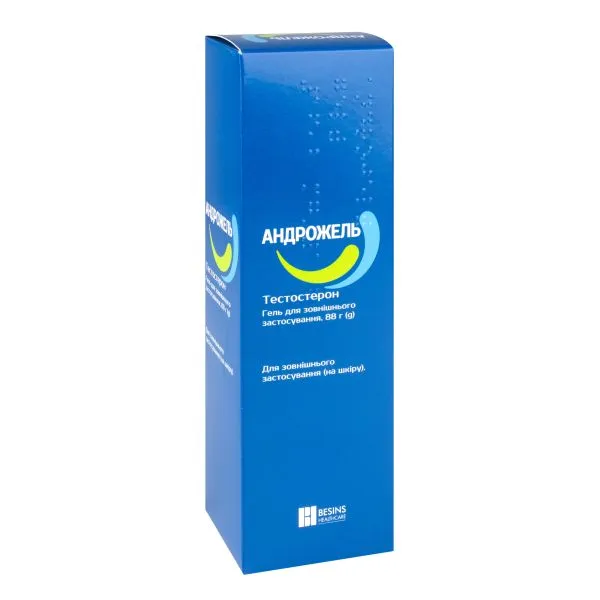
Table of Contents
INSTRUCTIONS FOR MEDICAL USE OF THE MEDICINAL PRODUCT A N D R O G E L (ANDROGEL)
Composition:
Active substance: testosterone;
1 g of gel contains 16.2 mg of testosterone;
Excipients: isopropyl myristate, ethanol 96%, carbomer (carbopol 980), sodium hydroxide 0.1 N, purified water.
Pharmaceutical form. Topical gel.
Main physicochemical characteristics: clear or slightly opalescent, colorless gel with a characteristic alcoholic odor.
Pharmacotherapeutic group. Androgens. Derivatives of 3-oxoandrostene. ATC code G03B A03.
Pharmacological properties.
Pharmacodynamics.
Endogenous androgens, primarily testosterone secreted by the testes, and its main metabolite dihydrotestosterone, are responsible for the development of external and internal genital organs as well as secondary sexual characteristics in males (stimulation of hair growth, voice deepening, libido development). Androgens also stimulate protein anabolism, skeletal muscle development, and fat distribution, and reduce fluid excretion and the levels of nitrogen, sodium, potassium, chloride, and phosphorus in urine. Testosterone reduces pituitary secretion of gonadotropins.
In certain target organs, testosterone exerts its effects after peripheral conversion to estradiol, which then binds to estrogen receptors in the nuclei of target organ cells, such as the pituitary gland, adipose tissue, brain, bones, and Leydig cells in the testes.
Pharmacokinetics.
Between 1% and 8.5% of the applied testosterone dose is absorbed through the skin.
After absorption through the skin, testosterone diffuses into systemic circulation at a relatively constant concentration over a 24-hour cycle.
Testosterone concentration in the blood increases from the first hour after application, reaching steady-state levels by the second day. Thereafter, daily fluctuations in testosterone concentration exhibit a similar amplitude to those characteristic of the circadian rhythm of endogenous testosterone secretion. Thus, transdermal administration avoids the peak concentrations in blood that occur after injections and supraphysiological concentrations of this steroid in the liver associated with oral administration of androgens.
Application of 5 g of the drug increases plasma testosterone concentration by an average of approximately 2.3 ng/mL (8.0 nmol/L).
After discontinuation of treatment, testosterone concentration begins to decrease approximately 24 hours after the last dose. Concentration returns to baseline levels approximately 72–96 hours after the last dose.
The main active metabolites of testosterone are dihydrotestosterone and estradiol. Testosterone is excreted primarily in urine, and to a lesser extent in feces, as conjugated metabolites.
In a double-blind Phase III study, at the end of the 112-day treatment period during which the dose of the medicinal product AndroGel could be adjusted based on total testosterone levels, total testosterone levels were within the normal range for eugonadal young men (300–1000 ng/dL) in 81.6% (95% CI: 75.1–87.0%) of men. In patients receiving daily treatment with AndroGel, mean (± SD) daily testosterone concentration on day 112 (Cav) was 561 (± 259) ng/dL, mean Cmax was 845 (± 480) ng/dL, and mean Cmin was 334 (± 155) ng/dL. Corresponding concentrations on day 184 (double-blind period) were: Cav – 536 (± 236) ng/dL, mean Cmax – 810 (± 497) ng/dL, and mean Cmin – 330 (± 147) ng/dL.
In an open-label Phase III study, at the end of the 264-day treatment period during which the dose of AndroGel could be adjusted based on total testosterone levels, total testosterone levels were within the normal range for eugonadal young men (300–1000 ng/dL) in 77% (95% CI: 69.8–83.2%) of men.
In patients receiving daily treatment with AndroGel, mean (± SD) daily testosterone concentration on day 266 (Cav) was 459 (± 218) ng/dL, mean Cmax was 689 (± 414) ng/dL, and mean Cmin was 305 (± 121) ng/dL. Corresponding concentrations on day 364 (extension of the open-label period) were: Cav – 454 (± 193) ng/dL, mean Cmax – 698 (± 382) ng/dL, and mean Cmin – 302 (± 126) ng/dL.
Preclinical safety data
Testosterone was non-mutagenic in in vitro studies using reverse mutation models (Ames test) or Chinese hamster ovary cells. In animal studies, an association between androgen treatment and certain types of cancer has been observed. Experimental data from rat studies showed an increased incidence of prostate cancer following testosterone treatment.
It is known that sex hormones may promote the development of certain tumors induced by known carcinogenic agents. The relevance of these findings and the actual risk for humans remain unknown.
Exogenous testosterone has been reported to suppress spermatogenesis in rats, dogs, and non-human primates. These changes were reversible after discontinuation of treatment.
Clinical characteristics.
Indications.
Testosterone replacement therapy in adult males with hypogonadism, when deficiency is confirmed by clinical presentation and laboratory tests.
Contraindications.
Diagnosed or suspected prostate cancer or breast cancer.
Hypersensitivity to testosterone or to any other component of the medicinal product.
Interaction with other medicinal products and other forms of interaction.
Due to changes in anticoagulant activity (potentiation of the effect of oral anticoagulants may occur as a result of modified hepatic synthesis of coagulation factors and competitive inhibition of plasma protein binding), careful monitoring of prothrombin time and determination of the international normalized ratio (INR) is recommended. Patients receiving oral anticoagulants require close monitoring, especially at the beginning of androgen therapy or after discontinuation.
Concomitant administration of testosterone with adrenocorticotropic hormone (ACTH) or corticosteroids may increase the risk of developing edema. Therefore, these agents should be used in combination with caution, particularly in patients with heart, kidney, or liver disease.
Effect on laboratory test results: androgens may reduce levels of thyroxine-binding globulin, resulting in decreased serum T4 concentrations and increased uptake of T3 and T4. Free thyroid hormone levels remain unchanged, and there are no clinical signs of thyroid insufficiency.
Changes in insulin sensitivity, glucose tolerance, glycemic control, blood glucose levels, and glycosylated hemoglobin have been reported during androgen therapy. Diabetic patients may require a reduction in dosage of antidiabetic agents.
Application of sunscreen cream or lotion does not reduce effectiveness.
Washing off 2 hours after application does not significantly affect testosterone blood levels.
Special precautions for use.
Androgel should be used only if hypogonadism (hyper- and hypogonadotropic) has been confirmed and other possible etiologies of symptoms have been excluded prior to initiating treatment. Deficiency of testosterone must be clearly demonstrated by clinical manifestations (regression of secondary sexual characteristics, changes in body composition, asthenia, decreased libido, erectile dysfunction, etc.) and confirmed by two separate blood tests measuring testosterone levels. Although there is currently no consensus regarding age-related changes in testosterone concentration, it should be borne in mind that physiological testosterone levels in blood decrease with age.
Due to possible variations in laboratory values, all testosterone measurements should be performed in the same laboratory.
Androgel is not a medication for the treatment of male infertility or impotence.
Prior to initiating testosterone therapy, all patients must undergo a complete examination to rule out prostate cancer. Patients receiving testosterone should have regular and careful monitoring of the prostate and breast glands according to recommended protocols (digital rectal examination, measurement of serum prostate-specific antigen [PSA]) at least once a year, and in elderly patients or those with risk factors (clinical or familial), twice a year.
Androgens may accelerate the progression of subclinical prostate cancer and benign prostatic hyperplasia.
Androgel should be used with caution in patients with malignant tumors due to the risk of developing hypercalcemia (and associated hypercalciuria) resulting from bone metastases. Such patients should have serum calcium levels monitored regularly.
In patients with severe cardiac, hepatic, or renal insufficiency or ischemic heart disease, testosterone therapy may cause serious complications characterized by edema with or without congestive heart failure. In such cases, treatment should be discontinued immediately. Additionally, diuretics should be prescribed if necessary.
Androgel should be used with caution in patients with ischemic heart disease.
Testosterone may increase blood pressure; therefore, Androgel should be prescribed with caution to patients with arterial hypertension.
Testosterone should be used cautiously in patients with thrombophilia, as post-marketing reports have described thrombotic complications in such patients during testosterone therapy.
Testosterone levels should be checked at the beginning of treatment and regularly throughout therapy. The physician should individually adjust the dose to maintain testosterone levels within the eugonadal range.
In patients receiving long-term androgen therapy, in addition to monitoring serum testosterone levels, periodic laboratory evaluations should include hemoglobin, hematocrit (to detect polycythemia), liver function tests, and lipid profile.
Safety and efficacy data for the use of Androgel in patients aged 65 years and older are limited. Currently, there is no consensus on age-dependent reference values for testosterone levels. However, the age-related decline in physiological testosterone levels in blood should be taken into account.
Androgel should be used with caution in patients with epilepsy or migraine, as the course of these conditions may worsen.
There are data indicating an increased risk of sleep apnea in patients with underdeveloped genital systems who are receiving testosterone esters, particularly in those with risk factors such as obesity and chronic respiratory diseases.
Improved insulin sensitivity may occur in patients treated with androgens, which may necessitate a reduction in the dosage of antidiabetic agents.
Some clinical signs—such as irritability, nervousness, weight gain, frequent or prolonged erections—may indicate excessive androgenic effects, requiring dose adjustment.
If a patient develops a severe local reaction, the continuation of therapy should be re-evaluated.
The use of high doses of exogenous androgens may suppress spermatogenesis due to feedback inhibition of pituitary follicle-stimulating hormone (FSH), potentially leading to abnormal semen parameters, including sperm count.
In patients receiving androgen therapy for hypogonadism, gynecomastia may occasionally develop, rarely with a persistent course.
Androgel must not be used in women due to the possible virilizing effect.
Information for athletes. This medicinal product contains an active substance (testosterone) that may lead to a positive result in anti-doping tests.
Potential transfer of gel to the skin of another person
If proper precautions are not observed, testosterone gel may be transferred to the skin of another person through close contact, potentially causing increased serum testosterone levels and adverse effects (excessive facial and/or body hair growth, voice deepening, menstrual cycle disturbances in women, and premature sexual development or enlargement of genital organs in children) upon repeated exposure (unintentional androgenization). In case of virilization, testosterone treatment should be discontinued immediately until the cause is determined.
The physician must inform the patient about this risk and the necessity of adhering to safety measures (see below). Androgel should not be prescribed to patients who have a significant risk of failing to comply with safety measures (e.g., in cases of severe alcoholism, drug addiction, or severe psychiatric disorders).
The risk of gel transfer to another person’s skin can be minimized (but not eliminated) by wearing clothing that covers the application site (e.g., a long-sleeved shirt). Most of the residual testosterone on the skin can be removed by washing with water and soap before close contact.
The following safety measures are recommended when using this product:
For patients:
- Wash hands thoroughly with water and soap after applying the gel;
- Cover the application site with clothing (e.g., a long-sleeved shirt) after the gel has dried;
- Take a shower and wash the application site with water and soap to remove residual testosterone before any situation involving close contact with another person;
For individuals not being treated with Androgel:
- If skin contact occurs with an un-washed or uncovered application site, immediately wash the affected skin area with water and soap;
- Consult a physician if signs of hyperandrogenization occur, such as acne or changes in normal hair growth patterns.
Due to data on the in vitro absorption of testosterone from Androgel, patients should wait at least 2 hours between gel application and bathing or showering. Occasional bathing or showering between 2 and 6 hours after gel application will not significantly affect treatment outcomes.
To ensure partner safety, patients should be advised, for example, to wash the gel application site with soap and water during a shower before sexual intercourse, or, if this is not feasible, to wear a shirt or T-shirt to cover the application site during contact.
Additionally, it is recommended to wear clothing covering the gel application site (e.g., a long-sleeved shirt) when in contact with children to prevent gel transfer to their skin.
Pregnant women should avoid any contact with sites where Androgel has been applied. If a patient’s partner is pregnant, increased attention to the safety measures described above must be taken (see also section "Use during pregnancy or breastfeeding").
Use during pregnancy or breastfeeding.
Androgel is intended only for treatment in men.
Androgel must not be used during pregnancy or breastfeeding due to the potential for fetal virilization. Clinical studies on this treatment in women have not been conducted.
Pregnant women should avoid any contact with sites where Androgel has been applied (see section "Special precautions for use"). In case of contact, the affected areas should be washed immediately with water and soap.
Androgel may reversibly suppress spermatogenesis.
Ability to influence reaction speed when driving or operating machinery.
Androgel has no effect or only a negligible effect on the ability to drive vehicles or operate machinery.
Method of Administration and Dosage
For external use (on the skin).
Adult and elderly men
The recommended dose is 2 actuations of the dosing device (40.5 mg of testosterone) once daily, preferably at the same time each morning. The daily dose may be individually adjusted by the physician depending on clinical response and laboratory monitoring results, but should not exceed 4 actuations of the dosing device (81 mg of testosterone) per day. Dose adjustments should be made by adding one actuation of the dosing device.
The dose should be increased gradually, taking into account the morning serum testosterone level before applying the gel. Steady-state testosterone concentration in blood is usually achieved by the second day of treatment with AndroGel. To adjust the testosterone dose, serum testosterone concentration should be measured in the morning before applying the gel, after reaching steady-state conditions. Serum testosterone levels should be periodically monitored. The dose may be reduced if serum testosterone concentration is found to be elevated. If the concentration is low, the dose may be gradually increased, but it should not exceed 81 mg of gel per day (4 actuations of the dosing device).
Treatment should be discontinued if serum testosterone levels consistently exceed the normal reference range even when using the lowest daily dose of 20.25 mg (1.25 g of gel, equivalent to one actuation of the dosing device), or if serum testosterone levels do not reach the normal reference range even when using the maximum daily dose of 81 mg of testosterone (5 g of gel, equivalent to four actuations of the dosing device).
Patients with severe renal or hepatic impairment
See section "Special precautions for use".
Method of Administration
The gel should be applied by the patient himself to clean, dry, intact skin on both shoulders and upper arms.
The gel should be applied gently, spreading it evenly over the skin in a thin layer. The gel should not be rubbed into the skin. Allow it to dry for at least 3–5 minutes before dressing. After applying the gel, wash hands thoroughly with soap and water, and cover the application site with clothing once the gel has dried. In any situation where close skin-to-skin contact with another person is expected, the application site should be thoroughly washed with soap and water. For additional information on washing after application, see section "Special precautions for use".
The gel should not be applied to the genital area, as the high concentration of alcohol may cause local irritation.
To obtain the first dose, the dosing device must be primed. To do this, hold the bottle in an upright position and press the dosing device fully down three times slowly and completely. The gel dispensed during the first three actuations should be discarded safely. The dosing device should be primed only once, prior to the first application.
After priming, press the dosing device fully once to dispense 1.25 g of AndroGel onto the palm of the hand, then apply it to the shoulders and upper arms (see figure).
Children
The safety and efficacy of AndroGel in children (under 18 years of age) have not been established. Data are lacking.
Overdose.
Only one case of acute testosterone overdose following injection has been reported in the literature. This involved a cerebrovascular event in a patient with a high plasma testosterone concentration of 114 ng/mL (395 nmol/L). It is unlikely that such a high testosterone level could be achieved with transdermal administration.
Management of overdose should include discontinuation of AndroGel and appropriate symptomatic and supportive therapy.
Adverse reactions
The most common adverse reactions with the use of the recommended dose of the drug Androgel may include psychiatric disorders and skin reactions at the site of gel application.
The table below lists the adverse reactions reported during the 182-day double-blind period of the phase III clinical trial of the drug Androgel, which occurred more frequently in the Androgel treatment group (n=234) than in the placebo group (n=40).
Table 1
Frequency of adverse reactions with the use of the drug Androgel in the phase III study
| MedDRA System Organ Classes |
Adverse Reactions(Preferred terms) |
|
| Common (≥ 1/100 to < 1/10) |
Uncommon (≥ 1/1000 to < 1/100) |
|
| Psychiatric Disorders |
Emotional symptoms * (mood changes, affective disorder, anger, aggression, irritability, insomnia, unusual dreams, increased libido) |
|
| Vascular Disorders |
Malignant hypertension, flushing, phlebitis |
|
| Gastrointestinal Disorders |
Diarrhea, abdominal distension, oral pain |
|
| Skin and Subcutaneous Tissue Disorders |
Skin reactions * (acne, alopecia, dry skin, skin disorder, contact dermatitis, hair color changes, rash, increased sensitivity at application site, itching at application site) |
|
| Reproductive System and Breast Disorders |
Gynecomastia, nipple disorder, testicular pain, prolonged erection |
|
| General Disorders and Administration Site Conditions |
Soft swelling |
|
| Investigations |
Increased PSA levels, increased hematocrit or increased hemoglobin levels |
|
* Adverse reactions are grouped.
Due to the presence of alcohol, frequent application to the skin may cause skin irritation and dryness.
The adverse reactions listed below were identified during post-marketing use of the medicinal product AndroGel. Since these adverse reactions have been reported voluntarily from a population of unknown size, it is not possible to reliably estimate their frequency or establish a causal relationship to exposure to the drug.
Table 2
Adverse reactions reported during spontaneous reporting with the use of the medicinal product AndroGel
| MedDRA system organ classes |
Adverse reactions(preferred terms) |
| Blood and lymphatic system disorders |
Polycthemia, anemia |
| Psychiatric disorders |
Insomnia, depression, anxiety, aggression |
| Nervous system disorders |
Headache, dizziness, paresthesia |
| Vascular disorders |
Vasodilatation (hot flushes), deep vein thrombosis |
| Respiratory, thoracic and mediastinal disorders |
Dyspnea |
| Gastrointestinal disorders |
Nausea |
| Skin and subcutaneous tissue disorders |
Application site reaction, acne, alopecia, increased sweating, hypertrichosis |
| Musculoskeletal and connective tissue disorders |
Myalgia, bone pain |
| Renal and urinary disorders |
Urinary retention |
| Reproductive system and breast disorders |
Gynecomastia, testicular disorder, prostate enlargement, oligospermia, benign prostatic hyperplasia |
| General disorders and administration site conditions |
Asthenia, edema, malaise |
| Investigations |
Weight increased, increased PSA level, increased hematocrit or increased hemoglobin level |
The adverse reactions listed below have been identified during post-marketing use of testosterone-containing medicinal products.
Table 3
Adverse reactions associated with the use of testosterone-containing medicinal products
| MedDRA system organ classes |
Adverse reactions(preferred terms) |
| Common (from ≥ 1/100 to < 1/10) |
|
| Blood and lymphatic system disorders |
Increased haematocrit, increased red blood cell count, increased haemoglobin level |
Reporting of suspected adverse reactions
Reporting of suspected adverse reactions after authorization of the medicinal product is important. This allows continued monitoring of the benefit/risk balance of the medicinal product. Healthcare professionals are requested to report any suspected adverse reactions through the national reporting system.
Shelf life. 3 years.
After first opening of the packaging – 30 days.
Storage conditions.
No special storage conditions required.
Keep out of the reach of children.
Packaging.
88 g of gel in a bottle with a dosing device, one bottle per cardboard box.
Prescription status. Prescription only.
Manufacturers.
Besins Manufacturing Belgium.
Laboratoires Besins International.
Manufacturers' locations and addresses of their business sites.
Groot-Bijgaardenstraat 128, 1620 Drogenbos, Belgium.
13 rue Pierre, Montrouge, 92120, France.