Andropharm
Ukraine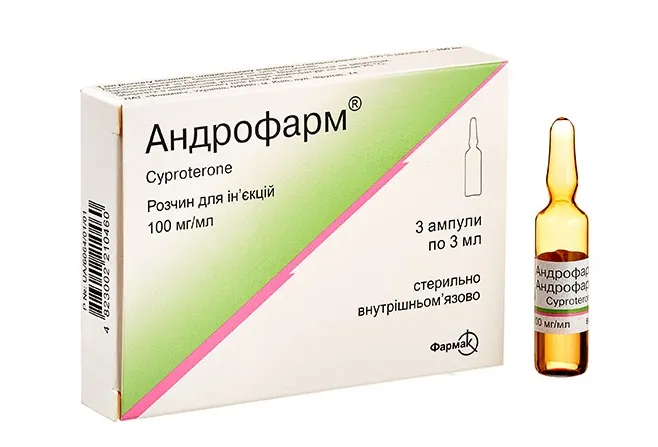
Table of Contents
INSTRUCTION FOR MEDICAL USE OF THE MEDICINAL PRODUCT ANDROFARM® (ANDROFARM)
Composition:
Active substance: cyproterone;
1 ml of the preparation contains 100 mg of cyproterone acetate calculated as 100 % substance;
Excipients: benzyl benzoate, castor oil.
Pharmaceutical form. Injection solution.
Main physicochemical properties: yellow or yellow-green oily liquid with a specific odor.
Pharmacotherapeutic group.
Sex gland hormones and drugs used in pathology of the genital system. Antiandrogens.
ATC code G03HA01.
Pharmacological properties.
Pharmacodynamics.
Cyproterone acetate exerts antiandrogenic, progestogenic, and antigonadotropic effects, which have been confirmed in studies on animals and human volunteers.
Preclinical studies
Antiandrogenic effect
Cyproterone acetate competitively inhibits the action of endogenously produced and exogenously administered androgens on target organs. This leads to blockade of the translocation of the DHT-receptor complex into the cell nucleus. In vitro cell culture experiments conducted to evaluate the effect of cyproterone acetate on androgen receptor function indicate high antiandrogenic efficacy of cyproterone acetate. Furthermore, certain in vitro test systems have demonstrated a slight partial agonistic activity of cyproterone acetate on androgen receptors. Cyproterone acetate reduces or abolishes the stimulatory effects of male sex hormones on androgen-dependent structures and functions: depending on the dose, administration of cyproterone acetate in animals causes atrophy of secondary sex glands. It affects testicular function: spermatogenesis is suppressed in a dose-dependent manner. As in humans, libido is reduced in dogs, rabbits, pigs, and monkeys following administration of cyproterone acetate.
In rats, interference with or delay of the onset of puberty may occur. Cyproterone acetate inhibits the physiological closure of the bone growth plates and bone maturation.
Sebaceous gland function is impaired, and epidermal thickness is reduced.
Treatment of pregnant animals with cyproterone acetate leads to disruption of male fetal development. Effects on testosterone-dependent differentiation processes result in more or less pronounced signs of feminization.
Progestogenic effect
Results of the Klauzner test (in rabbits) indicate that the potency of cyproterone acetate after subcutaneous administration is 100 times greater than that of progesterone. In progestogenic activity tests in rats, cyproterone acetate administered subcutaneously is approximately equipotent to progesterone.
Antigonadotropic effect
Like all potent progestogens, cyproterone acetate has antigonadotropic properties, manifested in males by inhibition of testicular growth and in females by suppression of ovulation.
Clinical studies
Antiandrogenic effect
Cyproterone acetate competitively inhibits the action of androgens on target organs. In humans, the following interrelated conditions have been described:
suppression of sexual desire, reduced sebaceous gland activity, effects on hair growth, inhibition of androgen-driven growth impulses in prostate tissue, suppression of premature pubertal development, including in bone tissue.
Progestogenic effect
Cyproterone acetate is a potent progestogen. According to results of the Kaufmann test, a total dose of 20–30 mg of the drug already induces endometrial transformation.
Antigonadotropic effect
As a potent progestogen, cyproterone acetate exerts a suppressive effect on the central nervous system. Due to this antigonadotropic action, there is no increase in the feedback secretion of luteinizing hormone, although as a result of the antiandrogenic action of cyproterone acetate, androgens are displaced from hypothalamic receptors, with which they normally exert negative feedback. Furthermore, the secretion of luteinizing hormone and follicle-stimulating hormone is additionally suppressed by the progestogenic action of cyproterone acetate. As a result, serum levels of testosterone and estrogens are reduced. This antigonadotropic effect is attenuated in males because the suppressive effect of androgens is diminished by the antiandrogenic components of the active substance acting on the hypothalamus.
Other effects on endocrine function
Administration of cyproterone acetate reduces the concentration of testosterone and estrogens.
No significant effect on 17-ketosteroids and 17-ketogenic steroids has been observed. Cortisol secretion remains unchanged or slightly reduced. The function of the hypothalamic-pituitary-adrenal axis in adults remains predominantly unchanged. Evaluation of all results allows the conclusion that the responsiveness of the system is generally unimpaired.
Pharmacokinetics.
After intramuscular administration, cyproterone acetate is gradually released from the intramuscular depot. Its maximum serum concentration is 180 ± 54 ng/mL, reached within 2–3 days. Thereafter, the hormone level in serum declines with a terminal half-life of 4 ± 1.1 days. Total clearance of cyproterone acetate from serum is 2.8 ± 1.4 mL/min/kg. Cyproterone acetate is metabolized via multiple pathways, including hydroxylation and conjugation. The main metabolite in plasma is 15β-hydroxy derivative. Phase I metabolism is primarily catalyzed by the CYP3A4 enzyme of the cytochrome P450 system. A small portion of the administered dose is excreted unchanged in bile. The majority of the substance is excreted as metabolites in urine and bile in a ratio of 3:7. Cyproterone acetate is almost completely bound to plasma albumins. Approximately 3.5–4% of the total steroid level remains unbound. Since protein binding is nonspecific, changes in levels of sex hormone-binding globulin do not affect the pharmacokinetics of cyproterone acetate. Due to the prolonged terminal half-life in plasma and the 7-day dosing interval, accumulation of cyproterone acetate in serum can be expected with repeated administration. A steady state between release of cyproterone acetate from the depot and its elimination is reached after approximately 5 weeks. Absolute bioavailability of cyproterone acetate after intramuscular injection is considered complete. Smoking does not affect the pharmacokinetics of cyproterone acetate.
Clinical characteristics.
Indications.
Androfame is intended for use in men only.
It is indicated:
- for reduction of libido in sexual deviations;
- for palliative therapy of metastatic or locally progressive inoperable prostate cancer, when treatment with analogues of luteinizing hormone-releasing hormone (LHRH) or surgical intervention has proven insufficient or contraindicated;
- initially, to reduce hot flushes that may be caused by a rise in serum testosterone levels at the beginning of treatment with LHRH agonists.
Contraindications.
When used as palliative therapy for progressive prostate cancer and initially to reduce hot flushes:
- liver disease;
- Dubin-Johnson syndrome, Rotor syndrome;
- liver tumors, including history thereof (only if the tumor is not due to metastases of prostate cancer);
- meningioma, including history thereof;
- confirmed malignant diseases or suspicion thereof (except progressive prostate cancer);
- severe chronic depression;
- thromboembolic events, including history thereof;
- hypersensitivity to the active substance or to any of the excipients;
- childhood and adolescent age before completion of the pubertal period (see section "Method of administration and dosage").
When used for reduction of sexual desire in pathological sexual deviations in men:
- liver disease;
- Dubin-Johnson syndrome, Rotor syndrome;
- liver tumors, including or history thereof;
- meningioma, including history thereof;
- confirmed malignant diseases or suspicion thereof;
- severe chronic depression;
- thromboembolic conditions, including history thereof;
- severe forms of diabetes mellitus with vascular complications;
- sickle cell anemia;
- hypersensitivity to the active substance or to any of the excipients;
- childhood and adolescent age before completion of the pubertal period (see section "Method of administration and dosage").
Interaction with other medicinal products and other types of interactions.
During treatment with Androfame®, dosage adjustment of oral antidiabetic agents or insulin may be required.
Clinical studies on drug interactions have not been conducted; however, since the drug is metabolized via the CYP3A4 enzyme, strong inhibitors of CYP3A4 such as ketoconazole, itraconazole, clotrimazole, ritonavir, and others are expected to inhibit the metabolism of cyproterone acetate. Conversely, inducers of CYP3A4 such as rifampicin, phenytoin, and medicinal products containing St. John's wort may reduce cyproterone acetate levels.
Based on in vitro study results, it can be assumed that administration of high therapeutic doses of cyproterone acetate (100 mg three times daily) may inhibit cytochrome P450 enzymes including CYP2C8, 2C9, 2C19, 3A4, and 2D6.
Concomitant use of HMG-CoA inhibitors (statins) and high therapeutic doses of cyproterone acetate may increase the statin-associated risk of myopathy or rhabdomyolysis due to the shared metabolic pathway of these substances.
Special precautions for use.
Liver
Cases of hepatotoxicity, including jaundice, hepatitis, and liver failure, have been reported in patients treated with cyproterone acetate. Fatal outcomes have been reported with doses of 100 mg and higher. Most fatal cases occurred in men being treated for advanced prostate cancer. The drug's toxicity is dose-dependent and usually develops after several months of treatment. Liver function tests should be performed before starting treatment, regularly throughout the treatment period, and whenever symptoms of hepatotoxicity occur. If hepatotoxicity is confirmed and no other cause (e.g., metastases) is identified, cyproterone acetate should be discontinued. Treatment may only be continued if the expected benefit outweighs the potential risk.
Benign, and more rarely malignant, liver tumors have been observed in isolated cases following cyproterone acetate use. In some instances, intra-abdominal hemorrhage caused by these tumors has been life-threatening. During treatment with Andrópharm®, upper abdominal pain, hepatomegaly, or signs of intra-abdominal bleeding should prompt consideration of liver tumor in the differential diagnosis. If necessary, treatment with the drug should be discontinued.
Meninigioma
Cases of meningioma (single or multiple) have been reported in association with long-term use (over several years) of cyproterone acetate at doses of 25 mg per day or higher. If a patient receiving Andrópharm® is diagnosed with meningioma, treatment with the drug should be discontinued.
Thromboembolic events
Thromboembolic events have been reported in patients receiving cyproterone acetate.
Patients with a history of arterial or venous thrombotic/thromboembolic events (e.g., deep vein thrombosis, pulmonary embolism, myocardial infarction), cerebrovascular disease, or those with advanced-stage tumors are considered at increased risk of developing further thromboembolic events.
Extreme caution is required when prescribing the drug to patients with inoperable prostate cancer and a history of thromboembolic events, severe forms of diabetes with vascular complications, or sickle cell anemia. In each individual case, the potential benefits of treatment must be weighed against the potential risks.
Anemia
Development of anemia has been reported during treatment with cyproterone acetate. Therefore, regular blood tests to monitor erythrocyte count should be performed throughout treatment.
Metabolism
In patients with diabetes mellitus, increased blood glucose levels have been observed during treatment with cyproterone acetate. Therefore, close monitoring of carbohydrate metabolism is recommended, as the required dosage of oral antidiabetic agents or insulin may change during treatment with Andrópharm®.
At the beginning of treatment with Andrópharm®, a negative nitrogen balance may occur, which normalizes over the course of treatment. Due to this initial catabolic effect, Andrópharm® should not be administered in confirmed or suspected malignant conditions (except prostate cancer).
Dyspnea
In isolated cases, dyspnea may occur during high-dose treatment with Andrópharm®.
If dyspnea occurs during treatment with Andrópharm®, the known stimulatory effect of progesterone and synthetic progestogens on the respiratory system—leading to hypocapnia and compensatory respiratory alkalosis—should be considered in the differential diagnosis. Such conditions are generally considered not to require specific treatment.
Adrenal cortex function
The function of the adrenal cortex should be monitored regularly throughout treatment, as preclinical data indicate possible suppression due to the corticoid-like effect of cyproterone acetate.
Spermatogenesis
Spermatogenesis may be gradually impaired during treatment, potentially leading to infertility. This effect reverses gradually after treatment discontinuation. Spermatogenesis usually returns to pre-treatment levels within several months, sometimes up to 20 months after therapy ends. For men of reproductive age for whom fertility after treatment is important, at least one baseline semen analysis should be performed before starting treatment with Andrópharm®. This allows exclusion of unfounded claims of infertility resulting from antiandrogen therapy.
Depression
Cyproterone acetate has been occasionally associated with an increased incidence of depressive mood, particularly during the first 6–8 weeks of treatment. Patients with a history of depression should be closely monitored.
Cardiovascular disorders
Edema and weight gain may occur. Therefore, cyproterone acetate should be used with caution in patients with thromboembolic cardiovascular disorders.
Other data
Like all oily solutions, Andrópharm® should be administered only intramuscularly and very slowly. Pulmonary microembolism caused by oily solutions may lead to symptoms such as cough, dyspnea, and chest pain. Other possible symptoms include vasovagal reactions such as malaise, hyperhidrosis, dizziness, paresthesia, and syncope. These reactions may occur during or immediately after injection and are reversible. Supportive therapy, such as oxygen administration, is usually recommended.
When prescribing Andrópharm® for the treatment of pathological deviations in sexual behavior, it should be remembered that alcohol may counteract the drug's effect on reducing libido.
Elderly patients
There are no data indicating the need for dose adjustment in elderly patients.
Patients with hepatic impairment
Andrópharm® is contraindicated in patients with liver disease (until liver function parameters return to normal).
Patients with renal impairment
There are no data indicating the need for dose adjustment in patients with renal impairment.
Use during pregnancy or breastfeeding.
The drug must not be used in women.
Ability to affect reaction speed when driving or operating machinery.
Patients whose activities require high attention (e.g., machine operators, drivers, etc.) should be aware that treatment with Andrópharm® may cause fatigue, reduced activity, and impaired concentration.
Reaction ability may be impaired to such an extent that active participation in road traffic and operation of machinery may be hazardous.
Method of Administration and Dosage
Injections should be administered very slowly. The medication is intended for intramuscular use only. Care must be taken to ensure that the injected substance does not enter a blood vessel.
- For reduction of sexual drive in pathological deviations in sexual behavior in men.
Sexual behavior disorders require treatment only when symptoms of the condition are significantly pronounced. A prerequisite for initiating treatment is the patient's willingness to undergo therapy.
The contents of one vial (3 ml) should be administered every 10–14 days as a deep intramuscular injection. In exceptional cases, if the therapeutic effect is insufficient, two vials may be administered every 10–14 days, preferably 3 ml (the contents of one vial) injected into the right and left gluteal muscles (M. gluteus maximus) respectively.
To stabilize the therapeutic effect, long-term use of Androfan® is required, and, if possible, concurrent psychotherapeutic measures should be implemented.
After achieving a satisfactory therapeutic response, the dose should be gradually reduced by increasing the interval between injections. Dose reduction or discontinuation of the medication must be performed gradually.
- For the treatment of inoperable prostate cancer.
The contents of one vial (3 ml) should be administered weekly as a deep intramuscular injection.
Even if the patient's condition improves or the disease goes into remission, the prescribed dose should not be altered or treatment discontinued.
- Initially, for reduction of hot flushes.
A single dose of Androfan® (300 mg) should be administered once as a deep intramuscular injection.
Children.
Androfan® is not recommended for use in children and adolescents (under 18 years of age) due to lack of safety and efficacy data.
Androfan® should not be administered before completion of sexual maturation, as a negative impact of the drug on growth and the endocrine system cannot be excluded.
Overdose.
Acute toxicity studies following single administration indicate that cyproterone acetate is a nearly non-toxic substance. No acute intoxication has been observed after accidental single administration of doses several times higher than the therapeutic dose.
Adverse Reactions
The most commonly observed adverse reactions in patients include decreased libido, erectile dysfunction, and reversible suppression of spermatogenesis.
The most serious adverse reactions observed in patients include hepatic toxicity, benign and malignant liver tumors (which may lead to intra-abdominal hemorrhage), and thromboembolic events.
Neoplasms benign, malignant and unspecified (including cysts and polyps): benign and malignant liver tumors, meningiomas.
Blood and lymphatic system disorders: anemia.
Immune system disorders: hypersensitivity reactions.
Metabolism and nutrition disorders: weight gain or weight loss, increased blood glucose levels in diabetic patients.
Psychiatric disorders: decreased libido, erectile dysfunction, depressed mood, restlessness (transient).
Vascular disorders: pulmonary microembolism due to injection of oily solutions, vasovagal reactions, thromboembolic events.
Respiratory, thoracic and mediastinal disorders: dyspnea.
Gastrointestinal disorders: nausea, vomiting, intra-abdominal hemorrhage.
Hepatobiliary disorders: hepatotoxicity, including jaundice, hepatitis, hepatic failure.
Cardiac disorders: ischemic heart disease.
Skin and subcutaneous tissue disorders: rash.
Musculoskeletal and connective tissue disorders: osteoporosis.
Reproductive system and breast disorders: reversible suppression of spermatogenesis, gynecomastia (sometimes associated with increased sensitivity of nipples to touch, which usually resolves after discontinuation of the drug).
General disorders and administration site conditions: increased fatigue, transient generalized indifference, hot flushes, increased sweating, injection site reactions.
Nervous system disorders: headache.
Investigations: elevated prolactin levels, decreased cortisol levels.
Treatment with Androfam® reduces sexual desire and potency and suppresses gonadal function. These effects are reversible upon discontinuation of therapy.
Cyproterone acetate, due to its antiandrogenic and antigonadotropic effects, suppresses spermatogenesis within several weeks of use. Spermatogenesis gradually recovers over several months after discontinuation of treatment.
As with other antiandrogenic agents, prolonged reduction in androgen levels caused by cyproterone acetate may lead to the development of osteoporosis.
Cases of meningioma development have been reported in association with long-term use (over several years) of the drug at doses of 25 mg or higher.
Incompatibilities
Due to lack of compatibility studies, this medicinal product must not be mixed with other medicinal products.
Shelf life
3 years.
Do not use the medicinal product after the expiry date stated on the packaging.
Storage conditions
Store in the original packaging at a temperature not exceeding 25 °C.
Keep out of the reach of children.
Packaging
3 mL in a vial. 3 vials in a blister pack, 1 blister pack in a carton.
Prescription category: Prescription only.
Manufacturer: JSC "Farmak".
Manufacturer's address and place of business:
74, Kyrylivska Street, Kyiv, 04080, Ukraine.