Amoxiclav® 2x
Ukraine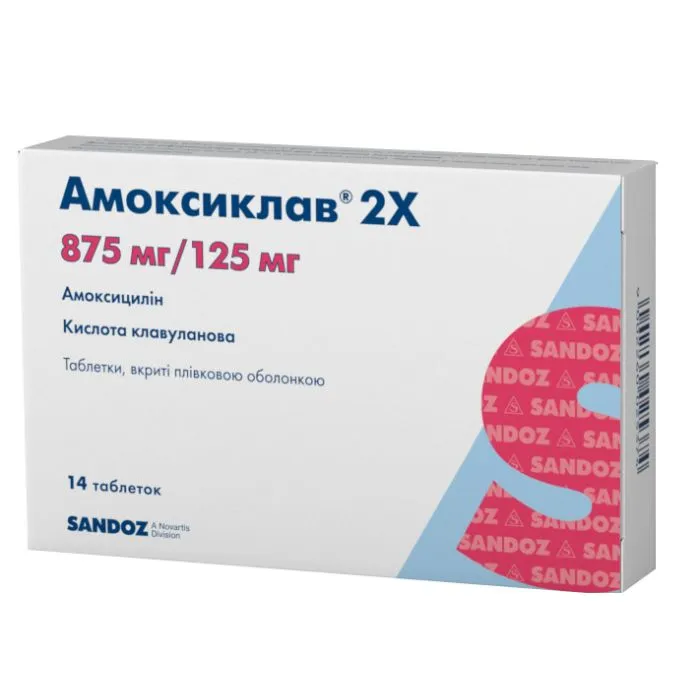
Table of Contents
INSTRUCTIONS FOR MEDICAL USE OF THE MEDICINAL PRODUCT AMOKSIKLAV® 2X (AMOKSIKLAV®2X)
Composition:
Active substances: amoxicillin, clavulanic acid;
One tablet contains 875 mg of amoxicillin in the form of trihydrate and 125 mg of clavulanic acid in the form of potassium salt;
Excipients: colloidal anhydrous silicon dioxide, magnesium stearate, talc, povidone K25, crospovidone type A, microcrystalline cellulose PH-112;
Coating: triethyl citrate, hypromellose 2910, talc, titanium dioxide (E 171), aqueous dispersion of ethylcellulose.
Pharmaceutical form. Film-coated tablets.
Main physicochemical properties: oval-shaped tablets, white to cream-colored, film-coated, with a break line on both sides of the tablet.
Pharmacotherapeutic group.
Antibacterials for systemic use. Beta-lactam antibiotics, penicillins. Combinations of penicillins with beta-lactamase inhibitors. ATC code J01CR02.
Pharmacological properties.
Pharmacodynamics.
Mechanism of action. Amoxicillin is a semisynthetic penicillin (beta-lactam antibiotic) that inhibits one or more enzymes (often referred to as penicillin-binding proteins) involved in the biosynthetic metabolism of bacterial peptidoglycan, an essential structural component of the bacterial cell wall. Inhibition of peptidoglycan synthesis leads to weakening of the cell wall, resulting in cell lysis and death.
Amoxicillin is susceptible to degradation by beta-lactamases produced by resistant bacteria; therefore, the antimicrobial spectrum of amoxicillin as monotherapy does not include organisms producing these enzymes.
Clavulanic acid is a beta-lactam compound structurally related to penicillins. It inactivates certain beta-lactamase enzymes, thereby preventing the inactivation of amoxicillin. Clavulanic acid has no clinically useful antibacterial activity when used alone.
PK/PD relationship. The time above the minimum inhibitory concentration (T>MIC) is considered the primary factor determining the efficacy of amoxicillin.
Mechanisms of resistance.
There are two main mechanisms of resistance to amoxicillin/clavulanic acid:
- Inactivation by bacterial beta-lactamases that are not themselves inhibited by clavulanic acid, including classes B, C, and D;
- Alteration of penicillin-binding proteins leading to reduced affinity of the antibacterial agent for its target.
Impermeability of bacterial cell membranes or efflux pump mechanisms may contribute to bacterial resistance or facilitate its development, particularly in Gram-negative bacteria.
Clinical breakpoints.
The minimum inhibitory concentration (MIC) clinical breakpoints for amoxicillin/clavulanic acid established by the European Committee on Antimicrobial Susceptibility Testing (EUCAST):
| Microorganisms |
Breakpoints of susceptibility (µg/ml) |
||
| Susceptible |
Intermediate |
Resistant |
|
| Haemophilus influenzae 1 |
≤1 |
- |
> 1 |
| Moraxella catarrhalis 1 |
≤1 |
- |
> 1 |
| Staphylococcus aureus 2 |
≤2 |
- |
>2 |
| Coagulase-negative staphylococci 2 |
≤ 0.25 |
- |
> 0.25 |
| Enterococcus 1 |
≤4 |
8 |
> 8 |
| Streptococcus A, B, C, G 5 |
≤ 0.25 |
- |
> 0.25 |
| Streptococcus pneumoniae 3 |
≤ 0.5 |
1–2 |
>2 |
| Enterobacteriaceae 1, 4 |
- |
- |
> 8 |
| Gram-negative anaerobic bacteria 1 |
≤4 |
8 |
> 8 |
| Gram-positive anaerobic bacteria 1 |
≤4 |
8 |
> 8 |
| Breakpoints not specific to individual species 1 |
≤2 |
4–8 |
> 8 |
| 1 The reported values are for amoxicillin concentrations. For susceptibility testing, the concentration of clavulanic acid is set at 2 mg/l. 2 The reported values are for oxacillin concentrations. 3 The breakpoints listed in the table are derived from ampicillin breakpoints. 4 The resistance breakpoint R>8 mg/l indicates that all strains with resistance mechanisms are classified as resistant. 5 The breakpoints listed in the table are derived from benzylpenicillin breakpoints. |
|||
The prevalence of resistance may vary geographically and over time for individual species, so local information on susceptibility is desirable, especially when treating severe infections. Expert guidance is needed if local resistance prevalence is such that the benefit of the drug, at least for certain types of infections, is questionable.
| Commonly susceptible species |
| Gram-positive aerobes: Enterococcus faecalis, Gardnerella vaginalis, Staphylococcus aureus (methicillin-susceptible)£, Coagulase-negative staphylococci (methicillin-susceptible), Streptococcus agalactiae, Streptococcus pneumoniae1, Streptococcus pyogenes and other beta-haemolytic streptococci, Streptococcus viridans group. Gram-negative aerobes: Capnocytophaga spp., Eikenella corrodens, Haemophilus influenzae2, Moraxella catarrhalis, Pasteurella multocida. Anaerobes: Bacteroides fragilis, Fusobacterium nucleatum, Prevotella spp. |
| Species for which development of resistance may be a concern |
| Gram-positive aerobes: Enterococcus faecium$. Gram-negative aerobes: Escherichia coli, Klebsiella oxytoca, Klebsiella pneumoniae, Proteus mirabilis, Proteus vulgaris. |
| Naturally resistant microorganisms |
| Gram-negative aerobes: Acinetobacter spp., Citrobacter freundii, Enterobacter spp., Legionella pneumophila, Morganella morganii, Providencia spp., Pseudomonas spp., Serratia spp., Stenotrophomonas maltophilia. Other microorganisms: Chlamydophila pneumoniae, Chlamydophila psittaci, Coxiella burnetii, Mycoplasma pneumoniae. |
| $ Natural moderate susceptibility in the absence of acquired resistance mechanisms. £ All methicillin-resistant staphylococci are resistant to amoxicillin/clavulanic acid. 1 Penicillin-resistant Streptococcus pneumoniae should not be treated with this amoxicillin/clavulanic acid formulation (see sections "Special warnings and precautions for use" and "Posology and method of administration"). 2 Strains with reduced susceptibility have been reported in some EU countries with a frequency greater than 10%. |
Pharmacokinetics.
Absorption. Amoxicillin and clavulanic acid are completely dissociated in aqueous solutions at physiological pH levels. Both components are rapidly and well absorbed following oral administration. The bioavailability of amoxicillin and clavulanic acid is approximately 70% upon oral administration. The plasma profiles of both components are identical, and the time to reach maximum plasma concentration (Tmax) for each component is approximately one hour.
Serum concentrations of amoxicillin and clavulanic acid achieved after administration of amoxicillin/clavulanic acid are identical to those achieved following oral administration of equivalent doses of amoxicillin or clavulanic acid given separately.
Distribution. Approximately 25% of the total clavulanic acid in plasma and 18% of the total amoxicillin in plasma are protein-bound. The apparent volume of distribution is approximately 0.3–0.4 L/kg for amoxicillin and about 0.2 L/kg for clavulanic acid.
Following intravenous administration, amoxicillin and clavulanic acid have been detected in the gallbladder, abdominal tissue, skin, adipose tissue, muscle tissue, synovial and peritoneal fluid, bile, and pus. Amoxicillin does not distribute adequately into cerebrospinal fluid.
Animal studies have not shown any evidence of significant retention of substances derived from either component of the drug in body tissues. Amoxicillin, like most penicillins, may be detected in breast milk. A small amount of clavulanic acid may also be detected in breast milk (see section "Use in pregnancy or lactation").
It is known that both amoxicillin and clavulanic acid cross the placental barrier (see section "Use in pregnancy or lactation").
Metabolism. Amoxicillin is partially excreted in urine as inactive penicilloic acid in amounts equivalent to 10–25% of the initial dose. Clavulanic acid is extensively metabolized in the human body and is excreted in urine and feces, as well as in the form of carbon dioxide in expired air.
Elimination. The primary route of elimination for amoxicillin is renal, whereas clavulanic acid is eliminated both via the kidneys and through non-renal mechanisms.
In healthy volunteers, the mean elimination half-life of amoxicillin/clavulanic acid is approximately 1 hour, and the mean total clearance is approximately 25 L/hour. Various studies have shown that urinary excretion amounts to 50–85% for amoxicillin and 27–60% for clavulanic acid over a 24-hour period. In the case of clavulanic acid, the majority of the substance is excreted within the first 2 hours after administration.
Concomitant administration of probenecid slows the elimination of amoxicillin but does not affect the renal excretion of clavulanic acid (see section "Interaction with other medicinal products and other forms of interaction").
Age. The elimination half-life of amoxicillin is similar in children aged 3 months to 2 years, older children, and adults. For neonates (including premature infants) during the first week of life, the dosing frequency should not exceed twice daily due to immaturity of the renal elimination pathway. Since elderly patients are more likely to have decreased renal function, dosage selection should be cautious, and monitoring of renal function is recommended.
Renal impairment. Total serum clearance of amoxicillin/clavulanic acid decreases proportionally with decreasing renal function. The reduction in clearance is more pronounced for amoxicillin than for clavulanic acid, as a larger fraction of amoxicillin is eliminated by the kidneys. In renal impairment, dosing should prevent excessive accumulation of amoxicillin while maintaining adequate levels of clavulanic acid (see section "Dosage and administration").
Hepatic impairment. Patients with hepatic impairment should be treated cautiously with this medicinal product, and regular monitoring of liver function is recommended.
Clinical characteristics.
Indications.
Treatment of bacterial infections in adults and children caused by microorganisms sensitive to the drug:
- acute bacterial sinusitis (confirmed);
- acute otitis media;
- confirmed exacerbation of chronic bronchitis;
- community-acquired pneumonia;
- cystitis;
- pyelonephritis;
- skin and soft tissue infections, including cellulitis, animal bites, severe dentoalveolar abscesses with spreading cellulitis;
- bone and joint infections, including osteomyelitis.
Contraindications.
Hypersensitivity to any component of the drug or to any antibacterial agent of the penicillin group.
History of severe hypersensitivity reactions (including anaphylaxis) associated with the use of other beta-lactam agents (including cephalosporins, carbapenems, or monobactams).
History of cholestatic jaundice or hepatic dysfunction associated with the use of amoxicillin/clavulanate.
Interaction with other medicinal products and other types of interactions.
Oral anticoagulants.
Oral anticoagulants and penicillin-class antibiotics are commonly used together in clinical practice, with no widespread reports of interaction. However, cases of increased international normalized ratio (INR) have been reported in patients receiving acenocoumarol or warfarin who were prescribed a course of amoxicillin therapy. If concomitant use is necessary, prothrombin time or INR should be closely monitored when starting or discontinuing amoxicillin. Additionally, dosage adjustment of oral anticoagulants may be required (see sections "Special precautions" and "Adverse reactions").
Concomitant use of probenecid is not recommended. Probenecid reduces renal tubular secretion of amoxicillin. Concomitant administration of probenecid may lead to increased and prolonged blood levels of amoxicillin.
Concomitant use of allopurinol during amoxicillin therapy may increase the likelihood of allergic skin reactions. There are no data available on the concomitant use of allopurinol and Amoxiclav® 2X.
Like other antibiotics, Amoxiclav® 2X may affect intestinal flora, leading to reduced reabsorption of estrogens and decreased efficacy of combined oral contraceptives.
There are isolated reports of increased international normalized ratio (INR) in patients treated with acenocoumarol or warfarin who were taking amoxicillin. If such concomitant use is necessary, prothrombin time or INR should be closely monitored when initiating or discontinuing treatment with the combination drug containing amoxicillin.
In patients treated with mycophenolate mofetil, initiation of oral amoxicillin with clavulanic acid may reduce the pre-dose concentration of the active metabolite mycophenolic acid by approximately 50%. This change in pre-dose levels may not accurately reflect changes in total exposure to mycophenolic acid.
Penicillins may reduce the excretion of methotrexate, potentially leading to increased toxicity.
Special precautions for use.
Before initiating therapy with the drug, it is essential to determine accurately whether the patient has a history of hypersensitivity reactions to penicillins, cephalosporins, or other beta-lactam agents (see sections "Contraindications" and "Side effects").
Severe hypersensitivity reactions, including anaphylactoid reactions and severe skin reactions, some of which have been fatal, have been reported in patients receiving penicillin therapy. Hypersensitivity reactions may also progress to Kounis syndrome—a serious allergic reaction that may lead to myocardial infarction (see section "Side effects"). Such reactions are more likely in patients with a history of penicillin hypersensitivity or those with atopic diseases. If an allergic reaction occurs, amoxicillin should be discontinued immediately and appropriate alternative therapy initiated.
If infection caused by microorganisms susceptible to amoxicillin has been confirmed, consideration should be given to switching from the combination amoxicillin/clavulanic acid to amoxicillin alone, in accordance with official guidelines.
This medicinal product should not be used when there is a high likelihood that pathogens are resistant to beta-lactams, and it should not be used for the treatment of pneumonia caused by penicillin-resistant S. pneumoniae strains.
Seizures may occur in patients with impaired renal function and in those receiving high doses of the drug (see section "Side effects").
The drug should not be prescribed if infectious mononucleosis is suspected, as rash resembling measles has been observed when amoxicillin is administered in this condition.
Concomitant administration of allopurinol during amoxicillin therapy increases the likelihood of developing skin-related allergic reactions.
Prolonged use of the drug may occasionally lead to overgrowth of microorganisms not susceptible to it.
Development of erythema multiforme with pustules at the beginning of treatment may be a symptom of acute generalized exanthematous pustulosis (AGEP) (see section "Side effects"). In such cases, treatment must be discontinued and further use of amoxicillin is contraindicated.
The drug should be prescribed with caution in patients showing signs of hepatic insufficiency (see sections "Contraindications", "Dosage and administration", "Side effects"). Hepatic side effects have mainly occurred in males and elderly patients and have been associated with prolonged treatment. Such events have been very rarely reported in children. In all patient groups, symptoms and signs usually appeared during or immediately after treatment, although in some cases they emerged several months after discontinuation. These effects are generally reversible. Hepatic reactions may be severe and very rarely fatal. They have always occurred in patients with severe underlying conditions or concomitant use of medicinal products known to have potential hepatotoxic effects (see section "Side effects").
Antibiotic-associated colitis has been reported with nearly all antibacterial agents and may range in severity from mild to life-threatening (see section "Side effects"). Therefore, it is important to consider this diagnosis in patients who develop diarrhea during or after antibiotic use. If antibiotic-associated colitis occurs, treatment with the drug should be immediately discontinued, medical advice should be sought, and appropriate therapy initiated.
During prolonged therapy, periodic monitoring of organ and organ system functions—including renal, hepatic, and hematopoietic function—is recommended.
Rarely, prolonged prothrombin time (elevated INR levels) has been observed in patients taking Amoxiclav® 2X and oral anticoagulants. Appropriate laboratory monitoring is required when anticoagulants are used concomitantly. Dose adjustment of oral anticoagulants may be necessary to maintain the desired level of anticoagulation.
Dosage adjustment is required for patients with impaired renal function according to the degree of renal impairment (see section "Dosage and administration").
Crystalluria (including acute kidney injury) has been very rarely observed in patients with reduced diuresis, primarily during parenteral therapy. Adequate fluid intake and diuresis should be maintained when high doses of amoxicillin are administered to reduce the risk of amoxicillin crystalluria. In patients with urinary catheters, catheter patency should be checked regularly (see sections "Side effects" and "Overdose").
When measuring urinary glucose levels during amoxicillin therapy, enzymatic glucose oxidase methods should be used, as other methods may yield false-positive results.
The presence of clavulanic acid in the drug may cause nonspecific binding of IgG and albumin to erythrocyte membranes, potentially leading to a false-positive Coombs test result.
Positive results in the enzyme immunoassay using Platelia Aspergillus (Bio-Rad Laboratories) have been reported in patients receiving amoxicillin/clavulanic acid, despite subsequent confirmation of absence of Aspergillus infection. Cross-reactivity with polysaccharides and polyfuranoses from non-Aspergillus species is known to occur with the Platelia Aspergillus immunoassay (Bio-Rad Laboratories). Therefore, positive results in patients treated with amoxicillin/clavulanic acid should be interpreted with caution and confirmed by other diagnostic methods.
Cases of drug-induced enterocolitis syndrome (DIES) have been reported, primarily in children receiving amoxicillin/clavulanic acid (see section "Side effects"). Drug-induced enterocolitis syndrome is an allergic reaction characterized primarily by persistent vomiting (1–4 hours after
Use during pregnancy or breastfeeding.
Pregnancy. Reproductive studies in animals with oral and parenteral forms of the drug have not revealed any teratogenic effects. In one study involving women with premature rupture of fetal membranes, prophylactic use of the drug was associated with an increased risk of necrotizing enterocolitis in newborns. As with other medicinal products, the drug should be avoided during pregnancy, especially in the first trimester, unless in the physician’s opinion the benefits outweigh the risks.
Breastfeeding period. Both active components of the drug are excreted in breast milk (there is no information on the effect of clavulanic acid on breastfed infants). Diarrhea and fungal mucosal infections may therefore occur in the breastfed infant, and breastfeeding should be discontinued. The possibility of allergic reactions should also be considered. The drug may be used during breastfeeding only if, in the physician’s opinion, the benefit to the mother outweighs the potential risk to the infant.
Ability to affect reaction speed when driving or operating machinery.
No studies have been conducted on the ability of the drug to affect reaction speed when driving or operating machinery. However, adverse reactions (e.g., allergic reactions, dizziness, seizures) may occur that could impair the ability to drive or operate machinery.
Method of Administration and Dosage
The medication should be administered in accordance with official recommendations on antibiotic therapy and local antibiotic susceptibility data. Susceptibility to amoxicillin/clavulanate varies across different regions and may change over time. Local susceptibility data should be consulted when available, and microbiological identification and susceptibility testing should be performed as necessary.
The recommended dosage range depends on the expected pathogens and their susceptibility to antibacterial agents, the severity and site of infection, as well as the patient's age, body weight, and renal function.
For adults and children with body weight ≥ 40 kg, the daily dose is 1750 mg amoxicillin/250 mg clavulanic acid (2 tablets), divided into 2 doses.
For children with body weight between 25 kg and 40 kg, the maximum daily dose is 1000–2800 mg amoxicillin/143–400 mg clavulanic acid.
If higher doses of amoxicillin are required for treatment, other formulations of the combination product should be used to avoid unnecessarily high doses of clavulanic acid.
The duration of treatment should be determined based on the patient’s clinical response. Certain infections (e.g., osteomyelitis) may require prolonged treatment.
Children with body weight from 25 to 40 kg.
Recommended doses range from 25 mg/3.6 mg/kg body weight/day to 45 mg/6.4 mg/kg body weight/day, divided into 2 doses.
For certain infections (such as otitis media, sinusitis, and lower respiratory tract infections), the maximum daily dose should not exceed 70 mg/10 mg/kg body weight/day, divided into 2 doses.
Since the tablet cannot be divided, this formulation should not be administered to children weighing less than 25 kg.
The table below indicates the dose in mg/kg body weight received by a child weighing between 25 kg and 40 kg when taking one tablet of Augmentin® 2X 875 mg/125 mg.
| Body weight (kg) |
40 |
35 |
30 |
25 |
Recommended single dose, mg/kg body weight (see above) |
| Amount of amoxicillin (mg/kg body weight) when taking a single dose of 1 tablet of Augmentin® 2X 875 mg/125 mg |
21.9 |
25.0 |
29.2 |
35.0 |
12.5–22.5 (not exceeding 35) |
| Amount of clavulanic acid (mg/kg body weight) when taking a single dose of 1 tablet of Augmentin® 2X 875 mg/125 mg |
3.1 |
3.6 |
4.2 |
5.0 |
1.8–3.2 (not exceeding 5) |
Elderly patients. Dose adjustment in elderly patients is not required. If necessary, the dose should be adjusted according to renal function.
Dosing in hepatic impairment. Use with caution; liver function should be monitored at regular intervals. Data to support dosing recommendations are insufficient.
Dosing in renal impairment. The drug should be administered only for the treatment of patients with creatinine clearance greater than 30 mL/min. The drug is contraindicated in renal impairment with creatinine clearance less than 30 mL/min.
The tablet should be swallowed whole, without chewing. If necessary, the tablet may be split in half and the halves swallowed without chewing.
For optimal absorption and to minimize possible gastrointestinal adverse effects, the drug should be taken at the beginning of a meal.
The duration of treatment should be determined individually. Treatment should not be continued for more than 14 days without reassessment of the patient's condition.
Treatment may be initiated with parenteral administration, followed by continuation with oral therapy.
Children.
The drug in this dosage strength and pharmaceutical form is not recommended for treatment of children with body weight below 25 kg.
Overdose.
Symptoms. Gastrointestinal disturbances and fluid and electrolyte imbalance may occur. Amoxicillin crystalluria has been observed, which in some cases led to renal failure (see section "Special precautions for use").
Seizures may occur in patients with impaired renal function and in patients receiving high doses of the drug.
Amoxicillin precipitation in urinary catheters has been reported, primarily after high-dose intravenous administration. The patency of catheters should be checked regularly (see section "Special precautions for use").
Treatment. Gastrointestinal disturbances can be treated symptomatically, with attention to fluid and electrolyte balance.
Amoxicillin/clavulanic acid can be removed from the bloodstream by hemodialysis.
Side effects
The most commonly reported adverse reactions to the drug are diarrhoea, nausea, and vomiting.
The list of known adverse drug reactions from clinical trials and post-marketing surveillance, classified by MedDRA System Organ Class, is provided below.
The following classification of adverse effect frequency is applied: very common (≥ 1/10); common (≥ 1/100 and < 1/10); uncommon (≥ 1/1,000 and < 1/100); rare (≥ 1/10,000 and < 1/1,000); very rare (< 1/10,000); frequency not known (frequency cannot be estimated from available data).
Infections and infestations.
Common: candidiasis of skin and mucous membranes.
Frequency not known: overgrowth of microorganisms not sensitive to the drug.
Blood and lymphatic system disorders.
Rare: reversible leucopenia (including neutropenia) and thrombocytopenia.
Frequency not known: reversible agranulocytosis and haemolytic anaemia; prolonged bleeding time and prothrombin index^1^.
Nervous system disorders.
Uncommon: dizziness, headache.
Frequency not known: reversible hyperactivity and convulsions^2^, aseptic meningitis.
Cardiac disorders.
Frequency not known: Coombs' syndrome.
Gastrointestinal disorders.
Common: diarrhoea, nausea^3^, vomiting.
Uncommon: gastric disturbances.
Frequency not known: antibiotic-associated colitis^4^ (including pseudomembranous colitis and haemorrhagic colitis), "black hairy tongue", drug-induced enterocolitis syndrome (DIES), acute pancreatitis.
Hepatobiliary disorders.
Uncommon: increased levels of AST and/or ALT^5^.
Frequency not known: hepatitis^6^ and cholestatic jaundice^6^.
Skin and subcutaneous tissue disorders^7^.
Uncommon: skin rashes, pruritus, urticaria.
Rare: erythema multiforme.
Frequency not known: Stevens-Johnson syndrome, toxic epidermal necrolysis, exfoliative bullous dermatitis, acute generalized exanthematous pustulosis^8^, drug reaction with eosinophilia and systemic symptoms (DRESS syndrome), linear IgA disease.
Renal and urinary disorders.
Very rare: interstitial nephritis.
Frequency not known: crystalluria^9^ (including acute kidney injury).
Immune system disorders^10^.
Frequency not known: angioneurotic oedema, anaphylaxis, serum sickness-like syndrome, allergic vasculitis.
^1^ See section "Special precautions for use".
^2^ See section "Special precautions for use".
^3^ Nausea is more frequently associated with higher oral doses of the drug. Gastrointestinal reactions may be reduced in severity by taking the drug with food.
^4^ Including pseudomembranous colitis and haemorrhagic colitis (see section "Special precautions for use").
^5^ Mild elevations in AST and/or ALT levels have been more frequently observed in patients receiving beta-lactam antibiotics, but the clinical significance of these findings is unknown.
^6^ These events have been observed with other penicillin and cephalosporin antibiotics (see section "Special precautions for use").
^7^ If hypersensitivity reactions (dermatitis) occur, the drug should be discontinued (see section "Special precautions for use").
^8^ See section "Special precautions for use".
^9^ See section "Overdose".
^10^ See sections "Contraindications" and "Special precautions for use".
Shelf life. 2 years.
Storage conditions.
Store at temperatures not exceeding 25 °C in the original packaging.
Keep out of reach and sight of children.
Packaging.
7 tablets per blister; 2 blisters (7 × 2) per cardboard box.
Prescription status. Prescription only.
Manufacturer.
Sandoz GmbH – Production Division Anti-Infectives GLZ and Chemical Operations Kufstein (AIHO GLZ Kufstein).
Manufacturer's address.
Biochemiestrasse 10, 6250 Kundl, Austria.