Amizonchik®
Ukraine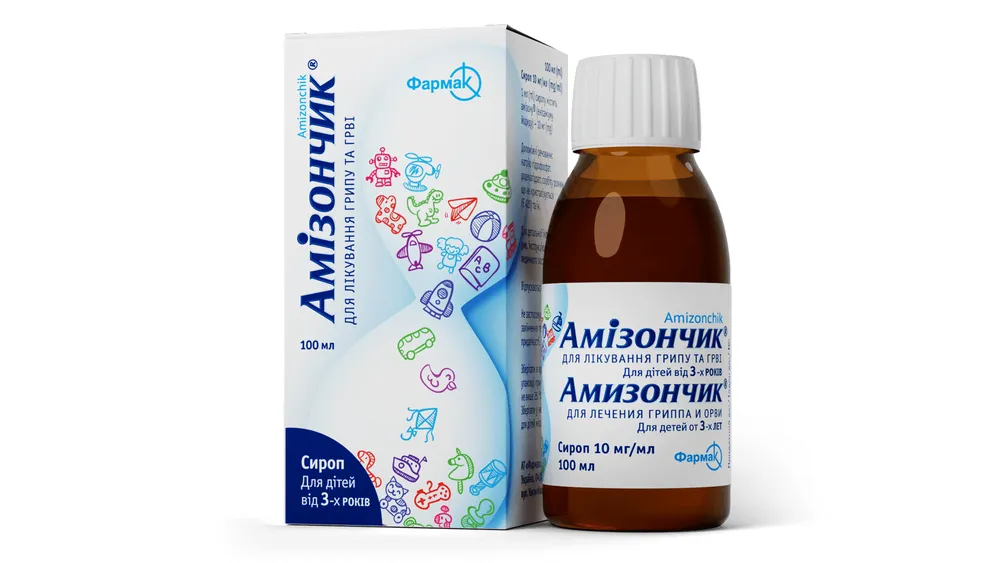
Table of Contents
INSTRUCTION FOR MEDICAL USE OF THE MEDICINAL PRODUCT AMIZONСHIK® (AMIZONСHIK)
Composition:
Active substance: amizon® (enizamium iodide);
1 ml of syrup contains amizon® (enizamium iodide) 10 mg;
Excipients: sodium hydrogen phosphate, dodecahydrate; citric acid, monohydrate; flavoring agent "Tutti-Frutti"; flavoring agent "Peach"; purified water; sorbitol solution, non-crystallizing (E 420).
Pharmaceutical form. Syrup.
Main physicochemical properties: clear, slightly yellowish-green liquid with a specific odor.
Pharmacotherapeutic group. Antiviral agents for systemic use. Direct-acting antiviral agents.
ATC code J05A X17.
Pharmacological Properties
Mode of Action
The antiviral activity of enisamium is associated with inhibition of influenza virus RNA polymerase. Enisamium iodide effectively inhibited SARS-CoV-2 virus replication in vitro in Caco-2 cells.
Pharmacodynamics
Enisamium exhibits antiviral activity against various strains of influenza virus A (H1N1, H3N2, H5N1, H7N9), influenza virus B, respiratory syncytial virus, as well as alpha-coronavirus NL-63 and beta-coronavirus SARS-CoV-2 in vitro.
Enisamium iodide has demonstrated efficacy against strains of influenza virus A and B in in vitro studies using differentiated normal human bronchial epithelial cells (NHBE), human hepatocellular carcinoma cells (HepG2), human rhabdomyosarcoma cells (RD), and human colorectal adenocarcinoma cells (Caco-2). In ferrets, as a representative animal model for influenza research, enisamium iodide reduced the duration of influenza virus shedding in nasal washes compared to the placebo control group.
Pharmacokinetics
After oral administration, enisamium iodide rapidly enters the bloodstream, with maximum plasma concentration observed within 2–2.5 hours after intake. The elimination half-life is 13.5–14 hours. The drug is metabolized in the liver but rapidly cleared from tissues (tissue half-life is 2–3 hours). It is excreted from the body by 90–95% via urine in the form of metabolites.
Clinical characteristics.
Indications.
Treatment of influenza and acute respiratory viral infections (ARVI).
Contraindications.
Hypersensitivity to drugs containing iodide, molecular iodine, or covalently bound iodine, as well as to other components of the drug.
Interaction with other medicinal products and other forms of interaction.
Enisamium iodide may reduce thyroid gland uptake of radioactive iodine isotopes for up to 6 weeks.
Concomitant use of iodine-containing medicinal products, as well as contrast agents and medicinal products containing covalently bound iodine, should be avoided. Additionally, avoid large-area wound treatment with iodine-containing antiseptics (e.g., molecular iodine) due to the possible increased risk of thyroid dysfunction.
Special precautions for use
Administration of enisamium iodide leads to an increase in iodide levels in plasma. Secondary elevation of circulating iodide levels triggers the self-regulation mechanism of thyroid function, whereby the uptake of inorganic iodide by thyrocytes is suppressed, thus preventing excessive production of thyroid hormones. Transiently, this causes an increase in thyroid-stimulating hormone (TSH) levels (the Wolff–Chaikoff effect). This effect lasts for several days; after completion of the treatment course, thyroid function returns to normal. In individual cases, transient elevation of TSH levels has been observed for several weeks.
There is no available information regarding the effect of enisamium iodide in patients with pre-existing thyroid dysfunction or in patients who previously developed hypothyroidism. However, monitoring of thyroid function during treatment with enisamium iodide is advisable.
Other iodine-containing medications should not be used during treatment and for 7 days after discontinuation of enisamium iodide therapy.
Greater efficacy of enisamium was observed when treatment was initiated early.
Sorbitol. The syrup contains sorbitol; therefore, patients with sugar intolerances should consult their physician before taking this medicinal product.
The maximum single dose of 12 mL contains 11.16 g of sorbitol. This may exert a mild laxative effect. The energy value of 1 g of sorbitol is 2.6 kcal.
Sodium. The maximum single dose of 12 mL contains 1.56 mmol (or 34.8 mg) of sodium. Caution is advised when administering to patients on a sodium-restricted diet.
Use during pregnancy or breastfeeding.
The use of this medicinal product is contraindicated during pregnancy, as clinical studies of enisamium iodide have not included pregnant women. Animal studies have not revealed any direct or indirect effects on reproductive function or fertility.
Breastfeeding
It is unknown whether enisamium iodide or its metabolites are excreted in human breast milk. The risk of enisamium iodide exposure to the newborn/infant cannot be excluded.
Ability to affect reaction speed when driving vehicles or operating machinery.
This medicinal product is not intended for use in this patient population.
Method of administration and dosage.
The drug is recommended for the treatment of children aged 3 years and older. The syrup should be taken orally, preferably after meals, with a small amount of water.
Children aged 3 to 4 years – 5 ml (50 mg) three times daily.
Children aged 4 to 5 years – 6 ml (60 mg) three times daily.
Children aged 5 to 6 years – 7 ml (70 mg) three times daily.
Children aged 6 to 12 years – the drug should be administered in tablet form. If a child cannot swallow tablets, administer 12 ml (120 mg) 2–3 times daily.
Do not exceed the recommended dosage.
An oral dosing spoon with a capacity of 5 ml and 1 ml graduations is provided for measuring the syrup. If a dose greater than 5 ml is required, measure the first 5 ml of syrup, then the remaining amount.
The duration of treatment is 5–7 days, depending on the severity of the disease and the therapeutic response.
Children.
The drug is indicated for the treatment of children aged 3 years and older (see section "Method of administration and dosage").
Overdose.
No cases of overdose with enisamium iodide have been reported in clinical trials or during post-marketing use.
There is no specific antidote.
Adverse reactions
The most commonly reported adverse reactions (ARs) were taste disturbances, folliculitis, nasopharyngitis, headache, and lymphadenopathy (in phase I placebo-controlled studies). Most of these ARs were reported as single events and resolved spontaneously. In the majority of patients, the aforementioned ARs did not lead to discontinuation of enisamium iodide.
In a phase III placebo-controlled study involving adult patients, mild gastrointestinal disorders were observed (bitter taste in mouth), as well as pyrosis and burning sensation in the throat.
Only adverse events occurring more frequently in the enisamium iodide group compared to the placebo group and reported in more than two individuals were considered.
Table 1 lists adverse reactions observed during clinical studies and post-marketing use of the drug. Frequency is defined as follows: very common (≥ 1/10), common (≥ 1/100, < 1/10), uncommon (≥ 1/1000, < 1/100), and frequency not known (cannot be estimated from available data).
Table 1
| System organ class |
Very common |
Common |
Uncommon |
Frequency unknown* |
| Investigations |
Elevated blood thyroid stimulating hormone levels |
Increased blood pressure |
||
| General disorders |
Fatigue |
|||
| Infections and infestations |
Folliculitis |
|||
| Respiratory, thoracic and mediastinal disorders |
Dyspnoea |
|||
| Blood and lymphatic system disorders |
Lymphadenopathy |
|||
| Nervous system disorders |
Headache |
Dizziness |
||
| Eye disorders |
Periorbital oedema |
|||
| Musculoskeletal and connective tissue disorders |
Arthralgia |
|||
| Skin and subcutaneous tissue disorders |
Erythema |
|||
| Gastrointestinal disorders |
Diarrhoea |
Abdominal pain |
* Reports from the post-marketing period.
Reporting suspected adverse reactions
Reporting adverse reactions after marketing authorization of a medicinal product is of great importance. It allows continuous monitoring of the benefit-risk balance of the medicinal product. Medical and pharmaceutical professionals, as well as patients or their legal representatives, should report all suspected adverse reactions and lack of efficacy of the medicinal product via the Automated Pharmacovigilance Information System at: https://aisf.dec.gov.ua.
Shelf life. 4 years.
Storage period after opening the vial – 90 days.
Do not use the medicinal product after the expiry date stated on the packaging.
Storage conditions. Store in the original packaging at a temperature not exceeding 25 °C.
Keep out of reach of children.
Packaging. 100 ml in a vial. 1 vial and 1 dosing spoon in a carton.
Availability. Over-the-counter.
Manufacturer. JSC "Farmak".
Manufacturer's address and place of business.
74, Kyrylivska Street, Kyiv, 04080, Ukraine.