Aminoplasmal b.braun 10 % e
Ukraine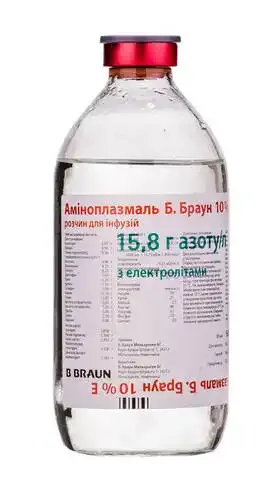
Table of Contents
INSTRUCTIONS FOR MEDICAL USE OF THE MEDICINAL PRODUCT AMINOPROPLASMALE B. BRAUN 10% E (AMINOPLASMAL® B. BRAUN 10% E)
Composition:
Active substances: 1000 ml of solution contains:
| Isoleucine |
5.00 g |
| Leucine |
8.90 g |
| Lysine hydrochloride (equivalent to lysine |
8.56 g 6.85 g |
| Methionine |
4.40 g |
| Phenylalanine |
4.70 g |
| Threonine |
4.20 g |
| Tryptophan |
1.60 g |
| Valine |
6.20 g |
| Arginine |
11.50 g |
| Histidine |
3.00 g |
| Alanine |
10.50 g |
| Glycine |
12.00 g |
| Aspartic acid |
5.60 g |
| Glutamic acid |
7.20 g |
| Proline |
5.50 g |
| Serine |
2.30 g |
| Tyrosine |
0.40 g |
| Sodium acetate, trihydrate |
2.858 g |
| Sodium hydroxide |
0.360 g |
| Potassium acetate |
2.453 g |
| Magnesium chloride, hexahydrate |
0.508 g |
| Disodium phosphate, dodecahydrate |
3.581 g |
| Electrolyte concentrations: |
mmol/l |
| Sodium |
50 |
| Potassium |
25 |
| Magnesium |
2.5 |
| Acetates |
46 |
| Chlorides |
52 |
| Phosphates |
10 |
| Citrate |
2.0 |
Excipients: acetylcysteine; citric acid, monohydrate; water for injections; nitrogen.
Dosage form. Infusion solution.
Main physico-chemical properties: clear solution, colorless to pale yellow, practically free from particles.
| Total amino acid content |
100 g/l |
| Total nitrogen content |
15.8 g/l |
| Energy value |
1000 ml ≈ 1675 kJ ≈ 400 kcal |
| Theoretical osmolarity |
1021 mOsm/l |
| Titratable acidity (at pH 7.4) |
approximately 26 mmol/l |
| pH |
5.7-6.3 |
Pharmacotherapeutic group. Solution for parenteral nutrition. Amino acids.
ATC code B05B A01.
Pharmacological Properties.
Pharmacodynamics. Aminoplasmal B. Braun 10% E is a solution designed to supply the body with amino acids and electrolytes within the framework of parenteral nutrition.
The purpose of parenteral nutrition is to provide the body with all the nutrients necessary for growth, maintenance, and tissue regeneration.
Amino acids are of particular importance, as they are essential structural components for protein synthesis. After intravenous administration, amino acids mix with the body's endogenous amino acids. Exogenous and endogenous amino acids serve as structural elements for the synthesis of functional and structural proteins.
To prevent improper utilization of amino acids and to simultaneously support energy-requiring processes, additional administration of energy sources (carbohydrates/fats) is required.
Pharmacokinetics. Since the components of Aminoplasmal B. Braun 10% E are administered intravenously, their bioavailability is 100%.
The composition of Aminoplasmal B. Braun 10% E is based on clinical studies of the properties of intravenously administered amino acids. The solution is formulated so that during infusion, a balanced increase in the concentration of all amino acids occurs in human plasma. Thus, the natural ratio of plasma amino acids to each other—the so-called amino acid homeostasis—is maintained even during infusion of Aminoplasmal B. Braun 10% E.
Amino acids not used for protein synthesis are metabolized in the body as follows. Through transamination, the amino group is separated from the carbon skeleton. The carbon skeleton is either immediately oxidized to CO₂ or used by the liver as a substrate for gluconeogenesis. The amino group is also metabolized in the liver into urea.
Clinical characteristics.
Indications.
The solution is used for administration of amino acids for protein synthesis in parenteral nutrition when oral or enteral nutrition is impossible, insufficient, or contraindicated.
During parenteral nutrition, administration of amino acid solutions must always be accompanied by adequate supply of energy substrates, for example in the form of carbohydrates.
Contraindications.
Contraindications related to the solution or parenteral nutrition:
- hypersensitivity to any component of the medicinal product;
- congenital disorders of amino acid metabolism;
- severe circulatory disorders with life-threatening risk (e.g., shock);
- hypoxia;
- inadequate cellular oxygen supply; metabolic acidosis; severe hepatic insufficiency;
- severe renal insufficiency without access to hemofiltration and hemodialysis;
- pathologically elevated plasma level of any of the electrolytes contained in the product.
This medicinal product should not be used in the treatment of neonates, infants, and children under 2 years of age, as the composition of nutrients does not fully meet the specific requirements for pediatric use.
Contraindications related to infusion therapy in general:
- decompensated heart failure;
- acute pulmonary edema;
- disturbances of fluid and electrolyte balance.
Interaction with other medicinal products and other forms of interaction.
Interactions with other medicinal products have not been studied.
Special precautions for use
In patients with renal impairment, dosage must be carefully adjusted according to individual patient requirements, severity of renal insufficiency, and the type of renal replacement therapy employed (e.g., hemodialysis, hemofiltration).
In patients with hepatic impairment, dosage should be individually adjusted based on individual patient needs and severity of liver dysfunction.
The drug should be used with caution in patients with increased plasma osmolarity.
Water balance and serum electrolyte levels should be monitored.
Administration of large volumes of infusion solutions in patients with cardiac insufficiency should be performed under close monitoring of the patient's condition.
Prior to initiating parenteral nutrition, any existing electrolyte or fluid imbalances should be appropriately corrected (e.g., hypotonic dehydration, hyponatremia, hyperkalemia).
In cases of amino acid metabolism disorders of non-inherited origin, the solution should be administered only after careful assessment of the benefit-risk ratio.
Plasma electrolytes, blood glucose, fluid and acid-base balance, and renal function (blood urea nitrogen, creatinine) should be monitored regularly.
Monitoring should also include plasma protein levels and liver function tests.
The infusion site should be examined daily to detect early signs of inflammation or infection.
Aminoplasmal B. Braun 10% E, as a component of parenteral nutrition, should be administered in combination with adequate amounts of non-protein energy substrates, essential fatty acids, electrolytes, vitamins, fluids, and trace elements.
Use during pregnancy or breastfeeding
Pregnancy
Studies on the use of the drug in pregnant women have not been conducted. Therefore, during pregnancy, the drug should be used with caution and only after careful assessment of the benefit-risk ratio.
Breastfeeding period
Amino acids/metabolites are excreted in breast milk; however, when Aminoplasmal B. Braun 10% E is used at therapeutic doses, no effect on neonates/infants who are breastfed is expected.
However, breastfeeding is not recommended in women receiving parenteral nutrition.
Ability to affect the speed of reactions when driving or operating machinery
Not applicable.
Method of Administration and Dosage
The product should be administered using a sterile infusion system immediately after opening the container.
The dose of the product is calculated according to the individual patient's requirements for carbohydrates, amino acids, and fluid, depending on the clinical status (nutritional status and/or degree of nitrogen catabolism due to the underlying disease).
Adults and adolescents aged 14–17 years
Daily dose:
10–20 mL/kg body weight, corresponding to 1.0–2.0 g amino acids/kg body weight and equivalent to
700–1400 mL of solution for a patient weighing 70 kg.
Maximum daily dose:
20 mL/kg body weight, corresponding to 2.0 g amino acids/kg body weight (140 g amino acids for a patient weighing 70 kg) and equivalent to 1400 mL for a patient weighing 70 kg.
Maximum infusion rate or drip rate, respectively:
1.0 mL/kg body weight/hour, corresponding to 0.1 g amino acids/kg body weight/hour, equivalent to 70 mL/hour for a patient weighing 70 kg (1.17 mL/min for a patient weighing 70 kg).
Children
Dosage data for children are approximate average values. Dosage should be individually adjusted according to the child's age, stage of development, and underlying disease.
Daily dose for children by age:
2 to 4 years of age: 15 mL/kg body weight, corresponding to 1.5 g amino acids/kg body weight;
5 to 13 years of age: 10 mL/kg body weight, corresponding to 1.0 g amino acids/kg body weight.
Maximum infusion rate:
1 mL/kg body weight/hour, corresponding to 0.1 g amino acids/kg body weight/hour.
Patients with renal or hepatic impairment
In patients with renal or hepatic impairment, doses should be individually adjusted
(see section "Special Warnings and Precautions for Use"). Aminoplasmal B. Braun 10% E is contraindicated in severe hepatic insufficiency and in renal insufficiency without replacement renal therapy (see section "Contraindications").
Method and duration of administration:
For infusion into a central vein (via central venous catheter).
The product may be administered as long as there are indications for parenteral nutrition.
The product is a structural component for protein synthesis. For complete parenteral nutrition, concomitant administration of energy-providing nutrients, essential fatty acids, vitamins, and trace elements is required.
Children
The product is indicated for use in children aged 2 years and older.
Overdose
Symptoms of fluid and electrolyte overdose
Overdose or excessively rapid infusion may lead to hyperhydration, electrolyte imbalance, and pulmonary edema.
Symptoms of amino acid overdose
In cases of overdose, e.g., due to too rapid infusion, intolerance reactions may occur, which may manifest as nausea, chills, vomiting, headache, metabolic acidosis, hyperammonemia, and excretion of unmetabolized amino acids in urine.
Treatment
In such cases, the infusion should be discontinued and resumed after some time at a slower rate.
Adverse reactions.
Adverse effects occur relatively infrequently when using this medicinal product; they are usually mild in intensity and reversible.
Adverse effects may occur which are related both to this specific solution and to parenteral nutrition in general, especially at the beginning of infusion therapy.
Uncommon (≥ 1/1000 to < 1/100):
Gastrointestinal disorders: nausea, vomiting;
Cardiovascular disorders: tachycardia, dyspnea, increased or decreased arterial pressure;
General disorders: headache, fever, tremor, allergic reactions.
Shelf life. 3 years.
Storage conditions.
Store in a place protected from light and inaccessible to children, at a temperature not exceeding 25 °C. Do not freeze.
The medicinal product is intended for single use only. Any unused portion of the solution must not be stored. Do not use the medicinal product if the solution is not clear, if there are signs of damage on the vial, or if the seal is compromised.
Incompatibilities.
Special attention should be paid to compatibility. The medicinal product must not be administered with other medicinal products unless their compatibility has been previously established.
It is not recommended to add any other medicinal products to Aminoplasmal® B. Braun 10% E solution. Such products should instead be added to standard carbohydrate and electrolyte solutions.
If it is necessary to add other nutritional components (such as carbohydrates, fats, vitamins, trace elements) to the parenteral nutrition regimen, mixing must be performed under strict aseptic conditions. After adding any component, the solution should be thoroughly mixed.
Packaging. 500 ml of solution in a vial; 10 vials per cardboard box.
Prescription category.
Prescription only.
Manufacturer.
B. Braun Melsungen AG.
Manufacturer's address and location of operations.
Carl-Braun-Strasse 1, 34212 Melsungen, Germany.