Amantin
Ukraine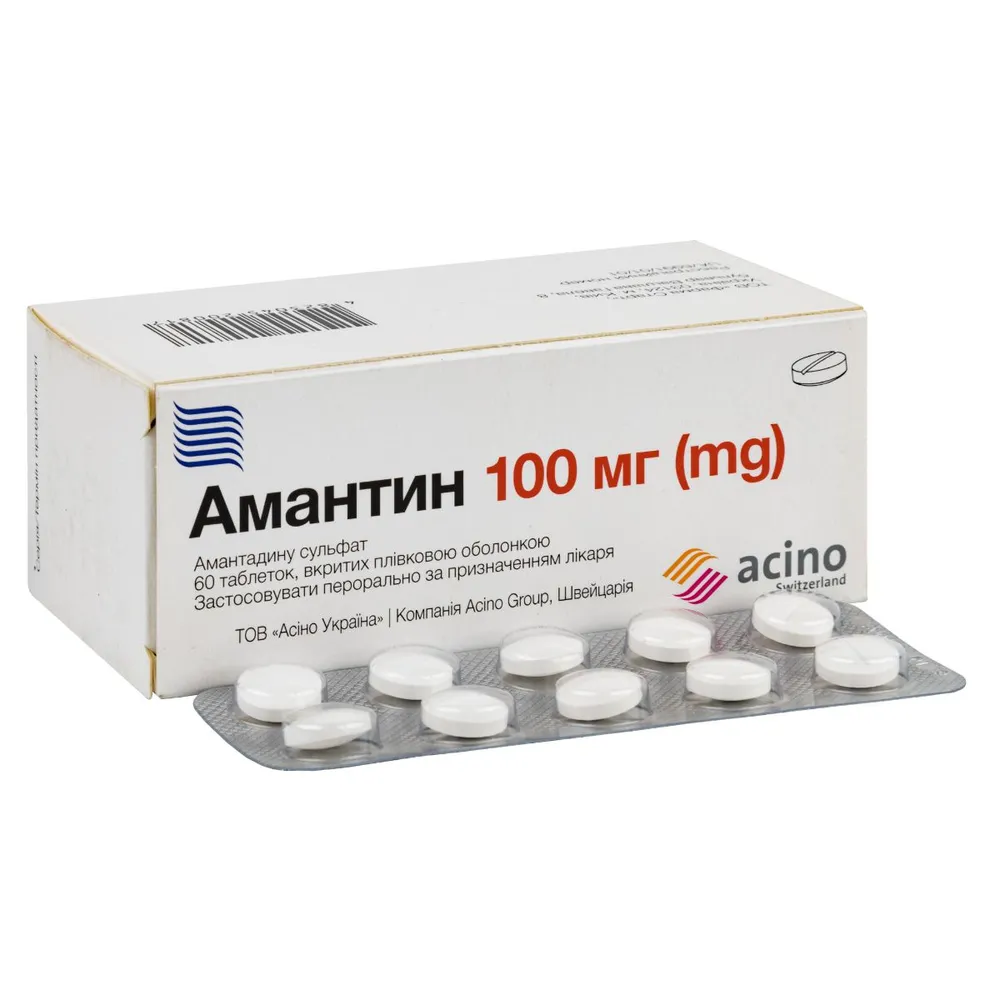
Table of Contents
INSTRUCTIONS FOR MEDICAL USE OF THE MEDICINAL PRODUCT amantin (amanTin)
Composition:
Active substance: amantadine sulfate;
1 tablet contains amantadine sulfate 100 mg;
Excipients: lactose monohydrate, microcrystalline cellulose, potato starch, gelatin, povidone, sodium croscarmellose, talc, colloidal anhydrous silicon dioxide, magnesium stearate, Opadry II White (polyethylene glycol, polyvinyl alcohol, talc, titanium dioxide (E 171)).
Pharmaceutical form. Film-coated tablets.
Main physicochemical properties: white, round, biconvex tablets with a score line, coated with a film coating.
Pharmacotherapeutic group.
Antiparkinsonian agents. Dopaminergic agents. ATC code N04BB01.
Pharmacological Properties.
Pharmacodynamics.
Amantadine has various pharmacological properties. It exerts an indirect agonist effect on striatal dopamine receptors. Animal studies have shown that amantadine increases extracellular dopamine concentration both by enhancing dopamine release and by blocking its reuptake in presynaptic nerve cells. At therapeutic concentrations, amantadine inhibits NMDA receptor-mediated acetylcholine release and thereby may exert an anticholinergic effect. Amantadine acts synergistically with L-dopa.
Pharmacokinetics.
After oral administration, amantadine is rapidly and completely absorbed from the gastrointestinal tract. Maximum plasma concentration (Cmax) is reached approximately 2–8 hours after a single dose. Amantadine hydrochloride, being more soluble, achieves higher plasma concentrations compared to the less soluble amantadine sulfate, in which peak plasma concentration (Cmax) occurs later than with the hydrochloride form. A Cmax of 0.5 μg/mL is achieved after a single oral dose of 250 mg amantadine hydrochloride.
When administered at a dose of 200 mg/day, steady-state plasma concentration is reached within 4–7 days, with plasma levels ranging from 400 to 900 ng/mL. After administration of 100 mg amantadine sulfate, Cmax reaches 0.15 μg/mL. Plasma clearance has been determined to be identical to renal clearance and averages 17.7±10 L/hour in healthy adult volunteers. The apparent volume of distribution is 4.2±1.9 L/kg and depends on patient age; in adults, it is 6 L/kg.
The elimination half-life ranges from 10 to 30 hours (average 15 hours) and depends significantly on patient age. In elderly male patients (62–72 years), the elimination half-life is about 30 hours. In patients with renal impairment, the terminal plasma half-life may be considerably prolonged (up to 68±10 hours).
Amantadine is approximately 67% bound to plasma proteins (in vitro), with about 33% remaining unbound in plasma. It penetrates the blood-brain barrier via saturable transport systems. It is excreted in urine almost unchanged (90% of the administered dose), with a small amount eliminated in feces.
Amantadine has low dialyzability, with approximately 5% removed per dialysis session.
Amantadine is not metabolized in the human body.
Clinical characteristics.
Indications.
Parkinson's syndrome: treatment of symptoms of Parkinson's disease such as rigidity, tremor, hypokinesia, and akinesia.
Extrapyramidal side effects of neuroleptics and other medicinal agents: early dyskinesia, akathisia, and parkinsonism.
Contraindications.
- Hypersensitivity to amantadine or to any component of the medicinal product;
- epilepsy and other seizure disorders;
- severe renal insufficiency;
- peptic ulcer disease;
- decompensated heart failure (NYHA class IV);
- cardiomyopathy and myocarditis;
- second- or third-degree atrioventricular block;
- bradycardia (less than 55 beats/min);
- prolonged QT interval (Bazett QTc > 420 ms) or with prominent U-waves, or congenital QT syndrome in family history;
- severe ventricular arrhythmia, including chaotic polymorphic ventricular tachycardia;
- concomitant treatment with budipine or other medicinal products that prolong the QT interval (see section "Interaction with other medicinal products and other forms of interaction");
- reduced blood levels of potassium or magnesium.
Special precautions.
Patients who are concurrently taking neuroleptics and amantadine are at risk of developing neuroleptic malignant syndrome if amantadine is abruptly discontinued.
Toxicity may occur in patients with renal impairment.
Extreme caution is required when prescribing the medicinal product to patients with organic brain syndrome or those prone to seizures, as seizures may occur or pre-existing symptoms may be exacerbated (see sections "Dosage and administration" and "Side effects").
Patients with cardiovascular disorders require medical supervision during treatment with amantadine.
In patients with Parkinson's disease, symptoms such as arterial hypotension, increased salivation, increased sweating, elevated body temperature, heat retention, edema, and depression are frequently observed. Special attention should be paid to side effects and interactions of amantadine with other medicinal products when treating such patients.
An ophthalmological examination is required if symptoms of visual acuity loss or blurred vision occur, in order to exclude possible corneal edema. If corneal edema is diagnosed, amantadine should be discontinued. Corneal edema caused by amantadine usually resolves within one month after discontinuation of treatment.
Patients should inform their physician if they experience difficulties with urination.
Interaction with other medicinal products and other forms of interaction.
Before starting concomitant use of other medicinal products with amantadine, carefully read the instructions for medical use regarding possible interactions of these products with amantadine, which may lead to QT interval prolongation. Amantadine may be combined with other antiparkinsonian agents. To avoid adverse effects (such as psychotic reactions), the dose of other agents or their combinations should be reduced.
It is known that specific interaction studies after concomitant administration of amantadine and other antiparkinsonian agents (such as levodopa, bromocriptine, memantine, trihexyphenidyl, etc.) have not been conducted (pay attention to side effects).
Concomitant administration of amantadine and any of the following types of medicinal products or active ingredients may lead to the following interactions.
Anticholinergic agents. Enhanced side effects (confusion and hallucinations) of anticholinergic agents (such as trihexyphenidyl, benztropine, scopolamine, biperiden, orphenadrine, etc.).
Central nervous system (CNS) direct-acting sympathomimetics. Enhanced primary effect of amantadine.
Alcohol. Reduced alcohol tolerance.
Levodopa (antiparkinsonian agent). Mutual enhancement of therapeutic effect. Therefore, levodopa may be prescribed concomitantly with amantadine.
Other antiparkinsonian agents. Memantine may enhance the action and side effects of amantadine (see section "Special precautions"), therefore concomitant use with memantine should be avoided.
Other medicinal products. Concomitant use of diuretics such as triamterene/hydrochlorothiazide may reduce amantadine plasma clearance, leading to toxic plasma concentrations. Therefore, concomitant use of this combination should be avoided.
Concomitant use of amantadine and medicinal products that prolong the QT interval is contraindicated. These include:
- certain class IA antiarrhythmics (e.g., quinidine, disopyramide, procainamide) and class III antiarrhythmics (e.g., amiodarone, sotalol);
- certain neuroleptics (e.g., thioridazine, chlorpromazine, haloperidol, pimozide);
- certain tricyclic and tetracyclic antidepressants (e.g., amitriptyline);
- certain antihistamines (e.g., astemizole, terfenadine);
- certain macrolide antibiotics (e.g., erythromycin, clarithromycin);
- certain gyrase inhibitors (e.g., sparfloxacin);
- azole antifungals and other agents such as budipine, halofantrine, cotrimoxazole, pentamidine, cisapride, and bepridil.
Special precautions for use
Particular caution is required when administering the drug to patients with:
- psychoses;
- hepatic dysfunction;
- thyrotoxicosis;
- recurrent eczema;
- prostatic hypertrophy;
- narrow-angle glaucoma;
- renal impairment (of varying severity); there is a risk of amantadine accumulation due to impaired renal filtration (see also section "Method of administration and dosage");
- agitation or confusion;
- history of delirium syndrome or exogenous psychosis;
- concomitant treatment with memantine (see section "Interaction with other medicinal products and other forms of interaction");
- concomitant use with medicinal products affecting the central nervous system (CNS) (see section "Interaction with other medicinal products and other forms of interaction").
An ECG (50 mm/s) with manual determination of Bazett-corrected QT interval (QTc) should be performed before initiating treatment, and again at 1 and 3 weeks after starting treatment. Such ECG monitoring should also be performed before any subsequent dose increase and 2 weeks after the increase. Thereafter, ECG should be performed at least once a year. Treatment must not be initiated or should be discontinued if the baseline QTc exceeds 420 ms, if QT prolongation exceeds 60 ms during treatment, if QTc exceeds 480 ms, or if prominent U-waves are visible on ECG.
Patients at risk of electrolyte imbalance—such as those receiving diuretic therapy, those with frequent vomiting and/or diarrhea, patients receiving insulin in crisis situations, or patients with renal or anorexia-related disorders—should undergo regular monitoring and laboratory assessment, with appropriate electrolyte supplementation, particularly potassium and magnesium.
If symptoms such as rapid heartbeat, dizziness, or fainting occur, amantadine treatment must be discontinued immediately and the patient should be observed for 24 hours for QT interval prolongation. If QT prolongation is not present, treatment may be resumed, taking into account contraindications and drug interactions.
In patients with cardiac pacemakers, accurate determination of QT interval is not feasible; therefore, the decision to use amantadine should be made individually after consultation with a cardiologist.
Additional use of amantadine for prevention and treatment of influenza A virus infection is not recommended due to the risk of overdose.
Amantadine treatment must not be stopped abruptly, as this may lead to worsening of Parkinson’s disease, emergence of symptoms characteristic of neuroleptic malignant syndrome, and development of cognitive disorders such as catatonia, confusion, disorientation, deterioration of mental status, delirium.
Abrupt discontinuation of amantadine should be avoided in patients concurrently receiving neuroleptics due to the potential risk of neuroleptic-induced catatonia.
Suicidal ideation and suicide attempts have been reported in patients receiving amantadine. Patients should be monitored for signs of suicidal thoughts and behavior, and appropriate treatment should be initiated if necessary.
Patients (and caregivers) should be advised that if signs of suicidal thoughts or behavior occur, immediate medical help should be sought.
To prevent the emergence of suicidal thoughts and intentions, the drug should be prescribed at the lowest effective doses.
Peripheral edema may occur in some patients during long-term treatment. This should be taken into account in patients with chronic heart failure.
The drug is contraindicated in patients with closed-angle glaucoma.
The product contains lactose; therefore, amantadine should not be administered to patients with rare hereditary conditions of galactose intolerance, lactase deficiency, or glucose-galactose malabsorption syndrome.
Use during pregnancy or breastfeeding
Amantadine is contraindicated in pregnant women and in women planning pregnancy. The drug is contraindicated during breastfeeding, as it passes into breast milk. If treatment with amantadine is necessary, breastfeeding should be discontinued.
Ability to affect reaction speed when driving or operating machinery
Amantadine may reduce attention concentration and reaction speed and may cause dizziness and decreased visual acuity. Patients should therefore be warned about the potential danger when driving vehicles or operating machinery.
Dosage and Administration
The tablets should be taken orally by adults with a small amount of liquid, after meals, preferably in the morning and/or during the day. Due to the possible stimulating effect on the central nervous system (CNS), the last dose of the drug should be taken no later than 4:00 PM.
Single and daily dose
By adhering to the aforementioned precautions and taking into account the contraindications, it is possible to prevent a life-threatening adverse reaction—chaotic polymorphic ventricular tachycardia.
Treatment of patients with Parkinson's syndrome and movement disorders caused by drug use should be conducted gradually, adjusting the dosage according to the therapeutic response.
Treatment should be initiated with a daily dose of 1 tablet (100 mg of amantadine sulfate) of the drug Amantin for the first 4–7 days, followed by a weekly increase of the daily dose by 1 tablet until the effective therapeutic dose is reached.
The usual effective dose is 1–3 tablets twice daily (200–600 mg of amantadine sulfate).
For elderly patients, particularly those with agitation, confusion, or delirium syndromes, a daily dose of 100 mg (1 tablet) is recommended. If this dose is not effective, it may be cautiously increased to 200 mg daily under medical supervision.
When used in combination therapy with other anti-Parkinson agents, the dosage should be individually adjusted.
For patients previously treated with amantadine, solution for injection, the initial dose should be higher.
In cases of sudden worsening of Parkinsonian symptoms during akinetic crisis, administration of amantadine sulfate solution should be prescribed.
Patients with renal impairment
Dosages for patients with renal impairment should be adjusted according to glomerular filtration rate (GFR), as shown in the table:
| CrCl (mL/min) |
Amantadine sulfate dose (mg) |
Dosing interval for amantadine sulfate |
| 80 – 60 |
100 |
Every 12 hours |
| 60 – 50 |
200 and 100* |
Every other day* |
| 50 – 30 |
100 |
Once daily |
| 30 – 20 |
200 |
Twice weekly |
| 20 – 10 |
100 |
Three times weekly |
| < 10 and patients undergoing hemodialysis |
200 and 100 |
Once weekly or once every 2 weeks |
* Achieved by taking alternately 1 tablet and 2 tablets of 100 mg amantadine sulfate once each.
Glomerular filtration rate (GFR) can be approximately calculated using the following equation:
cr
where,
Clcr – creatinine clearance in mL/min;
creatinine – serum creatinine in mg/100 mL.
The creatinine clearance calculated according to this formula applies exclusively to men (the corresponding value for women is 85% of this value) and can be equated to insulin clearance for determining GFR (120 mL/min for adults).
Amantadine is poorly dialyzed (approximately 5%).
Duration of treatment depends on the nature and severity of the disease and is determined by the physician. Patients should not discontinue treatment on their own.
Abrupt discontinuation of the drug should be avoided, as in patients with Parkinson's disease it may lead to exacerbation of extrapyramidal symptoms, which sometimes include akinetic crisis, and withdrawal effects may occasionally manifest as delirium.
Children.
Experience with the use of amantadine in children is insufficient; therefore, the drug is not used in this age group.
Overdose.
Multiple intoxications should always be considered possible, for example, ingestion of more than one drug for suicide purposes.
Symptoms. Prominent features in amantadine overdose are symptoms of acute toxic psychosis, including confusion with visual hallucinations, which sometimes include coma and myoclonus and may occur after concomitant intake of amantadine and other antiparkinsonian drugs. Excessive excitation, tremor, ataxia, blurred vision, lethargy, depression, dysarthria, neuromuscular disturbances, hyperreflexia, motor restlessness, seizures, extrapyramidal symptoms, torsional spasms, pupil dilation, dysphagia, confusion, disorientation, delirium, myoclonus, nausea, vomiting, dry mouth, hyperventilation, pulmonary edema, respiratory failure, respiratory distress syndrome, hypertension, cardiac arrhythmia, tachycardia, angina attack, cardiac arrest.
Renal function impairment may occur, including increased blood urea nitrogen and decreased creatinine clearance, urinary retention.
Treatment. There is no specific antidote or medication for amantadine overdose. To prevent absorption of the drug, induce vomiting and/or gastric lavage (if the patient is conscious), and administer activated charcoal. In cases of life-threatening intoxication, resuscitation measures are required. Supportive therapy should be initiated to maintain vital functions, ensure adequate hydration, and possibly provide sedation, anticonvulsant and antiarrhythmic treatment. For treatment of the neurotoxic symptoms described above, intravenous administration of physostigmine may be used at a dose of 1–2 mg every 2 hours in adults and 2 × 0.5 mg at 5–10 minute intervals up to a maximum dose of 2 mg in children.
Careful monitoring is recommended for patients at risk of QT interval prolongation and development of chaotic polymorphic ventricular tachycardia, such as those with electrolyte imbalances (particularly hypokalemia and hypomagnesemia) or bradycardia. Due to the low dialyzability of amantadine (approximately 5%), hemodialysis is not recommended.
Side effects
Side effects associated with amantadine are usually mild and transient in nature. They typically appear within 2–4 days after initiation of treatment and resolve rapidly upon discontinuation of the drug.
The frequency of adverse reactions is defined according to the following categories:
very common (> 1/10); common (> 1/100 to < 1/10); uncommon (> 1/1000 to < 1/100); rare (> 1/10,000 to < 1/1000); very rare (< 1/10,000); frequency not known (cannot be estimated from available data).
Psychiatric disorders:
common – sleep disturbances and psychic agitation.
In patients (especially elderly) predisposed to psychiatric disorders, paranoid exogenous psychoses accompanied by visual hallucinations may occur when amantadine is used concomitantly with anticholinergic agents. Such adverse reactions may occur more frequently when Amantin is administered in combination with other antiparkinsonian agents (such as levodopa, bromocriptine, or memantine).
Blood and lymphatic system disorders:
very rare – thrombocytopenia, leukopenia.
Nervous system disorders:
common – motor disturbances;
uncommon – dizziness, orthostatic disturbances;
rare – blurred vision;
very rare – epileptic seizures, usually after treatment with doses exceeding the recommended ones, myoclonus symptoms and peripheral neuropathies, anxiety, headache, somnolence, insomnia, weakness, fever, ataxia, dysarthria, impaired concentration, irritability, depression, paresthesia, confusion, disorientation, tremor, dyskinesia, stupor, suicidal thoughts and ideation, neuroleptic malignant syndrome, delirium, hypomanic or manic state, hallucinations, nightmares.
Eye disorders:
rare – blurred vision*;
very rare – transient loss of vision*, increased light sensitivity, corneal lesions (punctate subepithelial opacities possibly associated with superficial punctate keratitis), corneal epithelial edema, decreased visual acuity, oculogyric crises, mydriasis;
frequency not known – corneal edema, which resolves after discontinuation of treatment.
Cardiac disorders:
very rare – cardiac arrhythmia (ventricular tachycardia, ventricular fibrillation, chaotic polymorphic ventricular tachycardia, and QT interval prolongation), orthostatic hypotension, tachycardia, peripheral edema, heart failure. Most of these cases were associated with overdose, concomitant use of certain medications, or other risk factors (see sections "Contraindications" and "Interaction with other medicinal products and other forms of interaction"). Cardiac arrhythmia with tachycardia.
Vascular disorders:
common – orthostatic dysregulation.
Gastrointestinal disorders:
common – nausea, dry mouth sensation;
uncommon – anorexia, vomiting, constipation, diarrhea, reversible increase in liver enzyme activity.
Skin and subcutaneous tissue disorders:
common – livedo reticularis (appearance of a mottled bluish skin discoloration), sometimes associated with ankle edema;
very rare – skin rashes, pruritus, increased sweating, photosensitivity, eczematous dermatitis.
Musculoskeletal and connective tissue disorders:
rhabdomyolysis may occur. Patients should be carefully monitored. If symptoms such as myalgia, weakness, elevated creatine kinase (creatine phosphokinase) levels, or increased myoglobin levels in blood and urine are observed, administration of this medicinal product should be discontinued and appropriate measures taken. Additionally, caution is advised due to the potential risk of acute renal failure secondary to rhabdomyolysis.
Renal and urinary disorders:
common – urinary retention in patients with benign prostatic hyperplasia, urinary incontinence, libido changes.
Other:
hypersensitivity reactions in patients intolerant to any component of the medicinal product.
*Ophthalmological examination is required as soon as symptoms of decreased visual acuity or blurred vision occur, in order to rule out possible corneal edema (see section "Special precautions").
Shelf life.
3 years.
Storage conditions.
Store in the original packaging, out of reach of children, at a temperature not exceeding 25 °C.
Packaging.
10 tablets per blister; 3 or 6 blisters per cardboard box.
Prescription status.
Prescription only.
Manufacturer.
LLC "Pharma Start".
Manufacturer's address and location of its business activity.
8 Vatslava Havela Boulevard, Kyiv, 03124, Ukraine.
In case of adverse effects or questions regarding the safety of this medicinal product, please contact the Pharmacovigilance Department of LLC "ASINO UKRAINA" at: 8 Vatslava Havela Boulevard, Kyiv, 03124, Tel/Fax: +38 044 281 2333.