Allokine-alpha
Ukraine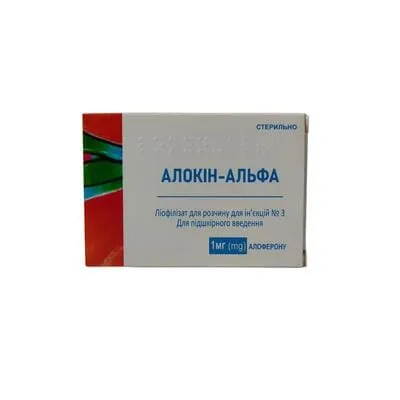
Table of Contents
INSTRUCTIONS FOR MEDICAL USE OF THE MEDICINAL PRODUCT ALOKIN-ALFA (ALLOKIN-ALFA)
Composition:
Active substance: alloferon;
1 ampoule or vial contains 1 mg of alloferon.
Pharmaceutical form.
Lyophilisate for solution for injection.
Main physico-chemical properties: white hygroscopic powder or porous mass, odorless.
Pharmacotherapeutic group.
Immunostimulants. ATC code L03A X.
Pharmacological properties.
Pharmacodynamics.
Alloferon is an oligopeptide. Alloferon is an effective inducer of endogenous alpha- and gamma-interferon synthesis and an activator of the natural killer cell system. The drug stimulates recognition and lysis of defective cells by cytotoxic lymphocytes. High efficacy of the drug has been demonstrated in experimental studies against infections caused by influenza viruses A and B, hepatitis B, herpes, and human papillomavirus. Alloferon does not cause general toxicity or allergic reactions, and has no mutagenic, carcinogenic, or embryotoxic effects; it does not affect reproductive function.
Pharmacokinetics.
After entering systemic circulation, Alloferon interacts with immunocompetent cells; subsequently, detection of Alloferon becomes difficult due to the significant structural similarity of its metabolites to serum proteins. An increase in interferon levels is observed 2 hours after administration and remains elevated (2–2.5 times higher than the normal baseline) for 6–8 hours, returning to baseline values by the end of 24 hours. Enhanced functional activity of natural killer cells persists for up to 7 days after drug administration.
Clinical characteristics.
Indications.
As part of combination therapy:
- Chronic recurrent herpes types I–II;
- Acute viral hepatitis B (mild to moderate severity);
- Chronic papillomavirus infection caused by oncogenic human papillomaviruses.
Contraindications.
Hypersensitivity to the drug. Autoimmune diseases.
Interaction with other medicinal products and other forms of interaction.
Incompatibility with other drugs is unlikely; however, concomitant administration with immunomodulators should be performed with caution. In the treatment of chronic recurrent genital herpes, the drug may be prescribed in combination with acyclovir and its derivatives (the drugs have different mechanisms of action and complement each other in the treatment of viral infection). In acute hepatitis B, the drug is administered against the background of standard basic therapy.
Special precautions for use.
Treatment is recommended to be initiated at the first signs of the disease; in case of hepatitis B, no later than day 7 from the onset of jaundice symptoms.
For acute hepatitis B, the drug should be administered as part of standard basic therapy.
In the treatment of chronic recurrent genital herpes, it may be prescribed in combination with antiviral agents.
As monotherapy, it is recommended for the treatment of papillomavirus infection caused by oncogenic virus types in the absence of clinical and subclinical lesions of the cervix and anogenital area.
As part of combination therapy, it is used for the treatment of clinical and subclinical forms of cervical and anogenital lesions caused by papillomavirus infection due to oncogenic virus types.
Use during pregnancy or breastfeeding.
The drug is contraindicated during pregnancy and breastfeeding.
Ability to influence reaction rate while driving or operating machinery.
During treatment, caution is required when driving or engaging in other potentially hazardous activities requiring increased attention and rapid psychomotor reactions, as dizziness may occur in some patients.
Method of Administration and Dosage
The drug should be administered subcutaneously. For the preparation of the injection solution, use 0.9% sodium chloride solution as the solvent. For subcutaneous administration, use 1 mL of solvent.
Herpes infection.
The standard treatment course for recurrent herpes infection includes subcutaneous injections of the drug at a dose of 1 mg every other day, for a total of 3 injections per course. If the response is inadequate and no pronounced adverse effects occur, in the case of the next recurrence it is recommended to administer injections at a dose of 1 mg every other day, for a total of 6–9 injections per course.
Hepatitis.
For the treatment of mild to moderate acute hepatitis B, after diagnosis confirmation, administer the drug at a dose of 1 mg three times a week for 3 weeks (a total of 9 injections).
Chronic papillomavirus infection caused by oncogenic human papillomaviruses.
The standard treatment course for infections caused by oncogenic types of human papillomavirus includes injections of the drug at a dose of 0.5 mg every other day, for a total of 6 injections per course.
Children.
The drug is contraindicated in children.
Overdose.
Cases of overdose are unknown.
Adverse Reactions.
Allergic reactions, including rashes; weakness, dizziness, formation of new rash elements (in herpes infection), local reactions at the site of administration.
In clinical studies, a case of influenza-like syndrome was reported during the use of the drug. Additionally, reactions following administration such as mild nausea and malaise were reported, which resolved spontaneously within 2–3 hours.
Shelf life. 2 years.
Do not use the drug after the expiry date stated on the packaging.
Storage conditions.
Store in the original packaging at a temperature not exceeding 8 °C. Do not freeze.
Keep out of reach and sight of children.
Packaging.
For manufacturer JSC “BIOFARMA”, Ukraine, Kyiv:
3 vials of lyophilisate in a blister pack. One blister pack per cardboard box with labeling in Ukrainian.
For manufacturer LLC “FZ BIOFARMA”, Ukraine, Kyiv region, Bila Tserkva:
3 vials of lyophilisate in a blister pack. One blister pack per cardboard box with labeling in Ukrainian;
3 bottles of lyophilisate in a blister pack. One blister pack per cardboard box with labeling in Ukrainian.
For manufacturer SE “ENZYM”, Ukraine, Vinnytsia region, city of Ladyzhyn:
3 bottles of lyophilisate in a blister pack. One blister pack per cardboard box with labeling in Ukrainian.
Prescription status.
By prescription only.
Manufacturers.
JSC “BIOFARMA” or
LLC FZ “BIOFARMA”
or
SE “ENZYM”
Manufacturers’ addresses and locations of their business activities.
JSC “BIOFARMA”, Ukraine, 03680, Kyiv, Mykola Amosov Street, 9.
LLC FZ “BIOFARMA”, Ukraine, 09100, Bila Tserkva, Kyiv Oblast, Kyivska Street, 37.
SE “ENZYM”, Ukraine, 24321, Ladyzhyn, Vinnytsia Oblast, Khlibozavodska Street, 2