Alksoyd (polymerized allergen extract)
Ukraine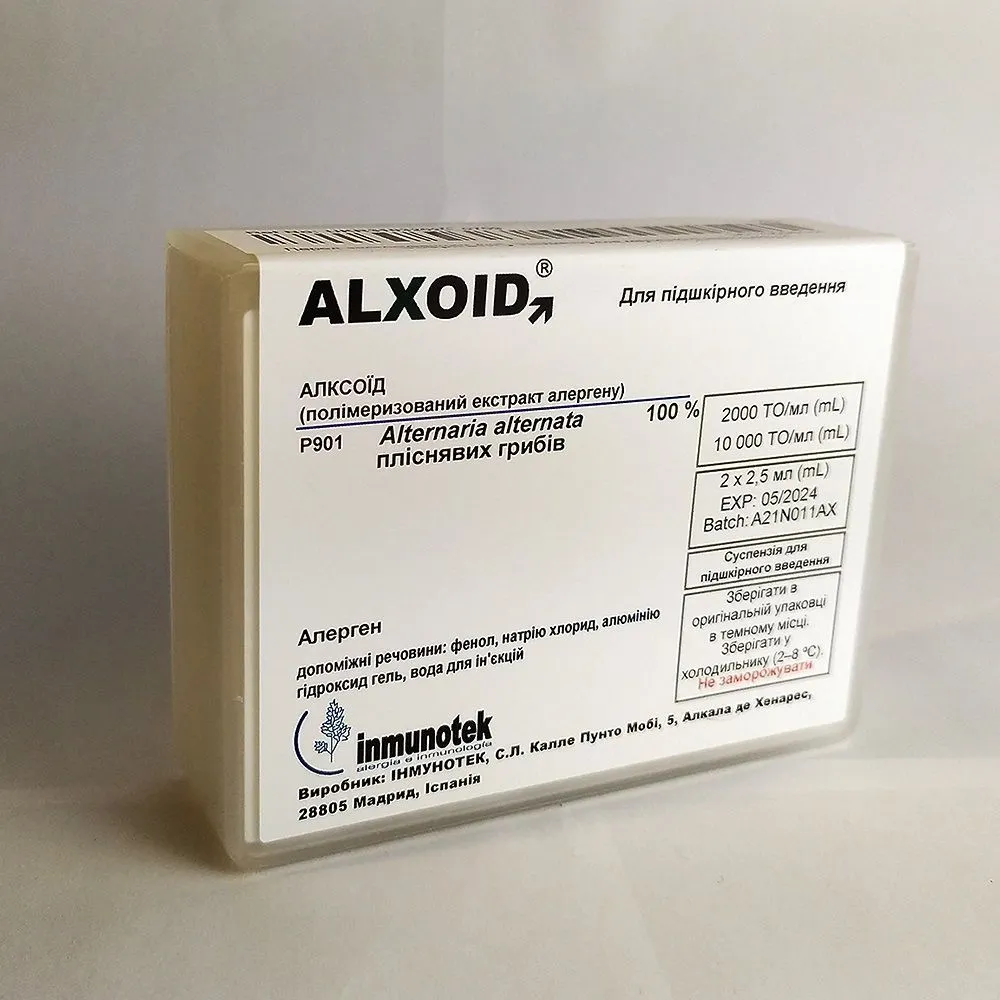
Table of Contents
INSTRUCTION FOR MEDICAL USE OF THE MEDICINAL PRODUCT ALXOID (polymerized allergen extract)
Composition:
Active substances: 1 ml of suspension contains 2,000 TU (bottle A for initial treatment) or 10,000 TU (bottle B for initial/maintenance treatment) of one glutaraldehyde-polymerized extract; each individual bottle contains the corresponding glutaraldehyde-polymerized allergen extract:
ragweed (Ambrosia artemisiifolia) 100%, or
mugwort (Artemisia vulgaris) 100%, or
silver birch (Betula pendula) 100%, or
mould fungi (Alternaria alternata) 100%, or
cat hair (Cat dander) 100%, or
dog hair (Dog dander) 100%;
Excipients: phenol, sodium chloride, aluminium hydroxide gel, water for injections. Concentration is expressed in therapeutic units (TU).
Pharmaceutical form. Suspension for subcutaneous administration.
Pharmacotherapeutic group. Various agents. Allergens, allergen extracts.
ATC code V01A A.
Pharmacological Properties
Subcutaneous immunotherapy increases tolerance to allergens through immunological mechanisms. This method of allergen-specific therapy persistently reduces the level of immunoglobulin E (IgE) in human serum and also prevents the seasonal increase in IgE levels caused by the natural rise in certain allergens during specific periods of the year.
Pharmacodynamics
Mechanism of action. ALKOID (polymerized allergen extract) is used for the treatment of patients with specific IgE-mediated allergic reactions to various allergens presenting with symptoms such as rhinitis and rhinoconjunctivitis. The pharmacodynamic target is the immune system. The purpose of the medicinal product is to modify the immune response to the allergens to which the patient is exposed. The complete and detailed mechanism of action in terms of the clinical effect of specific immunotherapy is not fully understood and has not been thoroughly investigated. Administration of the medicinal product ALKOID (polymerized allergen extract) induces a systemic competitive antibody response to various allergens, accompanied by a gradual increase in the production of specific IgG over two years of treatment or longer. The clinical significance of this observation has not been established.
Pharmacokinetics
Following the intended route of administration, significant systemic absorption of ALKOID (polymerized allergen extract) into the bloodstream is not expected. Therefore, no pharmacokinetic studies in animals or clinical studies on the pharmacokinetic profile and metabolism have been conducted.
Preclinical safety
Preclinical studies do not indicate any specific risk associated with the use of the medicinal product at therapeutic doses according to the instructions for medical use.
Clinical Characteristics
Indications
The medicinal product ALKSOID (polymerized allergen extract) is indicated for allergen-specific immunotherapy in the treatment of allergic rhinitis and rhinoconjunctivitis.
Immunotherapy can be administered to adults and children aged 5 years and older.
Contraindications
Hypersensitivity to components of the medicinal product (see section "Composition").
Concomitant use of β-blockers.
Elevated body temperature (above 38.5 °C).
Active infectious diseases (viral hepatitis, tuberculosis, pneumonia, mononucleosis, etc.).
Acquired immunodeficiency syndrome (AIDS).
Poorly controlled or partially controlled bronchial asthma.
In case of active infectious diseases in the patient (pneumonia, hepatitis, mononucleosis, etc.), initiation of treatment with the product should be postponed until the infection has been resolved.
Any autoimmune systemic disease: immunodeficiency or malignant disease. Pregnancy.
Special Safety Precautions
No special warnings or precautions are required for the use of allergen preparations.
Any unused medicinal product or waste material must be disposed of in accordance with local requirements.
Interaction with Other Medicinal Products and Other Forms of Interaction
Do not use concomitantly with β-blockers.
Data on possible risks of concomitant immunotherapy with other allergens during administration of the medicinal product are lacking.
Special precautions for use
The medicinal product ALXOID (polymerized allergen extract) must be prescribed exclusively by an allergist and administered under his/her supervision (self-administration of the medicinal product by patients is strictly prohibited).
The medicinal product ALXOID (polymerized allergen extract) may be used with caution in patients with autoimmune diseases in remission.
It is recommended to avoid any intense physical exertion for 1–2 hours after administration of the medicinal product.
Important information on excipients
This medicinal product contains less than 1 mmol (23 mg)/dose of sodium, i.e. it is practically sodium-free.
This medicinal product contains substances that may cause allergic reactions, systemic and/or local adverse reactions in patients.
The suspension contains a corresponding concentration of polymerized extract adsorbed onto aluminium hydroxide gel, suspended in isotonic physiological solution with 4% phenol.
Use during pregnancy or breastfeeding
Pregnancy
Currently, there are no reliable data on the use of the medicinal product ALXOID (polymerized allergen extract) in pregnant women. Therefore, the medicinal product is contraindicated during pregnancy. If pregnancy occurs during treatment, the decision to discontinue the medicinal product should be based on a complete assessment of the patient’s overall condition, including pulmonary function and reactions to previous administrations of ALXOID (polymerized allergen extract). Close monitoring of pregnant patients with bronchial asthma is recommended.
Breastfeeding
Clinical data on the use of the medicinal product ALXOID (polymerized allergen extract) during breastfeeding are lacking. No effects on breastfed infants are expected.
Ability to influence the speed of reactions while driving or operating machinery
The effect of allergen preparations on the ability to drive or operate machinery is absent or negligible.
Method of Administration and Dosage
Dosing Regimen
Suspension for subcutaneous administration. Injections must be administered only by a healthcare professional. Below are typical treatment regimens. A more precise treatment regimen should be determined by a physician.
Initial Treatment
Treatment requires 1 vial A and/or 1 or 2 vials B. Treatment begins with the suspension from vial A (2000 TO/mL). Initially, a dose of 0.2 mL is administered, followed one week later by a second dose of 0.5 mL. After the 0.5 mL dose (maximum dose) from vial A (concentration 2000 TO/mL), one week later treatment continues with the suspension from vial B (concentration 10,000 TO/mL): initially, a dose of 0.2 mL from this vial is administered, followed one week later by a dose of 0.5 mL. After the 0.5 mL dose (maximum dose) from vial B (concentration 10,000 TO/mL), the suspension from this vial is then administered once monthly at a dose of 0.5 mL until the solution in the vial is used up.
Before completing administration of the suspension from the last vial, it is necessary to consult a physician to obtain the medicinal product intended for maintenance therapy.
Table 1
Initial Treatment Schedule
| Vial |
Volume of one injection |
Interval |
Date |
Comment |
| A 2000 IU/ml |
0.2 ml |
|||
| 7 days |
||||
| 0.5 ml |
||||
| B 10,000 IU/ml |
7 days |
|||
| 0.2 ml |
||||
| 7 days |
||||
| 0.5 ml |
||||
| 30 days |
||||
| 0.5 ml |
||||
| 30 days |
Need for maintenance therapy |
|||
| 0.5 ml |
Supportive treatment
One or two vials of B are required for treatment. Treatment starts with a dose of 0.5 ml from vial B once a month. A total of 5 doses are administered from this vial.
Before the suspension from the last vial is completely used, it is necessary to consult a physician to obtain the medicinal product intended for supportive treatment.
Table 2
Supportive treatment regimen
| Vial |
Volume of one injection |
Interval |
Date |
Comment |
| B 10,000 IU/ml |
0.5 ml |
|||
| 30 days |
||||
| 0.5 ml |
||||
| 30 days |
||||
| 0.5 ml |
||||
| 30 days |
||||
| 0.5 ml |
||||
| 30 days |
Necessity of maintenance therapy |
|||
| 0.5 ml |
||||
| 30 days |
Pediatric patients
For children aged 5 years and older and adults, the recommended doses of the medicinal product ALKSOID (polymerized allergen extract) are identical.
Method of administration
Standard precautions for use and handling of medicinal products
The medicinal product ALKSOID (polymerized allergen extract) is intended for use in a hospital setting.
The medicinal product ALKSOID (polymerized allergen extract) must be administered only by an experienced physician.
The medicinal product must be administered subcutaneously.
Administration of the medicinal product ALKSOID (polymerized allergen extract) must be performed only in a medical facility equipped with emergency medical equipment for managing anaphylactic shock. In particular, epinephrine and equipment for cardiopulmonary resuscitation must be available.
Procedure for administering the medicinal product from vials:
- Ensure a high level of aseptic technique when handling vials;
- Use 1 mL syringes (insulin syringes) with needles 5/10 or 6/10 (1 cm in length) for the procedure;
- Gently shake the vial to ensure the medicinal product becomes homogeneous;
- Disinfect the rubber cap of the vial with alcohol and insert the needle;
- Before administration, disinfect the injection site with alcohol—the outer surface of the upper arm (deltoid muscle). Pinch the skin to form a skin fold to prevent blood from entering the syringe;
- After administration, do not rub the skin area where the injection was given.
The rubber stopper should not be punctured more than once in the same spot to prevent contamination of the suspension with microparticles from the stopper or even loss of self-sealing properties.
The patient must remain at the medical facility for at least 30 minutes after the injection to ensure immediate medical assistance in case of any adverse reactions.
Children
The medicinal product may be used in children aged 5 years and older.
Overdose
Exceeding the dose of allergens administered to a patient during allergen-specific immunotherapy may lead to the occurrence of systemic and local adverse reactions (see section "Adverse Reactions").
Adverse Reactions
Most adverse reactions associated with the use of the medicinal product ALKHOID (polymerized allergen extract) occur rarely or very rarely. They may be local (at the site of administration) or systemic.
Mild to moderate local allergic reactions (redness, pain and/or swelling at the injection site) may occur from 30 minutes to 72 hours after injection (see section "Special Warnings and Precautions for Use").
The presence of these adverse effects does not necessarily mean that treatment should be discontinued or postponed, but monitoring of the medicinal product administration may be required.
Isolated cases of severe acute worsening of asthma symptoms have been reported. In such cases, treatment should be discontinued, and patients are strongly advised to inform their physician.
Patients with known risk factors should not initiate treatment with the medicinal product ALKHOID (polymerized allergen extract) (see section "Contraindications").
Possible adverse reactions
All adverse reactions are listed by system organ classes and frequency of occurrence: very common (≥ 1/10), common (≥ 1/100 to < 1/10), uncommon (≥ 1/1,000 to < 1/100), rare (≥ 1/10,000 to < 1/1,000), very rare (< 1/10,000), frequency not known (cannot be estimated from available data).
Immune system disorders: common – hypersensitivity, very rare – anaphylactic reaction* and anaphylactic shock*.
Nervous system disorders: very rare – dizziness, headache, tremor.
Eye disorders: uncommon – conjunctivitis, very rare – conjunctival swelling.
Ear and labyrinth disorders: very rare – tinnitus.
Cardiac disorders: rare – disorders of the cardiovascular system, very rare – tachycardia.
Vascular disorders: uncommon – arterial hypotension, very rare – hypertensive crisis, pallor.
Respiratory, thoracic and mediastinal disorders: uncommon – bronchospasm, cough, dyspnea, nasal congestion, rhinitis, rhinorrhea, sneezing; rare – bronchial asthma, bronchial obstruction; very rare – bronchial hyperreactivity, dysphonia, throat and larynx irritation, discomfort in nose and oropharynx, nasopharyngitis, oropharyngeal pain, sensation of pharyngeal numbness, pharyngitis, increased respiratory rate, wheezing.
Gastrointestinal disorders: uncommon – nausea; very rare – gastrointestinal disorders, diarrhea, dysphagia, vomiting.
Skin and subcutaneous tissue disorders: common – pruritus; uncommon – skin reaction; very rare – angioneurotic edema, dermatitis, erythema, hyperhidrosis, abnormal hair growth, papule, pemphigoid, rash, skin discoloration, skin nodule, urticaria.
Musculoskeletal and connective tissue disorders: very rare – discomfort in limbs, myalgia.
General disorders and administration site conditions: common – local reaction; uncommon – fatigue, injection site induration, malaise, pain; rare – swelling; very rare – asthenia, chest discomfort, feeling of warmth, granuloma, inflammation, injection site reaction (including cyst and edema), edema, feeling of warmth, foreign body sensation, feeling of depression.
Investigations: very rare – increased body temperature; very rare – increased blood pressure.
If a patient experiences serious adverse reactions to treatment, consideration should be given to using antiallergic medicinal products.
*Severe systemic reactions, included under the term anaphylaxis, may lead to the development of anaphylactic shock. In the event of an anaphylactic reaction, adrenaline should be administered intramuscularly at a dose of: 0.01 mg/kg body weight, maximum 0.5 mg (solution 1/1000). Administration may be repeated after 5–15 minutes.
Reporting suspected adverse reactions
Reporting suspected adverse reactions after medicinal product authorization is important. It allows continued monitoring of the benefit-risk balance of the medicinal product. Medical and pharmaceutical personnel, as well as patients or their legal representatives, are encouraged to report all suspected adverse reactions and lack of efficacy via the Automated Pharmacovigilance Information System at: https://aisf.dec.gov.ua
Shelf life
3 years.
Storage conditions
Keep in the original packaging in a dark place.
Store in a refrigerator (at 2–8 °C). Do not freeze.
Keep out of reach of children.
Packaging
2.5 mL in a vial.
Primary packaging: Type I clear glass vial with a butyl rubber stopper, sealed with a silver cap (vials A 2000 TO for initial treatment) or blue cap (vials B 10000 TO for maintenance treatment).
2 vials sealed with silver caps (vials A 2000 TO for initial treatment) and blue caps (vials B 10000 TO for maintenance treatment), or 1 vial sealed with a blue cap (vials B 10000 TO for maintenance treatment), packed in a white impact-resistant plastic box filled with expanded material, into which the vials containing the medicinal product are inserted.
Prescription status
Prescription only.
Manufacturer
INMUNOTEC, S.L.
Manufacturer's address and place of business
Calle Punto Mobi, 5, Alcalá de Henares, 28805 Madrid, Spain