Algозan®
Ukraine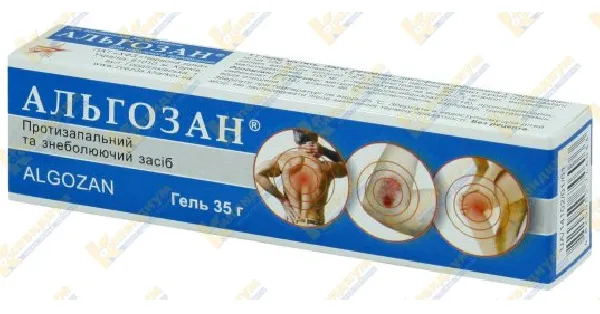
Table of Contents
INSTRUCTIONS FOR MEDICAL USE OF THE MEDICINAL PRODUCT ALGOZAN® (ALGOZAN)
Composition:
Active substances: diclofenac diethylamine, horse chestnut seed dry extract;
1 g of gel contains diclofenac diethylamine, calculated as 100 % substance – 15 mg, horse chestnut seed dry extract (Hippocastani semen extractum siccum) (5-7:1), (extractant – 60 % ethanol, excipient – maltodextrin) – 100 mg, calculated as escin – 5 mg;
Excipients: methylparahydroxybenzoate (E 218), propylparahydroxybenzoate (E 216), ethanol 96 %, propylene glycol, carbomer, triethanolamine, purified water.
Pharmaceutical form. Gel.
Main physicochemical characteristics: gel of light brown to yellowish-brown color, of uniform consistency. Specks may be present.
Pharmacotherapeutic group.
Non-steroidal anti-inflammatory drugs for topical use. Diclofenac, combinations.
ATC code M02A A65.
Pharmacological properties.
Pharmacodynamics.
Algozan® is a combined medicinal product containing a non-steroidal anti-inflammatory drug (NSAID) – diethylamine diclofenac – and an angioprotective agent – dried horse chestnut seed extract. The combined effect of these components leads to reduction or elimination of pain and inflammation, promotes increased range of motion in affected joints, reduces morning stiffness, accelerates resolution of post-traumatic hematomas and edema, and prevents blood stasis in venous insufficiency.
Diethylamine diclofenac. Inhibits prostaglandin synthesis, eliminates or significantly reduces the severity of inflammatory symptoms, and decreases heightened sensitivity of nerve endings to mechanical and biologically active substances produced at the site of inflammation. It penetrates well through the skin, accumulates in adjacent tissues, and reaches the inflamed area.
Dried horse chestnut seed extract. Escin. Escin is a natural mixture of triterpene saponins obtained from the seeds of horse chestnut (Aesculus hippocastanum L.), possessing anti-edematous, venotonic, and anti-inflammatory properties. Additionally, escin acts at the initial stage of the inflammatory process associated with increased membrane and capillary permeability and exudate production into surrounding tissues.
Escin exhibits anti-serotonin and anti-histamine effects.
Escin inhibits prostaglandin synthetase activity. This enzyme is essential for the formation of prostaglandins, which play a key role in the inflammatory mechanism.
Escin prevents the decrease in adenosine triphosphate (ATP) content in endothelial cells and increases phospholipase A2 activity, an enzyme responsible for releasing precursors of inflammatory mediators. Escin reduces the activity of lysosomal enzymes that degrade proteoglycans present in capillary walls. This enhances capillary resistance, reduces their permeability, and thereby decreases exudate formation and edema development.
Pharmacokinetics.
The amount of diclofenac absorbed through the skin is proportional to the application area and depends on both the total applied dose of the medicinal product and the degree of skin hydration. After topical application of 2.5 g of the product to a skin surface area of 500 cm², the absorption rate of diclofenac is approximately 6%. Diethylamine diclofenac is 99.7% bound to plasma proteins, primarily to albumin (99.4%), penetrates into synovial fluid (half-life from synovial fluid is 3–6 hours), crosses the placental barrier and the blood-brain barrier, and is excreted in urine.
Escin is well absorbed by tissues; maximum plasma concentration is reached within 2–3 hours. It undergoes hepatic metabolism. Escin is primarily excreted from the body via bile as metabolites, and to a lesser extent via urine. Elimination half-life is up to 20 hours.
Clinical characteristics.
Indications.
Symptomatic treatment of pain, inflammation, and swelling associated with:
- Soft tissue injuries: injuries of tendons, ligaments, muscles, and joints (due to dislocation, strain, bruising); sports injuries;
- Localized forms of soft tissue rheumatism: tendinitis (including "tennis elbow"), bursitis, shoulder syndrome and periarthropathy; localized forms of degenerative rheumatism (osteoarthritis of peripheral joints and spine).
Symptomatic therapy in diseases and symptoms caused by impaired peripheral circulation:
- Varicose veins;
- Leg swelling and pain associated with venous insufficiency;
- Post-traumatic hematomas and hematomas following injections and infusions.
Contraindications.
Hypersensitivity to diclofenac or to any of the excipients, renal failure, blood dyscrasias; presence of erosive-ulcerative lesions of the gastrointestinal tract.
History of attacks of bronchial asthma, urticaria, or acute rhinitis induced by acetylsalicylic acid or other NSAIDs.
The drug is contraindicated during pregnancy or breastfeeding.
Interaction with other medicinal products and other forms of interaction.
It is not permitted to apply other medicinal products simultaneously to the same area of skin when using the gel.
Diclofenac contained in the product may potentiate the specific effects of oral NSAIDs when used concomitantly, as well as the ulcerogenic effect of corticosteroids; increases blood concentrations of digoxin and lithium; reduces the efficacy of diuretics and thiazide diuretics and furosemide.
Therapeutic efficacy of the gel is reduced when used with salicylates, while the ulcerogenic effect on gastric mucosa is enhanced.
When used concomitantly with anticoagulants and coagulants, the status of the blood coagulation system should be monitored.
Since Algozan® contains escin as part of the dry extract of horse chestnut seed, it should not be used in combination with drugs that inhibit ovulation.
Special precautions for use
Consult a physician before use.
Do not exceed the recommended dosage.
Apply the gel only to intact areas of skin, avoiding contact with inflamed, injured, or infected skin. Avoid contact of the medicinal product with eyes and mucous membranes. The product must not be swallowed.
Do not rub in during application.
Be aware of the potential for systemic adverse effects (such as those associated with systemic diclofenac formulations) when using the product over larger skin areas or for longer durations than recommended. In such cases, use the medicinal product with caution in patients with hepatic, renal, or cardiac insufficiency, history of blood disorders, active peptic ulcer disease, or concomitant use of other NSAIDs.
In case of sudden onset of pronounced symptoms of venous insufficiency (sudden swelling of one or both legs, skin discoloration, sensation of tension, and severe pain), especially in one limb, rule out deep vein thrombosis.
Do not apply the product under an airtight occlusive dressing.
In case of ligament sprain, the affected area may be bandaged with a bandage.
The product contains methylparahydroxybenzoate (E 218) and propylparahydroxybenzoate (E 216), which may cause allergic reactions and bronchospasm. The product also contains propylene glycol, which may cause mild localized skin irritation.
Discontinue treatment with the product if any skin rash occurs.
Due to the possibility of photosensitivity, avoid direct sunlight and solarium use during treatment and for 2 weeks after discontinuation of treatment.
Use during pregnancy or breastfeeding.
Do not use during pregnancy or breastfeeding.
Ability to influence reaction rate when driving or operating machinery.
No effect.
Method of Administration and Dosage
Gel for external use.
Daily dose: Apply 2 g of gel as a thin strip (approximately 10 cm) to the skin at the site of inflammation (joints, veins, and other body areas with inflammation and pain), avoiding contact with damaged skin, open wounds, or mucous membranes, 2–4 times daily. After applying the gel, do not cover with an occlusive dressing.
Average daily dose: 4–8 g of gel.
Duration of treatment: 14 days. The treatment duration depends on the severity and course of the disease and is determined by the physician.
Consult a physician if the patient's condition does not improve or worsens after 7 days of treatment.
Children
Not recommended for use in pediatric practice.
Overdose
Overdose is unlikely.
In case of overdose, possible adverse effects include allergic reactions (skin itching, rash, burning sensation) and systemic side effects typical of diclofenac (generalized skin rashes, angioneurotic edema, photosensitization, headache, drowsiness, dizziness, nausea, gastrointestinal disturbances).
Treatment: Discontinue the drug. In case of excessive application, wash the skin thoroughly with large amounts of cool water and consult a physician. Symptomatic therapy.
In case of accidental ingestion, immediately empty the stomach and administer an adsorbent; seek medical advice. Symptomatic treatment is indicated, using therapeutic measures appropriate for poisoning with nonsteroidal anti-inflammatory drugs. Symptomatic therapy.
Side effects.
At the site of application, mild transient skin reactions are possible.
Allergic reactions may occur in rare cases.
Infections and infestations: pustular rashes.
Immune system disorders: hypersensitivity reactions, angioneurotic edema.
Respiratory system disorders: bronchial asthma.
Skin and subcutaneous tissue disorders: rash, erythema, eczema, dermatitis; bullous dermatitis; photosensitivity reactions, pruritus, rash, burning sensation.
If any of the above symptoms occur, treatment should be discontinued and medical advice sought.
Shelf life.
2 years.
Do not use after the expiry date stated on the packaging.
Storage conditions.
Store at a temperature not exceeding 25 °C.
Keep out of reach of children.
Packaging.
35 g in a tube.
1 tube per cardboard box.
Prescription status.
Over-the-counter (without prescription).
Manufacturer.
JSC "CHEMICAL PHARMACEUTICAL PLANT "CHERVONA ZIRKA".
Manufacturer's address and place of business.
1 Gordienkovskaya Street, Kharkiv, Kharkiv Oblast, 61010, Ukraine.