Algimax
Ukraine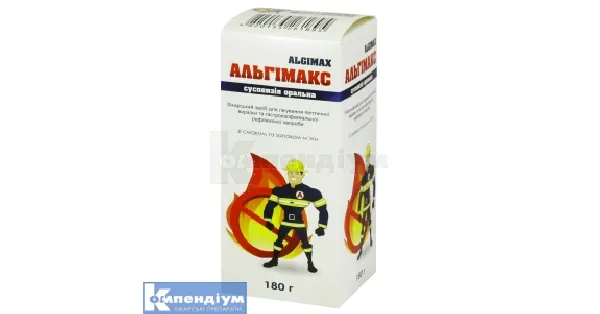
Table of Contents
INSTRUCTIONS FOR MEDICAL USE OF THE MEDICINAL PRODUCT ALGIMAX (ALGIMAX)
Composition:
Active substances: sodium alginate, sodium bicarbonate, calcium carbonate;
10 ml of suspension contains: sodium alginate — 500 mg, sodium bicarbonate — 213 mg, calcium carbonate — 325 mg;
Excipients: carbomer (974P), sodium hydroxide, methylparahydroxybenzoate (E 218), propylparahydroxybenzoate (E 216), sodium saccharin, peppermint oil, purified water.
Pharmaceutical form. Oral suspension.
Main physicochemical properties: viscous, opaque suspension, from almost white to creamy color, with a taste and odor of mint. Sedimentation or layering of the suspension may occur during storage.
Pharmacotherapeutic group. Medicinal products for the treatment of peptic ulcer and gastroesophageal reflux disease (GERD). ATC code A02B X.
Pharmacological properties.
Pharmacodynamics. The medicinal product is a combination of two antacids (calcium carbonate, sodium bicarbonate) and sodium alginate, and has adsorbing and coating effects. After administration, the medicinal product rapidly reacts with gastric acid, forming a mass of alginic acid gel with almost neutral pH, which covers the surface of gastric contents and effectively prevents manifestations of gastroesophageal reflux. In severe cases, the gel layer, preceding gastric contents, rises into the esophagus and prevents its irritation.
Calcium carbonate neutralizes gastric acid and provides rapid relief from indigestion and heartburn. This effect is enhanced by sodium bicarbonate, which also has a neutralizing action. The total neutralizing capacity of the product at the lowest dose of 10 mL is approximately 10 mEq H⁺.
The mechanism of action of the medicinal product is physical and does not depend on absorption into systemic circulation.
Pharmacokinetics. Not studied.
Clinical characteristics.
Indications. Treatment of symptoms of gastroesophageal reflux associated with acidity of gastric contents regurgitating into the esophagus, such as acid eructation, heartburn, and dyspepsia, for example after food intake or during pregnancy.
Contraindications. The medicinal product is contraindicated in patients with known or suspected hypersensitivity to the active substances or to any of the excipients, including methylparahydroxybenzoate (E 218) and propylparahydroxybenzoate (E 216).
Interaction with other medicinal products and other forms of interaction. Due to the presence of calcium carbonate in the medicinal product, which acts as an antacid, a two-hour interval should be maintained between the administration of Algimax and other medicinal products, especially H2-antihistamines, tetracyclines, digoxin, fluoroquinolones, iron salts, ketoconazole, neuroleptics, thyroxine, penicillamine, beta-blockers (atenolol, metoprolol, propranolol), glucocorticoids, chloroquine, bisphosphonates, and estramustine.
Special precautions for use
Each 20 mL of the medicinal product contains 270.09 mg (11.73 mmol) of sodium, equivalent to 13.5% of the maximum daily sodium intake for adults recommended by the World Health Organization.
The maximum daily dose of Algimax corresponds to 54% of the maximum daily sodium intake recommended by the World Health Organization.
This medicinal product has a high sodium content, which should be taken into account in patients on a low-salt diet, particularly those with kidney disease or congestive heart failure.
Each 20 mL of suspension contains 260 mg (6.5 mmol) of calcium. Caution is advised when treating patients with hypercalcemia, nephrocalcinosis, or recurrent calcium-containing kidney stones.
Prolonged use of the medicinal product should be avoided. If symptoms do not resolve within 7 days, medical advice should be sought.
The use of Algimax suspension, as with other antacids, in cases of uncertain diagnosis may mask symptoms of other diseases.
Algimax suspension should not be administered to patients with renal insufficiency or hypophosphatemia. There is a possibility of reduced efficacy in patients with very low gastric acidity.
There is an increased risk of hypernatremia in children with gastroenteritis or suspected renal insufficiency.
The medicinal product contains methylparahydroxybenzoate (E 218) and propylparahydroxybenzoate (E 216), which may cause allergic reactions (possibly delayed).
Use during pregnancy or breastfeeding
Pregnancy. Clinical studies involving more than 500 pregnant women, as well as extensive post-marketing data, indicate that the active substances do not cause developmental abnormalities and have no toxic effect on newborns/infants. The medicinal product Algimax suspension may be used during pregnancy when clinically necessary, following consultation with a physician.
Breastfeeding. Studies have shown no adverse effects on newborns/infants breastfed by women taking this medicinal product. Algimax suspension may be used during breastfeeding following consultation with a physician.
Fertility. Preclinical studies indicate that alginate has no negative effect on fertility or reproductive function in test animals or their offspring.
Clinical data do not indicate any effect on human fertility.
Ability to influence reaction speed when driving or operating machinery. The medicinal product does not affect the ability to drive or operate complex machinery.
Method of Administration and Dosage
The medicinal product is intended for oral administration.
Shake the suspension well before use.
Adults and children aged 12 years and older: 10–20 mL (2–4 teaspoons) after meals and at bedtime, up to 4 times daily.
Special Patient Groups
Elderly patients: dose adjustment is not required.
Patients with hepatic impairment: dose adjustment is not required.
Renal impairment: use with caution in patients on a low-sodium diet (see section "Special Warnings and Precautions for Use").
Children. Generally not recommended for children under 12 years of age.
Overdose.
Symptoms. In acute overdose, symptoms are usually mild. Overdose may manifest as abdominal discomfort and bloating. Milk-alkali syndrome has been reported in individuals taking high daily doses of calcium carbonate over a prolonged period.
Treatment. In case of overdose, discontinue the medicinal product and administer symptomatic therapy.
Adverse Reactions
The frequency of adverse reactions is defined as follows: very common (≥1/10), common (≥1/100 to <1/10), uncommon (≥1/1000 to <1/100), rare (≥1/10,000 to <1/1000), very rare (<1/10,000), frequency not known (cannot be estimated from the available data).
Immune system disorders. Very rare: anaphylactic and anaphylactoid reactions, hypersensitivity reactions such as urticaria.
Metabolism and nutrition disorders. Frequency not known: alkalosis1, acid rebound1, hypercalcemia1, milk-alkali syndrome1.
Respiratory, thoracic and mediastinal disorders. Very rare: respiratory manifestations such as bronchospasm.
Gastrointestinal disorders. Frequency not known: constipation1.
1 Usually due to exceeding the recommended dose.
Reporting of adverse reactions after marketing authorization is of great importance. It enables continuous monitoring of the benefit-risk balance of the medicinal product. Healthcare professionals and pharmacists, as well as patients or their legal representatives, are encouraged to report all suspected adverse reactions and lack of efficacy via the Automated Pharmacovigilance Information System at: https://aisf.dec.gov.ua
Shelf life. 2 years.
An opened bottle should not be stored for longer than 6 months.
Do not use after the expiry date stated on the packaging.
Storage conditions. Store in the original packaging at a temperature not exceeding 25 °C. Do not store in the refrigerator and do not freeze.
Keep out of reach of children.
Packaging. 180 g in a polymer bottle; 1 bottle with a measuring spoon in a cardboard box.
Availability. Over-the-counter (without prescription).
Manufacturer/Marketing Authorization Holder. Ternopharm LLC.
Address of manufacturer and location of its business activity / address of marketing authorization holder. 4 Fabrychna St., Ternopil, 46010, Ukraine.
Tel./fax: (0352) 521-444, www.ternopharm.com.ua