Alfiram
Ukraine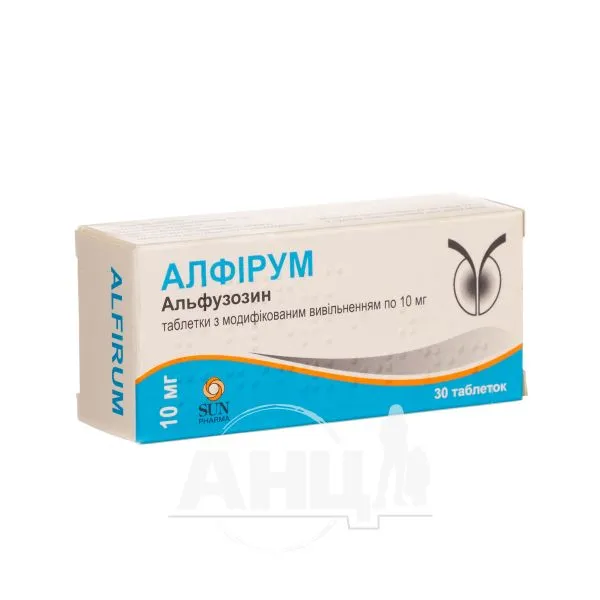
Table of Contents
INSTRUCTIONS FOR MEDICAL USE OF THE MEDICINAL PRODUCT ALFIRUM (ALFIRUM)
Composition:
active substance: alfuzosin;
1 tablet contains alfuzosin hydrochloride 10 mg;
excipients: anhydrous lactose, colloidal anhydrous silicon dioxide, povidone, talc, magnesium stearate, hypromellose, hydroxypropylcellulose.
Pharmaceutical form. Modified release tablets.
Main physicochemical properties: white or almost white, round, biconvex tablets with the imprint «RY 10» on one side of the tablet.
Pharmacotherapeutic group. Drugs used in benign prostatic hyperplasia. Alpha-adrenoreceptor antagonists. ATC code G04C A01.
Pharmacological Properties.
Pharmacodynamics.
Alfuzosin is an active quinazoline derivative. In vitro pharmacological studies have demonstrated that alfuzosin selectively acts on alpha1-adrenoceptors located in the prostate gland, bladder base, and prostatic urethra.
Clinical manifestations of benign prostatic hyperplasia (BPH) are associated with infravesical obstruction, the mechanism of which involves both anatomical (static) and functional (dynamic) factors. The functional component of obstruction occurs due to increased tone of the smooth muscle of the prostate mediated by alpha1-adrenoceptors. Activation of alpha1-adrenoceptors stimulates contraction of the smooth muscle, thereby increasing the tone of the prostate, prostatic capsule, prostatic urethra, and bladder base, leading to obstruction of urine outflow from the bladder and possibly secondary bladder instability.
Alpha-blockade reduces infravesical obstruction through a direct effect on the smooth muscle of the prostate.
Alfuzosin decreases urethral pressure and thus reduces resistance to urine flow during micturition. Alfuzosin inhibits the hypertonic response in the urethra earlier than in vascular smooth muscle.
Alfuzosin improves urinary flow parameters by reducing urethral tone and resistance to bladder emptying, thereby facilitating bladder evacuation.
Pharmacokinetics.
Absorption.
The mean relative bioavailability is 104.4% compared to the immediate-release formulation (2.5 mg twice daily) in healthy middle-aged volunteers, with Cmax achieved at 9 hours after administration compared to 1 hour for the immediate-release formulation.
Studies have shown that the desired pharmacokinetic profile is achieved when the drug is administered after food intake.
When administered after food, mean Cmax and Ctrough values are 13.6 (CV = 5.6) and 3.2 (CV = 1.6) ng/mL, respectively. The mean AUC0-24 value is 194 (CV = 75) ng*h/mL. A concentration plateau is observed from 3 to 14 hours, with concentrations exceeding 8.1 ng/mL (Cmax) for 11 hours.
Distribution.
Plasma protein binding of alfuzosin is approximately 90%.
Metabolism and Elimination.
Alfuzosin undergoes extensive hepatic metabolism; only 11% of the parent compound is excreted unchanged in urine. Most metabolites (which are inactive) are excreted in feces (75–91%).
The elimination half-life is 9.1 hours.
Special Patient Populations.
Renal Impairment. Mean Cmax and AUC values are moderately increased in patients with renal impairment, without changes in elimination half-life. This alteration in the pharmacokinetic profile is considered not to be clinically significant. Therefore, dose adjustment is not required.
Heart Failure. The pharmacokinetic profile of alfuzosin is not altered in chronic heart failure.
Elderly Patients. In elderly patients, pharmacokinetic parameters (Cmax and AUC) are not increased.
Clinical characteristics.
Indications.
Symptomatic treatment of benign prostatic hyperplasia.
Contraindications.
Hypersensitivity to alfuzosin or to any of the excipients. Orthostatic hypotension, concomitant use with other alpha-blockers, hepatic impairment, chronic renal failure (creatinine clearance < 30 mL/min).
Interaction with other medicinal products and other forms of interaction.
Particular caution is required when alfuzosin is used concomitantly with antihypertensive agents, nitrates, and strong CYP3A4 inhibitors (ketoconazole, itraconazole, and ritonavir).
The use of general anesthetics in patients taking alfuzosin may lead to severe arterial hypotension. It is recommended to discontinue the drug 24 hours prior to surgery.
Special precautions for use
As with all alpha1-blockers, in some patients (especially those receiving antihypertensive therapy), postural hypotension may develop within a few hours after taking the drug, either with symptoms (dizziness, fatigue, increased sweating) or without. In such cases, the patient should lie down until symptoms completely resolve. These effects are usually transient, occur at the beginning of treatment, and do not require discontinuation of the drug. Patients should be warned about the possibility of such events.
Patients known to be hypersensitive to alpha1-blockers should start treatment with lower doses. Regular monitoring of blood pressure is necessary, especially at the beginning of therapy.
Do not administer the drug to patients with coronary insufficiency. Specific treatment for coronary insufficiency should be continued. If angina pectoris recurs or worsens despite standard antianginal therapy, Alfirum should be discontinued.
In some patients who were treated with or had previously used tamsulosin, intraoperative floppy iris syndrome (IFIS, a variant of the small pupil syndrome) has been observed during cataract surgery. Isolated reports have also been received with other alpha1-blockers; therefore, the possibility of such an effect cannot be excluded with the use of Alfirum. Since IFIS may increase procedural complications during cataract surgery, the ophthalmic surgeon should be informed in advance about current or prior use of alpha1-blockers.
Experience with the use of the drug in patients with renal impairment is limited; therefore, caution is recommended when administering the drug to such patients.
The drug should not be used in patients with creatinine clearance below 30 mL/min.
Lactose content
Since the drug contains lactose, it should not be administered to patients with rare hereditary forms of galactose intolerance, acute lactase deficiency, glucose-galactose malabsorption, or lactose deficiency.
Use during pregnancy or breastfeeding
Do not use during pregnancy or breastfeeding.
Ability to influence reaction rate while driving or operating machinery
The drug may cause adverse reactions such as vertigo, dizziness, and asthenia; therefore, patients should refrain from driving or operating machinery during treatment.
Method of Administration and Dosage.
The medication is intended for men only!
The recommended dose is 1 tablet of 10 mg daily. Administer immediately after food intake. Tablets should be swallowed whole. Patients should be advised not to chew, crush, divide, or grind the tablets into powder. Crushing the tablets may lead to rapid release and absorption of the active substance, resulting in a rapid onset of adverse effects.
Children.
The medication is not intended for use in children.
Overdose.
In case of overdose, arterial hypotension may occur. In the event of overdose, the patient should be hospitalized and treated for arterial hypotension. The patient should remain in a supine position.
The drug is poorly dialyzable due to its high degree of protein binding.
Adverse Reactions
Adverse reactions are listed by frequency: very common (> 1/10), common (> 1/100; < 1/10), uncommon (> 1/1000; < 1/100), rare (> 1/10000; < 1/1000), very rare (< 1/10000). Within each group, adverse reactions are listed in order of decreasing severity.
Nervous system disorders:
Common − syncope/dizziness, headache;
Uncommon − vertigo, malaise, somnolence.
Cardiovascular system disorders:
Uncommon − tachycardia, palpitations, arterial hypotension (postural), syncope;
Very rare − onset, worsening, or recurrence of angina pectoris in patients with pre-existing coronary artery disease.
Gastrointestinal disorders:
Common − nausea, abdominal pain;
Uncommon − diarrhea, dry mouth.
Skin and subcutaneous tissue disorders:
Uncommon − rash, pruritus;
Very rare − urticaria, angioneurotic edema.
General disorders:
Common − asthenia;
Uncommon − flushing, edema, chest pain;
In isolated cases − priapism.
Shelf life.
2 years.
Storage conditions.
Store at a temperature not exceeding 25°C in a dry and child-proof place.
Packaging.
10 tablets per blister pack; 3 blisters per cardboard box.
Prescription status.
Prescription only.
Manufacturer.
Sun Pharmaceutical Industries Limited.
Manufacturer's address.
V. Ganguwala, Paonta Sahib, District Sirmour, Himachal Pradesh 173025, India.