Albendazole
Ukraine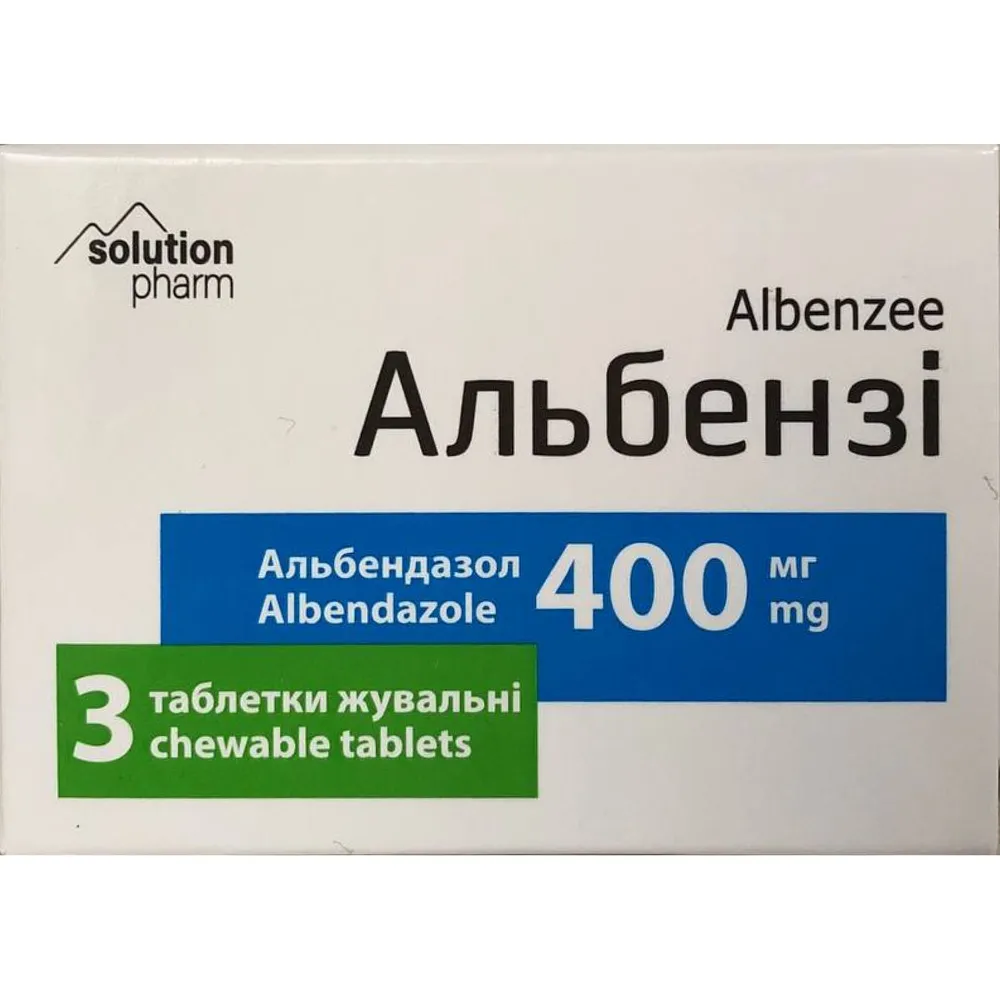
Table of Contents
INSTRUCTIONS FOR MEDICAL USE OF THE MEDICINAL PRODUCT ALBENZEE (ALBENZEE)
Composition:
Active substance: albendazole;
1 tablet contains 400 mg of albendazole;
Excipients: lactose, mannitol, corn starch, sodium saccharin, povidone, magnesium stearate, talc, sodium benzoate (E 211), sodium starch glycolate (type A), flavoring agent Essence Trusil Vanilla DM 8187, flavoring agent Essence Trusil Pineapple ASV, purified water.
Pharmaceutical form. Chewable tablets.
Main physicochemical properties: white or almost white, elongated, flavored tablets with a break line on one side.
Pharmacotherapeutic group. Anthelmintic agents. Agents used in nematode infections. Benzimidazole derivatives. ATC code P02CA03.
Pharmacological Properties.
Pharmacodynamics.
Albenzi is a broad-spectrum anthelmintic and antiprotozoal agent of the carbamate benzimidazole group. Albendazole acts against both intestinal and tissue parasites at the stages of eggs, larvae, and adult helminths. The anthelmintic effect of albendazole is due to inhibition of tubulin polymerization, leading to disruption of metabolism and subsequent death of helminths.
Albendazole demonstrates activity against the following intestinal parasites: nematodes – Ascaris lumbricoides, Trichuris trichiura, Enterobius vermicularis, Ancylostoma duodenale, Necator americanus, Strongyloides stercoralis, Cutaneus Larva Migrans; cestodes – Hymenolepsis nana, Taenia solium, Taenia saginata; trematodes – Opisthorchis viverrini, Clonorchis sinensis; protozoa – Giardia lamblia (intestinalis or duodenalis).
Pharmacokinetics.
After oral administration, the drug is poorly absorbed (up to 5%) from the gastrointestinal tract. Concomitant intake of fatty food increases absorption of the drug approximately fivefold.
Albendazole is rapidly metabolized in the liver during the first pass. The main metabolite, albendazole sulfoxide, retains half of the pharmacological activity of the parent compound.
The elimination half-life of albendazole sulfoxide from blood plasma is approximately 8.5 hours. Albendazole sulfoxide and other metabolites are excreted predominantly via bile, with only a small fraction eliminated in urine. After prolonged administration of high doses of the drug, elimination from cysts continues for several weeks.
Clinical characteristics.
Indications.
Intestinal forms of helminthiases: enterobiasis, ancylostomiasis, necatoriasis, hymenolepiasis, taeniasis, strongyloidiasis, ascariasis, trichocephalosis, clonorchiasis, opisthorchiasis, giardiasis in children.
Contraindications.
Hypersensitivity to albendazole, other benzimidazole derivatives, or any component of the drug. Retinal disease. Pregnancy and lactation period. Planned pregnancy. Women of childbearing age must use effective non-hormonal contraceptive methods during treatment and for 1 month after completion of therapy. Phenylketonuria.
Interaction with other medicinal products and other types of interactions.
Albendazole induces cytochrome P450 enzyme system.
Concomitant use with cimetidine, praziquantel, and dexamethasone may increase plasma levels of albendazole metabolites responsible for systemic activity, which in turn may lead to drug overdose.
Medicinal products that may slightly reduce albendazole efficacy: anticonvulsants (e.g., phenytoin, fosphenytoin, carbamazepine, phenobarbital, primidone), levamisole, ritonavir.
Treatment efficacy should be monitored in patients; alternative dosing regimens or therapies may be required.
Grapefruit juice also increases plasma levels of albendazole sulfoxide.
Due to the potential effect on cytochrome P450 activity, there is a theoretical risk of interaction with the following drugs: oral contraceptives, anticoagulants, oral hypoglycemic agents, theophylline.
When albendazole is used concomitantly with theophylline, serum theophylline levels should be monitored.
Simultaneous intake of the drug with fatty food leads to increased absorption of albendazole from the gastrointestinal tract (see section "Pharmacokinetics").
Special precautions.
Short-term treatment of intestinal infections.
To prevent administration of albendazole during early pregnancy, women of reproductive age should be treated only during the first week after menstruation or after a negative pregnancy test. Reliable contraception is required during treatment.
Albendazole treatment may reveal pre-existing neurocysticercosis, especially in areas with a high prevalence of Tenia solium strains. Patients may develop neurological symptoms such as seizures, increased intracranial pressure, and focal neurological signs due to inflammatory reactions caused by the death of parasites in the brain. These symptoms may appear rapidly after treatment initiation; therefore, immediate appropriate therapy with corticosteroids and anticonvulsants should be started.
The medicinal product can be used for deworming prior to vaccination, as well as for prophylactic treatment twice a year.
To prevent the use of albendazole in women during early pregnancy and in women of reproductive age, the following measures should be taken:
- initiate treatment only after a negative pregnancy test;
- advise the necessity of using effective contraceptive methods during
treatment with albendazole and for one month after its discontinuation.
Albenzi contains lactose in its composition; therefore, patients diagnosed with intolerance to certain sugars should consult a physician before taking this medicinal product.
Use during pregnancy and lactation.
The drug is contraindicated during pregnancy or breastfeeding, as well as for treatment of women who are planning to become pregnant.
Ability to influence reaction rate while driving or operating machinery.
Given the possibility of adverse reactions such as dizziness, it is recommended to avoid driving vehicles or operating machinery during treatment with albendazole.
Dosage and Administration.
Intestinal Infections
Take the medication with food. It is advisable to take it at the same time each day. If no improvement occurs within three weeks, a second course of treatment should be prescribed.
The tablet may be chewed or crushed and taken with a small amount of water.
| Infection |
Age |
Dosage and duration of administration |
| Enterobiasis, ancylostomiasis, necatoriasis, ascariasis, trichuriasis |
Adults and children aged 3 years and older* |
400 mg once daily (1 tablet) as a single dose. |
| Strongyloidiasis, taeniasis, hymenolepiasis |
Adults and children aged 3 years and older* |
400 mg once daily (1 tablet) for 3 days. In case of hymenolepiasis, a repeat course of treatment is recommended from day 10 to day 21 after the previous course. |
| Clonorchiasis, opisthorchiasis |
Adults and children aged 3 years and older* |
400 mg (1 tablet) twice daily for 3 days. |
| Giardiasis |
Children aged 3 to 12 years only* |
400 mg (1 tablet) once daily for 5 days. |
* For children aged 2 to 3 years, an alternative formulation of the drug should be used – oral suspension.
Elderly patients
Experience with the use of the drug in elderly patients is limited. Dose adjustment is not required; however, albendazole should be used with caution in elderly patients with impaired liver function.
Renal impairment
Since albendazole is excreted in very small amounts by the kidneys, dose adjustment is not required in this patient population. However, patients with signs of renal impairment should be closely monitored.
Hepatic impairment
Since albendazole is actively metabolized in the liver to a pharmacologically active metabolite, impaired liver function may significantly affect its pharmacokinetics. Therefore, patients with abnormal liver function tests (elevated transaminase levels) should be carefully evaluated before initiating albendazole therapy. Treatment should be discontinued if there is a significant increase in transaminase levels or a clinically significant decrease in blood parameters.
Children
The drug is intended for use in children aged 3 years and older. For the treatment of children aged 2 to 3 years, an alternative dosage form is recommended – oral suspension.
Administer to children according to the information provided in the section "Administration and dosage".
Overdose.
Symptoms: nausea, vomiting, diarrhea, tachycardia, drowsiness, visual disturbances, visual hallucinations, speech impairment, dizziness, loss of consciousness, hepatomegaly, elevated transaminase levels, jaundice; respiratory distress, brown-red or orange discoloration of the skin, urine, sweat, saliva, tears, and feces proportional to the administered dose of the drug.
Treatment: perform gastric lavage and administer symptomatic and supportive therapy.
Side effects
Gastrointestinal disorders: stomatitis, dry mouth, heartburn, nausea, vomiting, abdominal pain, flatulence, diarrhea, constipation, epigastric pain.
Hepatobiliary disorders: transient increase in liver enzyme activity, jaundice, hepatitis, hepatocellular disorders.
Cardiovascular system disorders: increased blood pressure, tachycardia.
Central nervous system and peripheral nervous system disorders: insomnia or drowsiness, headache, dizziness, confusion, disorientation, hallucinations, seizures, decreased visual acuity.
Blood and lymphatic system disorders: leukopenia, neutropenia, thrombocytopenia, anemia, including aplastic anemia; agranulocytosis, pancytopenia. Patients with liver disease, including hepatic echinococcosis, are more susceptible to bone marrow suppression.
Skin and subcutaneous tissue disorders: skin rashes, hyperemia, polymorphic erythema, Stevens–Johnson syndrome, reversible alopecia (thinning and moderate hair loss), pruritus, urticaria, bullous eruption, dermatitis, edema.
Renal and urinary system disorders: renal function impairment, acute renal failure, proteinuria.
General disorders: bone pain, sore throat, chills, weakness.
Hypersensitivity reactions are possible, including anaphylactic/anaphylactoid reactions.
Shelf life. 2 years.
Storage conditions. Store in the original packaging at a temperature not exceeding 25 °C. Keep out of reach of children.
Packaging. 3 tablets in a blister, 1 blister in a cardboard box.
1 tablet in a blister, 3 blisters in a cardboard box.
Prescription category. Prescription only.
Manufacturer.
Indoco Remedies Limited.
Manufacturer’s address and place of business.
Village Katha, Baddi, District Solan, IN-173 205, India.