Aquadektrim® vitamin d3
Ukraine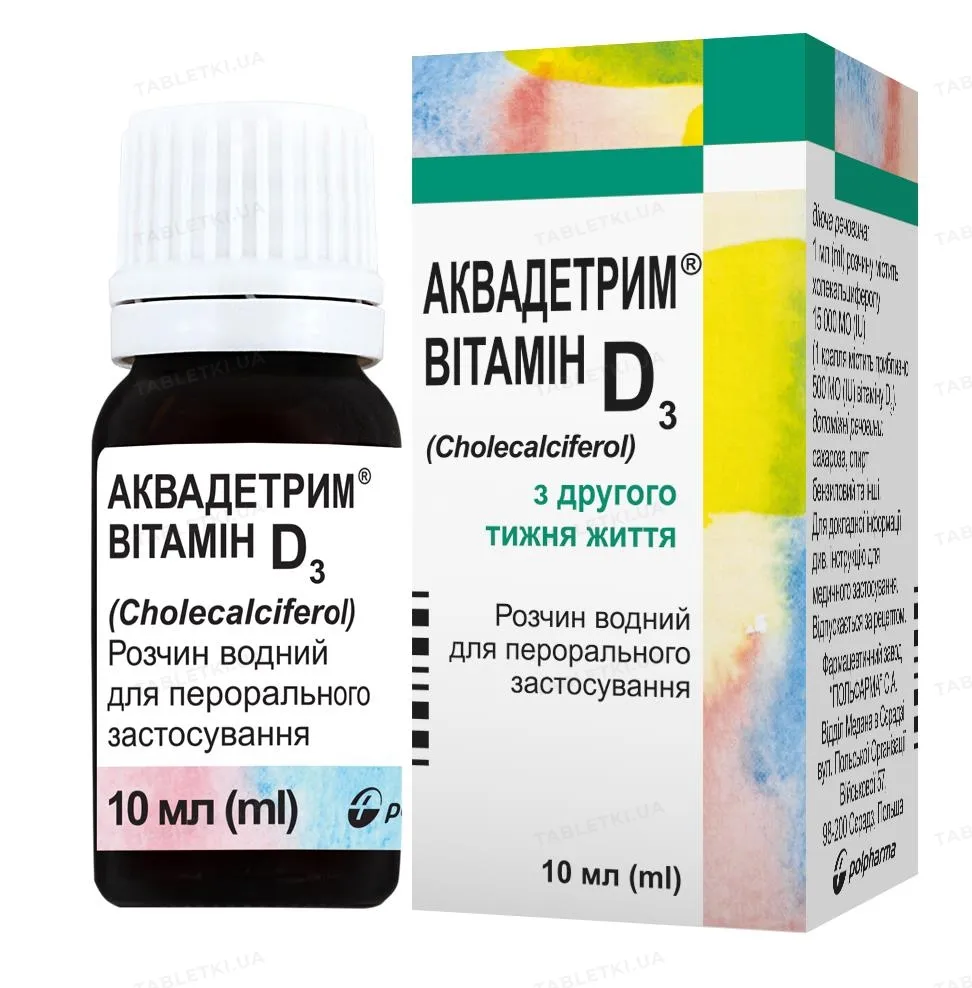
Table of Contents
INSTRUCTIONS FOR MEDICAL USE OF THE MEDICINAL PRODUCT AQUADETRIM® VITAMIN D3 (AQUADETRIM® VITAMINUM D3)
Composition:
Active substance: cholecalciferol;
1 ml (approximately 30 drops) of solution contains 15,000 IU of cholecalciferol (1 drop contains approximately 500 IU of vitamin D3);
Excipients: macrogol glycerol ricinoleate; sucrose; sodium hydrogen phosphate dodecahydrate; citric acid monohydrate; anise flavoring; benzyl alcohol; purified water.
Pharmaceutical form. Aqueous solution for oral administration.
Main physicochemical properties: colorless clear liquid with an anise odor and taste. Slight opalescence in the preparation is permissible.
Pharmacotherapeutic group. Vitamins. Vitamin D and its analogues preparations.
ATC code A11CC05.
Pharmacological properties.
Pharmacodynamics.
Vitamin D3 is the active antirachitic factor. The most important function of vitamin D is the regulation of calcium and phosphate metabolism, which promotes proper skeletal mineralization and growth.
Vitamin D3 is the natural form of vitamin D produced in animals and humans. Compared to vitamin D2, it has approximately 25% higher biological activity.
It is essential for the function of the parathyroid glands, intestines, kidneys, and skeletal system. It plays a crucial role in the absorption of calcium and phosphates from the intestine, in the transport of mineral salts, and in the process of bone calcification, as well as in regulating renal excretion of calcium and phosphates. Calcium ion concentration affects a number of vital biochemical processes that maintain skeletal muscle tone, are involved in nerve impulse conduction, and influence blood coagulation. Vitamin D3 also participates in immune system function by affecting lymphokine production.
Deficiency of vitamin D3 in the diet, impaired absorption, calcium deficiency, and lack of exposure to sunlight during periods of rapid growth in children lead to rickets; in adults, to osteomalacia; and in pregnant women, to tetany symptoms and defective enamel formation in newborns.
Women during menopause, who are frequently affected by osteoporosis due to hormonal imbalances, require increased doses of vitamin D3.
Pharmacokinetics.
Absorption. The aqueous solution of vitamin D3 is absorbed better than the oily solution. In premature infants, insufficient bile production and delivery to the intestine impair the absorption of vitamins formulated in oily solutions.
After oral administration, cholecalciferol is absorbed in the small intestine.
Distribution. It crosses the placental barrier and is excreted into breast milk.
Metabolism. It is metabolized in the liver and kidneys, where it is converted into its active metabolite—calcitriol. Calcitriol binds to a carrier protein and is transported to target organs (intestine, bones, kidneys). The half-life in blood is several days and may be prolonged in case of kidney disease.
Excretion. It is excreted in urine and feces.
Vitamin D3 participates in the regulation of phosphorus and calcium metabolism in the body within 6 hours after administration.
Significant elevation of serum cholecalciferol levels is observed as early as 48 hours after vitamin D3 intake.
Clinical characteristics.
Indications.
- Prophylaxis of rickets;
- prophylaxis of vitamin D3 deficiency in high-risk groups without malabsorption disorders;
- prophylaxis of rickets in premature newborns;
- prophylaxis of vitamin D3 deficiency in malabsorption;
- treatment of rickets and osteomalacia;
- supportive treatment of osteoporosis;
- treatment of hypoparathyroidism.
Contraindications. Hypersensitivity to components of the medicinal product, hypercalcemia and/or hypercalciuria, hypervitaminosis D, sarcoidosis, renal failure, nephrolithiasis, tuberculosis. Pseudohypoparathyroidism (vitamin D requirement may be lower than during normal vitamin sensitivity). Vitamin D administration may lead to overdose. In such cases, vitamin D should be administered in other pharmaceutical forms allowing easier control of concentration. The product is contraindicated in patients with rare hereditary fructose intolerance, glucose-galactose malabsorption, or sucrase-isomaltase deficiency.
Interaction with other medicinal products and other types of interactions.
Antiepileptic agents such as phenytoin and phenobarbital, as well as rifampicin, reduce the absorption of Aquadetrim® Vitamin D3.
Concomitant use of Aquadetrim® Vitamin D3 with thiazides increases the risk of hypercalcemia.
Concomitant use with cardiac glycosides may enhance their toxic effects (increased risk of cardiac arrhythmias).
Concomitant use of Aquadetrim® Vitamin D3 with antacids containing aluminum or magnesium may provoke toxic effects of aluminum on bone and hypermagnesemia in patients with renal failure.
Ketoconazole may reduce the biosynthesis and catabolism of 1,25(OH)2-cholecalciferol.
Glucocorticoids increase vitamin D metabolism, which may lead to reduced efficacy of vitamin D.
Concomitant administration of vitamin D3 with metabolites or analogs of vitamin D is possible only as an exception and only with monitoring of serum calcium levels (increased risk of toxic effects).
Concomitant use with medicinal products containing high doses of calcium or phosphorus increases the risk of hyperphosphatemia.
Vitamin D may antagonize medicinal products used in hypercalcemia, such as calcitonin, etidronate, pamidronate.
Concomitant use with weight-loss agents (orlistat) and cholesterol-lowering agents may reduce the absorption of vitamin D and other fat-soluble vitamins.
Special precautions for use.
The medicinal product should be used with caution in immobilized patients, patients taking thiazides, cardiac glycosides, and in patients with cardiovascular diseases.
When using Aquadetrim® Vitamin D3, additional intake of vitamin D3 must be taken into account (concomitant use of other vitamin D-containing preparations). Combined therapy with vitamin D or calcium should be administered only under medical supervision and with monitoring of serum and urinary calcium levels.
Individual dosage to meet specific requirements should take into account all possible sources of vitamin D intake.
Excessively high doses of Aquadetrim® Vitamin D3 used long-term or bolus doses may cause chronic vitamin D3 hypervitaminosis.
Daily vitamin D requirements in infants and the method of administration should be determined individually and reviewed regularly during periodic examinations, especially during the first months of life.
The medicinal product should be used with particular caution in newborns with a small anterior fontanelle.
Do not take Aquadetrim® Vitamin D3 simultaneously with high-dose calcium supplements.
During treatment with this product, monitoring of serum and urinary levels of calcium, phosphates, and glucose is recommended.
The product should be used with caution in patients with impaired renal function. Long-term use requires monitoring of renal function through serum creatinine levels.
The product should be used with caution during pregnancy and in breastfeeding women.
Benzyl alcohol
The use of benzyl alcohol is associated with an increased risk of serious adverse reactions, including respiratory problems (so-called "gasping syndrome") in young children. The medicinal product should be administered to children under 4 weeks of age only according to physician's recommendations.
Do not use for longer than one week in children under 3 years of age, except in cases recommended by a physician.
Additional consultation with a physician is recommended if you are pregnant or breastfeeding, or if you have liver or kidney disease, due to the potential for accumulation of large amounts of benzyl alcohol in the body, which may lead to adverse reactions (so-called "metabolic acidosis").
Due to the presence of sucrose in the medicinal product, this product should not be administered to patients with rare hereditary disorders of fructose intolerance, glucose-galactose malabsorption syndrome, or sucrase-isomaltase deficiency.
Prolonged use (more than 2 weeks) may be harmful to teeth.
Use during pregnancy or breastfeeding.
During pregnancy or breastfeeding, vitamin D should be supplied to the body in adequate amounts. Intake of vitamin D should be monitored.
Daily doses up to 500 IU of vitamin D. The risks associated with using vitamin D within this dosage range are unknown. Prolonged vitamin D overdosage should be avoided due to the potential risk of hypercalcemia.
Daily doses exceeding 500 IU of vitamin D. Aquadetrim® Vitamin D3 should be used during pregnancy only when clearly needed and at strictly recommended doses. Prolonged vitamin D overdosage should be avoided due to the potential risk of hypercalcemia, which may lead to physical and mental developmental abnormalities in the fetus, aortic stenosis, and retinopathy in children.
Vitamin D and its metabolites pass into breast milk. Data regarding potential overdosage are lacking.
Effect on the ability to drive or operate machinery.
There are no reports indicating that the medicinal product affects the ability to drive or operate machinery. However, when driving or operating machinery, particular caution is recommended due to the potential for adverse reactions affecting the nervous system.
Dosage and Administration
Administer orally.
Prophylaxis of rickets: The recommended dose is 1 drop (approximately 500 IU vitamin D3) daily.
Prophylaxis of vitamin D3 deficiency in high-risk patients without malabsorption disorders: The recommended dose is 1 drop (approximately 500 IU vitamin D3) daily.
Supportive treatment of osteoporosis: The recommended dose is 2 drops (approximately 1000 IU vitamin D3) daily.
Prophylaxis of rickets in preterm newborns: Dose to be determined by the physician. The general recommended dose is 2 drops (approximately 1000 IU vitamin D3) daily.
Prophylaxis of vitamin D3 deficiency in malabsorption: Dose to be individually determined by the physician. The general recommended dose is 6–10 drops (approximately 3000–5000 IU vitamin D3) daily.
Treatment of rickets and osteomalacia: Dose to be individually determined by the physician depending on the course and severity of the disease. The general recommended treatment dose for vitamin D3 deficiency in infants and children is 2–10 drops (approximately 1000–5000 IU vitamin D3) daily. The dose for treatment of vitamin D3 deficiency should be individually determined by the physician according to the course and severity of the disease.
Treatment of hypoparathyroidism: The recommended dose depends on serum calcium levels and ranges from 20–40 drops (approximately 10,000–20,000 IU vitamin D3) daily. If higher doses of cholecalciferol are required, medicinal products with higher dosage strengths should be used.
During prolonged treatment with Aquadektrim® Vitamin D3, it is necessary to regularly monitor serum creatinine levels as well as serum and urinary calcium levels. If necessary, the dose should be adjusted according to serum calcium concentration.
Duration and method of administration.
Aquadektrim® Vitamin D3 is prescribed to children for rickets prophylaxis starting from the second week of life until the end of the first year of life. During the second year of life, continued use of Aquadektrim® Vitamin D3 may be necessary, especially during winter months.
For infants, administer drops in a teaspoon of water, milk, or infant food.
The medication should not be administered directly from the bottle into the child's mouth due to the risk of overdose.
Adults and older children should take the medication in a spoon with liquid.
The duration of treatment depends on the course and severity of the disease and is individually determined by the physician. Treatment of rickets and osteomalacia caused by vitamin D3 deficiency lasts approximately 1 year.
1 drop contains 500 IU of vitamin D3. To accurately measure the dose, hold the bottle at a 45° angle during administration.
When doses exceeding 1000 IU of vitamin D3 daily are used, and during continuous treatment, serum calcium levels should be monitored.
Children.
The medication may be used in children starting from the second week of life.
Overdose.
Vitamin D3 regulates calcium and phosphate metabolism. Overdose may lead to hypercalcemia, hypercalciuria, renal calcifications, and bone damage, as well as cardiovascular changes. Hypercalcemia may occur after daily intake of 50,000–100,000 IU vitamin D3.
Symptoms of overdose may include: muscle weakness, loss of appetite, nausea, vomiting, constipation, polydipsia, polyuria, drowsiness, photophobia, pancreatitis, rhinorrhea, hyperthermia, decreased libido, conjunctivitis, hypercholesterolemia, elevated transaminase activity, arterial hypertension, cardiac arrhythmia, and uremia. Common symptoms include: muscle and joint pain, headache, and weight loss. Renal dysfunction may develop, characterized by albuminuria, erythrocyturia, polyuria, increased potassium loss, hypostenuria, nocturia, and moderate elevation of blood pressure.
In severe cases, corneal clouding may occur; less frequently, optic disc edema, uveitis, and even cataract development may be observed.
Kidney stones may form, and calcification may develop in soft tissues such as blood vessels, heart, lungs, and skin.
Cholestatic jaundice may rarely develop.
Treatment. Overdose requires treatment of hypercalcemia. Administration of the drug must be discontinued. Depending on the degree of hypercalcemia, a low-calcium or calcium-free diet, high fluid intake, forced diuresis induced by furosemide, and administration of glucocorticoids and calcitonin are recommended.
With normal renal function, serum calcium levels can be effectively reduced by infusion of sodium chloride solution (3–6 liters within 24 hours) combined with furosemide. In some cases, 15 mg/kg/hour of sodium edetate may also be administered, with continuous monitoring of calcium levels and ECG. In cases of oligoanuria, hemodialysis is required. There is no specific antidote.
Adverse reactions.
Generally not observed when administered at recommended doses.
In rare cases, individual hypersensitivity to the medicinal product Aquadetrim® Vitamin D3, or prolonged use of excessively high doses may lead to vitamin D hypercalcemia.
Cardiovascular system. Arrhythmia, hypertension.
Gastrointestinal tract. Loss of appetite, nausea, vomiting, constipation, dryness in the mouth, flatulence, abdominal pain, diarrhea, dyspepsia.
Nervous system. Headache, drowsiness, psychiatric disturbances, depression.
Urinary system. Increased calcium levels in blood and/or urine, urolithiasis and tissue calcification, uremia, polyuria.
Skin reactions. Hypersensitivity reactions, including urticaria, rash, pruritus.
Musculoskeletal system. Myalgia, arthralgia, muscle weakness.
Eyes. Conjunctivitis, photophobia.
Metabolic disturbances. Hypercholesterolemia, weight loss, polydipsia, increased sweating, pancreatitis.
Hepatobiliary system: increased aminotransferase activity.
Psychiatric: decreased libido.
There have also been reports of rhinorrhea, hyperthermia, and dry mouth.
Due to the presence of benzyl alcohol (15 mg/mL), the product may cause anaphylactoid reactions.
Shelf life. 3 years.
Do not use after the expiry date stated on the package.
After opening the bottle, store with tightly closed cap for up to 6 months.
Storage conditions.
Store at a temperature not exceeding 25 °C. Keep in the original packaging to protect from light.
Keep out of reach of children.
Packaging.
10 mL, 15 mL or 30 mL in amber glass bottles with dropper dispenser and screw cap with tamper-evident ring. One bottle per cardboard box.
Prescription status.
Prescription only.
Manufacturer.
Pharmaceutical Works POLPHARMA S.A.
Manufacturer's address and place of business.
Medana Branch in Sieradz, 10 Wladyslawa Lokietka Str., 98-200 Sieradz, Poland