Actovegin
Ukraine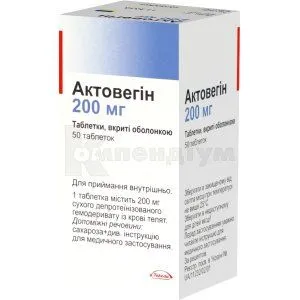
Table of Contents
INSTRUCTIONS FOR MEDICAL USE OF THE MEDICINAL PRODUCT AКTOVEGIN (ACTOVEGIN®)
Composition:
Active substance: Each tablet contains 200 mg of deproteinized hemoderivative from calf blood, in the form of dry Actovegin concentrate;
Excipients: microcrystalline cellulose, magnesium stearate, povidone (K 90), talc;
Coating: sucrose, titanium dioxide (E 171), quinoline yellow dye (E 104), montan wax glycolate, povidone (K 30), macrogol (6000), acacia gum, hypromellose phthalate, diethyl phthalate, talc.
Pharmaceutical form. Coated tablets.
Main physicochemical properties: round-shaped, greenish-yellow, glossy coated tablets.
Pharmacotherapeutic group. Agents affecting the blood and hematopoietic system. Other hematological agents. ATC code B06A B.
Pharmacological Properties.
Pharmacodynamics.
Mechanism of action. The drug Actovegin exhibits three main groups of effects: metabolic, neuroprotective, and microcirculatory. The inositol phosphate oligosaccharides (IPOs) present in Actovegin are responsible for improved oxygen utilization and uptake, enhanced energy metabolism, and increased glucose uptake. This action may potentially be beneficial following tissue or organ injury, including brain injury, and may reduce lactate formation.
Several pathways have been identified through which Actovegin exerts its neuroprotective effects. Actovegin reduces apoptosis induced by beta-amyloid peptides (Aβ25–35). Beta-amyloid peptides act as triggers in a number of molecular and cellular processes, including oxidative stress and inflammation, ultimately leading to neuronal cell death, which in turn results in memory and cognitive impairments.
Nuclear factor kappa B (NF-κB) plays numerous roles in both the central and peripheral nervous systems. It regulates inflammation, which exacerbates the progression of degenerative and vascular diseases, and is involved in pain syndrome development, as well as in learning, memory, and neuroprotection.
Actovegin dose-dependently activates NF-κB reporter gene expression. This transient activation may at least partially explain the neuroprotective properties of Actovegin.
Another important mechanism of action of Actovegin involves the nuclear enzyme poly (ADP-ribose) polymerase (PARP). PARP plays a key role in detecting single-strand DNA breaks and in their repair; however, excessive activation of this enzyme may trigger processes in the cell that lead to the termination of oxidative metabolism. These processes may ultimately result in cell death due to energy depletion. It has been shown that Actovegin reduces PARP activity, thereby improving function and optimizing the morphological structure of both the central and peripheral nervous systems.
The positive effect of Actovegin on microcirculation is due to several of its effects, including increased capillary blood flow velocity, reduced pericapillary zone, decreased tone of smooth muscles in precapillary arterioles and capillary sphincters, reduced arteriole-venular shunting of blood, increased capillary blood flow, and enhanced endothelial nitric oxide synthase function in the microcirculatory bed.
Various parameters in animal studies and clinical trials have shown that the effect begins no later than 30 minutes after administration. Maximum effect is achieved within 3 hours after parenteral or oral administration (2–6 hours).
Clinical efficacy and safety.
Cerebral circulation disorders, including post-stroke cognitive impairments and dementia. Actovegin demonstrated a positive effect in the symptomatic treatment of dementia and dementia-related conditions in over 450 patients across several small randomized clinical trials. Efficacy compared to placebo was demonstrated for endpoints related to cognitive function, daily activities, and overall clinical response; however, no statistically significant improvement in the speed of cognitive processes was observed.
In a 12-month randomized, double-blind, placebo-controlled study assessing safety and efficacy, the effect of Actovegin in patients with post-stroke cognitive impairments was compared to placebo. A total of 503 patients (250 receiving Actovegin) were randomized between days 5 and 7 after ischemic stroke onset. The 6-month treatment period included up to 20 infusions (2000 mg daily), followed by oral administration of tablets (2 tablets of 200 mg three times daily). This was followed by a 6-month observation period during which patients were managed according to standard clinical practice. At 6 and 12 months, patients receiving Actovegin showed statistically significant improvements in scores on the extended cognitive subscale of the Alzheimer's Disease Assessment Scale (ADAS-cog+) and on the Montreal Cognitive Assessment (MoCA) compared to placebo-treated patients. At 3, 6, and 12 months, a greater proportion of patients in the Actovegin group met the responder criteria based on the ADAS-cog+ scale. The frequency of serious adverse events and mortality was similar in both treatment groups. The overall incidence of recurrent ischemic stroke during the study was within expected ranges for this patient population, although a slightly higher frequency was observed in the Actovegin group compared to placebo.
Peripheral circulation disorders and their consequences. Approximately 190 patients with peripheral arterial disease received Actovegin treatment for 10 to 42 days in several small comparative randomized trials, which demonstrated short-term benefits of Actovegin infusions compared to placebo. Improvement in walking distance by 35–42% was observed in the Actovegin group compared to placebo.
In a 6-month randomized, double-blind, placebo-controlled study, the efficacy and safety of Actovegin in patients with Fontaine stage IIb peripheral arterial circulation disorders (claudication at distances < 200 m) were compared to placebo. A total of 366 subjects received intravenous infusions of Actovegin (1200 mg/day) (n = 184) or placebo (n = 182) daily for 2 weeks, followed by 2 tablets of Actovegin (1200 mg/day) or placebo three times daily for the next 10 weeks. A 12-week observation period without study medication followed to assess sustained efficacy after treatment and safety. The therapeutic effect of Actovegin was superior to placebo in increasing both initial claudication distance and absolute claudication distance at weeks 2 and 12, with benefits maintained for an additional 12 weeks after treatment ended. Results of this study showed that Actovegin (12-week treatment), administered initially intravenously (2 weeks at 1200 mg/day) and then orally (10 weeks at 1200 mg/day) in patients with peripheral arterial circulation disorders (Fontaine stage IIb), has an acceptable safety and tolerability profile.
In an open-label randomized study, 60 patients with large trophic leg ulcers due to venous insufficiency received standard therapy with or without Actovegin. Actovegin was administered as daily intravenous infusions of 250 ml of 10% solution for 4 weeks. Mean ulcer healing time was 31 days in the Actovegin group and 42 days in the control group. Improvement in pain scores compared to baseline was observed in both groups; specifically, in the Actovegin group, pain scores decreased from 4.47 to 1.77, while in the control group, they decreased from 4.13 to 2.07.
Diabetic polyneuropathy (DPN). In a study involving 70 patients with diabetic polyneuropathy, statistically significant improvements in walking distance, nerve conduction velocity, and pain sensitivity were demonstrated in patients treated with Actovegin compared to the placebo group. The difference in therapeutic effect compared to placebo was approximately 6.5 m in walking distance, 0.9 m/s in nerve conduction velocity, and 6.8 points on the pain sensitivity scale (on a 100-point scale).
In a 6-month, double-blind, randomized, placebo-controlled study assessing safety and efficacy, 567 patients with type 2 diabetes and symptomatic diabetic distal polyneuropathy received 20 intravenous infusions of Actovegin (2000 mg/day) (n = 281) or placebo (n = 286) once daily for up to 36 days, followed by 3 tablets of Actovegin (1800 mg/day) or placebo three times daily for 140 days. Actovegin treatment showed superior efficacy compared to placebo in the primary endpoint assessed by the Total Symptom Score (TSS) scale, including positive neuropathic pain symptoms such as burning, tingling, and numbness in the feet or legs. There were no significant differences between the treatment and control groups in the incidence of adverse events.
Pharmacokinetics.
Pharmacokinetic methods cannot be used to study the pharmacokinetic characteristics of Actovegin (absorption, distribution, and elimination of active ingredients), as it consists solely of physiological components normally present in the body.
Clinical characteristics.
Indications.
-
Treatment of cerebrovascular diseases, including post-stroke cognitive disorders and dementia.
-
Treatment of peripheral (arterial, venous) circulation disorders and their complications (arterial angiopathy, venous trophic ulcer).
-
Treatment of diabetic polyneuropathy (DPN).
Contraindications.
Hypersensitivity to the active substance, any component of the medicinal product, or to drugs of similar composition.
Interaction with other medicinal products and other forms of interaction.
There is no data available on interactions between the medicinal product Actovegin and other drugs.
Special precautions for use.
In a study involving patients with post-stroke cognitive impairment, a higher incidence of recurrent ischemic stroke was observed in the group treated with the drug Actovegin. The overall incidence of recurrent ischemic stroke during the study was within the expected range for this patient population; however, the incidence was slightly higher in the group receiving Actovegin compared to the placebo group (see section "Pharmacodynamics"). The benefit-risk ratio should be carefully considered when continuing Actovegin treatment in patients who have recently experienced a stroke.
The drug must not be administered to patients with rare hereditary fructose intolerance, glucose-galactose malabsorption, or sucrase-isomaltase deficiency, as the product contains sucrose.
The active ingredient of Actovegin contains phenylalanine, which may be harmful to patients with phenylketonuria.
The active ingredient of Actovegin contains sodium. One tablet of Actovegin contains up to 68 mg of sodium, which should be taken into account in patients on a low-salt (low-sodium) diet.
The active ingredient of Actovegin contains potassium. One tablet of Actovegin contains up to 13 mg of potassium, which should be considered in patients with impaired renal function and in patients on a potassium-controlled diet.
Use during pregnancy or breastfeeding.
The drug may be used during pregnancy or breastfeeding only if the therapeutic benefit to the woman outweighs the potential risk to the fetus or infant. During administration of Actovegin for placental insufficiency, fatal outcomes have been observed, although rarely, which could be consequences of the underlying disease. The use of Actovegin is not recommended in cases of placental insufficiency. Use of Actovegin during breastfeeding has not been associated with any adverse effects in either mother or child.
Ability to influence reaction speed when driving or operating machinery.
Actovegin has no effect or has a negligible effect on the ability to drive or operate machinery. However, possible adverse reactions affecting the nervous system should be taken into account (see section "Adverse reactions").
Method of Administration and Dosage
Actovegin tablets, coated, should be taken before meals, swallowed whole, and accompanied by a small amount of liquid.
Dosage selection for specific indications is based on clinical trial data. General dosage recommendations are also provided.
Treatment of Cerebrovascular Disorders
General Dosage Regimen: 1–2 tablets (200–400 mg) three times daily for 4–6 weeks.
Depending on the severity of the clinical course, treatment may be initiated with Actovegin, injection solution.
Dosage for Post-Stroke Cognitive Impairment and Dementia
Following treatment with Actovegin, injection solution: 2 tablets (400 mg) three times daily; total treatment duration: 6 months.
Treatment of Peripheral (Arterial, Venous) Circulatory Disorders and Their Complications (Arterial Angiopathy, Venous Trophic Ulcer)
General Dosage Regimen: 1–2 tablets (200–400 mg) three times daily for 4–6 weeks.
Depending on the severity of the clinical course, treatment may be initiated with Actovegin, injection solution.
Dosage for Peripheral Arterial Circulatory Disorders, Stage IIb according to Fontaine
Following treatment with Actovegin, injection solution: 2 tablets (400 mg) three times daily for 10 weeks.
Treatment of Diabetic Polyneuropathy (DPN)
General Dosage Regimen: The recommended dose is 1–3 tablets three times daily (up to 1800 mg/day) for 4–5 months.
Depending on the severity of the clinical course, treatment may be initiated with Actovegin, injection solution.
Dosage for Symptomatic Diabetic Distal Polyneuropathy in Patients with Type 2 Diabetes Mellitus
Following treatment with Actovegin, injection solution: up to 3 tablets (up to 600 mg) three times daily; total treatment duration: 6 months.
Children. Data on the use of the drug in children are currently unavailable; therefore, the drug is not recommended for use in this patient population.
Overdose. Cases of Actovegin overdose are unknown. Given the pharmacological properties of the medicinal product, no additional adverse effects are expected.
Side effects
The following criteria are used to classify the frequency of adverse reactions based on the guidelines of the Council for International Organizations of Medical Sciences (CIOMS): very common (≥ 1/10); common (≥ 1/100 but < 1/10); uncommon (≥ 1/1,000 but < 1/100); rare (≥ 1/10,000 but < 1/1,000); very rare (< 1/10,000).
Rarely, anaphylactoid (allergic) reactions may occur, which can manifest as follows:
Immune system and skin – hypersensitivity reactions possible, including allergic reactions, anaphylactic and anaphylactoid reactions up to anaphylactic shock, increased body temperature, chills, angioneurotic edema, skin hyperemia, skin rashes, pruritus, urticaria, increased sweating, swelling of the skin and/or mucous membranes, hot flushes;
Gastrointestinal tract – dyspeptic symptoms, including epigastric pain, nausea, vomiting, diarrhea;
Cardiovascular system – chest pain, increased heart rate (tachycardia), dyspnea, acrocyanosis, pallor, arterial hypotension or hypertension;
Respiratory system – increased respiratory rate, chest tightness, difficulty swallowing and/or breathing, throat pain, suffocation attack;
Nervous system – headache, general weakness, dizziness, loss of consciousness, excitement, tremor, paresthesia;
Musculoskeletal system – muscle and/or joint pain, back pain.
In such cases, treatment with Actovegin should be discontinued and symptomatic therapy initiated.
Reporting of suspected adverse reactions
Reporting of adverse reactions following drug registration is of great importance.
This enables ongoing monitoring of the benefit-risk balance of the medicinal product. Healthcare professionals, pharmacists, patients, or their legal representatives should report all suspected adverse reactions and lack of efficacy through the automated pharmacovigilance information system at the following link: https://aisf.dec.gov.ua.
Shelf life. 3 years.
Storage conditions. Store at a temperature not exceeding 25 °C in the original packaging. Keep out of reach of children!
Packaging. 50 tablets in a bottle; 1 bottle per cardboard box.
Prescription status. Prescription only.
Manufacturer. LLC "Kusum Pharm", Ukraine
(secondary packaging of bulk product from manufacturer Takeda GmbH, manufacturing site Oranienburg, Germany).
Manufacturer's location and address of business operations.
54 Skryabina Street, Sumy, Sumy Oblast, 40020, Ukraine