Aklyf
Ukraine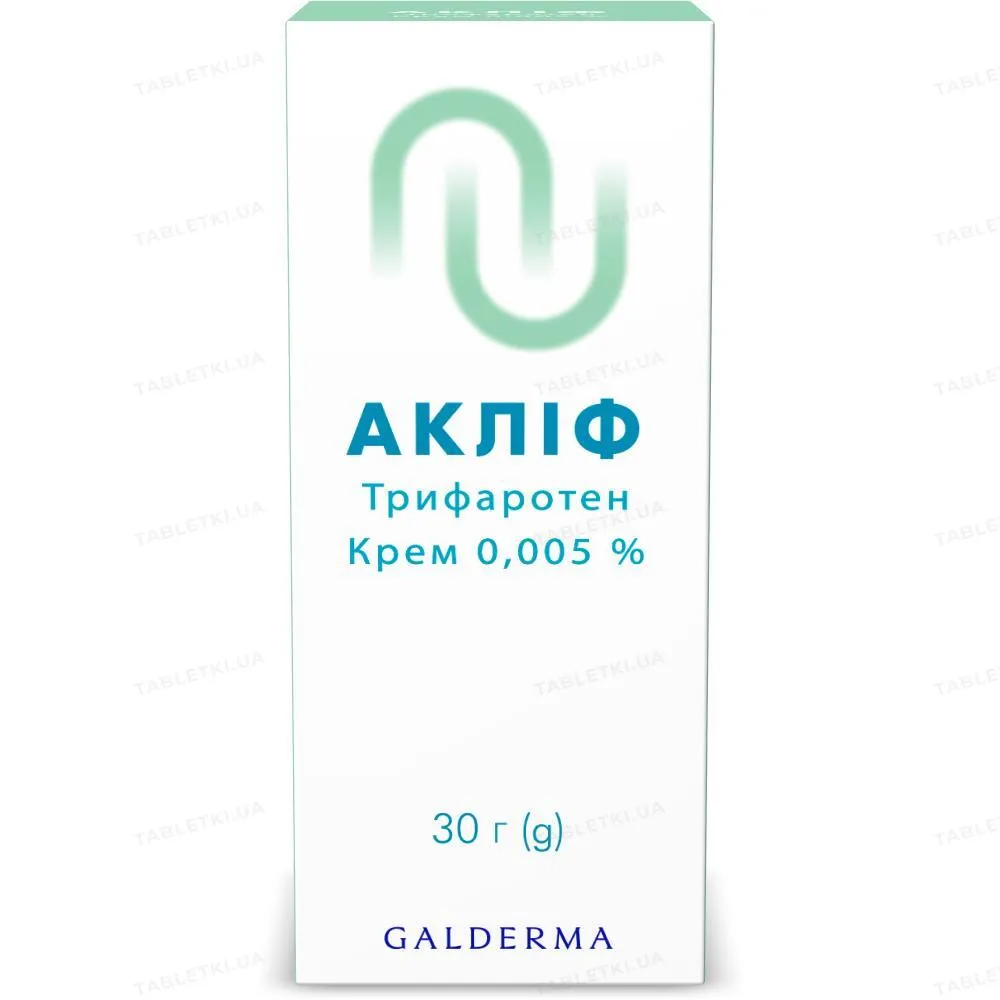
Table of Contents
INSTRUCTIONS FOR MEDICAL USE OF THE MEDICINAL PRODUCT AKLIEF
Composition:
Active substance: trifarotene;
1 g of cream contains trifarotene 0.05 mg;
Excipients: propylene glycol; allantoin; medium-chain triglycerides; phenoxyethanol; cyclomethicone; copolymer of acrylamide and sodium acryloyldimethyl taurate, 40 % dispersion in isohexadecane; ethanol 96 %; purified water.
Pharmaceutical form. Cream.
Main physico-chemical properties: white and homogeneous preparation.
Pharmacotherapeutic group. Topical anti-acne preparations. Topical retinoids for acne treatment. Trifarotene. ATC code D10AD06.
Pharmacological Properties
Pharmacodynamics
Aklif cream contains 0.05 mg/g of trifaroten, a chemically stable derivative of terphenyl acid with activity similar to that of retinoids. It is a potent RARγ agonist (retinoic acid receptor γ agonist), characterized by high specificity for this receptor compared to RARα and RARβ (50- and 8-fold higher, respectively), with no activity on the retinoid X receptor (RXR).
In addition, trifaroten modulates retinoid-target genes (involved in differentiation and inflammatory processes) in immortalized keratinocytes and reconstructed epidermis.
Pharmacodynamic effects
In a study using a mouse model with the Rhino mutation, trifaroten demonstrated significant comedolytic activity, reducing the number of comedones, as well as a marked increase in epidermal thickness. In this model, a comparable comedolytic effect was achieved with approximately 10 times lower dose of trifaroten compared to other known retinoids.
Trifaroten also demonstrated anti-inflammatory and depigmenting activity.
Pharmacokinetics
Absorption
Trifaroten absorption was evaluated in adults and children (10–17 years) with common acne. Patients were treated for 30 days with once-daily application of 2 g of Aklif cream to the face, shoulders, chest, and upper back.
Overall systemic exposure levels were low and similar in adults and children.
After 4 weeks of treatment, plasma levels of trifaroten were quantifiable in 7 out of 19 (37%) adult patients. The Cmax ranged from below the lower limit of quantification (LOQ < 5 pg/mL) to 10 pg/mL, and AUC0–24 h ranged from 75 to 104 pg·h/mL.
Systemic exposure was measurable in 3 out of 17 (18%) pediatric patients. The Cmax ranged from below the lower limit of quantification (LOQ < 5 pg/mL) to 9 pg/mL, and AUC0–24 h ranged from 89 to 106 pg·h/mL.
Steady state was reached in both adults and children after 2 weeks of topical application. Accumulation of the drug is not expected with prolonged use.
Distribution
Trifaroten penetrates the skin exponentially (gradually and continuously increasing concentration in tissues) from the stratum corneum to the epidermis and dermis.
In vitro studies have shown that trifaroten is more than 99.9% bound to plasma proteins. No significant binding of trifaroten to erythrocytes was observed.
Biotransformation
In vitro studies using human liver microsomes and recombinant CYP450 enzymes showed that trifaroten is primarily metabolized by CYP2C9, CYP3A4, and CYP2C8, and to a lesser extent by CYP2B6.
Pharmacokinetic interaction potential of the drug
In vitro studies demonstrated that Aklif cream, at concentrations systemically achieved after topical application, does not inhibit CYP450 isoenzymes CYP1A2, 2B6, 2C8, 2C9, 2C19, 2D6, or 3A4, and does not induce CYP1A2, 2B6, or 3A4.
In vitro studies demonstrated that Aklif cream, at concentrations systemically achieved after topical application, does not inhibit uptake transporters MATE, OATP, OAT, or OCT, nor efflux transporters BCRP, P-gp, BSEP, or MRP.
Preclinical safety data
Note: Based on animal studies, calculations of systemic exposure multiples in humans were based on comparisons of the area under the curve (AUC) following topical application of a 2 g dose of Aklif cream, applied once daily in humans.
Preclinical data revealed no special hazard to humans based on standard safety pharmacology, repeated-dose oral toxicity, genotoxicity, or carcinogenic potential studies.
In repeated-dose dermal toxicity studies in minipigs for up to 9 months, systemic exposure to trifaroten was very low, typically below the limit of quantification. No systemic effects were observed, and the only notable finding was reversible skin irritation at the application sites.
Oral administration studies in rats showed that trifaroten and/or related metabolites cross into breast milk.
Clinical characteristics.
Indications.
Aclif is indicated for the treatment of acne vulgaris on the face and/or trunk in patients aged 12 years and older, when numerous comedones, papules, and pustules are present.
Contraindications.
- Pregnancy.
- Planning pregnancy.
- Hypersensitivity to the active substances or to any of the excipients.
Interaction with other medicinal products and other forms of interaction.
Effect of Aclif cream on other medicinal products
A drug interaction study demonstrated that topical application of trifaroten does not affect circulating concentrations of oral hormonal contraceptives (ethinylestradiol and levonorgestrel).
Effect of other medicinal products on Aclif cream
Clinical drug interaction studies to evaluate the impact of other agents on systemic levels of trifaroten have not been conducted (see section "Pharmacological properties").
There are no data on the potential for pharmacodynamic interactions with trifaroten. Particular caution should be exercised when using cosmetic products with desquamating effects or those that irritate or dry the skin, as additional irritation may occur when used concomitantly with the medicinal product (see section "Special precautions for use").
Special precautions for use.
When using Aklyf cream, erythema, peeling, dryness, and stinging/burning may occur (see section "Adverse reactions"). Patients should be advised that to reduce the risk of such reactions during treatment, a moisturizer should be used, and if necessary, the frequency of Aklyf cream application should be reduced or its use temporarily discontinued. If severe reactions persist despite these mitigating measures, treatment may be discontinued.
The product should not be applied to cuts, abrasions, eczematous areas, or sunburned skin.
As with other retinoids, wax depilation should be avoided on skin treated with Aklyf cream.
If hypersensitivity to any component of the product is suspected, use of Aklyf cream should be discontinued. Particular caution should be exercised when using cosmetic products with desquamating effects or those that irritate or dry the skin, as their use in combination with the medicinal product may cause additional irritation.
Contact of Aklyf cream with eyes, eyelids, lips, or mucous membranes should be avoided. If the product gets into the eyes, they should be immediately and thoroughly rinsed with warm water.
During treatment, excessive exposure to sunlight, including sunlamps and phototherapy devices, should be avoided. When exposure cannot be avoided, it is recommended to use a broad-spectrum, water-resistant sunscreen with a sun protection factor (SPF) of 30 or higher and to cover treated areas with clothing.
This product contains propylene glycol (E1520), which may cause skin irritation. The product also contains ethanol (alcohol) 50 mg/g, which may cause a burning sensation on damaged skin.
Use during pregnancy or breastfeeding.
Oral administration of retinoids is associated with the occurrence of congenital malformations. When applied topically according to recommendations, retinoids generally exhibit low systemic exposure due to minimal skin absorption. However, individual factors (e.g., impaired skin barrier, excessive use) may increase systemic exposure.
Pregnancy
Aklyf is contraindicated during pregnancy (see section "Contraindications") and in women planning to become pregnant.
Animal studies with trifaroten have demonstrated reproductive toxicity following oral administration of high doses.
If the product is used during pregnancy or if a patient becomes pregnant while using this product, treatment should be discontinued.
Breastfeeding
It is unknown whether trifaroten or its metabolites are excreted in human breast milk.
Available data from pharmacological/toxicological animal studies have demonstrated excretion of trifaroten/metabolites into maternal milk.
A risk to the breastfed infant cannot be excluded. Therefore, a decision should be made whether to discontinue breastfeeding or to discontinue or suspend treatment with Aklyf, taking into account the benefits of breastfeeding for the infant and the benefits of therapy for the mother.
To avoid the risk of accidental ingestion by the infant and/or direct contact exposure, breastfeeding women should not apply trifaroten cream to the breasts or chest area.
Fertility
No studies have been conducted on the effect of Aklyf on reproductive function.
Reproductive studies in rats following oral administration showed no effect of trifaroten on fertility. However, after oral administration in dogs, signs of degeneration of germ cells were observed.
Ability to affect reaction speed when driving or operating machinery.
Aklyf has no effect or has a negligible effect on the ability to drive or operate machinery.
Method of Administration and Dosage
Dosage
Apply a thin layer of Aklif cream to affected areas of the face and/or trunk once daily in the evening, onto clean and dry skin.
It is recommended to consult a physician for evaluation of long-term improvement in the patient's condition after three months of treatment.
Special Patient Groups
Elderly Patients
The safety and efficacy of Aklif in geriatric patients over 65 years of age have not been established.
Renal and Hepatic Impairment
Studies with Aklif in patients with renal or hepatic impairment have not been conducted.
Method of Administration
For topical use only.
Apply a thin layer of Aklif cream to affected areas of the face (forehead, nose, chin, right and left cheeks) and trunk once daily in the evening, onto clean and dry skin.
For ease of use, the container holding Aklif is equipped with a pump. Before first use, prime the pump by pressing it several times until a small amount of the product is dispensed (up to 10 times). The pump is now ready for use:
- One pump actuation should be sufficient for application to the face (i.e., forehead, cheeks, nose, and chin).
- Two pump actuations should be sufficient for application to the upper trunk (i.e., accessible upper back, shoulders, and chest). One additional pump actuation may be used for application to the mid and lower back if acne is present in these areas.
Patients should be instructed to avoid contact of the product with eyes, eyelids, lips, and mucous membranes, and to wash hands after applying the medicinal product.
If needed, a moisturizing cream may be used during treatment with Aklif. Adequate time should be allowed so that the skin is dry both before and after application of Aklif cream.
Children
The safety and efficacy of Aklif in children under 12 years of age have not been established.
Overdose
Aklif is intended for topical use only, once daily.
Excessive application of the medicinal product will not produce faster or better results and may lead to noticeable redness, peeling, or discomfort of the skin. In such cases, treatment should be discontinued and resumed only after the skin has recovered.
In case of accidental ingestion, appropriate symptomatic measures should be taken. Chronic ingestion of the product may cause the same adverse effects as excessive oral intake of vitamin A.
Adverse Reactions
Summary of Safety Profile
Local skin reactions such as erythema, peeling, dryness, and stinging/burning have been identified among other adverse events as indicators of local tolerability. These skin reactions on the face were very common, with mild, moderate, and severe intensity observed in 39%, 29.7%, and 6.2% of patients, respectively. On the trunk, mild, moderate, and severe reactions occurred in up to 32.9%, 18.9%, and 5.2% of patients, respectively. The maximum severity of local skin reactions on the face typically occurred during the first week of treatment, while on the trunk it occurred during weeks 2–4, and decreased with continued use of the medicinal product (see section "Dosage and Administration").
The most commonly reported adverse reactions, as described in the table below, are application site irritation, pruritus, and application site sunburn, observed in 1.2–6.5% of patients treated with Aclif cream in clinical trials.
Summary Table of Adverse Reactions
Adverse reactions reported in 12-week, phase 3, placebo-controlled studies in 1220 patients treated with Aclif cream (and for which the incidence with Aclif cream was higher than with placebo cream) are presented in the table.
Adverse reactions are classified by system organ class and frequency as follows: very common (≥ 1/10), common (≥ 1/100 to < 1/10), uncommon (≥ 1/1000 to < 1/100), rare (≥ 1/10,000 to < 1/1000), very rare (< 1/10,000), frequency not known (cannot be estimated from available data).
| System organ class |
Frequency |
Adverse reactions |
| General disorders and administration site conditions |
Common |
Application site irritation Application site pruritus |
| Uncommon |
Application site pain Application site dryness Application site depigmentation Application site erosion Application site rash Application site swelling |
|
| Rare |
Application site erythema Application site urticaria Application site vesicles |
|
| Injury, poisoning and procedural complications |
Common |
Sunburn |
| Skin and subcutaneous tissue disorders |
Uncommon |
Skin irritation Acne Allergic dermatitis Erythema |
| Rare |
Asteatotic eczema Seborrheic dermatitis Skin burning sensation Skin fissures Skin hyperpigmentation |
|
| Eye disorders |
Rare |
Eyelid skin peeling Periorbital edema |
| Gastrointestinal disorders |
Rare |
Cheilitis |
| Vascular disorders |
Rare |
Flushing |
Reporting of suspected adverse reactions
Reporting of suspected adverse reactions during the post-marketing period of a medicinal product is important. This allows for continuous monitoring of the benefit/risk ratio of the use of the medicinal product. Healthcare professionals are obliged to report any cases of suspected adverse reactions through the national reporting system.
Shelf life.
2 years. After first opening of the packaging, the product is suitable for use for 6 months.
Storage conditions.
No special storage conditions required. Keep out of reach of children.
Packaging.
30 g of cream in a container; 1 container in a cardboard box.
Prescription status.
Prescription only.
Manufacturer.
LABORATOIRES GALDERMA.
Manufacturer's address and address of the place of business.
ZI Mondésir, 74540 ALBIGNY-SUR-SAONE, France.