Akistan duo
Ukraine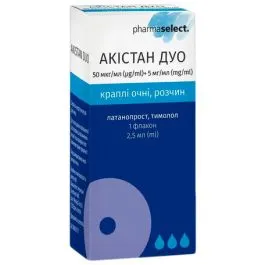
Table of Contents
INSTRUCTIONS FOR MEDICAL USE OF THE MEDICINAL PRODUCT AKISTANDUO
Composition:
active substances: latanoprost, timolol;
1 ml of solution contains 50 mcg of latanoprost and 5 mg of timolol (as timolol maleate);
excipients: sodium dihydrogen phosphate dihydrate; disodium hydrogen phosphate dodecahydrate; sodium chloride; 10% m/m solution of benzalkonium chloride; 10% m/m solution of sodium hydroxide / 10% m/m solution of phosphoric acid (for pH adjustment); purified water.
Pharmaceutical form. Eye drops, solution.
Main physicochemical properties: clear, colorless solution, not more intensely colored than water R, free from visible particles.
Pharmacotherapeutic group. Agents used in ophthalmology. Anti-glaucoma and miotic agents. Timolol, combinations. ATC code S01ED51.
Pharmacological Properties
Pharmacodynamics
Mechanism of action
The medicinal product Akistan Duo contains two components: latanoprost and timolol maleate. Both components reduce elevated intraocular pressure (IOP) through different mechanisms, and their combined effect results in a greater reduction of IOP than monotherapy with either component alone.
Latanoprost, a prostaglandin F2α analog, is a selective agonist of prostaglandin FP receptors that reduces IOP by enhancing the outflow of aqueous humor. The primary mechanism of action involves increased uveoscleral outflow. Additionally, a slightly enhanced outflow (reduced outflow resistance in the trabecular meshwork) has been reported in men. Latanoprost does not significantly affect aqueous humor production, the blood-aqueous barrier, or intraocular blood circulation. Long-term administration of latanoprost in animals that had undergone extracapsular lens extraction did not affect retinal blood vessels, as assessed by fluorescein angiography. Short-term use of latanoprost did not induce fluorescein leakage into the posterior segment of the eye in pseudophakic patients.
Timolol is a non-selective beta-1 and beta-2 adrenergic receptor blocker that lacks direct sympathomimetic activity and has no direct myocardial depressant or membrane-stabilizing effects. Timolol reduces IOP by decreasing aqueous humor production by the ciliary epithelium.
The exact mechanism of action is not fully established, but likely involves inhibition of enhanced cyclic AMP (cAMP) synthesis caused by endogenous stimulation of beta-adrenergic receptors. Timolol has no significant effect on the permeability of the blood-aqueous barrier to plasma proteins. In animals, timolol did not affect ocular blood flow after long-term administration.
Clinical efficacy and safety
In dose-finding studies, combination therapy with latanoprost and timolol resulted in significantly greater reduction in mean diurnal IOP compared to monotherapy with either latanoprost or timolol administered once daily. In two well-controlled, double-masked, six-month clinical studies, the IOP-lowering effect of combination therapy was compared with monotherapy using latanoprost or timolol in patients with elevated IOP of at least 25 mmHg. After a two-week treatment with timolol (mean IOP reduction of 5 mmHg), additional mean diurnal IOP reductions of 3.1, 2.0, and 0.6 mmHg were observed after 6 months of treatment with combination therapy, latanoprost monotherapy, and timolol (twice daily), respectively. The IOP-lowering effect of combination therapy was maintained throughout the six-month duration of these studies.
Pharmacokinetics
Latanoprost. Latanoprost is a prodrug, an isopropyl ester that is essentially inactive but is hydrolyzed by esterases in the cornea to the biologically active latanoprost acid. The drug is well absorbed through the cornea and, like all agents entering the aqueous humor, is hydrolyzed during passage through the cornea. Maximum concentration in aqueous humor (approximately 15–30 ng/mL) is reached about 2 hours after topical administration of latanoprost as monotherapy. It is distributed primarily in the anterior segment of the eye, conjunctiva, and eyelids.
Plasma clearance of latanoprost acid is 0.4 L/h/kg; the volume of distribution is low (0.16 L/kg), resulting in a short plasma half-life (17 minutes). After topical ophthalmic administration, the systemic bioavailability of latanoprost is 45%. Latanoprost acid is 87% bound to plasma proteins.
Metabolism of latanoprost acid in the eye is minimal. The main metabolism occurs in the liver. The primary metabolites (1,2-dinor and 1,2,3,4-tetranor) are either inactive or have only weak biological activity and are excreted predominantly in urine.
Timolol. Maximum concentration of timolol in aqueous humor is reached approximately 1 hour after topical administration of eye drops. A portion of the dose is systemically absorbed; maximum plasma concentration reaches 1 ng/mL and is achieved 10–20 minutes after topical administration of one drop in each eye once daily (300 µg/day). The plasma half-life of timolol is approximately 6 hours. Timolol is extensively metabolized in the liver. Metabolites are excreted in urine, primarily as unchanged timolol.
Akistan Duo. No pharmacological interactions between latanoprost and timolol have been observed, despite a nearly twofold increase in latanoprost acid concentration in aqueous humor after administration of the fixed combination compared to monotherapy.
In dose-finding studies, administration of the fixed combination resulted in significantly greater reduction in mean diurnal IOP than monotherapy with either latanoprost or timolol once daily.
It has been demonstrated that evening administration of the drug may be more effective in reducing IOP than morning administration. However, when considering recommendations for morning or evening dosing, the patient's lifestyle and likely adherence should be taken into account.
It should be noted that if the fixed combination is insufficiently effective, separate administration of timolol and latanoprost once daily may be effective, as supported by study data.
The onset of action occurs within one hour, and the maximum effect lasts from 6 to 8 hours. Adequate reduction in IOP persists for up to 24 hours with long-term treatment.
Clinical characteristics
Indications
Reduction of intraocular pressure (IOP) in patients with open-angle glaucoma and elevated IOP when local treatment with beta-adrenergic blockers or locally acting prostaglandin analogs is insufficiently effective.
Contraindications
- Hypersensitivity to the active substance or to any other component of the medicinal product.
- Respiratory hyperreactivity syndrome, including acute bronchial asthma and history of asthma attacks, severe chronic obstructive bronchopulmonary disease (COPD).
- Sinus bradycardia, sick sinus syndrome, sinoatrial block, second- or third-degree atrioventricular block not controlled by a pacemaker, cardiac failure, cardiogenic shock.
Interaction with other medicinal products and other forms of interaction
Specific studies on the interaction of Akistan Duo with other drugs have not been conducted.
Paradoxical increase in IOP has been reported with concomitant use of two prostaglandin analog medications. Therefore, the use of two or more prostaglandins, prostaglandin analogs, or prostaglandin derivatives is not recommended.
There is a potential for additive effects leading to arterial hypotension and/or marked bradycardia when beta-blockers in the form of eye drops are administered concomitantly with oral calcium channel blockers, catecholamine-depleting agents, beta-adrenergic blockers, antiarrhythmic drugs (including amiodarone), digitalis glycosides, parasympathomimetics, or guanethidine.
Enhanced systemic beta-blockade (e.g., reduced heart rate, depression) has been observed during combined use of CYP2D6 inhibitors (e.g., quinidine, fluoxetine, paroxetine) and timolol.
The effect on IOP or known systemic beta-receptor blockade effects may be potentiated when Akistan Duo is used concomitantly in patients already receiving oral beta-blockers. Concomitant use of two locally acting beta-blockers is not recommended.
Rarely, mydriasis has been reported when timolol was used concomitantly with adrenaline (epinephrine).
The hypertensive reaction associated with abrupt withdrawal of clonidine may be potentiated by beta-blockers.
Beta-blockers may enhance the hypoglycemic effect of antidiabetic medications. Beta-blocker therapy may mask the signs and symptoms of hypoglycemia.
Special precautions for use
Systemic effects
As with other ophthalmic agents applied locally, systemic absorption of Akistan Duo is possible. Since the product contains a beta-adrenergic receptor blocker (timolol), this medication may produce the same systemic adverse reactions affecting the cardiovascular and respiratory systems as systemic beta-blockers. The frequency of systemic adverse reactions after local administration is lower than after systemic administration of the drug. Measures to reduce systemic absorption are described in the section "Dosage and administration".
Cardiac disorders
The use of beta-blockers in patients with cardiovascular diseases (e.g., ischemic heart disease, Prinzmetal's angina, and cardiac failure), as well as in patients with hypotension, should be carefully evaluated, and alternative treatments should be considered. Patients with cardiovascular disorders should be monitored for signs of worsening of these conditions and for adverse reactions.
Since beta-blockers prolong conduction time, they should be used with caution in patients with first-degree heart block.
Cases of cardiovascular adverse reactions, and in some instances fatal outcomes due to cardiac failure, have been reported following administration of timolol.
Vascular disorders
The drug should be used with caution in the treatment of patients with severe peripheral circulatory disorders (e.g., patients with severe forms of Raynaud's disease or Raynaud's syndrome).
Respiratory disorders
Respiratory adverse reactions, including fatal cases due to bronchospasm in patients with asthma, have been reported with the use of some ophthalmic beta-blockers. The drug should be used with caution in patients with mild to moderate chronic obstructive pulmonary disease (COPD) and should be prescribed only when the expected benefit outweighs the potential risk of treatment.
Hypoglycemia / diabetes
Beta-blockers should be used with caution in patients prone to spontaneous hypoglycemia or in patients with labile insulin-dependent diabetes mellitus, as they may mask the signs and symptoms of acute hypoglycemia.
Beta-blockers may also mask the signs of hyperthyroidism.
Corneal disorders
Ophthalmic beta-blocker agents may cause dry eyes; therefore, these agents should be used with caution in patients with corneal disorders.
Other beta-blockers
The known effect of systemic beta-blockers on intraocular pressure (IOP) may be enhanced if Akistan Duo solution is administered to patients already receiving oral beta-blockers. Such patients require careful monitoring. The concomitant use of two locally acting beta-blockers is not recommended (see section "Interaction with other medicinal products and other forms of interaction").
Anaphylactic reactions
While on beta-blockers, patients with a history of atopy or severe anaphylactic reactions to various allergens may not respond to usual doses of adrenaline used in the treatment of anaphylactic reactions.
Ocular choroidal detachment
Choroidal detachment has been reported with the use of aqueous suppressants (e.g., timolol, acetazolamide) following filtration procedures.
Surgical anesthesia
Ophthalmic beta-blocker agents may block the systemic effects of beta-adrenergic agonists, such as adrenaline. If a patient is taking timolol, this should be communicated to the anesthesiologist.
Concomitant therapy
Timolol may interact with other drugs (see section "Interaction with other medicinal products and other forms of interaction").
Other prostaglandin analogs
Patients should not use two topical beta-blockers or two prostaglandin analogs simultaneously.
Change in iris pigmentation
Latanoprost may gradually change eye color by increasing the amount of brown pigment in the iris. Similar to data from treatment with latanoprost eye drops, increased iris pigmentation (based on photographs) was observed in 16–20% of patients treated with Akistan Duo for up to one year. This effect is predominantly seen in patients with mixed-color irises, i.e., green-brown, yellow-brown, or brown-blue/green, due to increased melanin concentration in the stromal melanocytes of the iris. Typically, brown pigmentation around the pupil spreads concentrically toward the periphery of the iris of the treated eye, but the entire iris or parts of it may become more distinctly brown. Clinical studies of latanoprost have shown that color changes were rare in patients with uniformly blue, gray, green, or brown eyes and occurred only after two years of treatment.
The change in iris color occurs slowly and may go unnoticed for several months to several years and is not associated with any symptoms or pathological changes.
Further intensification of brown iris pigmentation has not been observed after discontinuation of treatment, but the color change achieved may be permanent.
Neither iris nevi nor freckles have been affected by the therapy.
Pigment accumulation in the trabecular meshwork or any other part of the anterior chamber of the eye has not been observed; however, patients should be examined regularly, and treatment may be discontinued depending on the clinical situation if pigmentation intensifies.
Patients should be informed about the potential for eye color change before initiating treatment. Treatment of one eye may lead to permanent heterochromia.
Changes in eyelids and eyelashes
Skin darkening of the eyelids, which may be reversible, has been reported with the use of latanoprost.
These changes include increased length, thickness, pigmentation, and number of eyelashes or eyelid hair, as well as misdirected eyelash growth. Eyelash changes are reversible after discontinuation of treatment.
Glaucoma
There is no documented experience with the use of latanoprost in the treatment of inflammatory, neovascular, chronic angle-closure, or congenital glaucoma, open-angle glaucoma in pseudophakic patients, or pigmentary glaucone. Latanoprost has no or minimal effect on the pupil, but there is no experience with its use in acute attacks of angle-closure glaucoma. Therefore, Akistan Duo should be used with caution in such situations until more experience is accumulated.
Herpetic keratitis
Latanoprost should be used with caution in patients with a history of herpetic keratitis and should be avoided in patients with active herpetic keratitis caused by herpes simplex virus and in patients with a history of recurrent herpetic keratitis associated with the use of prostaglandin analogs.
Macular edema
Macular edema, including cystoid macular edema, may occur during treatment with latanoprost. Such cases have primarily occurred in pseudophakic patients with posterior lens capsule rupture or in patients with known risk factors for macular edema. Akistan Duo should be used with caution in these patients.
Preservative
Akistan Duo contains benzalkonium chloride, commonly used as a preservative in ophthalmic medicinal products. Benzalkonium chloride has been reported to cause punctate keratitis and/or toxic ulcerative keratopathy, may cause eye irritation, and is known to alter the color of soft contact lenses. Careful monitoring is required in patients with dry eye syndrome or conditions involving corneal damage during frequent and prolonged use of Akistan Duo.
Contact lenses
Contact lenses may absorb benzalkonium chloride; therefore, lenses must be removed before instilling Akistan Duo and may be reinserted 15 minutes later (see section "Dosage and administration").
Use during pregnancy or breastfeeding
Pregnancy
Latanoprost
There are no adequate data on the use of latanoprost in pregnant women. Animal studies have shown reproductive toxicity. The potential risk to humans is unknown.
Timolol
There are no adequate data on the use of timolol in pregnant women. Unless clearly necessary, timolol should not be prescribed during pregnancy. Methods to reduce systemic absorption are described in the section "Dosage and administration".
Epidemiological studies have not shown teratogenic effects, but a risk of intrauterine growth retardation has been demonstrated with systemic use of beta-blockers. In addition, signs and symptoms of beta-adrenergic blockade (e.g., bradycardia, hypotension, respiratory distress, and hypoglycemia) have been observed in newborns whose mothers received beta-blockers before delivery. When Akistan Duo is used by a pregnant woman in the period preceding childbirth, the newborn should be carefully monitored during the first days of life.
Given the above, the drug should not be used during pregnancy.
Breastfeeding
Timolol maleate has been detected in human milk after both oral administration and ocular instillation. Beta-blockers penetrate into breast milk. However, the therapeutic dose of timolol in eye drops is insufficient for the amount excreted into milk to cause clinical symptoms of beta-adrenergic blockade in the newborn. Methods to reduce systemic absorption are described in the section "Dosage and administration".
Latanoprost and its metabolites may pass into breast milk; therefore, Akistan Duo should not be used in women who are breastfeeding.
Fertility
Animal studies have not shown any effect of latanoprost or timolol on male or female fertility.
Ability to affect reaction speed when driving or operating machinery
Transient blurred vision may occur after administration of the drug; therefore, patients should wait until vision is fully restored before driving or operating machinery.
Dosage and Administration
Recommended dosage for adults (including elderly patients)
Recommended treatment: one drop in each affected eye once daily.
If a dose is missed once, the medication should be administered the following day.
The dose should not exceed one drop in each affected eye once daily, as more frequent administration may result in reduced intraocular pressure (IOP)-lowering effect.
Administration method
Contact lenses should be removed prior to instillation of eye drops and may be reinserted only 15 minutes after administration.
If more than one topical ophthalmic agent is prescribed, the medications should be administered with an interval of at least 5 minutes between them.
Application of nasolacrimal occlusion or eye closure for 2 minutes after instillation reduces systemic absorption of the medication. This may lead to reduced intensity of systemic adverse effects and increased local efficacy of the drug.
Children
Safety and efficacy of the medication in children have not been established; therefore, this medicinal product is not recommended for use in pediatric patients.
Overdose
There are no data on overdose in humans with the use of Akistan Duo.
Symptoms of timolol overdose with systemic administration: bradycardia, arterial hypotension, bronchospasm, cardiac arrest. If such symptoms occur, symptomatic and supportive therapy should be initiated. Dialysis is ineffective.
Apart from eye irritation and conjunctival hyperemia, no other systemic adverse effects of latanoprost have been observed.
In case of accidental ingestion of latanoprost
Treatment: gastric lavage if necessary.
Symptomatic treatment: Latanoprost is extensively metabolized during first-pass liver metabolism. Intravenous infusion at a dose of 3 mcg/kg in healthy volunteers did not produce any symptoms, whereas administration of 5.5–10 mcg/kg was associated with nausea, abdominal pain, dizziness, fatigue, flushing, and increased sweating. These manifestations were mild to moderate in severity and resolved spontaneously within 4 hours after completion of the infusion.
Adverse Reactions
Most adverse effects associated with latanoprost use occur in the eye. Clinical data indicate that iris pigmentation increased in 16–20% of patients. This effect may be permanent. In a 5-year open-label safety study of latanoprost, iris pigmentation occurred in 33% of patients (see section "Special Warnings and Precautions for Use"). Other ocular adverse effects are usually transient and dose-dependent. The most serious adverse effects associated with timolol are systemic and include bradycardia, arrhythmia, congestive heart failure, bronchospasm, and allergic reactions.
Like other topically administered ophthalmic agents, timol游戏副本