Agrelid
Ukraine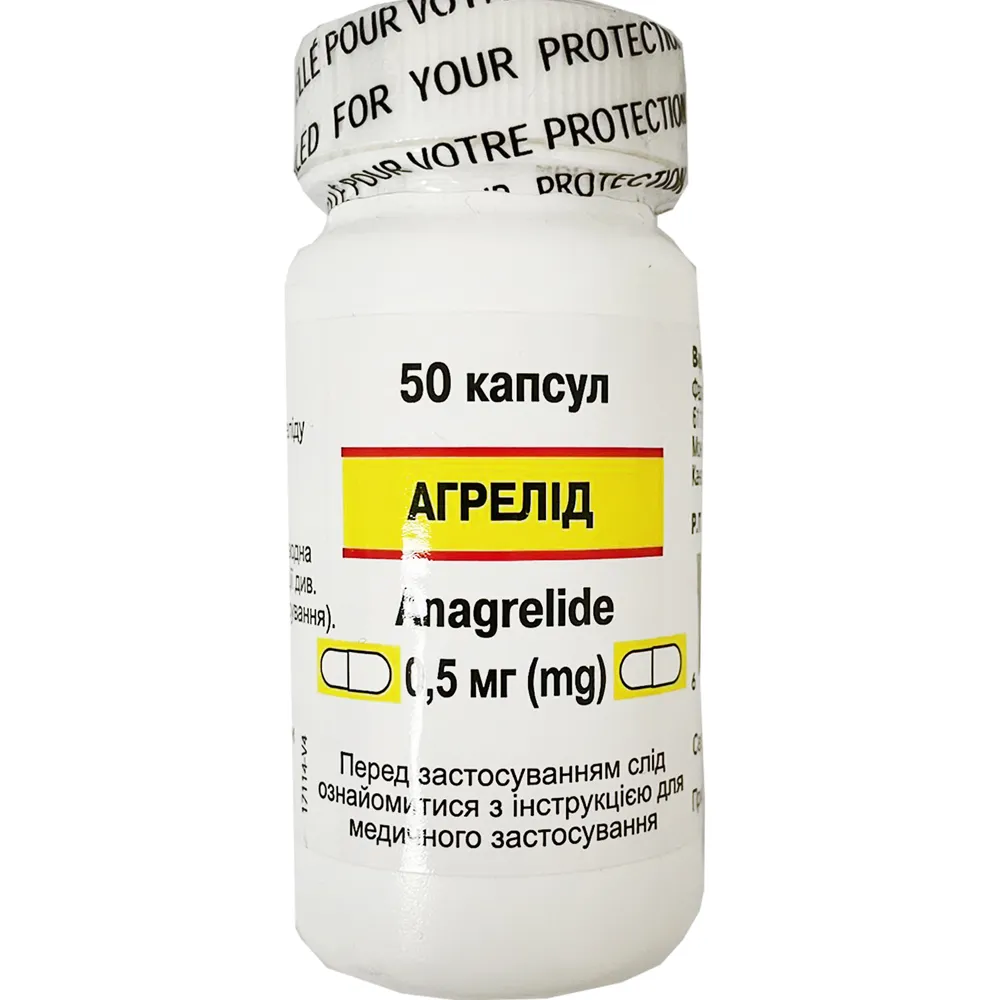
Table of Contents
INSTRUCTION FOR MEDICAL USE OF THE MEDICINAL PRODUCT AGRELID
Composition:
Active substance: anagrelide;
1 capsule contains anagrelide 0.5 mg in the form of anagrelide hydrochloride monohydrate;
Excipients: lactose monohydrate, anhydrous lactose, microcrystalline cellulose, crospovidone, povidone, magnesium stearate;
Capsule shell composition: silicon dioxide, sodium lauryl sulfate, titanium dioxide (E 171), purified water, gelatin.
Pharmaceutical form. Capsules.
Main physicochemical characteristics:
opaque hard gelatin capsules of white or almost white color, size № 4, with black print "0.5 mg" on the capsule body and cap. The capsules are filled with granules of white or almost white color.
Pharmacotherapeutic group.
Antineoplastic agents. Anagrelide. ATC code L01X X35.
Pharmacological properties.
Pharmacodynamics.
Agrelid is a specific agent affecting the reduction of platelet count in peripheral blood.
Oral administration of anagrelide results in a dose-dependent and reversible decrease in platelet count in peripheral blood. The mechanisms by which anagrelide causes reduction in platelet count are still under investigation.
Clinical study data indicate that anagrelide inhibits the hypermaturation of megakaryocytes, and this effect is dose-dependent. In blood samples obtained from healthy volunteers who received anagrelide, disturbances in the postmitotic phase of megakaryocyte development were observed, along with reduced size and ploidy of these cells. At therapeutic doses, anagrelide does not cause significant changes in leukocyte count and produces only a mild, clinically insignificant reduction in erythrocyte count.
Anagrelide inhibits cyclic AMP phosphodiesterase III. Phosphodiesterase III inhibitors may reduce platelet aggregation. However, a significant reduction in platelet aggregation occurs only at higher doses than those required to reduce platelet count. Administration of anagrelide does not lead to significant changes in parameters such as blood coagulation time and platelet lifespan, nor does it alter bone marrow morphology. Anagrelide does not affect arterial blood pressure, pulse rate, urine analysis parameters, or ECG readings.
Pharmacokinetics.
Following oral administration, anagrelide is rapidly absorbed in the gastrointestinal tract. Approximately 76% of the capsule content is absorbed in the intestine.
After oral administration of anagrelide in doses ranging from 0.5 to 2.0 mg, pharmacokinetic parameters remain linear. Following a single 0.5 mg dose administered on an empty stomach, the plasma half-life of the drug is 1.3 hours. Based on these data, optimal dosing frequency is considered to be 2 to 4 times daily.
With repeated administration, anagrelide does not accumulate in plasma. The drug undergoes rapid metabolism, and the main metabolite is excreted in urine within 24 hours; less than 1% is excreted unchanged.
Concomitant food intake slows the absorption of the drug from the gastrointestinal tract. Therefore, when anagrelide is taken with or after food, it remains detectable in the blood longer than when taken on an empty stomach. After administration of a 0.5 mg dose of anagrelide following food intake, a moderate reduction in bioavailability is observed, averaging 14%, and the plasma half-life slightly increases to 1.8 hours.
Pharmacokinetic studies following a single 1 mg dose of anagrelide in patients with severe renal impairment (creatinine clearance < 30 mL/min) showed no significant changes in pharmacokinetic parameters.
Pharmacokinetic studies following a single 1 mg dose of anagrelide in patients with moderate hepatic impairment indicate an 8-fold increase in the elimination half-life of the drug.
Clinical characteristics.
Indications.
Treatment of thrombocytosis in patients with myeloproliferative disorders to reduce platelet count, lower the risk of thrombosis, and control associated symptoms, including thrombohemorrhagic manifestations (chronic forms of the disease).
Contraindications.
Hypersensitivity to the components of the drug.
Moderate or severe hepatic impairment (transaminase levels more than 5 times above the upper limit of normal).
Moderate or severe renal impairment (creatinine clearance < 50 mL/min).
The drug should not be used for the treatment of acute, life-threatening complications of thrombocytosis.
Interaction with other medicinal products and other forms of interaction.
Anagrelide is a phosphodiesterase III inhibitor. Concomitant use of anagrelide with other phosphodiesterase III inhibitors such as milrinone, enoximone, amrinone, olprinone, and cilostazol is not recommended. Fluvoxamine and omeprazole may negatively affect anagrelide clearance. At recommended doses, the drug may potentiate the effect of other medicinal products that inhibit or modify platelet function, such as acetylsalicylic acid. In some patients with essential thrombocythemia receiving concomitant acetylsalicylic acid and anagrelide, episodes of massive bleeding have occurred. The potential risk of hemorrhage should be assessed before initiating concomitant therapy with acetylsalicylic acid and anagrelide.
Pharmacokinetic studies of concomitant administration of anagrelide with warfarin and digoxin showed no interaction between these drugs.
During clinical trials, the following medicinal products were most frequently co-administered with anagrelide: acetaminophen, furosemide, iron preparations, ranitidine, hydroxyurea, allopurinol. No clinical evidence of interaction between these drugs and anagrelide was observed. In clinical practice, sucralfate has been reported to interfere with anagrelide absorption in the gastrointestinal tract.
Concomitant use of anagrelide with phlebotomy has been effective, as has combination therapy with hydroxyurea, aspirin, interferon, and alkylating agents in patients receiving anagrelide.
Special precautions for use.
Hepatic impairment. In mild degrees of hepatic dysfunction, liver function should be continuously monitored in order to detect early signs of hepatotoxicity and cardiotoxicity.
Anagrelide is contraindicated in patients with moderate to severe hepatic impairment.
Renal impairment. The potential risks and benefits of using anagrelide in patients with renal impairment should be carefully considered before initiating therapy.
Monitoring. Treatment with this medicinal product requires careful patient monitoring, including blood tests (haemoglobin, leukocytes, and platelets), assessment of liver function (ALT and AST), and kidney function (serum creatinine and urea).
Administration of anagrelide in patients with cardiovascular disorders or hepatic dysfunction should be performed under continuous medical supervision.
Platelets. Platelet counts begin to increase within 4 days after discontinuation of the drug and return to pre-treatment levels by days 10–14.
Anagrelide should not be used for the treatment of acute or life-threatening complications of thrombocytosis.
Cardiovascular system. Cases of cardiomegaly and heart failure have been reported.
Anagrelide should be administered to patients of any age with cardiovascular disease or suspected cardiovascular disorders only if the benefit outweighs the potential risk.
Patients with cardiovascular disorders should undergo a cardiological evaluation (electrocardiogram and echocardiogram) prior to initiating anagrelide therapy, and regular monitoring should be performed during treatment due to the positive ionotropic effect of anagrelide and possible cardiovascular effects, including vasodilation, tachycardia, palpitations, and congestive heart failure.
Elderly patients. No differences in dosage, safety profile, or frequency of adverse reactions have been observed between elderly patients (aged 65 years and older) and younger patients.
The product contains lactose. This medicinal product is contraindicated in patients with congenital galactosemia, glucose-galactose malabsorption syndrome, or lactase deficiency.
Use during pregnancy or breastfeeding.
Safety and efficacy studies of the drug in pregnant or breastfeeding women have not been conducted. The use of anagrelide during pregnancy is not recommended.
If a woman becomes pregnant while taking anagrelide or is taking the drug during pregnancy, she should be informed of the potential risk to the fetus.
Women of reproductive potential who are taking anagrelide should use contraception.
It is unknown whether anagrelide is excreted in human breast milk. Due to the potential risk of the drug to the infant, if treatment with anagrelide is necessary during breastfeeding, breastfeeding should be discontinued.
Ability to affect reaction speed when driving or operating machinery.
Patients who experience dizziness, visual disturbances, or similar adverse effects during treatment should refrain from driving or operating machinery.
Method of Administration and Dosage
Agrylin is administered orally.
Treatment should be initiated under continuous medical supervision.
The recommended initial dose of anagrelide is 0.5 mg four times daily or 1.0 mg twice daily. This dose should be maintained for 1 week. After 1 week, the dose may be individually adjusted, increasing gradually to the minimum effective dose sufficient to reduce/maintain platelet count below 600×10⁹/L, and ideally within the range of 150×10⁹/L to 400×10⁹/L.
The dose increase should not exceed 0.5 mg per day per week. The maximum single dose of the drug should not exceed 2.5 mg. The highest daily dose used during clinical trials was 10 mg/day.
During the first week of treatment, platelet counts should be monitored every 2 days, and thereafter at least weekly until a stable dose is achieved. Platelet count reduction is generally observed within 14–21 days after initiation of therapy, and in most patients, adequate therapeutic response is achieved and maintained with a daily dose of 1–3 mg.
There are no specific dosage recommendations for elderly patients.
For patients with mild hepatic impairment, the risks and benefits of treatment should be carefully considered before initiating therapy. Treatment should be initiated at a dose of 0.5 mg/day, maintained for at least one week under careful cardiovascular monitoring. The dose should not be increased by more than 0.5 mg per week.
Children
The safety and efficacy of anagrelide in pediatric patients have not been established. Myeloproliferative disorders are rare in pediatric patients, and data in this population are limited. In an open-label study involving 17 pediatric patients aged 7 to 14 years and 18 adult patients (67% of whom were elderly patients aged 65 years or older) with essential thrombocythemia, doses and body weight-normalized exposure, Cmax, and AUC of anagrelide were lower in children/adolescents compared to adults (Cmax 48%, AUCt 55%).
Anagrelide should be used with caution in this patient population.
The observed pharmacokinetic differences between adults and younger patients in essential thrombocythemia do not require dose adjustment.
Overdose
A small number of anagrelide overdose cases have been reported, with symptoms including sinus tachycardia and vomiting.
Treatment in cases of overdose
There is no specific antidote for anagrelide. In case of overdose, the patient should be under close medical supervision. Platelet counts should be monitored. Administration of the drug should be discontinued until platelet counts return to normal.
Anagrelide administered at doses higher than recommended has been associated with decreased arterial blood pressure and periodic hypotension. A dose of 5 mg of anagrelide may lead to reduced blood pressure accompanied by dizziness.
Adverse Reactions.
Anagrelide is well tolerated at low doses. Most adverse events are mild and transient, and usually do not require specific treatment for resolution.
Adverse reactions in patients with myeloproliferative disorders of various etiologies have practically the same nature and frequency. Most adverse reactions are mild, and their frequency decreases with continued therapy. However, in some cases, serious adverse reactions may occur: congestive heart failure, myocardial infarction, cardiomyopathy, cardiomegaly, complete heart block, atrial fibrillation, cerebrovascular accidents, pericarditis, pulmonary infiltrates, pneumofibrosis, pulmonary hypertension, pancreatitis, gastritis, gastric and duodenal ulcers, seizures. The incidence of adverse reactions increases with increasing dose of the drug.
Frequency of adverse reactions: very common (≥ 1/10); common (≥ 1/100 to < 1/10); uncommon (≥ 1/1000 to < 1/100); rare (≥ 1/10,000 to < 1/1,000); very rare (< 1/10,000); frequency not known (cannot be estimated from available data).
Very common adverse reactions.
General: headache.
Common adverse reactions.
Cardiovascular system: palpitations, tachycardia.
Gastrointestinal tract: diarrhea, nausea, abdominal distension, vomiting, abdominal pain.
Nervous system: dizziness, paresthesia.
Respiratory system: dyspnea, pharyngitis, cough, chest pain.
Skin and appendages: peripheral edema, rash.
General: asthenia, back pain, fluid retention, increased fatigue.
Hematopoietic and lymphatic systems: anemia.
Uncommon adverse reactions.
Cardiovascular system: arrhythmia, hemorrhages, cardiovascular disorders, heart failure, vasodilation, arterial hypotension or hypertension, migraine, atrial fibrillation, supraventricular tachycardia, ventricular tachycardia, syncope.
Gastrointestinal tract: melena, dysphagia, dyspepsia, anorexia, pancreatitis, gastrointestinal bleeding, constipation.
Hematopoietic and lymphatic systems: thrombocytopenia, bleeding, lymphadenopathy, pancytopenia, ecchymosis, hemorrhage, thrombosis.
Musculoskeletal system: arthralgia, myalgia, muscle cramps, arthritis, bone pain.
Nervous system: depression, insomnia, confusion, nervousness, amnesia, paresthesia, hypesthesia, dry mouth, hallucinations.
Metabolism: weight loss.
Respiratory system: rhinitis, epistaxis, sinusitis, pneumonia, bronchitis, dyspnea, hydrothorax.
Skin and appendages: sweating, skin disorders, skin ulcers, alopecia, skin pigmentation disorders, pruritus.
Sensory organs: amblyopia, visual and hearing disturbances, conjunctivitis, visual field abnormalities, tinnitus.
Genitourinary system: increased urine output, hematuria, dysuria, urinary incontinence, impotence.
Hepatobiliary system: increased liver enzyme levels.
General: influenza-like syndrome, accidental injuries, photosensitivity, cellulitis, chest pain, weakness, hot flushes, chills.
Infections: genitourinary infections.
Rare adverse reactions.
Cardiovascular system: angina pectoris, myocardial infarction, cardiomegaly, cardiomyopathy, hydropericardium, vasodilation, postural hypotension.
Gastrointestinal tract: colitis, gastritis, gingival bleeding.
Nervous system: somnolence, coordination disturbances, dysarthria, migraine.
Metabolism: weight gain.
Respiratory system: pulmonary hypertension, pulmonary infiltrates, pleural effusion, allergic alveolitis.
Skin and appendages: dry skin.
Sensory organs: diplopia, tinnitus.
Genitourinary system: nocturia, renal failure, tubulointerstitial nephritis.
General: pain, increased blood creatinine levels.
Frequency not known.
Hepatobiliary system: hepatitis.
Shelf life.
50 capsules in bottles – 5 years.
100 capsules in bottles – 2 years.
Storage conditions.
Store at temperatures not exceeding 30 °C in a place inaccessible to children.
Packaging. 50 capsules in bottles or 100 capsules in bottles.
Prescription category. Prescription only.
Manufacturer. Pharmascience Inc.
Manufacturer's address and place of business.
6111 Royalmount Avenue, Suite 100, Montreal, Quebec H4P 2T4, Canada.