Afloderm
Ukraine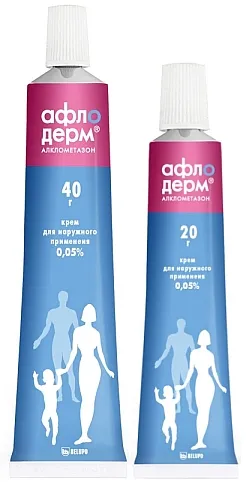
Table of Contents
APPROVED
Order of the Ministry of Health of Ukraine __________ № __________
Registration Certificate № _________________
INSTRUCTIONS FOR MEDICAL USE OF THE MEDICINAL PRODUCT AFLODERM (AFLODERM)
Composition:
Active substance: aclometasone dipropionate;
1 g of cream contains 0.5 mg of aclometasone dipropionate;
Excipients: chlorocresol; sodium dihydrogen phosphate, dihydrate; propylene glycol; concentrated phosphoric acid; cetostearyl alcohol; macrogol cetostearyl ether; soft white paraffin; sodium hydroxide; glyceryl stearate PEG-100 stearate; purified water.
Pharmaceutical form. Cream.
Main physicochemical characteristics: homogeneous white cream.
Pharmacotherapeutic group. Corticosteroids for dermatological use.
ATC code: D07AB10.
Pharmacological properties.
Pharmacodynamics.
Alclometasone is a synthetic, non-fluorinated, moderately acting corticosteroid for topical use. It exerts anti-inflammatory, antipruritic, immunosuppressive, vasoconstrictive, and antiproliferative effects.
The anti-inflammatory activity is associated with reduced production, release, and activity of inflammatory mediators such as kinins, histamine, lysosomal enzymes, prostaglandins, and leukotrienes that promote the development of the inflammatory process.
Corticosteroids prevent vasodilation and increased vascular permeability, thereby reducing the migration of inflammatory cells into sites of damaged tissue. This effect reduces serum extravasation, edema, and pain.
The immunosuppressive effect is manifested by inhibition of early hypersensitivity reactions (type III and IV). The mechanism of activity involves reducing the toxic effects of antigen-antibody complexes deposited on the walls of blood vessels, which lead to allergic vasculitis on one hand, and decreasing the activity of lymphokines, target cells, and macrophages, all of which contribute to the development of allergic contact dermatitis, on the other hand.
Corticosteroids also prevent access of sensitized T-lymphocytes and macrophages to target cells.
The antiproliferative effect of alclometasone is manifested by reduction in the amount of hyperplastic tissue typical for psoriasis.
Pharmacokinetics.
When alclometasone is applied topically to intact healthy skin, approximately 3% of the total amount of the drug is absorbed into the systemic circulation. Skin damage or use of an occlusive dressing may increase absorption of alclometasone.
Alclometasone dipropionate is metabolized primarily in the liver; metabolites are mainly excreted in urine, with a smaller portion eliminated via bile.
Clinical characteristics.
Indications.
Treatment of dermatoses sensitive to topical corticosteroid therapy (including atopic and contact dermatitis, psoriasis).
Treatment:
- dermatoses in areas of skin with increased sensitivity (e.g., face, intertriginous areas);
- chronic dermatoses in patients with sensitive skin (children and elderly patients);
- large skin areas, especially in children due to minimal systemic absorption;
- dermatoses requiring continuation of treatment after using more potent corticosteroids.
Contraindications.
Hypersensitivity to alclometasone or to any other component of the medicinal product, acne, rosacea, cutaneous tuberculosis, skin manifestations of syphilis, skin reactions following vaccination, viral infections (e.g., herpes simplex, herpes zoster, varicella), perioral dermatitis, rosacea, molluscum contagiosum, fungal and bacterial skin infections, varicose veins, open wounds.
Should not be used under occlusive dressings.
Interaction with other medicinal products and other forms of interaction.
Due to the presence of soft white paraffin as an excipient, application of the cream in the anogenital area may damage the structure of latex condoms and reduce their safety during treatment.
Special precautions for use.
Treatment should be discontinued if hypersensitivity reactions occur (skin irritation accompanied by itching, burning sensation, and redness). In the presence of bacterial infection or fungal skin lesions, appropriate antifungal or antibacterial agents should be prescribed. If the desired effect is not achieved, corticosteroid use should be discontinued until the infection is resolved.
The drug is not intended for ophthalmic use. Afrodern should not be applied to the eyes or the area around the eyes due to the risk of developing glaucoma, cataracts, fungal eye infections, and herpes simplex exacerbation.
The drug should not be used over large skin areas for prolonged periods, especially under occlusive dressings, due to the potential for systemic absorption of alclometasone and the occurrence of systemic adverse effects.
Any adverse effects associated with systemic corticosteroid use, including suppression of adrenal cortex function, may also occur with topical application of glucocorticosteroids, particularly in children.
Patients at risk of systemic adverse effects from alclometasone (children, patients with hepatic dysfunction, and those requiring long-term treatment) should undergo periodic monitoring of hypothalamic-pituitary-adrenal (HPA) axis function (free cortisol tests in urine and blood plasma, ACTH stimulation test). If suppression develops, the drug should be discontinued.
Local and systemic toxicity may occur, especially after prolonged use over large areas or on damaged skin and skin folds.
Long-term therapy with the drug should be avoided in all patients, regardless of age.
Do not use under occlusive dressings or diapers, as they may increase systemic absorption of the active ingredients.
Certain body areas, such as the groin, axillae, and perianal region, where natural occlusion exists, are more susceptible to the development of striae during treatment with alclometasone. Therefore, use of the drug in these areas should be minimized.
Do not use in the treatment of varicose leg ulcers (trophic dermatomycoses). Afrodern cream contains cetyl alcohol and stearyl alcohol, which may cause local skin reactions (e.g., contact dermatitis). Afrodern cream also contains chlorocresol, which may cause allergic reactions, and propylene glycol, which may cause skin irritation.
Visual disturbances
Visual disturbances may occur with systemic and topical use of corticosteroids (including intranasal, inhaled, and intraocular administration). If symptoms such as blurred vision or other visual disturbances occur, the patient should undergo an ophthalmological examination to evaluate possible causes, which may include cataracts, glaucoma, or rare conditions such as central serous choroidopathy, which has been reported after systemic and topical corticosteroid use.
Use during pregnancy or breastfeeding.
Pregnancy.
Since the safety of topical corticosteroids in pregnant women has not been established, the drug should not be used during the first trimester of pregnancy. These drugs may be prescribed only in later stages of pregnancy if the expected benefit to the mother clearly outweighs the potential risk to the fetus. Drugs of this class are contraindicated in pregnancy when used in high doses or for prolonged periods.
Breastfeeding period.
It is currently unknown whether corticosteroids, after topical application and subsequent systemic absorption, can pass into breast milk. Therefore, when deciding whether to discontinue breastfeeding or discontinue drug use, the necessity of drug administration should be considered.
Ability to affect reaction speed while driving or operating machinery.
The drug does not affect reaction speed while driving or operating machinery.
Dosage and Administration
Afroderm, cream, is for topical use only. Apply 2–3 times daily as a thin layer to the affected area with gentle rubbing in. Treatment should be discontinued once symptoms of the disease have disappeared. The frequency and duration of use are determined by the physician based on the severity of the condition.
The drug should not be used for prolonged periods over large areas of affected skin or under occlusive dressings, as this may enhance the absorption of alclometasone, except in the treatment of severe and persistent (resistant) dermatitis.
The maximum daily dose should be gradually reduced to the lowest possible dose that still controls symptoms.
Children
The drug is not recommended for children under 12 years of age.
Use in children only after consultation with and under close medical supervision. Increased absorption of the drug in children should be considered due to the higher ratio of skin surface area to body weight, which may lead to enhanced systemic toxicity and suppression of the hypothalamic-pituitary-adrenal (HPA) axis.
Signs of HPA axis suppression and external corticosteroid effects occur more frequently in children than in adult patients under topical corticosteroid therapy. In children receiving topical corticosteroids, suppression of the hypothalamic-pituitary-adrenal system, Cushing's syndrome, linear growth retardation, inadequate weight gain, and increased intracranial pressure may be observed.
Signs of adrenal suppression in children include low plasma cortisol levels and lack of response to adrenocorticotropic hormone (ACTH) stimulation. Increased intracranial pressure manifests as bulging of the fontanelle, headache, and bilateral optic disc swelling.
The duration of treatment in children should be minimized.
Overdose
Prolonged or excessive use of topical glucocorticosteroids, application over large areas or damaged skin, or use under occlusive dressings—especially in children—may result in systemic absorption and the development of systemic adverse effects such as hypoglycemia, glucosuria, suppression of pituitary-adrenal function leading to secondary adrenal insufficiency, and symptoms of hypercorticism, including Cushing's disease.
Signs of hypothalamic-pituitary-adrenal (HPA) axis suppression in children include linear growth retardation, inadequate weight gain, low plasma and urinary cortisol levels, and lack of response to ACTH stimulation. Increased intracranial pressure presents as bulging fontanelle, headache, and bilateral optic disc swelling.
Treatment
In case of overdose, discontinue the drug. Provide appropriate symptomatic therapy and standard supportive measures to maintain normal body function. Symptoms of acute hypercorticism are usually reversible. If necessary, correct electrolyte imbalances. In cases of chronic toxic effects, gradual withdrawal of corticosteroids is recommended. Withdrawal symptoms (e.g., fever, myalgia, arthralgia, weakness) are very rare but may require systemic corticosteroid replacement therapy.
Adverse Reactions
Topical application of alclometasone in therapeutic doses is generally well tolerated and rarely causes adverse effects. Adverse effects may be local or systemic. Local adverse reactions occur more frequently under occlusive dressings.
Any adverse events associated with systemic use of glucocorticoids, including suppression of the adrenal cortex, may also occur with topical application.
Adverse reactions associated with the use of this medicinal product are classified by organ systems and frequency of occurrence: very common: ≥ 1/10; common: ≥ 1/100 to < 1/10; uncommon: ≥ 1/1000 to < 1/100; rare: ≥ 1/10,000 to < 1/1000; very rare: < 1/10,000; unknown (frequency cannot be estimated due to limited available data).
Skin and subcutaneous tissue disorders.
Common: pruritus, burning sensation, erythema, skin irritation or exacerbation of existing lesions, dryness of skin, papular rash.
Very rare: acneiform eruptions, skin maceration, stinging sensation, skin induration, sensation of warmth, lamellar desquamation, focal desquamation, depigmentation or hyperpigmentation of the skin, miliaria, folliculitis, steroid-induced acne, skin atrophy, striae, ecchymoses (especially on the face), hypertrichosis, allergic contact dermatitis, perioral dermatitis, secondary infection.
Ophthalmological disorders.
Unknown: blurred vision (see also section "Special precautions for use").
Shelf life.
3 years.
Storage conditions.
Store at temperatures not exceeding 30 °C.
Keep out of reach of children.
Packaging.
20 g or 40 g in a tube, 1 tube per cardboard box.
Prescription status.
Prescription only.
Manufacturer.
Belupo, lijekovi i kozmetika, d.d.
Manufacturer's address and place of business.
Danic 5, 48000 Koprivnica, Croatia.
Date of last review.