Aerophyllin
Ukraine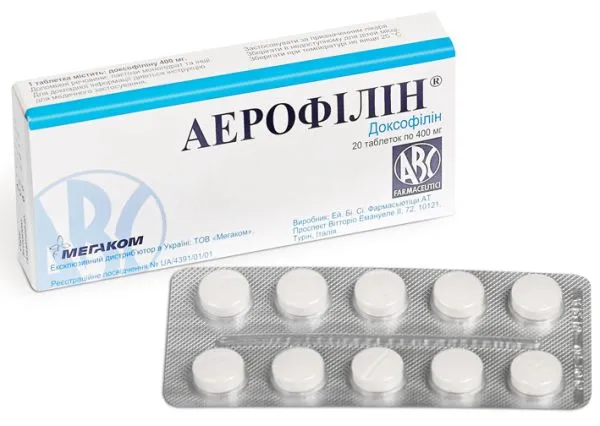
Table of Contents
INSTRUCTIONS for Medical Use of the Medicinal Product AEROFYLLIN® (AEROFYLLIN®)
Composition:
Active substance: doxofylline;
1 tablet contains 400 mg of doxofylline;
Excipients: sodium carboxymethylcellulose-microcrystalline cellulose; pregelatinized starch; lactose monohydrate; talc; povidone K-30; colloidal hydrated silicon dioxide; magnesium stearate; colloidal anhydrous silicon dioxide.
Pharmaceutical form. Tablets.
Main physicochemical properties: white, round, biconvex tablets with a score line on one side.
Pharmacotherapeutic group. Other systemic agents for obstructive respiratory diseases. Xanthines. Doxofylline. ATC code R03DA11.
Pharmacological properties.
Pharmacodynamics.
Doxofylline acts directly on the smooth muscles of the bronchi and pulmonary vessels, resulting in bronchodilation. It primarily acts as a bronchodilator, pulmonary vasodilator, and bronchial muscle myorelaxant. The activity of doxofylline may be mediated, at least in part, by inhibition of the enzyme phosphodiesterase, leading to increased intracellular levels of cAMP (cyclic adenosine monophosphate), which causes reduced contractile activity of smooth muscle. At higher concentrations, doxofylline may also slow the release of histamine from cells.
Pharmacokinetics.
The biological half-life of doxofylline exceeds 6 hours, thus ensuring effective, sustained plasma levels with administration three times daily. After administration of the tablet dosage form, maximum plasma concentration is reached within 60 minutes.
Absolute bioavailability is approximately 62.6%; at pH 7.4, approximately 48% of plasma proteins bind to the drug.
After oral administration, less than 4% of the drug is excreted unchanged in urine.
Clinical characteristics.
Indications.
Bronchial asthma.
Lung diseases with bronchial spastic component.
Contraindications.
Aerophyllin® is contraindicated in patients with hypersensitivity to doxofylline or to other xanthine derivatives. It is also contraindicated in patients with acute myocardial infarction and arterial hypotension.
Interaction with other medicinal products and other forms of interactions.
Aerophyllin® should not be used concomitantly with other xanthine derivatives. It is recommended to limit the intake of food and beverages containing caffeine.
Caution is required when using Aerophyllin® concomitantly with ephedrine and other sympathomimetics.
When doxofylline is used concomitantly with other medicinal products such as erythromycin, troleandomycin, lincomycin, clindamycin, allopurinol, cimetidine, influenza vaccine, and propranolol, as well as in interactions of xanthines with disulfiram, fluvoxamine, interferon α, oral contraceptives, elimination of xanthine derivatives may be slowed, resulting in increased plasma drug levels. In such cases, the dose should be reduced.
As with other xanthines, concomitant use of ranitidine may reduce hepatic clearance of doxofylline, leading to increased blood levels. In such cases, the dose should be reduced. No correlation has been established between serum doxofylline concentration and toxic effects.
Concomitant use of doxofylline with phenytoin and other anticonvulsants, use of doxofylline in patients who smoke, as well as interactions of xanthines with rifampicin, ritonavir, sulfinpyrazone, may accelerate elimination of xanthine derivatives, resulting in reduced plasma half-life. In these cases, the dose should be increased.
Xanthines carry a risk of toxic synergy with ephedrine or halothane and ketamine. They may interfere with the action of adenosine and other neuromuscular blockers.
Lithium elimination may be increased, leading to loss of effect. Xanthines may enhance hypokalemia caused by hypoxia or associated with the use of β2-adrenergic receptor stimulants (β2-adrenergic receptor agonists), corticosteroids, and diuretic agents. Concomitant use of xanthines and β-blockers should be avoided, as β-blockers may induce bronchospasm.
Special precautions for use.
Certain factors may reduce hepatic clearance of xanthine derivatives, thereby increasing the drug concentration in blood plasma. These include: age, congestive heart failure, chronic obstructive pulmonary disease, severe liver disease, concomitant infections, and concurrent use of various drugs such as erythromycin, lincomycin, troleandomycin, clindamycin, allopurinol, cimetidine, influenza vaccine, and propranolol. In such cases, the dose of the drug should be reduced.
Phenytoin, other anticonvulsants, and smoking may increase the clearance of xanthine derivatives, resulting in a corresponding decrease in the drug's plasma half-life. In these cases, the dose of the drug should be increased.
In situations that may affect the elimination of xanthine derivatives, laboratory monitoring of doxofylline plasma concentrations is recommended to maintain therapeutic levels.
The drug should be used with particular caution in patients with elevated body temperature, cardiac arrhythmias, or alcoholism.
Aerophyllin® should be used cautiously in patients with heart disease, arterial hypertension, elderly patients, and patients with severe hypoxemia, hyperthyroidism, chronic right ventricular failure, congestive heart failure, liver disease, peptic ulcer, or impaired renal function.
Particular caution is required when treating patients with congestive heart failure, as in these patients the elimination of the drug from the blood is significantly slowed, resulting in prolonged high plasma levels after discontinuation of the drug.
Doxofylline does not cause habituation or dependence.
Aerophyllin® contains lactose; therefore, if a patient has known intolerance to certain sugars, medical advice should be sought before taking this medication.
Use during pregnancy or breastfeeding.
Pregnancy. Animal studies have shown that the active substance doxofylline does not impair prenatal or postnatal development.
Since clinical experience with doxofylline use during pregnancy is limited, this medication should be administered to pregnant women only when clearly necessary, after careful consideration of the benefit-risk ratio.
Breastfeeding period. Doxofylline is contraindicated in women during breastfeeding.
Ability to affect reaction speed when driving or operating machinery.
The drug does not affect reaction speed when driving or operating machinery.
However, if adverse reactions involving the nervous system (tremor, dizziness) occur, driving or operating machinery should be avoided.
Dosage and Administration.
The dosage is determined individually by a physician according to the patient's age, body weight, and metabolic characteristics. The average daily dose for adults and children aged 12 years and older is 800–1200 mg (1 tablet 2–3 times daily). For children aged 6 to 12 years: ½ tablet 2–3 times daily (12–18 mg/kg daily).
Children.
The drug is intended for use in children aged 6 years and older.
Overdose.
In case of overdose, the patient may develop severe cardiac arrhythmia, tonic-clonic seizures, agitation, increased diuresis, and intensification of adverse reactions. These symptoms may be the first signs of intoxication.
As there is no specific antidote, symptomatic treatment of heart failure and anticonvulsant therapy should be administered in case of overdose.
Side effects.
Gastrointestinal tract: nausea, vomiting, epigastric pain, gastroesophageal reflux; rarely – diarrhea, dyspepsia.
Nervous system: irritability, headache, insomnia, dizziness, tremor, seizures.
Cardiovascular system: extrasystole, palpitations, tachycardia, arrhythmia.
Respiratory system: tachypnea.
Blood system: in isolated cases – hyperglycemia, albuminuria.
Allergic reactions: rarely – hypersensitivity reactions, including anaphylactic shock, angioneurotic edema.
Shelf life. 5 years.
Storage conditions.
Store at a temperature not exceeding 25 °C.
Keep out of reach of children.
Packaging.
10 tablets in a blister; 2 blisters in a cardboard box.
Prescription category. Prescription only.
Manufacturer.
E. B. C. FARMACEUTICI S.P.A.
Manufacturer's address and place of business.
VIA CANTONE MORETTI, 29 (LOCALITA' SAN BERNARDO) - 10015 IVREA (TO), Italy.
Marketing Authorization Holder.
E. B. C. FARMACEUTICI S.P.A.
Address of the Marketing Authorization Holder.
CORSO VITTORIO EMANUELE II, 72 10121 - TURIN (TO), Italy.