Adjovi™
Ukraine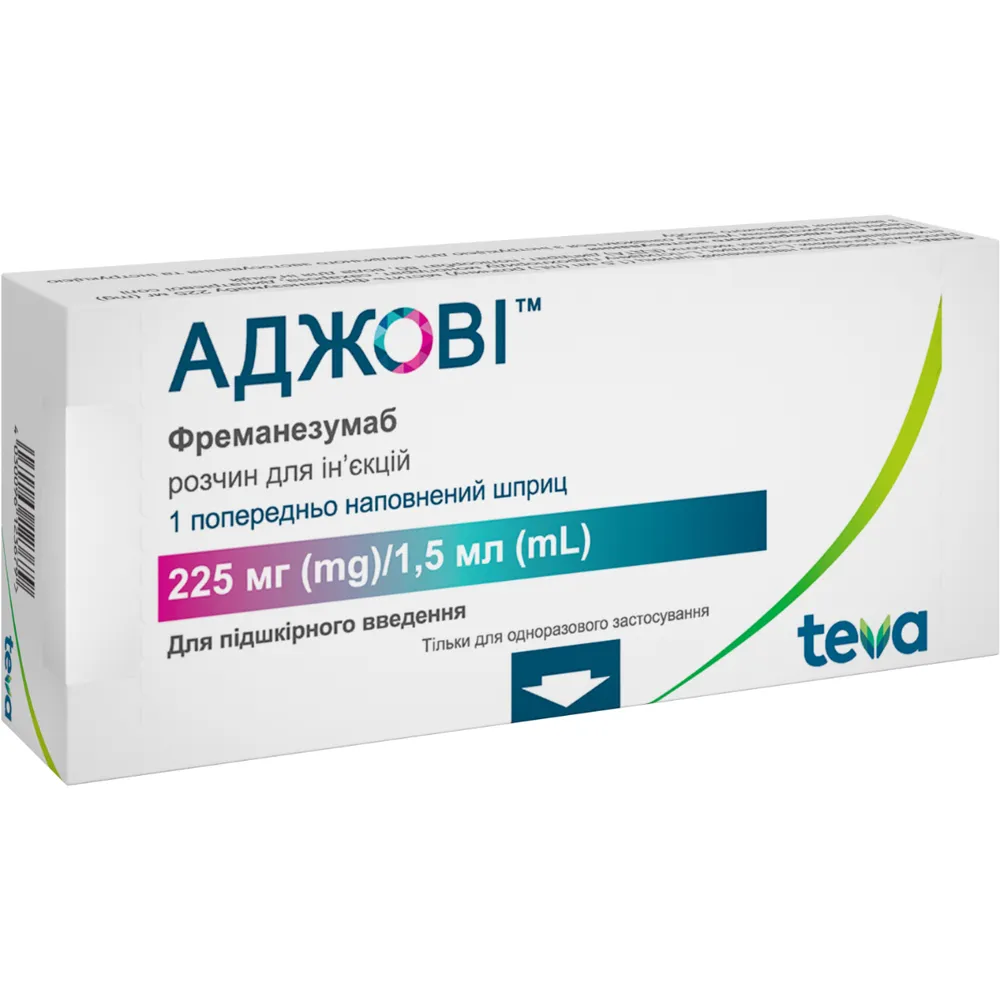
Table of Contents
INSTRUCTIONS FOR MEDICAL USE OF THE MEDICINAL PRODUCT ADJOVIE™ (AJOVY®)
Composition:
Active substance: fremanezumab;
1 pre-filled syringe (1.5 ml solution) contains fremanezumab 225 mg;
Excipients: L-histidine, L-histidine hydrochloride monohydrate, sucrose, disodium edetate dihydrate, polysorbate 80, water for injections.
Pharmaceutical form. Solution for injection.
Main physicochemical properties: clear or opalescent, colorless or slightly yellowish solution.
Pharmacotherapeutic group. Calcitonin gene-related peptide (CGRP) antagonists. ATC code N02CD03.
Pharmacological Properties.
Pharmacodynamics.
Mechanism of action
Fremanezumab is a humanized monoclonal antibody of the IgG2Δa/kappa isotype, derived from a murine precursor. Fremanezumab selectively binds to the calcitonin gene-related peptide (CGRP) ligand and blocks the binding of both CGRP isoforms (α- and β-CGRP) to the CGRP receptor. The precise mechanism by which fremanezumab prevents migraine attacks is not fully understood; however, it is believed that migraine prevention is achieved through modulation of the trigeminal nerve system. It has been established that CGRP levels are significantly elevated during migraine attacks and return to normal levels as headache symptoms subside.
Fremanezumab has high specificity for CGRP and does not bind to related peptides such as amylin, calcitonin, intermedin, or adrenomedullin.
Clinical efficacy and safety
The efficacy of fremanezumab was evaluated in two randomized, double-blind, placebo-controlled, Phase 3 studies of 12 weeks’ duration involving adult patients with episodic (Study 1) and chronic migraine (Study 2). Patients enrolled in the studies had a confirmed diagnosis of migraine (with or without aura) for at least 12 months according to the diagnostic criteria of the International Classification of Headache Disorders (ICHD-III). Patients were excluded if they were elderly (>70 years of age), used opioids or barbiturates for more than 4 days per month, or had a history of myocardial infarction, cerebrovascular events, or thromboembolic events.
Study evaluating fremanezumab in episodic migraine (Study 1)
The efficacy of fremanezumab in episodic migraine was assessed in a randomized, multicenter, double-blind, placebo-controlled study of 12 weeks’ duration (Study 1). Adult patients with a history of episodic migraine (defined as fewer than 15 headache days per month) were enrolled. A total of 875 patients (742 women and 133 men) were randomized into one of three treatment groups: 675 mg fremanezumab every three months (quarterly, n=291), 225 mg fremanezumab once monthly (monthly, n=290), or monthly placebo (n=294), administered via subcutaneous injection. The distribution of patients across treatment groups was balanced and comparable with respect to demographic and baseline disease characteristics. The mean patient age was 42 years (range: 18–70 years), 85% were women, and 80% were of Caucasian race. At study entry, the mean frequency of migraine episodes was approximately 9 days per month. During the study, patients were permitted to use medications for acute migraine treatment. A subgroup of patients (21%) was also allowed to continue one commonly used concomitant preventive medication (a beta-blocker, calcium channel blocker/tricyclic agent, antidepressant, or anticonvulsant). Nineteen percent (19%) of patients had previously used topiramate. A total of 791 patients completed the 12-week double-blind treatment period.
The primary efficacy endpoint was the change from baseline in the mean number of migraine days per month over the 12-week treatment period. Key secondary endpoints included the proportion of patients achieving at least a 50% reduction in monthly migraine days compared to baseline (50% response rate), the mean change from baseline in patient-reported MIDAS scores, and the change from baseline in the mean monthly number of days using acute migraine medications. Compared with placebo, both monthly and quarterly fremanezumab regimens demonstrated statistically significant and clinically meaningful improvements across all primary and key secondary efficacy endpoints. These effects were evident within the first month and were maintained throughout the treatment period.
Table 1. Key efficacy outcomes in Study 1 for episodic migraine
| Efficiency endpoint |
Placebo (n=290) |
Fremanezumab 675 mg quarterly (n=288) |
Fremanezumab 225 mg monthly (n=287) |
| MMD Mean changea (95% CI) TD (95% CI)b Baseline (SD) |
-2.2 (-2.68, -1.71) - 9.1 (2.65) |
-3.4 (-3.94, -2.96) -1.2 (-1.74, -0.69) 9.2 (2.62) p<0.0001a |
-3.7 (-4.15, -3.18) -1.4 (-1.96, -0.90) 8.9 (2.63) p<0.0001a |
| MHD Mean changea (95% CI) TD (95% CI)b Baseline (SD) |
-1.5 (-1.88, -1.06) - 6.9 (3.13) |
-3.0 (-3.39, -2.55) -1.5 (-1.95, -1.02) 7.2 (3.14) p<0.0001a |
-2.9 (-3.34, -2.51) -1.5 (-1.92, -0.99) 6.8 (2.90) p<0.0001a |
| Frequency of 50% positive treatment response, MMD Percentage [%] |
27.9% |
44.4%, p<0.0001 |
47.7%, p<0.0001 |
| Frequency of 75% positive treatment response, MMD Percentage [%] |
9.7% |
18.4%, p=0.0025 |
18.5%, p=0.0023 |
| Total MIDAS score Mean changea (95% CI) Baseline (SD) |
-17.5 (-20.62, -14.47) 37.3 (27.75) |
-23.0 (-26.10, -19.82) 41.7 (33.09), p=0.0023a |
-24.6 (-27.68, -21.45) 38 (33.30), p<0.0001a |
| MAHMD Mean changea (95% CI) TD (95% CI)b Baseline (SD) |
-1.6 (-2.04, -1.20) - 7.7 (3.60) |
-2.9 (-3.34, -2.48) -1.3 (-1.73, -0.78) 7.7 (3.70), p<0.0001a |
-3.0 (-3.41, -2.56) -1.3 (-1.81, -0.86) 7.7 (3.37), p<0.0001a |
CI – confidence interval; MAHMD – mean number of days of acute migraine medication use per month; MHD – mean number of headache days of at least moderate severity per month; MIDAS – Migraine Disability Assessment scale; MMD – mean number of migraine days per month; SD – standard deviation; TD – treatment difference; p – p-value comparing to placebo.
a For all endpoints, mean change and CI are based on an ANCOVA model with treatment, sex, region, and use of preventive medications prior to study entry (yes/no) as fixed effects, and the corresponding baseline values and number of years since migraine onset as covariates.
b Treatment differences are based on MMRM analysis with treatment, sex, region, use of preventive medications prior to study entry (yes/no), month, and treatment month as fixed effects, and the corresponding baseline values and number of years since migraine onset as covariates.
Study of fremanezumab in chronic migraine (Study 2)
The use of fremanezumab in chronic migraine was evaluated in a randomized, multicenter, placebo-controlled, double-blind study lasting 12 weeks (Study 2). The study population included adult patients with a history of chronic migraine (15 or more headache days per month). A total of 1130 patients (991 women and 139 men) were randomized to receive one of three treatment regimens: fremanezumab 675 mg initial dose followed by 225 mg fremanezumab once monthly (monthly, n=379), fremanezumab 675 mg every three months (quarterly, n=376), or monthly placebo (n=375) administered as subcutaneous injections. Demographic and baseline disease characteristics were balanced and comparable across all treatment groups. The mean age of patients was 41 years (range: 18–70 years), 88% were women, and 79% were of Caucasian race. The mean headache frequency prior to the study was approximately 21 days per month (of which 13 days were of at least moderate severity). During the study, patients were permitted to use acute migraine medications. A subgroup of patients (21%) was also allowed to continue one commonly used concomitant preventive medication (beta-blocker, calcium channel blocker/benzocycloheptene, antidepressant, or anticonvulsant). Thirty percent of patients had previously used topiramate, and 15% had used onabotulinumtoxinA. A total of 1034 patients completed the 12-week double-blind treatment period.
The primary efficacy endpoint was the change from baseline over the 12-week treatment period in the mean number of headache days of at least moderate severity, expressed as a monthly average, compared to baseline. Key secondary endpoints included the proportion of patients achieving at least a 50% reduction in the number of headache days of at least moderate severity per month compared to baseline (50% response rate), mean change from baseline in patient-reported Migraine-Specific Quality of Life Questionnaire (MSQ) scores, and change from baseline in the mean monthly number of days of acute migraine medication use. Compared to placebo, both monthly and quarterly fremanezumab regimens demonstrated statistically significant and clinically meaningful improvements across key efficacy endpoints compared to baseline. These effects were evident within the first month and were maintained throughout the treatment period.
Table 2. Key efficacy outcomes in Study 2 in chronic migraine
[Note: The table itself is not provided in the source text, so it is not included in the translation.]
| Primary efficacy endpoint |
Placebo (n=371) |
Fremanezumab 675 mg quarterly (n=375) |
Fremanezumab 225 mg monthly with initial dose of 675 mg (n=375) |
| MHD Mean changea (95% CI) TD (95% CI)b Baseline (SD) |
-2.5 (-3.06, -1.85) - 13.3 (5.80) |
-4.3 (-4.87, -3.66) -1.8 (-2.45, -1.13) 13.2 (5.45) p<0.0001a |
-4.6 (-5.16, -3.97) -2.1 (-2.77, -1.46) 12.8 (5.79) p<0.0001a |
| MMD Mean changea (95% CI) TD (95% CI)b Baseline (SD) |
-3.2 (-3.86, -2.47) - 16.3 (5.13) |
-4.9 (-5.59, -4.20) -1.7 (-2.44, -0.92) 16.2 (4.87) p<0.0001a |
-5.0 (-5.70, -4.33) -1.9 (-2.61, -1.09) 16.0 (5.20) p<0.0001a |
| Proportion achieving 50% treatment response rate, MHD Percentage [%] |
18.1% |
37.6%, p<0.0001 |
40.8%, p<0.0001 |
| Proportion achieving 75% treatment response rate, MHD Percentage [%] |
7.0% |
14.7%, p=0.0008 |
15.2%, p=0.0003 |
| Total score of HIT-6 Mean changea (95% CI) Baseline (SD) |
-4.5 (-5.38, -3.60) 64.1 (4.79) |
-6.4 (-7.31, -5.52) 64.3 (4.75), p=0.0001a |
-6.7 (-7.71, -5.97) 64.6 (4.43), p<0.0001a |
| MAHMD Mean changea (95% CI) TD (95% CI)b Baseline (SD) |
-1.9 (-2.48, -1.28) - 13.0 (6.89) |
-3.7 (-4.25, -3.06) -1.7 (-2.40, -1.09) 13.1 (6.79), p<0.0001a |
-4.2 (-4.79, -3.61) -2.3 (-2.95, -1.64) 13.1 (7.22), p<0.0001a |
CI – confidence interval; HIT-6 – Headache Impact Test assessing the impact of headache on quality of life; MAHMD – monthly number of days of medication use for abortive migraine treatment; MHD – monthly number of days with headache of at least moderate severity; MMD – monthly number of migraine days; SD – standard deviation; TD – treatment difference; p – p-value when comparing with placebo.
a For all endpoints, mean change and CI are based on an ANCOVA model, with treatment, sex, region, and use of preventive medications prior to study initiation (yes/no) as fixed effects, and corresponding baseline values and number of years since onset of migraine as covariates.
b Treatment differences are based on MMRM analysis, with treatment, sex, region, use of preventive medications prior to study initiation (yes/no), month, and treatment month as fixed effects, and corresponding baseline values and number of years since onset of migraine as covariates.
Approximately 52% of patients in the study demonstrated overuse of medications for abortive migraine treatment. In these patients, the treatment difference in reduction of monthly number of headache days (MHD) of at least moderate severity between quarterly fremanezumab 675 mg and placebo was -2.2 days (95% CI: -3.14, -1.22), and between monthly fremanezumab 225 mg with an initial dose of 675 mg and placebo was -2.7 days (95% CI: -3.71, -1.78).
Long-term study (Study 3)
In the long-term study (Study 3), in which patients received 225 mg fremanezumab monthly or 675 mg quarterly, treatment efficacy was maintained over an additional 12 months in all patients, both with episodic and chronic migraine. 79% of patients completed the 12-month treatment period per protocol in Study 3. A combined analysis of both dosing regimens showed a reduction of 6.6 days in monthly migraine days at 15 months compared to baseline values from Study 1 and Study 2. 61% of patients who completed Study 3 demonstrated a 50% therapeutic response during the final month of the study. No safety signals were observed during the 15-month combined treatment period.
Study evaluating fremanezumab in patients with difficult-to-treat migraine (Study 4)
The efficacy and safety of fremanezumab were evaluated in a randomized study (Study 4) consisting of a 12-week double-blind, placebo-controlled treatment period followed by a 12-week open-label period, involving a total of 838 patients with episodic and chronic migraine who had documented inadequate response to 2–4 classes of prior preventive migraine medications. The primary efficacy endpoint was change over the 12-week double-blind treatment period in the mean number of migraine days, adjusted to a monthly average, compared to baseline. Key secondary endpoints included ≥50% reduction in monthly migraine days compared to baseline, mean change in monthly number of headache days of at least moderate severity compared to baseline, and change in monthly number of days of abortive migraine medication use compared to baseline. Both fremanezumab regimens, monthly and quarterly, demonstrated statistically and clinically significant improvement across key efficacy endpoints compared to placebo. Thus, results from Study 4 are consistent with the main findings of previous efficacy studies and further demonstrate efficacy in difficult-to-treat migraine, including a mean reduction in monthly migraine days (MMD) of -3.7 (95% CI: -4.38, -3.05) with quarterly fremanezumab and -4.1 (95% CI: -4.73, -3.41) with monthly fremanezumab, compared to -0.6 (95% CI: -1.25, 0.07) in patients receiving placebo. During the 12-week treatment period, 34% of patients receiving quarterly fremanezumab and 34% receiving monthly fremanezumab achieved at least a 50% reduction in MMD, compared to 9% in the placebo group (p<0.0001). This effect was observed as early as the first month and was maintained throughout the treatment period. No safety signals were observed during the 6-month treatment period.
Pharmacokinetics.
Absorption
After a single subcutaneous administration of 225 mg and 675 mg fremanezumab, the median time to reach maximum concentrations (tmax) in healthy volunteers was 5 to 7 days. The absolute bioavailability of fremanezumab following subcutaneous administration at doses of 225 mg and 900 mg in healthy volunteers ranged from 55% (±SD 23%) to 66% (±SD 26%). Population pharmacokinetic data showed dose proportionality in the range of 225–675 mg. Steady-state concentrations were reached approximately by day 168 (about 6 months) with monthly 225 mg and quarterly 675 mg dosing regimens. The median accumulation ratio for monthly and quarterly dosing regimens was approximately 2.4 and 1.2, respectively.
Distribution
Based on a bioavailability of 66% (±SD 26%) calculated from the population model in patients, the volume of distribution for a standard patient was 3.6 L (with a coefficient of variation of 35.1%) following subcutaneous administration of fremanezumab at doses of 225 mg, 675 mg, or 900 mg.
Biotransformation
Similar to other monoclonal antibodies, fremanezumab is expected to undergo enzymatic degradation during catabolism, resulting in small peptides and amino acids.
Elimination
Based on a bioavailability of 66% (±SD 26%) calculated from the population model in patients, the central clearance for a standard patient was 0.09 L/day (with a coefficient of variation of 23.4%) following subcutaneous administration of fremanezumab at doses of 225 mg, 675 mg, and 900 mg. The resulting small peptides and amino acids may be reused in the body for new protein synthesis or excreted via the kidneys. The estimated half-life of fremanezumab is 30 days.
Special populations
A population pharmacokinetic analysis was conducted on data from 2546 individuals regarding age, race, sex, and body weight. In the lower quartile of body weight (43.5–60.5 kg), exposure to the drug is expected to be approximately twice higher compared to the upper quartile of body weight (84.4–131.8 kg). However, exposure-response analysis did not demonstrate any impact of body weight on clinical efficacy in patients with episodic or chronic migraine. Dose adjustment of fremanezumab is not required. Data on the exposure-efficacy relationship in individuals with body weight >132 kg are lacking.
Renal or hepatic impairment
Since monoclonal antibodies are not known to be excreted via the kidneys or metabolized in the liver, it is unlikely that renal or hepatic impairment would affect the pharmacokinetics of fremanezumab. The use of the drug in patients with severe renal impairment (estimated glomerular filtration rate <30 mL/min/1.73 m²) has not been studied. Population pharmacokinetic analysis of pooled clinical trial data for ADJUVI™ did not show differences in fremanezumab pharmacokinetics in patients with hepatic impairment or mild to moderate renal impairment compared to individuals without hepatic or renal impairment.
Clinical characteristics.
Indications.
ADHEVIO™ is indicated for preventive treatment of migraine in adults who have migraine attacks on at least 4 days per month.
Contraindications.
Hypersensitivity to the active substance or to any of the excipients.
Special precautions.
Each pre-filled syringe is intended for single use only.
ADHEVIO™ should not be used if the solution is cloudy, discoloured or contains particles.
ADHEVIO™ that has been frozen should not be used.
Pre-filled syringes must not be shaken.
Any unused medicinal product or waste material must be disposed of in accordance with local requirements.
Interaction with other medicinal products and other forms of interaction.
Formal clinical studies investigating drug interactions have not been conducted for ADHEVIO™. Given the characteristics of fremanezumab, pharmacokinetic drug interactions are unlikely. Furthermore, in clinical trials, concomitant use of medications for the acute treatment of migraine attacks (including analgesics, ergot alkaloids and triptans) and medications for migraine prevention did not affect the pharmacokinetics of fremanezumab.
Special Warnings and Precautions for Use
Traceability. In order to improve traceability of biological medicinal products, the name and batch number of the administered product should always be clearly recorded.
Serious hypersensitivity reactions. Anaphylactic reactions have been reported rarely with fremanezumab (see section "Side Effects"). Most reactions occurred within 24 hours after administration, although some reactions were delayed. Patients should be informed about symptoms associated with hypersensitivity reactions. If a serious hypersensitivity reaction occurs, appropriate therapy should be initiated and treatment with fremanezumab must not be continued (see section "Contraindications").
Severe cardiovascular disease. Patients with severe cardiovascular disease were excluded from clinical studies. Safety data in such patients are lacking.
Excipients. This medicinal product contains less than 1 mmol of sodium (23 mg) per dose, i.e. it is considered "sodium-free".
Use during pregnancy or breastfeeding.
Pregnancy
Data on the use of AJOVY™ in pregnant women are limited. Animal studies indicate no direct or indirect harmful effects related to reproductive toxicity. As a precautionary measure, it is advisable to avoid the use of AJOVY™ during pregnancy.
Breastfeeding
It is unknown whether fremanezumab is excreted in human breast milk. It has been established that human immunoglobulin G is excreted in breast milk during the first few days after birth, and its concentration subsequently decreases to low levels. Therefore, during this short period, a risk to breastfed infants cannot be excluded. Later in breastfeeding, the use of fremanezumab may be considered only if clinically necessary.
Fertility
There are no data on the effect of fremanezumab on fertility in humans. Available preclinical data do not indicate an effect on fertility.
Effects on ability to drive and use machines.
AJOVY™ has no or negligible influence on the ability to drive or operate machinery.
Dosage and Administration
Treatment should be initiated by a physician experienced in the diagnosis and treatment of migraine.
Dosage
This medicinal product is indicated for patients who, at the initiation of fremanezumab treatment, experience migraine attacks on at least 4 days per month.
There are two dosage options:
- 225 mg once monthly (monthly administration), or
- 675 mg once every three months (quarterly administration).
When switching between dosage regimens, the first dose under the new regimen should be administered on the next scheduled dose date of the previous regimen.
Concomitant preventive migraine therapy may be continued at the initiation of fremanezumab treatment, if considered appropriate by the physician.
Treatment efficacy should be evaluated within 3 months after initiation of therapy. All subsequent decisions regarding continuation of treatment should be made based on individual patient response. Thereafter, the need for continued treatment should be regularly reassessed.
Missed dose
If a fremanezumab injection is missed on the scheduled day, the injection should be administered as soon as possible, following the prescribed dose and administration schedule. A double dose must not be administered to compensate for a missed dose.
Special populations
Elderly patients. Experience with fremanezumab in patients aged 65 years and older is limited. Based on population pharmacokinetic analyses, dose adjustment is not required.
Renal or hepatic impairment. Patients with mild or moderate hepatic or renal impairment do not require dose adjustment.
Administration
Subcutaneous injection
ADHEVIO™ is intended for subcutaneous administration only. Intravenous or intramuscular administration of this medicinal product is not permitted. ADHEVIO™ injections may be administered in non-tender, non-bruised areas of the abdomen, thigh, or upper arm, free from redness or induration. Injection sites should be rotated with repeated injections.
Patients may self-administer injections provided they have received proper training from a healthcare professional on the technique of subcutaneous self-injection.
Further detailed information on the administration of ADHEVIO™ is provided in the separate instructions for use.
Paediatric population
The safety and efficacy of ADHEVIO™ in children (under 18 years of age) have not been established. There is no data available.
Overdose
In clinical studies, intravenous doses up to 2000 mg were administered without dose-limiting toxicity. In case of overdose, patients should be monitored for any signs or symptoms of adverse reactions, and appropriate symptomatic treatment should be instituted as necessary.
Adverse Reactions
Summary of Safety Profile
In clinical studies conducted for the registration of the medicinal product, more than 2500 patients (over 1900 patient-years) received ADJUVI™. Over 1400 patients were treated with the medicinal product for at least 12 months.
Commonly reported adverse reactions included injection site reactions (pain [24%], induration [17%], erythema [16%], and pruritus [2%]).
Table of Adverse Reactions
Adverse reactions reported for the medicinal product, collected from clinical trials and post-marketing experience, are listed by MedDRA system organ class. Within each system organ class, adverse reactions are listed in descending order of frequency, with the most frequent ones listed first. Within each frequency category, adverse reactions are presented in order of decreasing severity. Based on the frequency of occurrence, adverse reactions are categorized as follows: very common (≥1/10); common (≥1/100, <1/10); uncommon (≥1/1000, <1/100); rare (≥1/10,000, <1/1000); very rare (<1/10,000).
The following adverse reactions have been identified for ADJUVI™.
Table 3. Adverse Reactions
| MedDRA system organ class |
Frequency |
Adverse reaction |
| Immune system disorders |
Uncommon |
Hypersensitivity reactions such as rash, pruritus, urticaria, and swelling |
| Rare |
Anaphylactic reaction |
|
| General disorders and administration site conditions |
Very common |
Injection site pain |
| Injection site induration |
||
| Injection site erythema |
||
| Common |
Injection site pruritus |
|
| Uncommon |
Injection site rash |
Description of individual adverse reactions
Injection site reactions. The most common injection site reactions were pain, induration, and erythema. All injection site reactions were transient and predominantly mild or moderate in severity. Pain, induration, and erythema were typically observed immediately after injection, whereas pruritus and rash occurred on average within 24 and 48 hours, respectively. All injection site reactions resolved predominantly within several hours or days. Overall, injection site reactions did not require discontinuation of the medicinal product.
Serious hypersensitivity reactions. Anaphylactic reactions were rarely reported. These reactions mostly occurred within 24 hours after administration, although some reactions were delayed.
Immunogenicity. In placebo-controlled studies, antibodies to the medicinal product developed in 0.4% of patients (6 out of 1701) treated with fremanezumab. The immune response was characterized by low antibody titres. Neutralizing antibodies developed in one of the 6 patients. After 12 months of treatment, antibodies to the medicinal product were detected in 2.3% of patients (43 out of 1888), and neutralizing antibodies developed in 0.95% of patients. Antibodies to the medicinal product do not affect the safety and efficacy of fremanezumab.
Shelf life.
3 years.
Storage conditions.
Store in a refrigerator (2 – 8 °C). Do not freeze!
Keep the pre-filled syringe in the cardboard box to protect from light and in a place inaccessible to children.
ADHEVIO**™** may be stored outside the refrigerator for up to 7 days at temperatures not exceeding 30 °C.
ADHEVIO**™** that has been stored outside the refrigerator for more than 7 days must be discarded.
If the medicinal product has been stored at room temperature, do not return it to the refrigerator.
Incompatibilities.
Since compatibility studies have not been conducted, this medicinal product must not be mixed with other medicinal products.
Packaging.
1.5 ml of solution in a pre-filled syringe; 1 or 3 syringes per cardboard box.
Prescription status. Prescription only.
Manufacturer.
Merckle GmbH.
Manufacturer's address and place of business.
Graf-Arco-Strasse 3, 89079 Ulm, Germany.