Adrenaline-zdorovya
Ukraine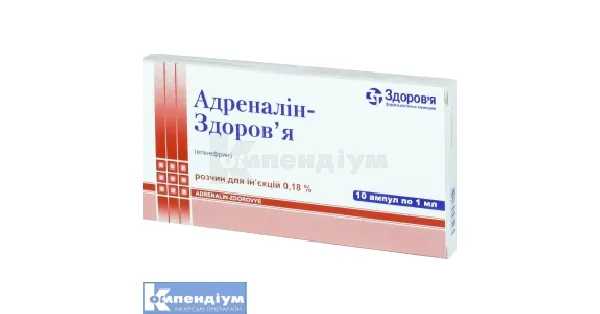
Table of Contents
INSTRUCTIONS FOR MEDICAL USE of the medicinal product ADRENALIN-ZDOROV'YA (ADRENALIN-ZDOROVYE)
Composition:
Active substance: epinephrine;
1 ml of solution contains 1.82 mg of adrenaline tartrate;
Excipients: sodium metabisulfite (E 223), sodium chloride, water for injections.
Medicinal form. Solution for injection.
Main physico-chemical properties: clear, colorless solution.
Pharmacotherapeutic group. Agents affecting the cardiovascular system. Nonglycoside cardiotonics. Adrenergic and dopaminergic agents. ATC code C01CA24.
Pharmacological Properties
Pharmacodynamics
Cardiostimulatory, vasoconstrictive, hypertensive, and antihypoglycemic agent.
The drug stimulates α- and β-adrenergic receptors of various locations. It exerts pronounced effects on smooth muscles of internal organs, the cardiovascular and respiratory systems, and activates carbohydrate and lipid metabolism.
The mechanism of action is mediated by activation of adenylate cyclase on the inner surface of cell membranes, increasing intracellular concentrations of cyclic adenosine monophosphate (cAMP) and Ca²⁺. The first phase of action is primarily due to stimulation of β-adrenergic receptors in various organs, manifesting as tachycardia, increased cardiac output, myocardial excitability and conduction, arteriolar and bronchodilation, reduced uterine tone, and mobilization of glycogen from the liver and fatty acids from fat stores. In the second phase, α-adrenergic receptors are stimulated, resulting in vasoconstriction of abdominal organs, skin, and mucous membranes (to a lesser extent in skeletal muscles), increased arterial pressure (mainly systolic), and increased systemic vascular resistance.
The drug's effectiveness is dose-dependent. At very low doses, with an infusion rate of less than 0.01 mcg/kg/min, it may reduce arterial pressure due to vasodilation in skeletal muscles. At an infusion rate of 0.04–0.1 mcg/kg/min, it increases heart rate and force of cardiac contractions, stroke volume, and cardiac output, while reducing systemic vascular resistance. At doses above 0.2 mcg/kg/min, it causes vasoconstriction, increases arterial pressure (mainly systolic), and increases systemic vascular resistance. The pressor effect may cause transient reflex bradycardia. It relaxes bronchial smooth muscles. Doses exceeding 0.3 mcg/kg/min reduce renal blood flow, perfusion of internal organs, and gastrointestinal tone and motility.
It enhances myocardial conduction, excitability, and automaticity. It increases myocardial oxygen demand. It inhibits antigen-induced release of histamine and leukotrienes, relieves bronchiolar spasm, and prevents edema of the mucous membrane. By acting on α-adrenergic receptors in the skin, mucous membranes, and internal organs, it induces vasoconstriction, reduces the absorption rate of local anesthetics, prolongs their duration of action, and reduces the toxic effects of local anesthesia. Stimulation of β₂-adrenergic receptors leads to increased potassium efflux from cells and may result in hypokalemia. When administered intracavernously, it reduces blood filling of the corpora cavernosa.
It dilates pupils, reduces production of intraocular fluid, and lowers intraocular pressure. It induces hyperglycemia (by enhancing glycogenolysis and gluconeogenesis) and increases plasma levels of free fatty acids, thereby improving tissue metabolism. It weakly stimulates the central nervous system and exhibits antiallergic and anti-inflammatory effects.
Therapeutic effects occur almost immediately after intravenous administration (duration of action: 1–2 minutes), within 5–10 minutes after subcutaneous injection (peak effect at 20 minutes), and with variable onset time after intramuscular injection.
Pharmacokinetics
After intramuscular or subcutaneous administration, the drug is rapidly absorbed; maximum plasma concentration (Cmax) is reached within 3–10 minutes. It crosses the placental barrier and is excreted into breast milk, but does not cross the blood-brain barrier. It is metabolized by monoamine oxidase (to vanillylmandelic acid) and catechol-O-methyltransferase (to metanephrine) in liver, kidney, intestinal mucosa, and axon cells. The elimination half-life (t½) after intravenous administration is 1–2 minutes. Metabolites are excreted by the kidneys.
Clinical characteristics.
Indications.
− Immediate-type allergic reactions: anaphylactic shock developed following administration of drugs, serums, blood transfusion, insect bites, or contact with allergens.
− Bronchial asthma – relief of an attack.
− Arterial hypotension of various origins (posthemorrhagic, intoxication-related, infectious).
− Hypoglycemia due to insulin overdose.
− Asystole, cardiac arrest.
− Prolongation of local anesthetics' action.
− Acutely developed third-degree AV block.
Contraindications.
Hypersensitivity to the components of the drug; hypertrophic obstructive cardiomyopathy, severe aortic stenosis, tachyarrhythmia, ventricular fibrillation, pheochromocytoma, closed-angle glaucoma, shock (except anaphylactic), general anesthesia using inhalational agents: halothane, cyclopropane, chloroform; second stage of labor; application to fingers and toes, nose, genital areas.
Interaction with other medicinal products and other forms of interaction.
Antagonists of adrenaline are α- and β-adrenoreceptor blockers.
Concomitant use of the drug with other medicinal products may result in:
− with narcotic analgesics and sedatives – weakening of their effects;
− with cardiac glycosides, quinidine, tricyclic antidepressants, dopamine, inhalational anesthetics (chloroform, enflurane, halothane, isoflurane, methoxyflurane), cocaine – increased risk of developing arrhythmias;
− with other sympathomimetic agents – enhanced severity of adverse cardiovascular effects;
− with antihypertensive agents (including diuretics) – reduced effectiveness;
− with monoamine oxidase inhibitors (MAO) (including furazolidone, procarbazine, selegiline) – sudden and pronounced increase in blood pressure, hyperpyretic crisis, headache, cardiac arrhythmias, vomiting;
− with nitrates – reduced therapeutic effect;
− with phenoxybenzamine – enhanced hypotensive effect and tachycardia;
− with phenytoin – sudden dose- and rate-of-administration-dependent decrease in blood pressure and bradycardia;
− with thyroid hormones – mutual enhancement of effects;
− with astemizole, cisapride, terfenadine – QT interval prolongation on ECG;
− with diatrizoates, iotalamic acid or ioxaglic acid – enhanced neurological effects;
− with ergot alkaloids – enhanced vasoconstrictor effect up to marked ischemia and gangrene development;
− with hypoglycemic medicinal products (including insulin) – reduced hypoglycemic effect.
Special precautions for use.
Adrenaline is administered intracardially in asystole only when other methods of management are unavailable; however, this route is associated with an increased risk of cardiac tamponade and pneumothorax.
If infusion is required, an infusion device with a measuring apparatus should be used to control the infusion rate. Infusion should be administered into a large vein, preferably a central vein.
During infusion, monitoring is recommended for serum K+ concentration, arterial pressure, diuresis, ECG, central venous pressure, and pulmonary artery pressure.
Use of the drug in patients with diabetes mellitus may increase blood glucose levels, thus requiring higher doses of insulin or sulfonylurea derivatives.
Prolonged use of adrenaline is not recommended, as peripheral vasoconstriction may lead to the development of necrosis or gangrene.
When discontinuing treatment, the dose of adrenaline should be tapered gradually, since abrupt withdrawal may result in severe hypotension.
Use with caution in patients with ventricular arrhythmias, ischemic heart disease, atrial fibrillation, arterial hypertension, pulmonary hypertension, myocardial infarction (if use is necessary during myocardial infarction, bear in mind that adrenaline may exacerbate ischemia by increasing myocardial oxygen demand), metabolic acidosis, hypercapnia, hypoxia, hypovolemia, thyrotoxicosis, and in patients with occlusive vascular diseases (arterial embolism, atherosclerosis, Buerger's disease, cold injury, diabetic endarteritis, Raynaud's disease; due to the risk of necrosis and gangrene, peripheral circulation should be monitored), cerebral atherosclerosis, Parkinson's disease, seizure disorders, and prostate hyperplasia.
In cases of hypovolemia, appropriate hydration should be administered prior to using sympathomimetics.
Sodium metabisulfite may rarely cause hypersensitivity reactions and bronchospasm.
Use during pregnancy or breastfeeding.
Controlled studies on the use of adrenaline in pregnant women have not been conducted.
Do not use during labor to correct hypotension, as the drug may delay the second stage of labor due to uterine muscle relaxation. When administered in high doses to reduce uterine contractions, it may cause prolonged uterine atony with hemorrhage.
If use of the drug is necessary, breastfeeding should be discontinued.
Effect on the ability to drive or operate machinery.
During treatment with this drug, driving vehicles and engaging in other potentially hazardous activities requiring increased attention and rapid psychomotor reactions is not recommended.
Method of Administration and Dosage.
Administer intramuscularly, subcutaneously, occasionally intravenously, or intracardially (during resuscitation in cardiac arrest). Intramuscular administration produces a faster onset of action than subcutaneous administration. Dosage regimen is individual.
Adults.
Anaphylactic shock: Administer slowly intravenously 0.5 mL diluted in 20 mL of 40% glucose solution. Subsequently, if necessary, continue intravenous infusion at a rate of 1 mcg/min, for which 1 mL of adrenaline solution should be diluted in 400 mL of 0.9% sodium chloride or 5% glucose. If the patient's condition permits, intramuscular or subcutaneous administration of 0.3–0.5 mL, either diluted or undiluted, is preferred.
Bronchial asthma: Administer subcutaneously 0.3–0.5 mL, either diluted or undiluted. If repeated administration is necessary, this dose may be repeated every 20 minutes (up to 3 times). Intravenous administration of 0.3–0.5 mL in diluted form is also possible.
As a vasoconstrictor: Administer intravenous infusion at an initial rate of 1 mcg/min (may be increased to 2–10 mcg/min as needed).
Asystole: Administer intracardially 0.5 mL diluted in 10 mL of 0.9% sodium chloride solution. During resuscitation measures, administer 1 mL (in diluted form) slowly intravenously every 3–5 minutes.
Children.
Asystole in neonates: Administer intravenously 10–30 mcg/kg body weight every 3–5 minutes, slowly.
Anaphylactic shock: Administer subcutaneously or intramuscularly 10 mcg/kg body weight (maximum dose up to 0.3 mg). If necessary, repeat administration every 15 minutes (up to 3 times).
Bronchospasm: Administer subcutaneously 10 mcg/kg body weight (maximum dose up to 0.3 mg). If necessary, repeat administration every 15 minutes (up to 3–4 times) or every 4 hours.
Children.
The medicinal product may be used in children. Dosage recommendations for children are provided in the section "Method of Administration and Dosage."
Overdose.
Symptoms: Excessive increase in arterial blood pressure, tachyarrhythmia alternating with bradycardia, cardiac rhythm disturbances (including atrial and ventricular fibrillation), coldness and pallor of the skin, vomiting, fear, anxiety, tremor, headache, metabolic acidosis, myocardial infarction, intracranial hemorrhage (especially in elderly patients), pulmonary edema, renal failure, potentially fatal outcome. When administered in large doses (minimum lethal dose with subcutaneous administration is 10 mL of 0.18% solution), mydriasis, marked increase in arterial blood pressure, tachycardia possibly progressing to ventricular fibrillation may develop.
Treatment: Discontinue administration of the drug. Adrenaline overdose can be counteracted by using α- and β-adrenoblockers and fast-acting nitrates. In severe complications, comprehensive therapy is required. In case of arrhythmia, parenteral administration of β-adrenoblockers is indicated.
Side effects.
Cardiac: angina pectoris, bradycardia or tachycardia, palpitations, dyspnea; at high doses – ventricular arrhythmias; rarely – arrhythmia, chest pain, ECG changes (including reduced T-wave amplitude).
Vascular: decreased or increased blood pressure (even with subcutaneous administration at usual doses, elevated blood pressure may lead to subarachnoid hemorrhage and hemiplegia).
Nervous system: headache, tremor, dizziness, nervousness, muscle twitching; in patients with Parkinson's disease, possible increase in rigidity and tremor.
Psychiatric: anxiety, psychoneurotic disorders, psychomotor agitation, disorientation, memory impairment, aggressive or panic behavior, schizophrenia-like disorders, paranoia, sleep disturbances.
Gastrointestinal system: nausea, vomiting, anorexia.
Urinary system: rarely – difficult and painful urination (in case of prostatic hyperplasia).
Skin and subcutaneous tissue: skin rashes, erythema multiforme.
Metabolism and nutrition: hypokalemia, hyperglycemia.
Immune system: angioneurotic edema, bronchospasm.
Local reactions: pain or burning at the site of intramuscular injection.
Other: increased fatigue, excessive sweating, thermoregulation disorders (chills or flushing), cold extremities; with repeated adrenaline injections, necrosis may occur due to adrenaline's vasoconstrictive effect (including hepatic and renal necrosis).
Shelf life. 2 years.
Storage conditions.
Store in original packaging at a temperature not exceeding 25 °C.
Keep out of reach of children.
Packaging. 1 ml in ampoules, pack of 10 in a box; 5×2, 10 in blister packs in a box.
Prescription category. Prescription only.
Manufacturer. LIMITED LIABILITY COMPANY "CORPORATION "ZDOROVIYA".
Manufacturer's address and place of business.
22, Shevchenka Street, Kharkiv, Kharkiv region, 61013, Ukraine.