Adrenaline-darnitsa
Ukraine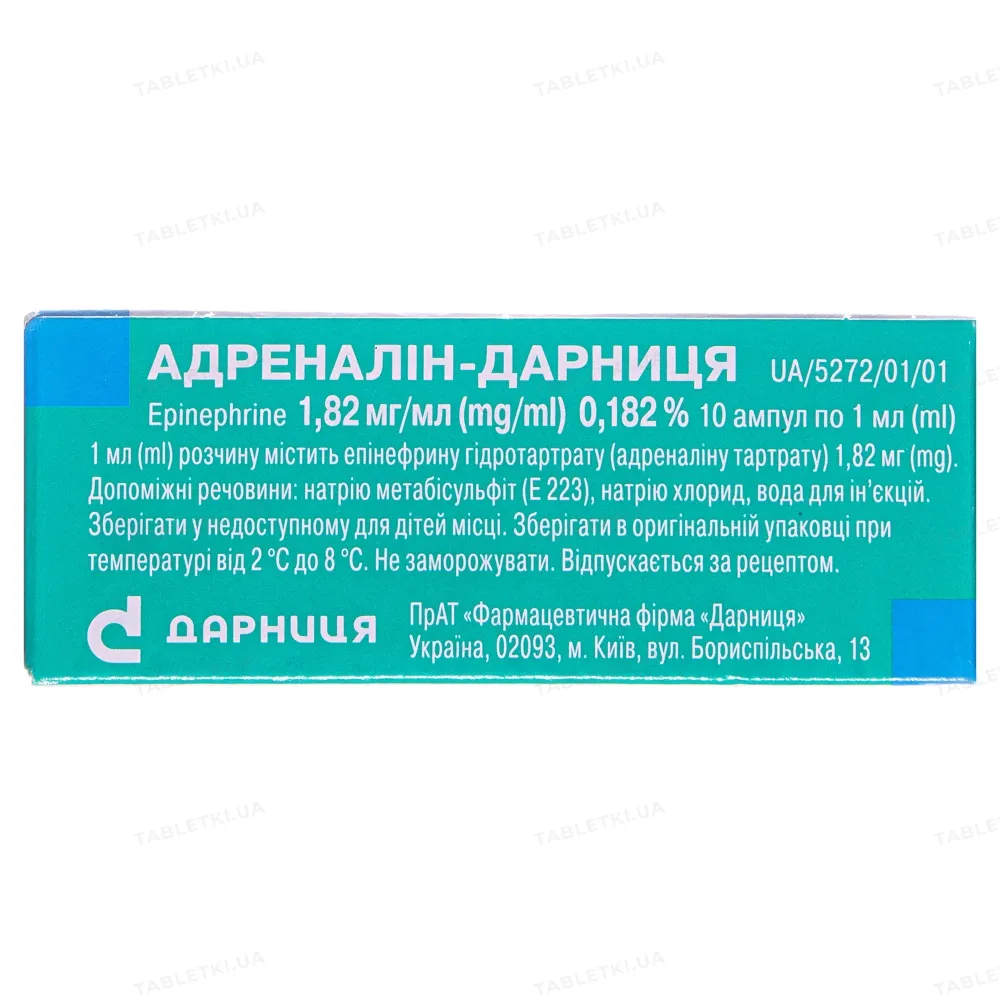
Table of Contents
INSTRUCTION FOR MEDICAL USE OF THE MEDICINAL PRODUCT ADRENALIN-DARNITSA (Adrenalin-Darnitsa)
Composition:
Active substance: epinephrine;
1 ml of solution contains epinephrine hydrochloride (adrenaline tartrate) 1.82 mg;
Excipients: sodium metabisulfite (E 223), sodium chloride, water for injections.
Pharmaceutical form. Solution for injection.
Main physicochemical properties: clear, colorless or slightly colored liquid.
Pharmacotherapeutic group. Non-glycoside cardiotonics. Adrenergic and dopaminergic agents. ATC code C01CA24.
Pharmacological Properties
Pharmacodynamics
Belongs to natural hormones. It is formed by methylation of noradrenaline and storage of the resulting adrenaline in chromaffin tissue of the adrenal medulla. It is a sympathomimetic agent acting on α- and β-adrenergic receptors. Adrenaline has higher affinity for α₂, β₂, and β₃-adrenergic receptors, and lower affinity for α₁- and β₁-adrenergic receptors.
The effect is mediated by activation of adenylate cyclase on the inner surface of the cell membrane, increasing intracellular cAMP and Ca²⁺ concentrations. At very low doses, with an infusion rate below 0.01 mcg/kg/min, it may reduce arterial blood pressure due to vasodilation in skeletal muscle. At infusion rates of 0.04–0.1 mcg/kg/min, it increases heart rate and contractility, stroke volume, and cardiac output, while reducing total peripheral vascular resistance. At infusion rates above 0.02 mcg/kg/min, it causes vasoconstriction, increases arterial pressure (mainly systolic) and total peripheral vascular resistance. The pressor effect may induce transient reflex bradycardia. It relaxes bronchial smooth muscles. Doses exceeding 0.3 mcg/kg/min reduce renal blood flow, blood supply to internal organs, and gastrointestinal tone and motility. It causes pupillary dilation, promotes reduction in aqueous humor production and intraocular pressure. It induces hyperglycemia (by enhancing glycogenolysis and gluconeogenesis) and increases plasma levels of free fatty acids. It enhances myocardial conductivity, excitability, and automaticity. It increases myocardial oxygen demand. It inhibits antigen-induced release of histamine and leukotrienes, relieves bronchiolar spasm, and prevents mucosal edema. By acting on α-adrenergic receptors located in the skin, mucous membranes, and internal organs, it causes vasoconstriction, reduces the absorption rate of local anesthetics, and thereby prolongs the duration of local anesthesia while reducing its toxic effects. Stimulation of β₂-adrenergic receptors promotes K⁺ efflux from cells and may lead to hypokalemia. When administered intracavernosally, it reduces blood filling of the corpora cavernosa. The therapeutic effect develops almost immediately after intravenous administration (duration of action – 1–2 minutes), within 5–10 minutes after subcutaneous administration (maximum effect – after 20 minutes). The onset time after intramuscular administration is variable.
Pharmacokinetics
Absorption. Well absorbed after intramuscular or subcutaneous administration. Time to reach maximum plasma concentration (Tmax) after subcutaneous or intramuscular administration is 3–10 minutes.
Distribution. Crosses the placenta and is excreted in breast milk; does not cross the blood-brain barrier.
Metabolism. Metabolized primarily by two enzymes: catechol-O-methyltransferase, which converts adrenaline in the liver and other tissues into metanephrine, and monoamine oxidase, which converts it into vanillylmandelic acid.
Excretion. Metabolites are excreted mainly as sulfate conjugates and, to a lesser extent, as glucuronides in urine. Elimination half-life (T½) is 1–2 minutes.
Clinical characteristics.
Indications.
Immediate-type allergic reactions: anaphylactic shock developed during administration of drugs or sera, or upon contact with allergens; bronchial asthma – relief of an attack; asystole; cardiac arrest; prolongation of the action of local anesthetics; acute-onset III degree AV block.
Contraindications.
Increased individual sensitivity to components of the drug; hypertrophic obstructive cardiomyopathy; severe aortic stenosis; tachyarrhythmia; ventricular fibrillation; pheochromocytoma; closed-angle glaucoma; shock (except anaphylactic); general anesthesia using inhalation agents: halothane, cyclopropane, chloroform; second stage of labor; application to fingers of hands and feet, nose, genitals.
Interaction with other medicinal products and other forms of interaction.
Antagonists of epinephrine are α- and β-adrenoreceptor blockers.
Possible interactions when the drug is used concomitantly with other agents:
with narcotic analgesics and sedative-hypnotic drugs – weakening of their effects;
with cardiac glycosides, quinidine, tricyclic antidepressants, dopamine, inhalational anesthetics (chloroform, enflurane, halothane, isoflurane, methoxyflurane), cocaine – increased risk of developing arrhythmias;
with other sympathomimetic agents – enhanced intensity of adverse cardiovascular effects;
with antihypertensive agents (including diuretics) – reduced effectiveness;
with monoamine oxidase inhibitors (including furazolidone, procarbazine, selegiline) – sudden and pronounced increase in arterial pressure, hypertensive crisis, headache, cardiac arrhythmias, vomiting;
with nitrates – reduced therapeutic effect;
with phenoxybenzamine – enhanced hypotensive effect and tachycardia;
with phenytoin – sudden dose- and infusion-rate-dependent decrease in arterial pressure and bradycardia;
with thyroid hormone drugs – mutual enhancement of effects;
with astemizole, cisapride, terfenadine – QT interval prolongation on ECG;
with diatrizoate, iotalamic acid, or ioxaglic acid – enhanced neurological effects;
with ergot alkaloids – enhanced vasoconstrictor effect up to marked ischemia and gangrene development;
with hypoglycemic agents (including insulin) – reduced hypoglycemic effect.
Special precautions for use.
Epinephrine should be administered intracardially in asystole only when other methods of resuscitation are unavailable; however, this route is associated with an increased risk of cardiac tamponade and pneumothorax.
If infusion is required, an infusion pump with a measuring device should be used to control the infusion rate. The infusion should be administered into a large vein, preferably a central vein.
During infusion, it is recommended to monitor serum K+ concentration, arterial blood pressure, diuresis, ECG, central venous pressure, and pulmonary artery pressure.
Use of this medicinal product in patients with diabetes mellitus may increase blood glucose levels; therefore, higher doses of insulin or sulfonylurea derivatives may be required.
Prolonged use of epinephrine is not recommended, as it may cause peripheral vasoconstriction leading to tissue necrosis or gangrene.
When discontinuing treatment, the dose of epinephrine should be tapered gradually, as abrupt withdrawal may result in severe hypotension.
Use with caution in patients with ventricular arrhythmias, ischemic heart disease, atrial fibrillation, arterial hypertension, pulmonary hypertension, or myocardial infarction (if epinephrine must be used during myocardial infarction, bear in mind that it may exacerbate ischemia by increasing myocardial oxygen demand). Also use with caution in patients with metabolic acidosis, hypercapnia, hypoxia, hypovolemia, thyrotoxicosis, occlusive vascular diseases (arterial embolism, atherosclerosis, Buerger’s disease, cold injury, diabetic endarteritis, Raynaud’s disease; due to the risk of necrosis and gangrene, peripheral circulation should be closely monitored), cerebral atherosclerosis, Parkinson’s disease, seizure disorders, or benign prostatic hyperplasia.
In cases of hypovolemia, appropriate fluid resuscitation should be performed prior to administration of sympathomimetic agents.
Use during pregnancy or breastfeeding.
Controlled studies on the use of epinephrine in pregnant women have not been conducted.
Do not use during labor to correct arterial hypotension, as the drug may prolong the second stage of labor due to uterine muscle relaxation. When administered in high doses to reduce uterine contractions, it may cause prolonged uterine atony with subsequent hemorrhage.
If it is necessary to use this medicinal product, breastfeeding should be discontinued.
Ability to affect reaction speed when driving or operating machinery.
During treatment with this medicinal product, driving vehicles or engaging in other potentially hazardous activities requiring high concentration and rapid psychomotor reactions is not recommended.
Method of Administration and Dosage.
The medicinal product should be administered subcutaneously, intramuscularly, occasionally intravenously, or by intravenous infusion.
Adults.
Anaphylactic shock: Administer the medicinal product slowly intravenously in a dose of 0.5 mL, diluted (the single dose should be dissolved in 20 mL of 40% glucose solution). Subsequently, if necessary, continue intravenous infusion at a rate of 1 mcg/min, for which 1 mL of adrenaline solution should be diluted in 400 mL of 0.9% sodium chloride solution or 5% glucose. If the patient's condition permits, intramuscular or subcutaneous administration of 0.3–0.5 mL of the medicinal product, either diluted or undiluted, is more appropriate.
Bronchial asthma: Administer the medicinal product subcutaneously in a dose of 0.3–0.5 mL, either diluted or undiluted. If repeated administration is required, this dose may be repeated every 20 minutes (up to 3 times). Intravenous administration of 0.3–0.5 mL of the medicinal product diluted (the single dose dissolved in 20 mL of 40% glucose solution) is also possible.
As a vasoconstrictor: Administer the medicinal product by intravenous infusion at a rate of 1 mcg/min (may be increased to 2–10 mcg/min).
Asystole: Administer the medicinal product intracardially in a dose of 0.5 mL, diluted (the single dose should be dissolved in 10 mL of 0.9% sodium chloride solution).
Resuscitation measures (cardiac arrest, acute-onset third-degree AV block): Administer the medicinal product slowly intravenously, 1 mL every 3–5 minutes, in diluted form.
Prolongation of local anesthetics' action: The medicinal product should be used at a concentration of 1:50,000–1:100,000. Dosage depends on the type of anesthetic.
Children.
Asystole in neonates: Administer the medicinal product slowly intravenously in a dose of 10–30 mcg/kg body weight every 3–5 minutes.
Anaphylactic shock: Administer the medicinal product subcutaneously or intramuscularly in a dose of 10 mcg/kg body weight (maximum dose up to 0.3 mg). If necessary, repeat administration every 15 minutes (up to 3 times).
Bronchospasm: Administer the medicinal product subcutaneously in a dose of 10 mcg/kg body weight (maximum dose up to 0.3 mg). If necessary, repeat administration every 15 minutes (up to 3–4 times) or every 4 hours.
Children.
The medicinal product may be used in children.
Overdose.
Symptoms: Excessive increase in arterial blood pressure, tachyarrhythmia alternating with bradycardia, cardiac rhythm disturbances (including atrial and ventricular fibrillation), coldness and pallor of the skin, vomiting, fear, anxiety, tremor, headache, metabolic acidosis, myocardial infarction, intracranial hemorrhage (especially in elderly patients), pulmonary edema, renal failure, fatal outcome. When administered in large doses (minimum lethal dose with subcutaneous administration – 10 mL of 0.18% solution), mydriasis, significant increase in arterial blood pressure, tachycardia progressing to ventricular fibrillation may develop.
Treatment: Discontinue administration of the medicinal product. Adrenaline overdose can be counteracted by using α- and β-adrenoblockers, fast-acting nitrates. In severe complications, comprehensive therapy is required. In case of arrhythmia, parenteral administration of β-adrenoblockers should be prescribed.
Adverse Reactions.
The following adverse reactions may occur during the use of the medicinal product.
Gastrointestinal disorders: nausea, vomiting, anorexia.
Renal and urinary system disorders: rarely – difficult and painful urination (in patients with prostatic hyperplasia).
Metabolism and nutrition disorders: hypokalaemia, hyperglycaemia.
Nervous system disorders: headache, tremor, dizziness, nervousness, muscle twitching; in patients with Parkinson's disease, possible increase in rigidity and tremor.
Psychiatric disorders: anxiety, psychoneurotic disorders, psychomotor agitation, disorientation, memory impairment, aggressive or panic behaviour, schizophrenia-like disorders, paranoia, sleep disturbances.
Cardiac disorders: angina pectoris, bradycardia or tachycardia, palpitations, dyspnoea; at high doses – ventricular arrhythmias; rarely – arrhythmia, chest pain; ECG changes (including reduced T-wave amplitude).
Vascular disorders: decreased or increased blood pressure (even after subcutaneous administration at usual doses, increased blood pressure may lead to subarachnoid haemorrhage and hemiplegia).
Immune system disorders: angioneurotic oedema, bronchospasm.
Skin and subcutaneous tissue disorders: skin rash, erythema multiforme.
General disorders and administration site reactions: pain or burning at the site of intramuscular injection; fatigue, increased sweating, thermoregulation disorders (feeling of cold or heat), cold extremities; with repeated injections of adrenaline, tissue necrosis may occur due to vasoconstrictive effects of adrenaline (including liver or kidney necrosis).
Shelf life. 2 years.
Storage conditions.
Store in the original packaging at a temperature between 2 °C and 8 °C. Do not freeze.
Keep out of reach of children.
Incompatibilities.
Do not mix in the same syringe with solutions of acids, alkalis, or oxidizing agents due to the possibility of chemical interaction with the active substance.
Packaging.
1 ml in an ampoule; 5 ampoules in a blister pack; 2 blisters per carton; 10 ampoules in a blister pack; 1 blister per carton.
Prescription status. Prescription only.
Manufacturer.
JSC "Pharmaceutical Company "Darnytsia".
Address of manufacturer and site of operation.