Adp-biolic
Ukraine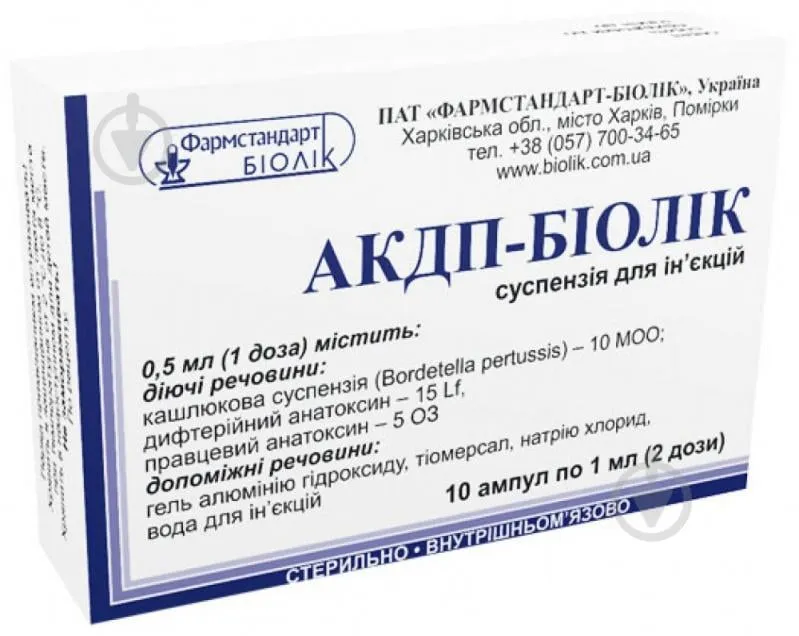
Table of Contents
Instructions for the Medical Use of the Medicinal Product ADP-Biolik
Composition:
Active substances:
diphtheria toxoid (obtained by inactivating the toxin with formaldehyde);
tetanus toxoid (obtained by inactivating the toxin with formaldehyde);
0.5 mL (1 dose) of the preparation contains:
diphtheria toxoid (obtained by inactivating the toxin with formaldehyde) – 30 flocculating units (Lf);
tetanus toxoid (obtained by inactivating the toxin with formaldehyde) – 10 binding units (BU);
Excipients: aluminium hydroxide gel (calculated as aluminium) – 0.5 mg, thiomersal (preservative) – 0.05 mg, sodium chloride – 4.5 mg, water for injections – up to 0.5 mL.
Pharmaceutical form. Injection suspension.
Main physicochemical properties: the preparation consists of a mixture of purified diphtheria and tetanus toxoids adsorbed onto aluminium hydroxide gel. The preparation is a yellowish-white suspension, which on standing separates into a clear supernatant liquid and a loose sediment that completely disperses upon shaking.
Pharmacotherapeutic group.
Bacterial vaccines. Tetanus toxoid, combined with diphtheria toxoid.
ATC code J07AM51.
Immunological and Biological Properties.
Pharmacodynamics.
Administration of the preparation according to the approved vaccination schedule promotes the development of specific immunity against diphtheria and tetanus.
Pharmacokinetics.
Assessment of pharmacokinetic data is not performed.
Clinical characteristics.
Indications.
Prevention of diphtheria and tetanus in children according to the official recommendations of the National Calendar of Preventive Vaccinations.
Contraindications.
Severe complications following a previous dose of ADP-Biolik, ADP, or DT toxoids, such as anaphylactic reaction or toxic erythema.
Allergic reaction to any component of the vaccine.
Acute illness or exacerbation of a chronic disease.
Congenital combined immunodeficiencies, primary hypogammaglobulinemia.
Immunosuppressive therapy (see section "Special precautions").
Special safety measures.
The vaccine must not be used if the vials are damaged, unlabelled, if there is a change in physical properties (change in color, presence of an insoluble precipitate upon shaking), if the expiry date has passed, or if storage conditions have been compromised.
Opening of vials and the vaccination procedure must be performed under strict adherence to aseptic and antiseptic rules. The vaccine in an opened vial must not be stored.
Disposal of all unused vaccines or waste must be carried out in accordance with national requirements.
Interaction with other medicinal products and other forms of interaction.
Simultaneous administration of ADP-Biolik vaccine with other inactivated vaccines and/or toxoids, as well as with live vaccines (except BCG), is permitted. When administering ADP-Biolik vaccine simultaneously with other injectable vaccines, these products should be injected at different body sites, unless otherwise specified in the instructions for use of the specific vaccine/toxoid.
Vaccination with ADP-Biolik vaccine may be administered with an interval of at least 1 month before or after BCG vaccination.
Special precautions for use.
Appropriate clinical practice recommends considering the child's medical history and previous vaccination record prior to vaccination; laboratory tests (complete blood count and urine analysis) are also recommended.
Vaccination must be administered by healthcare professionals in vaccination rooms of healthcare facilities. Preventive vaccinations should be carried out in compliance with sanitary and anti-epidemic regulations.
To identify contraindications, the physician must interview the parents and perform a medical examination of the child on the day of vaccination, including mandatory temperature measurement. Children who have been temporarily exempted from vaccination should be placed under medical supervision and monitored, and vaccinated promptly after contraindications are resolved.
Syncope (fainting) may occur during or before vaccination as a psychogenic reaction to needle injection. To prevent injury, vaccination should be administered while the patient is seated or lying down, and the patient should remain in this position for at least 15 minutes after vaccination.
Due to the possibility of immediate-type allergic reactions, vaccinated children must be medically observed for 30 minutes after vaccination. Vaccination rooms must be equipped with emergency anti-shock therapy supplies.
Human immunodeficiency virus (HIV) infection is not considered a contraindication. HIV-infected children should receive diphtheria and tetanus vaccination according to the standard schedule.
As with other vaccines, administration of ADP-Biolik vaccine should be postponed in case of an acute serious illness accompanied by fever.
Children who have had acute illnesses should be vaccinated 2–4 weeks after recovery. Vaccination may be administered after resolution of clinical symptoms in mild cases.
Vaccination of individuals with chronic diseases should be performed after achieving clinical and laboratory remission; if necessary, under inpatient conditions.
Vaccination of individuals with neurological disorders should be performed after excluding disease progression and achieving clinical stability.
For patients with thrombocytopenia or coagulation disorders (due to risk of bleeding with intramuscular injection), the injection site should be firmly pressed (without rubbing) for at least two minutes.
Due to the use of formaldehyde during the manufacturing process, residual amounts of this substance may be present in the vaccine. Therefore, the vaccine should be used with caution in individuals with hypersensitivity to formaldehyde.
Vaccination of individuals with allergic diseases should be performed 2–4 weeks after an exacerbation. However, stable manifestations of the disease (localized skin symptoms, subclinical bronchospasm, etc.) are not contraindications to vaccination, which may be performed while continuing appropriate therapy.
If the patient has received immunosuppressive therapy (treatment with cytostatic drugs, including monotherapy with cyclosporin A, or corticosteroids at doses exceeding 2 mg/kg/day of prednisolone equivalent for more than 14 days of systemic use), ADP-Biolik vaccination should be administered after completion of such therapy. If corticosteroid treatment duration is less than 14 days regardless of dose, or more than 14 days at a prednisolone dose of less than 2 mg/kg/day, or if corticosteroids are used as replacement or local therapy, such treatment is not considered immunosuppressive and is not a contraindication to vaccination.
Following vaccination, an adequate immunological response may not develop in patients with suppressed immunity.
Administration of the vaccine must be recorded in the designated documentation, specifying the batch number, dose, expiration date, manufacturer, date of administration, and nature of the reaction to the vaccine, which should be assessed by healthcare staff of outpatient clinics or childcare institutions the day after vaccination.
Protective immune response may not be achieved in all vaccinated individuals.
This medicinal product contains less than 1 mmol (23 mg)/dose of sodium, i.e., it is practically sodium-free.
Under no circumstances should ADP-Biolik be administered intravenously or intradermally.
When conducting immunization in Ukraine, the immunization schedule, contraindications, and interactions with other medicinal products should follow the current regulatory documents issued by the Ministry of Health of Ukraine.
Use during pregnancy or breastfeeding.
Not applicable.
Ability to affect reaction speed when operating vehicles or machinery.
Data unavailable.
Method of Administration and Dosage
According to the National Immunization Schedule, the ADP-Biolik vaccine should be used for routine booster vaccination against diphtheria and tetanus in children aged 6 years.
ADP-anatoxin vaccination may be administered if a child has contraindications to the use of DTP vaccine containing the pertussis component. The ADP-Biolik vaccine can be administered to children aged from 3 months up to 6 years 11 months 29 days, with an interval of at least 1 month between the first and second doses and an interval of at least 9 months between the second and third doses. Shortening of these intervals is not permitted. If it is necessary to extend the vaccination intervals, the next dose should be administered as soon as possible, depending on the child's condition.
Children aged 7 years and older, as well as adults who have not been previously vaccinated or whose vaccination history is unknown, should be vaccinated with ADP-M vaccine according to the instructions for use.
The ADP-Biolik vaccine is intended for deep intramuscular injection. The recommended site of administration in infants and young children is the anterolateral aspect of the thigh (middle third). In older children (> 3 years of age), the vaccine should be administered into the densest part of the deltoid muscle (the muscular prominence on the shoulder, upper third, lateral injection) at a dose of 0.5 mL (single dose).
Before vaccination, the vial should be shaken until a homogeneous suspension is obtained.
Children. Administer to children aged from 3 months to 6 years 11 months 29 days.
Overdose.
No cases of overdose have been reported.
Adverse reactions.
Adverse reactions are listed based on post-marketing surveillance data.
The following criteria were used to assess the frequency of adverse reactions:
very common – more than 10 %;
common – 1–10 %;
uncommon – 0.1–1 %;
rare – 0.01–0.1 %;
very rare – less than 0.01 %.
Within the first two days after vaccination, general and local reactions may develop.
General disorders and administration site reactions
Uncommon: hyperemia, swelling at the injection site.
Rare: fever; pain, infiltration at the injection site.
Very rare: malaise.
Nervous system disorders
Very rare: encephalitic (convulsive) reactions, collapse-like state.
Immune system disorders
Very rare: angioedema (Quincke's edema), exacerbation of allergic diseases, systemic reactions resembling anaphylactic shock.
Skin and subcutaneous tissue disorders
Very rare: urticaria, polymorphic rash.
When other vaccines containing tetanus toxoid were used, cases of brachial neuritis and Guillain-Barré syndrome were reported.
Additional information regarding specific populations.
The potential risk of apnea should be considered in preterm infants born at early gestational ages (< 28 weeks).
Shelf life.
2 years.
Storage conditions.
Store protected from light at a temperature of 2 °C to 8 °C. Do not freeze! Keep out of reach of children.
Incompatibilities.
The product should not be mixed with other medicinal products, as compatibility studies have not been conducted.
Packaging.
0.5 mL (1 dose) or 1 mL (2 doses) in an ampoule, 10 ampoules per pack.
Prescription status.
Prescription only.
Manufacturer.
JSC "Biolyk", Ukraine.
Manufacturer's address and location of its business activity.
Pomirky, Kharkiv region, Ukraine.