Adenosterid-zdorovya
Ukraine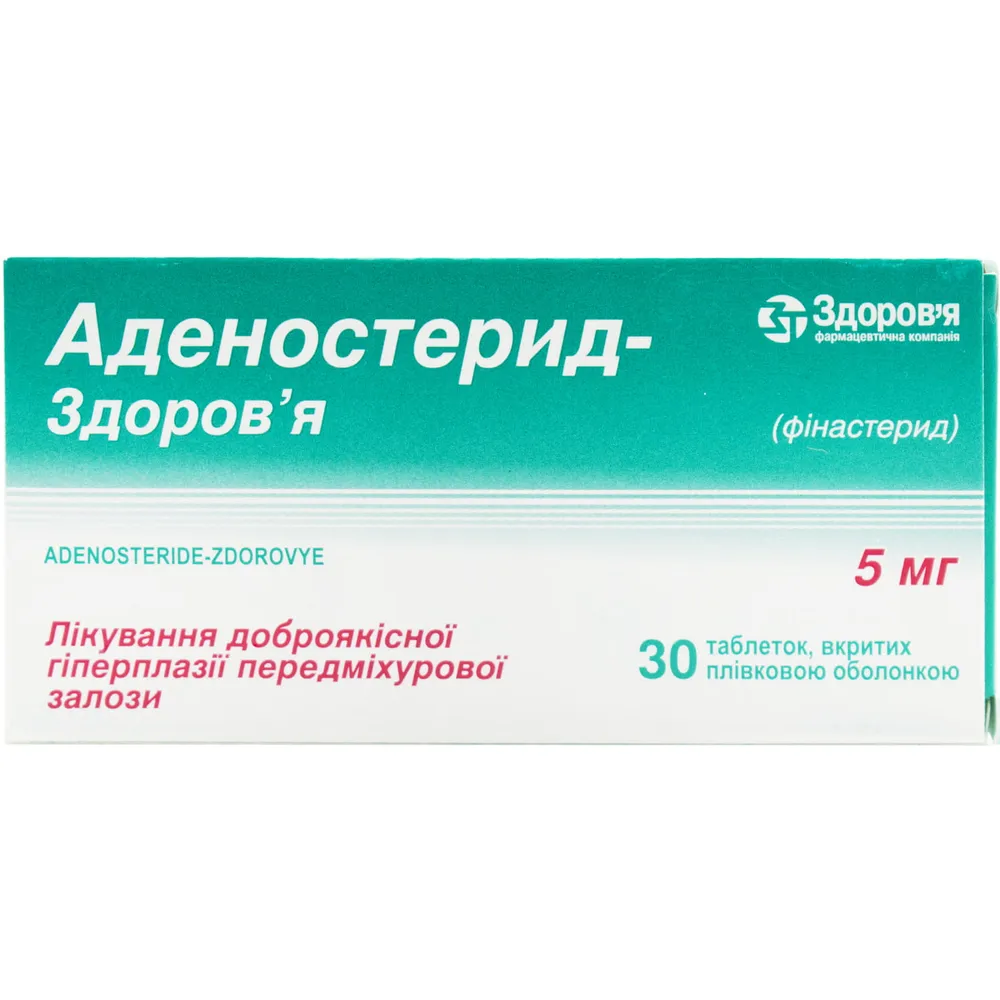
Table of Contents
INSTRUCTION FOR MEDICAL USE OF THE MEDICINAL PRODUCT ADESTORIDE-ZDOROVYE (ADENOSTERIDE-ZDOROVYE)
Composition:
Active substance: finasteride;
1 tablet contains 5 mg of finasteride;
Excipients: lactose monohydrate; microcrystalline cellulose; maize starch; magnesium stearate; colloidal anhydrous silicon dioxide; hypromellose; titanium dioxide (E 171); Candurin (silver glitter) containing potassium aluminosilicate, titanium dioxide (E 171); colorant "Sepispers dry blue I" containing hypromellose, microcrystalline cellulose, indigocarmine (E 132).
Medicinal form: Film-coated tablets.
Main physicochemical properties: film-coated tablets of blue color with a slight pearly sheen.
Pharmacotherapeutic group. Drugs used in benign prostatic hyperplasia. Inhibitors of testosterone 5-α-reductase. ATC code G04CB01.
Pharmacological Properties
Pharmacodynamics
Finasteride is a specific inhibitor of type II 5-alpha-reductase, an intracellular enzyme that converts testosterone into the more active androgen dihydrotestosterone (DHT). In benign prostatic hyperplasia (BPH), prostate enlargement depends on the conversion of testosterone to DHT within prostate tissue. Finasteride effectively reduces both circulating and intraprostatic DHT levels. Finasteride has no affinity for androgen receptors.
In patients with moderate to severe symptoms of BPH, enlarged prostate on digital rectal examination, and low residual urine volume, finasteride reduced the incidence of acute urinary retention from 7/100 to 3/100 over 4 years and the need for surgical intervention (transurethral resection of the prostate or prostatectomy) from 10/100 to 5/100. This reduction was associated with a 2-point improvement on the symptom assessment scale QUASI-AUA (range 0–34), significant regression of prostate volume—approximately 20%—and a significant increase in urinary flow rate.
Data are available from the MTOPS (Medical Therapy of Prostatic Symptoms) study, a 4–6-year trial involving 3047 men with symptomatic BPH who were randomized to receive finasteride (5 mg/day), doxazosin (4 or 8 mg/day), combination of finasteride (5 mg/day) and doxazosin (4 or 8 mg/day), or placebo. The primary endpoint was time to clinical progression of BPH (defined as an increase of ≥4 points from baseline on symptom score, acute urinary retention, BPH-related renal insufficiency, recurrent urinary tract infection or urosepsis, or urinary incontinence). Compared with placebo, treatment with finasteride, doxazosin, or the combination significantly reduced the risk of clinical progression of BPH by 34% (p=0.002), 39% (p<0.001), and 67% (p<0.001), respectively. The majority of cases (274 out of 351) constituting BPH progression were confirmed by an increase of ≥4 points on the symptom score; under treatment, the risk of symptom progression was reduced by 30% (95% confidence interval 6–48%), 46% (95% confidence interval 25–60%), and 64% (95% confidence interval 48–75%) in the finasteride, doxazosin, and combination groups, respectively, compared to placebo. Acute urinary retention occurred in 41 out of 351 cases of BPH progression; under treatment, the risk of acute urinary retention was reduced by 67% (p=0.011), 31% (p=0.296), and 79% (p=0.001) in the finasteride, doxazosin, and combination groups, respectively, compared to placebo. Only the finasteride and combination therapy groups showed a statistically significant difference compared to the placebo group.
Pharmacokinetics
The bioavailability of finasteride after oral administration is approximately 80%. Food intake does not affect the bioavailability of the drug. The Cmax of finasteride in plasma is reached approximately 2 hours after oral administration. Absorption from the gastrointestinal tract is complete within 6–8 hours after administration. The plasma half-life (T½) of finasteride averages 6 hours. Plasma protein binding is 93%. Systemic clearance is approximately 165 mL/min, and the volume of distribution is 76.1 liters.
In elderly individuals, the elimination rate of finasteride is slightly reduced. In men aged 70 years and older, the T½ of finasteride is approximately 8 hours, compared to 6 hours in individuals aged 18 to 60 years. However, this does not warrant dose reduction in elderly patients.
In patients with chronic renal impairment (creatinine clearance from 9 to 55 mL/min), no differences in the elimination rate of a single dose of finasteride were observed compared to patients without renal disease. Plasma protein binding in these patients was also unchanged. This is explained by the fact that in patients with renal impairment, the fraction of finasteride metabolites normally excreted in urine is eliminated via feces. This is confirmed by increased levels of finasteride metabolites in feces and simultaneously decreased concentrations in urine in these patients. Therefore, in patients with renal impairment who are not undergoing hemodialysis, dose adjustment is not required.
Pharmacokinetic data in patients with hepatic impairment are not available.
Finasteride crosses the blood-brain barrier. A small amount of finasteride has been detected in semen.
Clinical characteristics.
Indications.
Treatment and control of benign prostatic hyperplasia (BPH) in patients with an enlarged prostate gland, aimed at:
- reducing the size (regression) of the enlarged gland, improving urinary flow, and alleviating symptoms associated with BPH;
- reducing the risk of acute urinary retention and the need for surgical intervention, including transurethral resection of the prostate and prostatectomy.
Contraindications.
Hypersensitivity to the components of the drug.
The drug is not intended for use in women and children.
Pregnancy: use in women who are or may potentially be pregnant (see section "Use during pregnancy or breastfeeding").
Interaction with other medicinal products and other forms of interaction.
No clinically significant interactions with other drugs have been identified. Finasteride has no substantial effect on the enzyme system metabolizing drugs related to cytochrome P450. Although the risk of finasteride affecting the pharmacokinetics of other medicinal products is considered low, there is a possibility that inhibitors and inducers of CYP3A4 may influence finasteride plasma concentrations. However, given the established safety profile, any increase in finasteride concentration due to concomitant use of CYP3A4 inhibitors is unlikely to have clinical significance. No clinically relevant interactions were observed when finasteride was administered with propranolol, digoxin, glyburide, warfarin, theophylline, and antipyrine.
Other concomitant therapies. Although specific interaction studies have not been conducted, the drug has been used concomitantly with angiotensin-converting enzyme inhibitors, α-blockers, β-blockers, calcium channel blockers, nitrates, diuretics, H2-histamine receptor antagonists, HMG-CoA reductase inhibitors, nonsteroidal anti-inflammatory drugs, including acetylsalicylic acid and paracetamol, quinolones, and benzodiazepines. No clinically significant adverse interactions have been observed.
Special precautions.
General measures. Careful monitoring for possible development of obstructive uropathy is necessary in patients with a large residual urine volume and/or suddenly reduced urine flow. Surgical intervention should be considered as an alternative option.
Effect on prostate-specific antigen (PSA) and diagnosis of prostate cancer. To date, a beneficial clinical effect of treatment with the drug in patients with prostate cancer has not been demonstrated. Patients with benign prostatic hyperplasia (BPH) and elevated PSA levels were monitored with multiple PSA measurements and prostate biopsies. Treatment with the drug did not affect the frequency of prostate cancer detection. The overall incidence of prostate cancer was not significantly different between patients receiving the drug and those not receiving it.
Before initiating treatment and periodically during therapy, patients should be examined by digital rectal examination and other methods to rule out prostate cancer. Serum PSA measurement is also used in the detection of prostate cancer. In general, when the baseline PSA level exceeds 10 ng/mL (Hybritech), a thorough patient evaluation should be performed, including, if necessary, prostate biopsy. For PSA levels between 4 and 10 ng/mL, further evaluation is recommended. There is considerable overlap in PSA levels between men with and without prostate cancer. Therefore, in men with BPH, PSA levels cannot exclude the presence of prostate cancer, regardless of treatment with the drug. A baseline PSA level below 4 ng/mL does not exclude the presence of prostate cancer.
The drug causes a reduction in serum PSA levels by approximately 50% in patients with BPH, even in the presence of prostate cancer. This decrease in serum PSA levels in patients with BPH receiving treatment with the drug must be taken into account when interpreting PSA values, as this reduction does not rule out concomitant prostate cancer. This reduction is predictable across the entire range of PSA values, although individual variations may occur. In most patients treated with the drug for 6 months or longer, PSA values should be doubled when compared to normal values in individuals not taking the drug. This adjustment maintains the sensitivity and specificity of PSA testing and preserves its ability to detect prostate cancer.
Any persistent increase in PSA levels in a patient receiving finasteride (5 mg) requires thorough evaluation to determine the cause, including non-adherence to the prescribed dosing regimen.
Effect on PSA levels. Serum PSA levels correlate with patient age and prostate volume, and prostate volume correlates with age. When evaluating laboratory PSA results, it should be noted that PSA levels decrease during treatment with the drug. Most patients experience a rapid decline in PSA during the first few months of treatment, after which PSA stabilizes at a new level approximately half the baseline value. Therefore, in typical patients treated with the drug for 6 months or longer, PSA values should be doubled compared to normal values in individuals not taking the drug.
The drug does not significantly alter the percentage of free PSA (ratio of free to total PSA). The free-to-total PSA ratio remains constant even under the influence of the drug. When using the percentage of free PSA for prostate cancer diagnosis, correction of its values is not required.
Breast cancer in men. Cases of male breast cancer have been reported in men taking finasteride (5 mg). Physicians should instruct their patients to immediately report any changes in breast tissue, including lumps, pain, gynecomastia, or nipple discharge.
Mood changes and depression. Cases of mood changes, including depressive mood, depression, and, less frequently, suicidal ideation, have been reported in patients receiving finasteride 5 mg. Patients should be monitored for the emergence of psychiatric symptoms, and if such symptoms occur, patients should be advised to seek medical help.
Hepatic impairment. The effect of hepatic impairment on the pharmacokinetics of finasteride has not been studied.
The drug contains lactose. If a patient has known sugar intolerance, consultation with a physician is necessary before taking this medicinal product.
Use during pregnancy or breastfeeding.
The drug is contraindicated in pregnant women.
Finasteride poses a risk to the male fetus.
Women who are or may become pregnant should avoid contact with crushed or damaged tablets of the drug due to the potential for finasteride absorption and subsequent risk to a male fetus.
Available data indicate excretion of small amounts of finasteride in the semen of patients taking finasteride 5 mg daily. It is unknown whether exposure of a pregnant woman to semen from a finasteride-treated patient could adversely affect a male fetus. If a patient's sexual partner is pregnant or potentially pregnant, the patient should be advised to avoid exposing her to his semen.
Due to the ability of type II 5-α-reductase inhibitors to inhibit the conversion of testosterone to dihydrotestosterone, these drugs, including finasteride, may cause abnormalities in the development of external genitalia in a male fetus.
The drug's tablets are coated with a film that prevents contact with the active ingredient as long as the tablets are not crushed or damaged.
The drug is not indicated for use in women. It is unknown whether finasteride is excreted in human milk.
Ability to affect reaction speed when driving or operating machinery.
The drug does not affect the ability to drive a vehicle or operate machinery.
Method of administration and dosage.
The recommended dose is – 1 tablet of 5 mg once daily, during or independent of food intake.
The drug can be used in combination with the α-blocker doxazosin (see section "Pharmacological properties").
The duration of treatment is determined individually by a physician. Although improvement in symptoms may occur earlier, at least six months of treatment are required to assess therapeutic efficacy, after which treatment should be continued. The risk of acute urinary retention decreases during four months following the end of treatment.
No dose adjustment is required for elderly patients or for patients with renal impairment of any severity (creatinine clearance down to 9 ml/min).
There are no data regarding the use of the drug in patients with hepatic impairment.
Children.
The drug is contraindicated in children.
Safety and efficacy of the drug in children have not been established.
Overdose.
In patients who received single doses of up to 400 mg and daily doses of up to 80 mg for 3 months, no adverse effects were observed.
There are no specific recommendations for the treatment of overdose.
Adverse reactions.
The most common adverse reactions are impotence and decreased libido. These adverse reactions occur at the beginning of therapy and resolve with continued treatment in most patients.
Immune system disorders: hypersensitivity reactions, including rash, pruritus, urticaria, and angioedema (including swelling of the lips, tongue, throat, and face).
Psychiatric disorders: decreased libido, which may persist after discontinuation of therapy, depression, anxiety; suicidal ideation with frequency "unknown".
Cardiac disorders: tachycardia.
Hepatobiliary disorders: increased liver enzymes.
Reproductive system and breast disorders: impotence, ejaculation disorder, breast tenderness and enlargement, breast cancer, testicular pain, sexual dysfunction (erectile dysfunction and ejaculation disorders), which may persist after discontinuation of treatment; male infertility and/or reversible changes in semen quality (normalization or improvement in semen quality has been reported after discontinuation of finasteride), hematospermia.
Patients should immediately inform their physician about any changes in breast tissue, including lumps, pain, gynecomastia, or nipple discharge.
In clinical studies: reduced ejaculate volume.
In the MTOPS study, the safety and tolerability profile of combination therapy was consistent with the profiles of the individual components. The incidence of ejaculation disorders in patients receiving combination therapy was comparable to the sum of the incidences of adverse reactions observed with the two monotherapies.
There is data suggesting an increased risk of high-grade prostate cancer with the use of the drug. This may be explained by the drug's effect on prostate volume. Among all cases of prostate cancer, the majority were classified as intracapsular (stage T1 or T2) cancer. Information on the relationship between long-term use of the drug and tumors with Gleason scores of 7–10 is lacking.
Laboratory test data. Serum PSA levels correlate with patient age and prostate volume, with prostate volume also correlating with patient age. When evaluating laboratory PSA results, it should be noted that PSA levels decrease during treatment with the drug (see section "Special instructions").
Shelf life. 3 years.
Storage conditions. Store in the original packaging at a temperature not exceeding 25 °C. Keep out of reach of children.
Packaging. Tablets, 10 × 3 in blisters in a carton.
Prescription status. Prescription only.
Manufacturer. LIMITED LIABILITY COMPANY "CORPORATION "ZDOROVYA".
Limited Liability Company "FARMEKS GROUP".
Manufacturer's address and location of business activity. Ukraine, 61013, Kharkiv region, city of Kharkiv, Shevchenka Street, 22.
(LIMITED LIABILITY COMPANY "CORPORATION "ZDOROVYA")
Ukraine, 08301, Kyiv region, city of Boryspil, Shevchenka Street, 100.
(Limited Liability Company "FARMEKS GROUP")