3-dinir
Ukraine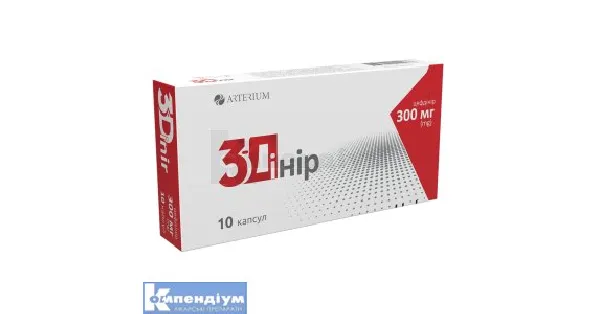
Table of Contents
for medical use of the medicinal product 3-DINIR (3-DINIR)
Composition:
Active substance: cefdinir;
1 capsule contains: cefdinir, calculated as dry substance — 300 mg;
Excipients: calcium carboxymethylcellulose, polyethylene glycol (macrogol) stearate, colloidal anhydrous silicon dioxide, magnesium stearate.
Capsule shell composition: iron oxide black (E 172), titanium dioxide (E 171), gelatin.
Pharmaceutical form. Capsules.
Main physicochemical properties: hard gelatin capsules with grey body and black cap.
Pharmacotherapeutic group. Antibacterials for systemic use. Other beta-lactam antibacterials. Third-generation cephalosporins. Cefdinir.
ATC code J01D D15.
Pharmacological Properties
Pharmacodynamics
Like other cephalosporins, the bactericidal activity of cefdinir results from inhibition of bacterial cell wall synthesis. Cefdinir is stable against the action of certain β-lactamase enzymes. Due to this property, many organisms resistant to penicillins and some other cephalosporins remain susceptible to cefdinir. Cefdinir has been shown to be active against most strains of the following microorganisms, both in vitro and in clinical infections.
The antimicrobial spectrum of cefdinir includes:
- Aerobic Gram-positive microorganisms:
Staphylococcus aureus (including β-lactamase-producing strains; however, it is not active against methicillin-resistant strains);
Streptococcus pneumoniae (only penicillin-susceptible strains);
Streptococcus pyogenes.
- Aerobic Gram-negative microorganisms:
Haemophilus influenzae (including β-lactamase-producing strains);
Haemophilus parainfluenzae (including β-lactamase-producing strains);
Moraxella catarrhalis (including β-lactamase-producing strains).
The following data were obtained in vitro, but their clinical significance is unknown.
The in vitro minimal inhibitory concentration (MIC) of cefdinir is 1 mcg/mL or less against strains (>90%) of the following microorganisms; however, the safety and efficacy of cefdinir in treating infections caused by the microorganisms listed below have not been established in clinical trials.
- Aerobic Gram-positive microorganisms:
Staphylococcus epidermidis (only methicillin-susceptible strains);
Streptococcus agalactiae;
Streptococcus group viridans.
Note: cefdinir is not active against Enterococcus or methicillin-resistant Staphylococcus species.
- Aerobic Gram-negative microorganisms:
Citrobacter diversus;
Escherichia coli;
Klebsiella pneumoniae;
Proteus mirabilis.
Note: cefdinir is not active against Pseudomonas or Enterobacter species.
Susceptibility Testing
By serial dilution method, the following MIC values were determined:
- For organisms other than Haemophilus spp. and Streptococcus spp.:
| MIC (mg/ml) |
Interpretation |
| ≤ 1 |
Susceptible (S) |
| 2 |
Intermediate (I) |
| ≥ 4 |
Resistant (R) |
- For Haemophilus spp.:a
| МІК (мг/мл) |
Інтерпретаціяb |
| ≤ 1 |
susceptible (S) |
a These interpretive standards apply only to broth microdilution susceptibility tests with Haemophilus spp. strains using Haemophilus Test Medium (HTM)(1).
b The lack of data on resistant strains precludes defining interpretive categories other than "susceptible." Strains yielding MIC results suggesting the "not susceptible" category should be referred to a reference laboratory for further testing.
- For Streptococcus spp.:
Streptococcus pneumoniae susceptible to penicillin (MIC ≤ 0.06 mcg/mL), or streptococci other than S. pneumoniae susceptible to penicillin (MIC ≤ 0.12 mcg/mL), may be considered susceptible to cefdinir. Testing cefdinir against penicillin-intermediate or penicillin-resistant isolates is not recommended. Reliable interpretive criteria for cefdinir are not available.
A "susceptible" result indicates that the microorganism is likely to be inhibited if the antimicrobial compound reaches concentrations at the infection site commonly achieved in the blood. A "intermediate" result indicates that the result should be considered equivocal and that the microorganism is not fully susceptible to alternative, clinically effective drugs. Such testing should be repeated. The "intermediate" category implies possible clinical utility in body sites where the drug concentrates physiologically or in situations where high drug doses may be administered. This category also provides a buffer zone, preventing minor, uncontrolled technical factors from causing major discrepancies in interpretation. A "resistant" result indicates that the microorganism is likely not inhibited if the antimicrobial compound reaches concentrations in the blood commonly achieved at standard dosing. Alternative therapy should be selected when such results are obtained.
Standardized susceptibility testing procedures require the use of quality control microorganisms (to monitor technical performance). Standard cefdinir powder should yield the following MIC values:
| Microorganism |
Range of MIC (μg/ml) |
| Escherichia coli ATCC 25922 |
0.12–0.5 |
| Haemophilus influenzae ATCC 49766c |
0.12–0.5 |
| Staphylococcus aureus ATCC 29213 |
0.12–0.5 |
This quality control range applies only to Haemophilus influenzae ATCC 49766, tested by the broth dilution method using HTM.
Agar diffusion method determined the following MIC values:
- For organisms other than Haemophilus spp. and Streptococcus spp.:
| Diameter of the zone (mm) |
Interpretation |
| ≥ 20 |
susceptible (S) |
| 17–19 |
intermediately susceptible (I) |
| ≤ 16 |
resistant (R) |
d Since some strains of Citrobacter, Providencia, and Enterobacter spp. may yield unreliable susceptibility results when tested with cefdinir disks, strains of these genera should not be tested or interpreted using this disk.
- For Haemophilus spp.: e
| Diameter of the zone (mm) |
Interpretation f |
| ≥ 20 |
susceptible (S) |
e The indicated zone diameter standards apply only to tests with Haemophilus spp., using HTM(2).
f The absence of data on resistant strains precludes the determination of categories other than "susceptible." Strains yielding MIC results indicating the "not susceptible" category should be referred to a reference laboratory for further testing.
- For Streptococcus spp.:
Streptococcus pneumoniae isolates should be tested using 1 µg oxacillin disks. Isolates with oxacillin zone diameters ≥ 20 mm are susceptible to penicillin and may be considered susceptible to cefdinir. Streptococci (other than S. pneumoniae) should be tested using 10 units penicillin disks. Isolates with penicillin zone diameters ≥ 28 mm are susceptible to penicillin and may be considered susceptible to cefdinir.
As with standardized dilution methods, agar diffusion methods require the use of test microorganisms to monitor the technical performance of laboratory procedures. For the disk diffusion method using a 5 µg cefdinir disk, the following zone diameters should be achieved:
| Microorganism |
Diameter of zones (mm) |
| Escherichia coli ATCC 25922 |
24–28 |
| Haemophilus influenzae ATCC 49766g |
24–31 |
| Staphylococcus aureus ATCC 29213 |
25–32 |
g This quality control range applies only to Haemophilus influenzae ATCC 49766 using HTM.
Pharmacokinetics.
Absorption
Oral bioavailability
Maximum plasma concentration (Cmax) of cefdinir is achieved 2–4 hours after administration of the drug. Plasma cefdinir concentration increases with dose, but the increase becomes less than proportional in the dose range of 300 (7 mg/kg) to 600 mg (14 mg/kg). The expected bioavailability of cefdinir capsules is 21% after administration of 300 mg and 16% after administration of 600 mg.
Effect of food
Cefdinir Cmax and AUC are reduced by 16% and 10%, respectively, when administered with a high-fat meal. The extent of this reduction is unlikely to be clinically significant. Therefore, cefdinir may be administered without regard to food intake.
Plasma cefdinir concentrations and pharmacokinetic parameter values after single oral doses of 300–600 mg administered to healthy adult volunteers are presented in the table below:
Mean (± SD [standard deviation]) plasma pharmacokinetic parameters of cefdinir after drug administration
| Dose (mg) |
Cmax (mg/mL) |
tmax (hours) |
AUC (mg·hour/mL) |
| 300 |
1.60 (0.55) |
2.9 (0.89) |
7.05 (2.17) |
| 600 |
2.87 (1.01) |
3.0 (0.66) |
11.1 (3.87) |
Multiple dosing
Cefdinir does not accumulate in plasma after administration once or twice daily in patients with normal renal function.
Distribution
The mean volume of distribution (Vd) of cefdinir in adults is 0.35 L/kg (± 0.29), and in children (aged 6 months to 12 years) the Vd of cefdinir is 0.67 L/kg (± 0.38). 60–70% of cefdinir is protein-bound in plasma in both adults and children, and binding is independent of concentration.
Skin blister fluid
In adult patients, median (ranges) cefdinir concentrations in skin blister fluid were 0.65 (0.33–1.1) and 1.1 (0.49–1.9) mg/mL observed 4–5 hours after administration of 300 and 600 mg doses, respectively. Mean (± SD) values of Cmax and AUC(0–∞) in skin blister fluid were 48% (± 13) and 91% (± 18), respectively, of those in plasma.
Tonsillar tissue
In adult patients undergoing elective tonsillectomy, mean cefdinir concentrations in tonsillar tissue 4 hours after single 300 and 600 mg doses were 0.25 (0.22–0.46) and 0.36 (0.22–0.80) µg/g, respectively. Mean drug concentration in tonsillar tissue was 24% (± 8) of plasma concentration values.
Sinus tissue
In adult patients undergoing surgical maxillary and ethmoid sinus surgery, mean cefdinir concentrations in sinus tissue 4 hours after 300 and 600 mg doses were <0.12 (<0.12–0.46) and 0.21 (<0.12–2.0) µg/g, respectively. Mean cefdinir concentration in sinus tissue was 16% (± 20) of plasma concentration values.
Lung tissue
In adult patients undergoing diagnostic bronchoscopy, mean cefdinir concentrations in bronchial mucosa 4 hours after 300 and 600 mg doses were 0.78 (<0.06–1.33) and 1.14 (<0.06–1.92) µg/mL, respectively, representing 31% (± 18) of plasma concentration values. Corresponding concentrations in lung tissue were 0.29 (<0.3–4.73) and 0.49 (<0.3–0.59) µg/mL, representing 35% (± 83) of plasma concentration values.
Middle ear fluid
In pediatric patients with signs of acute bacterial otitis media, mean cefdinir concentrations in middle ear fluid were 0.21 (<0.09–0.94) and 0.72 (0.14–1.42) µg/mL at 3 hours after single 7 and 14 mg/kg doses, respectively. Mean drug concentration in middle ear fluid was 15% (± 15) of plasma concentration values.
Cerebrospinal fluid
There are no data on cefdinir penetration into cerebrospinal fluid.
Metabolism and excretion
Cefdinir is minimally metabolized. The drug is primarily excreted by the kidneys, and the mean elimination half-life (t½) is 1.7 (± 0.6) hours. In healthy volunteers with normal renal function, renal clearance of cefdinir is 2.0 (± 1.0) mL/min/kg, and apparent oral clearance is 11.6 (± 6.0) and 15.5 (± 5.4) mL/min/kg at 300 and 600 mg doses, respectively. The mean percentage of dose excreted unchanged in urine after 300 and 600 mg doses is 18.4% (± 6.4) and 11.6% (± 4.6) of the administered dose, respectively. Cefdinir clearance is reduced in patients with renal impairment (see section «Special precautions» and subsection «Patients with renal impairment» below).
Since renal excretion is the predominant elimination pathway, dosage adjustment of the drug should be appropriately considered for patients with severe renal impairment and for those undergoing hemodialysis (see section «Dosage and administration»).
Special patient groups
Patients with renal impairment
In patients with creatinine clearance (CCr) of 30 to 60 mL/min, Cmax and t1/2 increased approximately 2-fold, and AUC increased approximately 3-fold. In patients with CCr <30 mL/min, Cmax increased approximately 2-fold, t1/2 increased approximately 5-fold, and AUC increased approximately 6-fold. Dosage adjustment is recommended for patients with severe renal impairment (CCr <30 mL/min) (see section «Dosage and administration»).
Hemodialysis
Cefdinir is removed by dialysis (4-hour duration) by 63%; t1/2 decreases from 16 (± 3.5) to 3.2 (± 1.2) hours. Dosage adjustment is recommended for this patient group (see section «Dosage and administration»).
Hepatic impairment
Since cefdinir is primarily excreted by the kidneys and is minimally metabolized, studies in patients with hepatic impairment have not been conducted. Dosage adjustment is not necessary in this patient population.
Elderly patients
Dosage adjustment is not required for elderly patients with normal renal function.
Gender and race
These factors do not influence the pharmacokinetics of cefdinir.
Clinical characteristics.
Indications.
To reduce the development of antibiotic resistance, this medicinal product should be used only for the treatment or prevention of infections caused by susceptible bacteria. If culture and susceptibility data are available, they should be taken into account when selecting or modifying antibacterial therapy. In the absence of such data, local epidemiological information and typical patterns of bacterial susceptibility should be considered when empirically selecting therapy.
For the treatment of mild to moderate infections caused by microorganisms susceptible to cefdinir:
- Community-acquired pneumonia caused by Haemophilus influenzae (including β-lactamase-producing strains), Haemophilus parainfluenzae (including β-lactamase-producing strains), Streptococcus pneumoniae (penicillin-susceptible strains only), and Moraxella catarrhalis (including β-lactamase-producing strains).
- Exacerbation of chronic bronchitis caused by Haemophilus influenzae (including β-lactamase-producing strains), Haemophilus parainfluenzae (including β-lactamase-producing strains), Streptococcus pneumoniae (penicillin-susceptible strains only), and Moraxella catarrhalis (including β-lactamase-producing strains).
- Acute sinusitis caused by Haemophilus influenzae (including β-lactamase-producing strains), Streptococcus pneumoniae (penicillin-susceptible strains only), and Moraxella catarrhalis (including β-lactamase-producing strains).
- Pharyngitis/tonsillitis caused by Streptococcus pyogenes. Cefdinir is effective in treating S. pyogenes in the oropharynx. However, there are no data on the use of cefdinir for the prevention of rheumatic fever following pharyngitis/tonsillitis caused by S. pyogenes.
- Uncomplicated skin and soft tissue infections caused by Staphylococcus aureus (including β-lactamase-producing strains) and Streptococcus pyogenes.
Contraindications.
Hypersensitivity to cefdinir or to any other cephalosporin antibiotic.
Interaction with other medicinal products and other forms of interaction.
Aluminum- and magnesium-containing antacids
Concomitant administration of cefdinir and antacids results in approximately a 40% reduction in Cmax and AUC of cefdinir. Time to reach Cmax is prolonged by 1 hour. There is no significant effect on the pharmacokinetics of cefdinir if the antacid is administered 2 hours before or 2 hours after cefdinir. If antacids are required during treatment with 3-Dinir, the product should be taken at least 2 hours before or 2 hours after the antacid.
Probenecid
As with other β-lactam antibiotics, probenecid interferes with the renal excretion of cefdinir when administered concomitantly, resulting in approximately a doubling of AUC, a 54% increase in Cmax of cefdinir, and a 50% prolongation of t½.
Iron-containing medicinal products and iron-fortified foods
Concomitant administration of cefdinir with iron-containing medicinal products containing 60 mg of elemental iron (as FeSO₄) or vitamin preparations containing 10 mg of iron reduces the absorption of cefdinir by 80% and 31%, respectively. If iron supplementation is required during cefdinir therapy, 3-Dinir should be taken at least 2 hours before or 2 hours after the iron-containing medicinal product.
There are no data on the effect of iron-fortified foods (typically iron-fortified breakfast cereals) on the absorption of cefdinir.
Reddish discoloration of feces has been reported in patients taking cefdinir. In many cases, these patients were also taking iron-fortified products. The red coloration may be due to the formation in the gastrointestinal tract of a non-absorbed complex of cefdinir or its degradation products with iron.
Interaction with laboratory tests
A false-positive ketone reaction in urine may occur with nitroprusside-based tests, but not with nitroferrocyanide. Cefdinir may cause false-positive results in urine glucose tests using Clinitest®, Benedict's solution, or Fehling's reagent. Glucose levels in urine should be determined using enzymatic methods. Cephalosporins may lead to false-positive results in the Coombs test.
Special precautions.
Safety measures
The use of cefdinir in the absence of confirmed or strongly suspected bacterial infection, or for prophylactic purposes, is of questionable benefit to the patient and increases the risk of developing antimicrobial resistance.
As with other broad-spectrum antibiotics, prolonged treatment with cefdinir may lead to overgrowth of non-susceptible microorganisms. Careful monitoring of the patient is required. If superinfection occurs, appropriate alternative therapy should be initiated.
Effect on the immune system
Before prescribing the medicinal product 3-Dinir, it is necessary to determine whether the patient has previously experienced hypersensitivity reactions to cefdinir, other cephalosporins, penicillins, or other drugs. Cefdinir should be administered with caution to patients with penicillin sensitivity due to the possibility of cross-hypersensitivity between β-lactam antibiotics. If allergic reactions to cefdinir occur, the drug should be discontinued. Severe acute hypersensitivity reactions may require administration of epinephrine (adrenaline) and other emergency measures as clinically indicated.
Effect on the gastrointestinal tract
Diarrhea associated with Clostridium difficile (CDAD — Clostridium difficile-associated diarrhea) has been reported during or following the use of nearly all antibacterial agents, including cefdinir, with severity ranging from mild diarrhea to fatal colitis. Antibacterial therapy alters the normal flora of the colon, leading to overgrowth of C. difficile.
C. difficile produces toxins A and B, which contribute to the development of CDAD. Strains of C. difficile with hyperproduction of toxins are associated with increased morbidity and mortality, as infections caused by these strains may be refractory to antimicrobial therapy and may require colectomy. CDAD should be suspected in all patients who develop diarrhea following antibiotic use. Careful medical history is essential, as CDAD has been reported to occur more than two months after administration of antibacterial agents.
If pseudomembranous colitis is suspected or confirmed, the drug should be discontinued. Depending on the clinical condition, appropriate management may include fluid and electrolyte replacement, protein supplementation, antibiotic treatment effective against C. difficile, and surgical evaluation.
Use in patients with a history of colitis
3-Dinir, like other broad-spectrum antimicrobial agents, should be used with caution in patients with a history of colitis.
Use in patients with renal impairment
In patients with transient or persistent renal impairment (creatinine clearance <30 mL/min), the daily dose of cefdinir should be reduced, as administration of the drug at recommended doses may lead to significantly increased plasma concentrations and prolonged t1/2 of cefdinir (see section "Dosage and administration").
The efficacy of cefdinir in elderly patients is comparable to that in younger adults. Although cefdinir is well tolerated across all age groups, clinical trials have shown a lower incidence of adverse effects (including diarrhea) in elderly patients compared to younger adults. Dose adjustment in elderly patients with normal renal function is not required.
Use during pregnancy or breastfeeding
Pregnancy. No teratogenic effects of cefdinir were observed in preclinical studies following oral administration to rats at doses up to 1000 mg/kg/day (70 times the recommended maximum therapeutic dose on a mg/kg/day basis, 11 times on a mg/m2/day basis) or to rabbits at doses up to 10 mg/kg/day (0.7 times the recommended maximum therapeutic dose on a mg/kg/day basis, 0.23 times on a mg/m2/day basis). Cefdinir did not affect reproductive performance in female animals, offspring survival, or developmental, behavioral, and reproductive parameters. However, clinical data on the use of cefdinir in pregnant women are lacking. Since animal studies on reproductive effects do not always predict human responses, cefdinir should be used during pregnancy only if clearly needed. The effect of cefdinir on labor has not been studied.
Breastfeeding period . After administration of cefdinir at a dose of 600 mg, the drug was not detected in human breast milk.
Ability to affect reaction speed when driving vehicles or operating machinery
Experience with cefdinir has shown no adverse effect on the ability to drive vehicles or operate machinery.
Method of administration and dosing.
The medicinal product in capsule form is intended for use in adults and adolescents aged 13 years and older.
Recommended doses and duration of treatment for infections in adults and adolescents are provided in the table below. The total daily dose for all infections is 600 mg. Administration once daily for 10 days is as effective as administration twice daily. Once-daily dosing has not been studied in pneumonia and skin infections. Therefore, for these infections, the medicinal product 3-Dinir should be taken twice daily. The medicinal product can be administered regardless of food intake.
| Infection type |
Dosage |
Duration of treatment |
| Community-acquired pneumonia |
300 mg every 12 hours |
10 days |
| Acute exacerbation of chronic bronchitis |
300 mg every 12 hours or 600 mg every 24 hours |
5–10 days 10 days |
| Acute sinusitis |
300 mg every 12 hours or 600 mg every 24 hours |
10 days 10 days |
| Pharyngitis/tonsillitis |
300 mg every 12 hours or 600 mg every 24 hours |
5–10 days 10 days |
| Uncomplicated skin and soft tissue infections |
300 mg every 12 hours |
10 days |
Patients with renal impairment
In adult patients with a CCr <30 mL/min, the dose of cefdinir should be 300 mg once daily.
Patients undergoing hemodialysis
Hemodialysis promotes the elimination of cefdinir from the body. For patients undergoing regular hemodialysis, the initial dose is 7 mg/kg (not exceeding 300 mg) administered every other day. A dose of 7 mg/kg (not exceeding 300 mg) should be given at the end of each hemodialysis session. Subsequent doses of 7 mg/kg (not exceeding 300 mg) are then administered every other day (i.e., every 48 hours).
Children.
3-Dinir in capsule form is not indicated for the treatment of children under 13 years of age.
Overdose.
There are no data on cefdinir overdose in humans. In acute toxicity studies in rodents, single oral doses of cefdinir up to 5600 mg/kg did not result in any adverse reactions. Toxic signs and symptoms reported with overdose of other β-lactam antibiotics include nausea, vomiting, gastrointestinal disturbances, diarrhea, and seizures. Cefdinir is removed by hemodialysis, which may be beneficial in managing severe toxic reactions caused by overdose, especially in patients with impaired renal function.
Adverse Reactions
The adverse reactions listed below were observed during clinical trials with the following frequency: very common (≥1/10), common (≥1/100 and <1/10), uncommon (≥1/1000 and <1/100), rare (≥1/10,000 and <1/1000), very rare (<1/10,000), frequency not known (cannot be estimated from available data):
Common — diarrhoea, vaginal candidiasis, nausea, headache, abdominal pain, vaginitis;
Uncommon — rash, dyspepsia, flatulence, vomiting, changes in bowel movements, anorexia, constipation, dizziness, dry mouth, asthenia, insomnia, leucorrhoea, candidiasis, pruritus, somnolence.
The following adverse reactions have been reported during use of cephalosporin-class antibiotics:
Eye disorders: conjunctivitis.
Gastrointestinal disorders: dryness of oral mucosa, stomatitis, flatulence, abdominal pain, nausea, diarrhoea, bowel disturbances, dyspepsia, pseudomembranous colitis, acute enterocolitis, haemorrhagic colitis, haemorrhagic diarrhoea, intestinal obstruction, constipation, anorexia, upper gastrointestinal haemorrhage, peptic ulcer, melena.
Respiratory, thoracic and mediastinal disorders: sensation of suffocation, acute respiratory failure, drug-induced lung inflammation, asthma attack, eosinophilic pneumonia, idiopathic interstitial pneumonia.
Cardiac disorders: heart failure, chest pain, myocardial infarction, hypertension.
Central nervous system disorders: headache, insomnia, somnolence, dizziness, loss of consciousness, seizures, hyperkinesia, involuntary movements, and rhabdomyolysis.
Blood and lymphatic system disorders: granulocytopenia, neutropenia, transient leukopenia, thrombocytopenia, pancytopenia and agranulocytosis, aplastic anaemia, haemolytic anaemia, coagulation disorders (disseminated intravascular coagulation syndrome), tendency to bleeding, haemorrhages and haematomas, haemorrhagic disorders, idiopathic thrombocytopenic purpura, haemorrhage.
Immune system disorders: serum sickness-like syndrome, hypersensitivity reactions, including anaphylaxis (in rare cases with fatal outcome).
Hepatobiliary disorders: liver failure, acute hepatitis, fulminant hepatitis, hepatic function abnormalities, including cholestasis, jaundice.
Renal and urinary disorders: renal function abnormalities, toxic nephropathy, acute renal failure, nephropathy.
Skin and subcutaneous tissue disorders: rash, skin pruritus, erythema multiforme, Stevens-Johnson syndrome, toxic epidermal necrolysis, anaphylactic reactions, maculopapular rash, allergic vasculitis, exfoliative dermatitis, nodular erythema, toxic epidermal necrolysis, laryngeal and facial oedema, shock.
Biochemical test abnormalities: increased aspartate aminotransferase (AST) levels, increased blood amylase levels, false-positive urine glucose test.
Effects due to biological action: pruritus, leucorrhoea, cutaneous candidiasis, vaginal candidiasis, vaginitis.
General disorders: fever, asthenia.
Reporting of suspected adverse reactions
Reporting suspected adverse reactions after marketing authorization is of great importance. It allows continued monitoring of the benefit-risk balance of the medicinal product. Healthcare professionals, pharmacists, patients, or their legal representatives are encouraged to report any suspected adverse reactions and lack of efficacy via the Automated Pharmacovigilance Information System at the following link: https://aisf.dec.gov.ua.
Shelf life. 3 years from the date of manufacture in bulk.
Storage conditions.
Store in the original packaging at a temperature not exceeding 25 °C.
Keep out of reach and sight of children.
Packaging. 10 capsules per blister. 1 blister per carton.
Prescription status. Prescription only.
Manufacturer. JSC "Kyivmedpreparat" (packaging from in bulk supplied by the manufacturer Farmasiviyi Sanayi ve Ticaret A.S., Turkey).
Marketing Authorisation Holder. LLC "ARTERIUM LTD", Ukraine.
Manufacturer's address and location of its business operations.
139 Saksaganskogo Street, Kyiv, 01032, Ukraine.