Zolmiles
Poland
Table of Contents
Patient Information Leaflet
Zolmiles, 2.5 mg, orodispersible tablets
Zolmiles, 5 mg, orodispersible tablets
Zolmitriptan
Please read this leaflet carefully before taking this medicine, as it contains important information for you.
- Keep this leaflet, as you may need to read it again.
- If you have any further questions, please ask your doctor or pharmacist.
- This medicine has been prescribed for you personally. Do not share it with others. It may harm them even if their symptoms are the same as yours.
- If you experience any side effects, including any not listed in this leaflet, tell your doctor or pharmacist. See section 4.
Table of Contents
- What Zolmiles is and what it is used for
- Important information before taking Zolmiles
- How to take Zolmiles
- Possible side effects
- How to store Zolmiles
- Contents of the pack and other information
1. What Zolmiles is and what it is used for
Zolmiles contains the active substance zolmitriptan and belongs to a group of medicines called triptans.
Zolmiles is used to treat migraine headache.
Migraine symptoms may be caused by the dilation of blood vessels in the head. Zolmiles is thought to work by narrowing these dilated blood vessels. This helps to reduce headache pain and other migraine symptoms such as nausea or vomiting, and sensitivity to light and sound.
Zolmiles works only once a migraine attack has started. It will not prevent migraine attacks from occurring.
2. Important information before using Zolmiles
When not to use Zolmiles:
- if the patient is allergic to the active substance or to any of the other ingredients of this medicine (listed in section 6)
- if the patient has high blood pressure
- if the patient has ever had heart problems, including heart attack, angina (chest pain caused by exercise or exertion), Prinzmetal's angina (chest pain occurring at rest), or experienced heart-related symptoms such as shortness of breath or chest tightness
- if the patient has circulation problems (reduced blood flow to legs or arms)
- if the patient has had a stroke or a transient episode similar to stroke [transient ischaemic attack (TIA)]
- if the patient has severe kidney function impairment
- if the patient is currently taking certain other medicines used to treat migraine (e.g. ergotamine or ergot-type medicines such as dihydroergotamine and methysergide) or other triptans used for migraine. For further information, see section below "Zolmiles with other medicines".
If the patient is unsure whether any of the above apply, they should contact their doctor or pharmacist.
Warnings and precautions
Before taking Zolmiles, discuss with your doctor or pharmacist if:
- the patient is at risk of ischaemic heart disease (reduced blood flow through the blood vessels of the heart). The risk is higher if the patient smokes, has high blood pressure, high cholesterol levels, diabetes, or if there is a family history of ischaemic heart disease
- the patient has been diagnosed with Wolff-Parkinson-White syndrome (a type of heart rhythm disorder)
- the patient has ever had liver function problems
- the patient experiences headaches that are not typical migraine headaches
- the patient is taking other medicines used to treat depression (see section "Zolmiles with other medicines" below).
If Zolmiles is taken together with medicines from the SSRI (selective serotonin reuptake inhibitors) or SNRI (serotonin-norepinephrine reuptake inhibitors) groups used to treat depression, there is a risk of developing serotonin syndrome. Symptoms may be severe and include shivering, hyperactivity, nausea, fever, excessive sweating, hallucinations, confusion, and coma. If the patient is receiving combination treatment, the doctor should closely monitor the patient, especially at the beginning of treatment, when increasing the dose, or when other serotonergic medicines are added to the treatment. If any of these symptoms occur, the patient should contact their doctor as soon as possible.
As with other anti-migraine treatments, taking too much zolmitriptan may lead to daily headaches or worsening of migraine headaches. If the patient suspects this is happening, they should consult their doctor. To resolve the problem, it may be necessary to stop taking zolmitriptan.
If hospitalised, inform hospital staff that you are taking Zolmiles.
Children and adolescents
Zolmiles is not recommended for patients under 18 years of age.
Elderly patients
Zolmiles is not recommended for patients over 65 years of age.
Zolmiles with other medicines
Tell your doctor or pharmacist about all medicines you are currently taking, have recently taken, or plan to take.
In particular, inform your doctor if the patient is taking any of the following medicines:
Migraine treatments
- if the patient is taking triptans other than zolmitriptan – Zolmiles may be taken 24 hours after taking another triptan medicine and 24 hours before taking another triptan medicine
- if taking medicines containing ergotamine or ergot-type medicines (e.g. dihydroergotamine or methysergide), a 24-hour interval must be observed before taking Zolmiles, and after taking Zolmiles, a 6-hour interval must be observed before taking ergotamine-containing or ergot-type medicines.
Medicines used to treat depression (see also section above "Warnings and precautions")
- moclobemide or fluvoxamine
- medicines known as selective serotonin reuptake inhibitors (SSRIs)
- medicines known as serotonin-norepinephrine reuptake inhibitors (SNRIs), such as venlafaxine, duloxetine.
Other medicines
- cimetidine (used for indigestion or stomach ulcer)
- quinolone antibiotics (such as ciprofloxacin).
If the patient is taking herbal preparations containing St John's wort (Hypericum perforatum), the risk of experiencing adverse effects with Zolmiles is increased.
Zolmiles with food and drink
Zolmiles may be taken with or without food. Food does not affect the action of Zolmiles.
Pregnancy and breastfeeding
If the patient is pregnant or breastfeeding, suspects she may be pregnant, or is planning to have a baby, she should consult her doctor or pharmacist before using this medicine.
It is not known whether using Zolmiles during pregnancy may harm the unborn child.
Breastfeeding should be avoided for 24 hours after taking Zolmiles.
Driving and using machines
During a migraine attack, the patient's reactions may be slower than usual. This should be taken into account when driving, using tools, or operating machinery.
It is unlikely that Zolmiles will affect the ability to drive, use tools, or operate machinery. However, it is best to wait and observe how Zolmiles affects the patient before engaging in such activities.
Zolmiles contains glucose (component of maltodextrin)
If the patient has previously been diagnosed with intolerance to certain sugars, they should consult their doctor before taking this medicine.
Zolmiles contains aspartame (E951)
Each orally disintegrating tablet of Zolmiles 2.5 mg contains 4 mg of aspartame.
Each orally disintegrating tablet of Zolmiles 5 mg contains 8 mg of aspartame.
Aspartame is a source of phenylalanine. It may be harmful for patients with phenylketonuria (PKU).
This is a rare genetic disorder in which phenylalanine accumulates in the body due to improper excretion.
Zolmiles contains sodium
This medicine contains less than 1 mmol (23 mg) of sodium per orally disintegrating tablet, meaning the medicine is considered "sodium-free".
3. How to use Zolmiles
This medicine should always be taken as advised by your doctor or pharmacist. If in doubt,
consult your doctor or pharmacist.
Zolmiles should be taken at the first sign of a migraine attack. It may also be taken during an attack.
The recommended dose is one tablet (2.5 mg or 5 mg).
A second tablet may be taken if migraine symptoms do not improve after 2 hours or if symptoms return within 24 hours.
If the tablets do not provide significant relief from migraine symptoms, consult your doctor.
Your doctor may recommend increasing the dose to 5 mg or changing the treatment.
Do not take more than the recommended dose.
Do not take more than two doses per day. If 2.5 mg tablets have been prescribed, the maximum daily dose is 5 mg. If 5 mg tablets have been prescribed, the maximum daily dose is 10 mg.
Instructions for use
- Do not push the tablet through the foil (Figure 1).

Figure 1
- Tear off one blister cell (Figure 2).
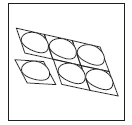
Figure 2
- Carefully peel back the foil starting at the point indicated by the arrow (Figures 3 and 4).

Figure 3
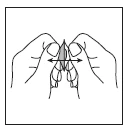
Figure 4
- Remove the tablet from the packaging with dry hands and place it on the tongue (Figure 5). The tablet will dissolve quickly and can be swallowed without water.
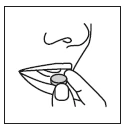
Figure 5
Overdose of Zolmiles
If more Zolmiles has been taken than recommended, contact your doctor or go to the nearest hospital immediately. Bring the medicine with you.
If too many orally disintegrating tablets are swallowed, adverse effects may occur, including sedation.
If you have any further doubts about the use of this medicine, consult your doctor or pharmacist.
4. Possible side effects
Like all medicines, this medicine can cause side effects, although not everybody will experience them.
Some of the symptoms listed below may be part of the migraine attack itself.
If any of the following severe side effects occur in a patient,
discontinue Zolmiles immediately and consult a doctor:
Rare (may affect up to 1 in 1,000 people)
- Allergic reactions including itchy rash (urticaria) and swelling of the face, lips, mouth, tongue, or throat.
Very rare (may affect up to 1 in 10,000 people)
- Chest pain (pain in the chest, often triggered by exertion), heart attack, or coronary artery spasm. Symptoms include chest pain and shortness of breath.
- Constriction of blood vessels in the intestine, which may lead to intestinal damage. Symptoms include abdominal pain or bloody diarrhoea.
Other possible side effects include:
Common (may affect up to 1 in 10 people)
- Abnormal sensations such as tingling in fingers and toes or skin sensitivity to touch
- Drowsiness, dizziness, or feeling of warmth
- Headache
- Irregular heartbeat
- Nausea, vomiting
- Abdominal pain
- Dry mouth
- Swallowing difficulties
- Muscle weakness or muscle pain
- Feeling of weakness
- Heaviness, tightness, pain, or pressure in the throat, neck, arms, legs, or chest.
Uncommon (may affect up to 1 in 100 people)
- Very rapid heartbeat
- Slight increase in blood pressure
- Increased amount or frequency of urination.
Very rare (may affect up to 1 in 10,000 people)
- Sudden, urgent need to urinate.
Reporting of side effects
If any side effects occur, including any not listed in this leaflet, inform your doctor or pharmacist. Side effects can be reported directly to the Department for Monitoring Adverse Reactions to Medicinal Products at the Office for Registration of Medicinal Products, Medical Devices and Biocidal Products, Al. Jerozolimskie 181C, 02-222 Warsaw, tel.: +48 22 49 21 301, fax: +48 22 49 21 309.
Website: https://smz.ezdrowie.gov.pl
Side effects can also be reported to the marketing authorisation holder. Reporting side effects helps provide more information on the safety of this medicine.
5. How to store Zolmiles
Keep this medicine out of sight and reach of children.
Do not use this medicine after the expiry date stated on the blister and carton after: EXP.
The expiry date refers to the last day of the stated month.
Do not store above 30°C.
Medicines must not be disposed of via wastewater or household waste. Ask your pharmacist how to dispose of medicines no longer required. Such measures will help protect the environment.
6. Contents of the pack and other information
What Zolmiles contains
- The active substance is zolmitriptan. Zolmiles 2.5 mg orodispersible tablets contain 2.5 mg of zolmitriptan. Zolmiles 5 mg orodispersible tablets contain 5 mg of zolmitriptan.
- The other ingredients are: mannitol, calcium silicate, microcrystalline cellulose, aspartame, sodium carboxymethyl starch (type A), crospovidone (type B), colloidal anhydrous silica, magnesium stearate and orange flavour with the following composition: flavouring agents identical to natural, flavouring substances, natural flavouring substances, maltodextrin (contains glucose), gum arabic, ascorbic acid (E 300), butylhydroxyanisole (E 320).
What Zolmiles looks like and contents of the pack
Zolmiles 2.5 mg orodispersible tablets are white, round and flat, with a diameter of 7.5 mm.
Zolmiles 5 mg orodispersible tablets are white, round and flat, with a diameter of 9.5 mm.
Zolmiles is packed in blisters covered with a peelable foil containing 2, 3, 6 or 12 orodispersible tablets.
Not all pack sizes may be marketed.
Marketing Authorisation Holder
Actavis Group PTC ehf.
Dalshraun 1
220 Hafnarfjörður
Iceland
Manufacturer
Actavis Ltd.
BLB 015-016, Bulebel Industrial Estate
Zejtun ZTN 3000
Malta
For further information on the medicinal product and its names in the European Economic Area countries,
please contact the representative of the Marketing Authorisation Holder:
Teva Pharmaceuticals Polska Sp. z o.o., ul. Emilii Plater 53, 00-113 Warsaw, Poland, tel. (22) 345 93 00.