Zoledronic acid fresenius kabi
Poland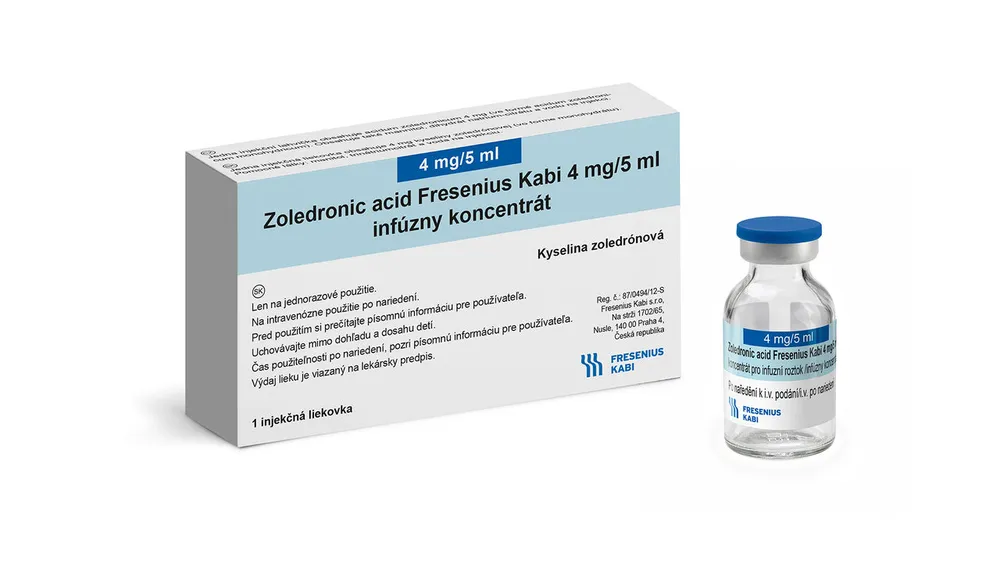
Table of Contents
- Patient Information Leaflet
- 1. What Zoledronic acid Fresenius Kabi is and what it is used for
- 2. What you need to know before you use Zoledronic acid Fresenius Kabi
- 3. How to use Zoledronic acid Fresenius Kabi
- 4. Possible adverse reactions
- 5. How to store Zoledronic acid Fresenius Kabi
- 6. Contents of the pack and other information
- Information intended exclusively for medical professionals:
Patient Information Leaflet
Zoledronic acid Fresenius Kabi, 4 mg/5 ml, concentrate for solution for infusion
Acidum zoledronicum
Please read all of this leaflet carefully before using this medicine, because it contains
important information for you.
- Keep this leaflet. You may need to read it again.
- If you have any further questions, ask your doctor, pharmacist, or nurse.
- If you get any side effects, talk to your doctor, pharmacist, or nurse. This includes any side effects not listed in this leaflet. See section 4.
Contents of the leaflet
- What Zoledronic acid Fresenius Kabi is and what it is used for
- What you need to know before you use Zoledronic acid Fresenius Kabi
- How to use Zoledronic acid Fresenius Kabi
- Possible side effects
- How to store Zoledronic acid Fresenius Kabi
- Contents of the pack and other information
1. What Zoledronic acid Fresenius Kabi is and what it is used for
The active substance in Zoledronic acid Fresenius Kabi is zoledronic acid, which belongs to a group of medicines called bisphosphonates. Zoledronic acid works by binding to bone tissue and slowing down the rate of bone turnover. It is used:
- to prevent bone complications, such as fractures, in adult patients with bone metastases (cancer spread from its original site to the bones);
- to reduce calcium levels in the blood in adult patients when calcium levels are elevated due to cancer. Tumours can accelerate bone turnover, causing increased release of calcium from bones. This condition is known as tumour-induced hypercalcaemia (TIH).
2. What you need to know before you use Zoledronic acid Fresenius Kabi
Follow all instructions given by your doctor carefully.
Your doctor will order blood tests before starting treatment with Zoledronic acid Fresenius Kabi and will regularly monitor your response to treatment.
Do not use Zoledronic acid Fresenius Kabi:
- if you are allergic to zoledronic acid, any other bisphosphonate (a group of medicines to which Zoledronic acid Fresenius Kabi belongs), or any of the other ingredients of this medicine (listed in section 6);
- during breastfeeding.
Warnings and precautions
Before starting treatment with Zoledronic acid Fresenius Kabi, tell your doctor:
- if you have or have had kidney problems;
- if you have or have had pain, swelling, or numbness in the jaw, a feeling of heaviness in the jaw, or loose teeth. Your doctor may recommend a dental examination before starting treatment;
- if you are undergoing dental treatment or plan to have jaw surgery; in such cases, inform your dentist that you are using Zoledronic acid Fresenius Kabi and inform your doctor about any dental treatment.
While being treated with Zoledronic acid Fresenius Kabi, maintain good oral hygiene (including regular tooth brushing) and attend routine dental check-ups.
Contact your doctor and dentist immediately if you experience any symptoms in the mouth or teeth, such as loose teeth, pain or swelling, non-healing sores, or discharge, as these may be signs of a condition called osteonecrosis of the jaw.
Patients receiving chemotherapy and/or radiotherapy, taking corticosteroids, undergoing jaw surgery, not receiving routine dental care, having gum disease, smoking, or who have previously used bisphosphonates (to treat or prevent bone disorders) may be at increased risk of developing osteonecrosis of the jaw.
Low blood calcium levels (hypocalcaemia) have been reported in patients treated with zoledronic acid, which may sometimes cause muscle cramps, dry skin, and a burning sensation. Cases of irregular heartbeat (cardiac arrhythmia), seizures, muscle spasms, and twitching (tetany) due to severe hypocalcaemia have also been reported. In some cases, hypocalcaemia may be life-threatening. If any of these apply to you, inform your doctor immediately. If you have hypocalcaemia, it must be corrected before the first dose of Zoledronic acid Fresenius Kabi is administered. You will be given appropriate calcium and vitamin D supplements.
Patients aged 65 years and older
Zoledronic acid Fresenius Kabi can be given to patients aged 65 years and older. There are no additional warnings required specifically for this patient group.
Children and adolescents
Zoledronic acid Fresenius Kabi is not recommended for use in children and adolescents under 18 years of age.
Zoledronic acid Fresenius Kabi and other medicines
Tell your doctor about all medicines you are currently using, have recently used, or plan to use. It is especially important to inform your doctor if you are using:
- aminoglycosides (used to treat serious infections), calcitonin (used to treat postmenopausal osteoporosis and hypercalcaemia), loop diuretics (used to treat high blood pressure and oedema), or other medicines that lower calcium levels, as using them together with bisphosphonates may cause excessive reduction in blood calcium;
- thalidomide (used to treat certain blood cancers with bone involvement) or other medicines that may be harmful to the kidneys;
- other medicines containing zoledronic acid used to treat osteoporosis and other non-oncological bone diseases, or other bisphosphonates, because the combined effects of these medicines with zoledronic acid are unknown;
- anti-angiogenic medicines (used to treat cancer), as their use in combination with zoledronic acid has been associated with an increased risk of osteonecrosis of the jaw (ONJ).
Pregnancy and breastfeeding
Zoledronic acid Fresenius Kabi must not be used during pregnancy. Inform your doctor if you are pregnant or suspect you may be pregnant.
Zoledronic acid Fresenius Kabi must not be used during breastfeeding.
Consult your doctor before taking any medicine if you are pregnant or breastfeeding.
Driving and using machines
Drowsiness has very rarely been reported with zoledronic acid. Therefore, exercise caution when driving, operating machinery, or performing other tasks requiring concentration.
Zoledronic acid Fresenius Kabi contains sodium
This medicine contains less than 1 mmol (23 mg) of sodium per dose, i.e. it is considered "sodium-free".
3. How to use Zoledronic acid Fresenius Kabi
Zoledronic acid Fresenius Kabi must be administered only by trained medical personnel with appropriate expertise in intravenous administration of bisphosphonates, i.e. administration of bisphosphonates into a vein.
The physician will recommend drinking an adequate amount of water before each administration of the medicinal product to prevent dehydration.
All other instructions provided by the physician, nurse, or pharmacist should be followed carefully.
What dose of Zoledronic acid Fresenius Kabi should be used
- The usual single dose is 4 mg.
- If the patient has impaired kidney function, the treating physician will administer a lower dose depending on the severity of kidney disease.
How often Zoledronic acid Fresenius Kabi should be used
- For the prevention of skeletal complications caused by bone metastases, one infusion of Zoledronic acid Fresenius Kabi is administered every three to four weeks.
- For the treatment aimed at reducing elevated blood calcium levels, usually only one infusion of Zoledronic acid Fresenius Kabi is given.
How Zoledronic acid Fresenius Kabi is administered
Zoledronic acid Fresenius Kabi is administered as an intravenous infusion (drip into a vein), which should last at least 20 minutes, and must be given as a separate intravenous solution through a separate infusion line.
Patients whose blood calcium levels are not too high will also be prescribed calcium and vitamin D for daily use by their physician.
Overdose of Zoledronic acid Fresenius Kabi
Patients who have received doses higher than recommended should be closely monitored by a physician. This is necessary due to the potential occurrence of abnormal serum electrolyte levels (e.g. calcium, phosphate, and magnesium) and/or kidney function disorders, including severe kidney impairment. Patients with low calcium levels may require supplemental calcium infusion.
If you have any further doubts regarding the use of this medicinal product, please consult your physician, pharmacist, or nurse.
4. Possible adverse reactions
Like all medicines, this medicinal product can cause adverse reactions, although not everyone will experience them.
The most commonly occurring adverse reactions are usually mild and are likely to resolve within a short period of time.
Immediately inform your doctor about the following serious adverse reactions:
Common (may affect up to 1 in 10 patients):
- severe kidney function disorders (usually detected by the treating physician based on specific blood tests);
- low blood calcium levels.
Uncommon (may affect up to 1 in 100 patients):
- oral pain, tooth and/or jaw pain, swelling or non-healing oral or jaw lesions, discharge, numbness, or sensation of heaviness in the jaw, or loose teeth; these may be symptoms of jaw bone damage (osteonecrosis); if such symptoms occur, immediately inform your doctor and dentist during or after treatment with Zoledronic acid Fresenius Kabi;
- in postmenopausal women with osteoporosis treated with zoledronic acid, irregular heartbeat (atrial fibrillation) has been observed; it is currently unknown whether zoledronic acid causes the observed irregular heartbeat, but you should inform your treating physician if such symptoms occur after administration of zoledronic acid;
- severe allergic reactions: shortness of breath, swelling mainly of the face and throat.
Rare (may affect up to 1 in 1,000 patients):
- as a consequence of low blood calcium levels: irregular heartbeat (cardiac arrhythmia secondary to hypocalcemia);
- kidney function disorders known as Fanconi syndrome (confirmed by the physician after specific urine tests).
Very rare (may affect up to 1 in 10,000 patients):
- as a consequence of low blood calcium levels: seizures, tetany, and numbness (secondary to hypocalcemia);
- if the patient experiences ear pain, ear discharge, and/or ear infection, inform the doctor. These may be symptoms of bone tissue damage in the ear;
- very rarely, osteonecrosis of bones other than the jaw, particularly in the hip and femur, has been observed. Immediately inform your doctor if symptoms such as new or worsening pain, or pain and stiffness during or after treatment with Zoledronic acid Fresenius Kabi occur.
Frequency not known (frequency cannot be estimated from available data):
- kidney inflammation (tubulointerstitial nephritis): objective and subjective symptoms may include decreased urine volume, presence of blood in urine, nausea, general malaise.
Inform your doctor as soon as possible about the following adverse reactions:
Very common (may affect more than 1 in 10 patients):
- low blood phosphate levels.
Common (may affect up to 1 in 10 patients): - headache and flu-like symptoms including fever, fatigue, weakness, somnolence, chills, and bone, joint, and/or muscle pain; in most cases, specific treatment is not required and symptoms resolve within a short time (a few hours or days);
- gastrointestinal symptoms such as nausea, vomiting, and loss of appetite;
- conjunctivitis;
- low red blood cell count (anemia).
Uncommon (may affect up to 1 in 100 patients):
- hypersensitivity reactions;
- low blood pressure;
- chest pain;
- skin reactions (redness and swelling) at the injection site, rash, itching;
- high blood pressure;
- shortness of breath;
- dizziness;
- anxiety;
- sleep disturbances;
- taste disturbances;
- tremor;
- tingling or numbness of hands or feet;
- diarrhea;
- constipation;
- abdominal pain;
- dry mouth;
- low white blood cell and platelet count;
- low blood magnesium and potassium levels; your doctor will monitor these and order necessary tests;
- weight gain;
- excessive sweating;
- somnolence;
- blurred vision, tearing, light sensitivity;
- sudden feeling of cold with fainting, collapse, or loss of consciousness;
- difficulty breathing with wheezing or cough;
- urticaria.
Rare (may affect up to 1 in 1,000 patients):
- slow heart rate;
- confusion;
- in rare cases, atypical femoral fractures may occur, particularly in patients receiving long-term treatment for osteoporosis; consult your doctor if you experience pain, weakness, or discomfort in the thigh, hip, or groin area, as this may be an early sign of a potential femoral fracture;
- interstitial lung disease (inflammation of the tissue surrounding the lung alveoli);
- flu-like symptoms, including joint inflammation and joint swelling;
- painful redness and/or swelling around the eyes.
Very rare (may affect up to 1 in 10,000 patients):
- fainting due to low blood pressure;
- severe bone, joint, and/or muscle pain, sometimes leading to immobility.
Reporting of adverse reactions
If any adverse reactions occur, including any not listed in this leaflet, inform your doctor, pharmacist, or nurse. Adverse reactions can be reported directly to the Department of Monitoring Adverse Drug Reactions, Office for Registration of Medicinal Products, Medical Devices and Biocidal Products
Al. Jerozolimskie 181C
02-222 Warsaw
Phone: +48 22 49 21 301
Fax: +48 22 49 21 309
Website: https://smz.ezdrowie.gov.pl
Adverse reactions can also be reported to the marketing authorization holder.
Reporting adverse reactions helps provide more information on the safety of this medicinal product.
5. How to store Zoledronic acid Fresenius Kabi
The physician, pharmacist or nurse in charge is informed about how Zoledronic acid Fresenius Kabi should be properly stored (see section 6).
6. Contents of the pack and other information
What Zoledronic acid Fresenius Kabi contains
- The active substance in Zoledronic acid Fresenius Kabi is zoledronic acid. One vial contains 4 mg of zoledronic acid (monohydrate).
- The other ingredients are: mannitol, disodium citrate dihydrate, water for injections.
What Zoledronic acid Fresenius Kabi looks like and contents of the pack
Zoledronic acid Fresenius Kabi is available as a solution in clear, colourless plastic vials.
Zoledronic acid Fresenius Kabi is available in packs containing 1, 4 or 10 vials, in a cardboard box.
Not all pack sizes may be marketed.
Marketing Authorisation Holder and Manufacturer
Marketing Authorisation Holder
Fresenius Kabi Polska Sp. z o.o.
Al. Jerozolimskie 134
02-305 Warsaw
Poland
Manufacturer
Fresenius Kabi Austria GmbH
Hafnerstrasse 36
8055 Graz
Austria
For further information, please contact the Marketing Authorisation Holder:
Fresenius Kabi Polska Sp. z o.o.
Al. Jerozolimskie 134
02-305 Warsaw
Poland
Tel.: +48 22 345 67 89
This medicinal product is authorised in the European Economic Area countries under the following names:
Austria Zoledronsäure Fresenius Kabi 4 mg/5 ml Konzentrat zur Herstellung einer Infusionslösung
Belgium Zoledroninezuur Fresenius Kabi 4 mg/5 ml concentraat voor oplossing voor infusie
Bulgaria Zoledronic acid Fresenius Kabi 4 mg/5 ml концентрат за инфузионен разтвор
Czech Republic Zoledronic acid Fresenius Kabi 4 mg/5 ml
Denmark Zoledronsyre Fresenius Kabi
Estonia Zoledronic acid Fresenius Kabi 4 mg/5 ml
Finland Zoledronsyra Fresenius Kabi 4 mg/5 ml infuusiokonsentraatti, liuosta varten
France Acide Zolédronique Fresenius Kabi 4 mg/5 ml, solution à diluer pour perfusion
Greece Zoledronic acid / Fresenius Kabi, πυκνό διάλυμα για διάλυμα προς έγχυση, 4 mg/5 ml
Spain Ácido Zoledrónico Fresenius Kabi 4 mg / 5 ml concentrado para solución para perfusión
Netherlands Zoledroninezuur Fresenius Kabi 4 mg/5 ml concentraat voor oplossing voor infusie
Ireland Zoledronic acid Fresenius Kabi 4 mg/5 ml concentrate for solution for infusion
Lithuania Zoledronic acid Fresenius Kabi 4 mg/5 ml koncentratas infuziniam tirpalui
Luxembourg Zoledronsäure Fresenius Kabi 4 mg/5 ml Konzentrat zur Herstellung einer Infusionslösung
Latvia Zoledronic acid Fresenius Kabi 4 mg/5 ml koncentrāts infūziju šķīduma pagatavošanai
Germany Zoledronsäure Fresenius Kabi 4 mg/5 ml Konzentrat zur Herstellung einer Infusionslösung
Norway Zoledronsyre Fresenius Kabi
Poland Zoledronic acid Fresenius Kabi
Portugal Ácido zoledrónico Fresenius Kabi
Romania Acid zoledronic Fresenius Kabi 4 mg/5 ml concentrat pentru soluţie perfuzabilă
Slovakia Zoledronic acid Fresenius Kabi 4 mg/5 ml
Slovenia Zoledronska kislina Fresenius Kabi 4 mg/5 ml koncentrat za raztopino za infundiranje
Sweden Zoledronsyra Fresenius Kabi
Hungary Zoledronsav Fresenius Kabi 4 mg/5 ml koncentrátum oldatos infúzióhoz
United Kingdom Zoledronic acid Fresenius Kabi 4 mg/5 ml concentrate for solution for infusion
Italy Acido zoledronico Fresenius Kabi
Information intended exclusively for medical professionals:
How to prepare and administer Zoledronic acid Fresenius Kabi
- To prepare an infusion solution containing 4 mg of zoledronic acid, dilute Zoledronic acid Fresenius Kabi (5.0 ml) in 100 ml of infusion solution free of calcium or other divalent cations. If a lower dose of Zoledronic acid Fresenius Kabi is required, first withdraw the appropriate volume of concentrate as recommended below, then dilute it in 100 ml of infusion solution. To avoid potential incompatibilities, only 0.9% sodium chloride solution or 5% glucose solution should be used for dilution.
Zoledronic acid Fresenius Kabi must not be mixed with solutions containing calcium or
other divalent cations, such as Ringer's lactate solution.
Method for preparing reduced doses of Zoledronic acid Fresenius Kabi:
Withdraw the appropriate volume of concentrate as follows:
- 4.4 ml for a 3.5 mg dose;
- 4.1 ml for a 3.3 mg dose;
- 3.8 ml for a 3.0 mg dose.
- The product is for single use only. Any unused portions must be discarded. Only clear solutions without visible particulate matter or discoloration should be used. Aseptic techniques must be observed during preparation of the infusion.
- Stability after dilution: Chemical and physical stability of the solution has been demonstrated for 24 hours at 2°C to 8°C. From a microbiological standpoint, the diluted infusion solution should be used immediately. If not used immediately, the responsibility for storage conditions and duration prior to use lies with the user. The storage period should not exceed 24 hours at 2°C to 8°C. Prior to administration, refrigerated solution should be allowed to reach room temperature.
- The solution containing Zoledronic acid Fresenius Kabi should be administered as a single 20-minute intravenous infusion through a separate infusion line. Before and after each administration of Zoledronic acid Fresenius Kabi, the patient's hydration status should be assessed to ensure adequate hydration.
- Studies have shown no incompatibility of Zoledronic acid Fresenius Kabi with glass vials and several types of containers made of polyvinyl chloride, polyethylene, and polypropylene (previously filled with 0.9% sodium chloride solution or 5% glucose solution).
- Due to lack of available data on compatibility with other intravenous drugs, Zoledronic acid Fresenius Kabi should not be mixed with other medicinal products and should always be administered through a separate infusion line.
How to store Zoledronic acid Fresenius Kabi
- Keep the medicine out of the sight and reach of children.
- Do not use this medicine after the expiry date stated on the packaging.
- No special storage conditions are required for unopened vials.
- Storage conditions for the diluted product, see section "Stability after dilution".