Zineryt
Poland
Table of Contents
Patient Information Leaflet
Warning! Keep this leaflet! Information on the immediate packaging is in a foreign language.
Zineryt (Zinerit)
40 mg/ml + 12 mg/ml, powder and solvent for solution for skin application
Erythromycinum cum zinco
Zineryt and Zinerit are the same brand names of the same medicinal product written in Polish and Bulgarian.
Please read this leaflet carefully before using the medicine, as it contains important information for the patient.
- Keep this leaflet, so that you can read it again if necessary.
- If you have any doubts, please consult your doctor or pharmacist.
- This medicine has been prescribed for a specific individual. Do not pass it on to others. The medicine may harm another person, even if their symptoms are identical.
- If you experience any adverse reactions, including those not listed in this leaflet, inform your doctor or pharmacist. See section 4.
Table of contents of the leaflet
- What Zineryt is and what it is used for
- Important information before using Zineryt
- How to use Zineryt
- Possible side effects
- How to store Zineryt
- Contents of the pack and other information
1. What Zineryt is and what it is used for
Zineryt is an anti-acne medicine for topical use.
Zineryt contains erythromycin in the form of a complex with zinc acetate. Bacteria sensitive to erythromycin include Staphylococcus epidermidis and Propionibacterium acnes, which are commonly involved in acne. Zinc enhances the action of erythromycin in the topical treatment of acne.
Once dried, Zineryt is invisible on the skin and is therefore cosmetically acceptable.
Indications
Zineryt is indicated for topical treatment of moderate to severe acne, when topical treatment without antibiotics has been insufficient or not tolerated.
2. Important information before using Zineryt
When not to use Zineryt:
- if the patient is allergic to the active substances or to any of the other ingredients of this medicine (listed in section 6).
- if there is hypersensitivity to other antibiotics of the macrolide group.
Warnings and precautions
Before starting treatment with Zineryt, discuss this with your doctor or pharmacist.
Avoid contact of Zineryt with the eyes or the mucous membranes of the nose and mouth. The medicine may cause stinging and irritation in these areas. If Zineryt comes into contact with the eyes or the mucous membranes of the nose or mouth, rinse thoroughly with water and inform your doctor.
Cross-resistance may occur with other antibiotics of the macrolide group, as well as with lincomycin and clindamycin. Mutual cross-hypersensitivity between macrolides may also occur.
Zineryt and other medicines
Tell your doctor or pharmacist about all medicines the patient is currently taking or has recently taken, as well as any medicines the patient plans to use.
Interactions between Zineryt and other medicines are not known.
Pregnancy and breastfeeding
If the patient is pregnant or breastfeeding, suspects she may be pregnant, or is planning to have a baby, she should consult her doctor or pharmacist before using this medicine.
Zineryt should not be used during pregnancy unless the doctor considers it absolutely necessary.
Driving and operating machinery
There are no data regarding the effect of Zineryt on the ability to drive or operate machinery.
However, such an effect seems unlikely.
3. How to use Zineryt
This medicine should always be used exactly as prescribed by your doctor. If in doubt, consult your
doctor or pharmacist.
Dosage
Before applying the medicine, thoroughly clean and dry the area of skin where the medicine will be
applied.
Unless otherwise directed by your doctor, Zineryt should be applied to the affected areas of skin
twice daily, usually for a period of 10 to 12 weeks. A significant therapeutic effect is usually achieved
within 12 weeks. If there is no improvement or if symptoms worsen, consult your doctor. If your doctor
detects bacterial resistance to the medicine, treatment should be discontinued for a period of two months.
Instructions for use
Zineryt should be applied to the entire face or other affected areas (not only the individual lesions),
ensuring complete coverage of the treated area, using approximately 0.5 ml of solution each time.
To prepare the solution for use, follow the instructions described in the Instructions for using the
medicine provided later in this leaflet.
After preparing the solution, invert the bottle with the applicator and apply the medicine to the affected
skin area by moving the applicator over the surface. The amount of solution dispensed from the bottle
is controlled by increasing or decreasing the pressure of the applicator on the skin.
Instructions for using the medicine
Preparing the solution
The package contains the following (see figure):
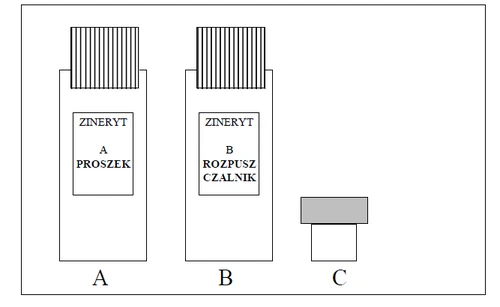
(A) Vial with powder for solution
(B) Vial with solvent for solution
(C) Applicator
- After removing the caps, pour the contents of the solvent vial (B) into the vial containing the powder (A).
- Close the vial containing the powder and solvent and mix thoroughly by shaking for about one minute.
- Remove the cap from the vial containing the solution.
- Insert the applicator (C) into the neck of the solution vial, pressing firmly until fully seated.
- Close the vial with the applicator.
- Once prepared, the solution may be used for up to 8 weeks. The expiry date should be written on the vial.
Use of more than the recommended dose of Zineryt
The risk of accidental overdose is negligible when the medicine is used as directed.
Accidental ingestion of the entire contents of a Zineryt package will primarily cause symptoms of acute
ethanol poisoning due to the ethanol content of the medicine.
Missed dose of Zineryt
If a single dose is missed, continue treatment as usual. There is no need to apply an additional amount
of medicine to the skin.
If you have any further questions about the use of this medicine, consult your doctor or pharmacist.
4. Possible adverse reactions
Like all medicines, this medicine can cause adverse reactions, although not everyone will experience them.
Adverse reactions occurring not frequently (occur in 1 to 10 people out of 1,000):
itching, redness, skin irritation, burning sensation, stinging, dry skin, peeling of the outer layer of skin.
Adverse reactions occurring very rarely (occur in fewer than 1 person out of 10,000)/frequency unknown, cannot be estimated from the available data):
hypersensitivity.
If a patient develops a severe skin reaction: red, peeling rash with subcutaneous nodules and blisters (erythema multiforme), contact a doctor immediately. The frequency of these adverse reactions is unknown (cannot be estimated from the available data).
In some individuals, other adverse reactions may occur during treatment with Zineryt.
Reporting of adverse reactions
If any adverse reactions occur, including any adverse reactions not listed in this leaflet, inform a doctor or pharmacist. Adverse reactions can be reported directly to the Department of Monitoring Adverse Drug Reactions of the Office for Registration of Medicinal Products, Medical Devices and Biocidal Products, Al. Jerozolimskie 181C, 02-222 Warsaw, phone: +48 22 49 21 301, fax: +48 22 49 21 309, website: https://smz.ezdrowie.gov.pl.
Reporting adverse reactions enables further information on the safety of the medicine to be collected.
5. How to store Zineryt
Keep the medicine out of the sight and reach of children.
Store below 25°C.
The shelf life of the solution after preparation is 8 weeks.
Do not use Zineryt after the expiry date stated on the packaging.
The expiry date refers to the last day of the stated month.
Medicines must not be disposed of via wastewater or household waste. Ask your pharmacist
how to dispose of medicines no longer required. This will help protect the environment.
6. Contents of the pack and other information
What Zineryt contains
1 ml of ready-to-use solution contains:
- active substances: 40 mg of erythromycin and 12 mg of zinc acetate in the form of an erythromycin-zinc acetate complex;
- excipients: diisopropyl sebacate, anhydrous ethanol.
What Zineryt looks like and contents of the pack
Zineryt is a powder and solvent for solution for skin application.
Pack contents:
1 vial containing powder and 1 vial containing solvent for preparation of 30 ml of solution, together with an applicator,
in a cardboard box.
The vial with powder contains the active substances: erythromycin and zinc acetate.
The vial with solvent contains the excipients: diisopropyl sebacate and anhydrous ethanol.
For more detailed information, please contact the responsible entity or parallel importer.
Marketing Authorisation Holder in Bulgaria, country of export:
CHEPLAPHARM Arzneimittel GmbH
Ziegelhof 24
17489 Greifswald
Germany
Manufacturer:
LEO Pharma A/S
Industriparken 55
DK-2750 Ballerup
Denmark
Parallel Importer:
InPharm Sp. z o.o.
ul. Strumykowa 28/11
03-138 Warsaw
Repackaged in:
InPharm Sp. z o.o. Services sp. k.
ul. Chełmżyńska 249
04-458 Warsaw
Marketing Authorisation Number in Bulgaria, country of export: 20010281
Parallel Import Authorisation Number: 365/25