Zelefion
Poland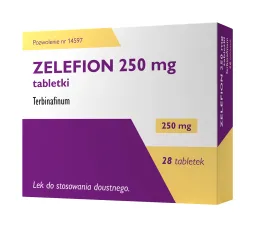
Table of Contents
Package leaflet: Information for the patient
ZELEFION, 250 mg, tablets
Terbinafinum
Please read the entire leaflet carefully before using the medicine, as it contains important information for the patient.
- Keep this leaflet, so that you can read it again if necessary.
- If you have any questions, please consult your doctor or pharmacist.
- This medicine has been prescribed for a specific individual. Do not pass it on to others. The medicine may harm another person, even if their symptoms are the same.
- If you experience any adverse reactions, including any adverse reactions not listed in this leaflet, inform your doctor or pharmacist. See section 4.
Table of contents
- What Zelefion is and what it is used for
- Important information before taking Zelefion
- How to take Zelefion
- Possible side effects
- How to store Zelefion
- Contents of the pack and other information
1. What Zelefion is and what it is used for
Zelefion is available as tablets. The active substance in Zelefion is terbinafine, which has antifungal activity.
The medicine is used to treat fungal infections of the skin, hair and nails caused, among others, by dermatophytes of the genus Trichophyton (e.g. T. rubrum, T. mentagrophytes, T. verrucosum, T. violaceum), Microsporum (e.g. M. canis), Epidermophyton floccosum, as well as yeasts of the genus Candida (e.g. C. albicans) and Pityrosporum.
Indications:
Fungal skin infections such as:
- Tinea corporis, tinea cruris, tinea pedis, tinea capitis, onychomycosis caused by dermatophytes,
- Cutaneous candidiasis caused by Candida species (e.g. Candida albicans).
In cases of tinea corporis, tinea cruris and tinea pedis, oral treatment with terbinafine depends on the location, severity and extent of the infection.
Zelefion oral tablets are not effective in the treatment of pityriasis versicolor or vaginal candidiasis.
2. Important information before using Zelefion
When not to use Zelefion:
- if the patient is allergic to terbinafine or any of the other ingredients of this medicine (listed in section 6),
- if the patient has had or currently has liver disease,
- if the patient has severe kidney disease.
If any of the above points apply to the patient, treatment should be discontinued
and the patient should contact a doctor.
The doctor should be informed about any suspected allergic reaction to
any of the ingredients of this medicine in the past.
Warnings and precautions
Before starting treatment with Zelefion, discuss this with your doctor or pharmacist.
Inform your doctor about any liver disease, as use of Zelefion is not recommended
in patients with liver disease.
If symptoms indicating liver dysfunction occur, such as persistent
nausea of unknown origin, vomiting, abdominal pain, loss of appetite, or feeling tired,
fever, sore throat or other infection, jaundice, dark urine, pale stools,
- treatment should be stopped immediately and the doctor contacted. The doctor will decide whether treatment with Zelefion should be discontinued. Before and periodically after starting treatment with Zelefion, the doctor may order blood tests to monitor liver function. If test results are abnormal, treatment should be discontinued.
Inform your doctor about any kidney disease, as this medicine should not be used in patients with
kidney disease.
If skin reactions occur, such as rash, redness of the skin, blisters on the lips or eyelids, peeling skin,
fever (possible symptoms of severe skin reactions),
or skin rash associated with a high number of certain types of white blood cells (eosinophilia),
contact your doctor immediately.
Contact your doctor immediately if a red, scaly rash with subcutaneous nodules and pus-filled blisters appears,
mainly on the face and skin folds, on the trunk and upper limbs, accompanied by fever at the beginning of treatment
(acute generalized exanthematous pustulosis).
Inform your doctor if you have had or currently have thickened areas of skin with red or silvery appearance (psoriasis),
facial rash, joint pain, muscle weakness, fever (cutaneous and systemic lupus erythematosus), or if you experience
weakness, bleeding, bruising, or frequent infections (symptoms of blood disorders).
This medicine may cause altered or loss of taste (taste returns after stopping treatment).
Use of this medicine is not recommended if the patient relies on the sense of taste for occupational purposes.
Elderly patients (aged 65 years and older)
Patients aged 65 years and older may take the same dose of Zelefion as younger patients.
Elderly patients should inform their doctor about any previous liver or kidney dysfunction.
Children
This medicine should not be used in children with body weight below 20 kg.
Zelefion with other medicines
Tell your doctor or pharmacist about any medicines the patient is currently taking, has recently taken, or plans to take, especially:
- certain medicines used for peptic ulcer disease (e.g. cimetidine),
- certain antifungal medicines (e.g. fluconazole, ketoconazole),
- certain antibiotics used to treat infectious diseases (e.g. rifampicin),
- certain medicines used to treat insomnia (e.g. triazolam),
- certain medicines that lower blood sugar levels (e.g. tolbutamide),
- oral contraceptives,
- medicines used to treat cough (e.g. dextromethorphan, codeine),
- medicines used to treat irregular heart rhythm (certain antiarrhythmics such as propafenone, amiodarone, flecainide),
- certain medicines used to treat allergies (e.g. mequitazine, terfenadine),
- certain medicines used to treat pain (e.g. tramadol),
- certain medicines used to treat Huntington's disease (e.g. tetrabenazine),
- cyclosporine, a medicine used to control the immune system (e.g. a medicine used to prevent transplant rejection),
- medicines used to treat high blood pressure (beta-blockers such as metoprolol),
- certain medicines used in cancer treatment (e.g. tamoxifen).
If Zelefion is taken together with medicines that induce metabolism (e.g.
rifampicin - an antibiotic) or medicines that inhibit cytochrome P450 activity (e.g. cimetidine
used in peptic ulcer disease), the doctor may decide to adjust the dosage.
Inform your doctor about all concomitant medications.
Zelefion with food and drink
This medicine can be taken independently of meals.
Pregnancy, breastfeeding and fertility
If the patient is pregnant or breastfeeding, suspects she may be pregnant, or is planning to have a child,
she should consult her doctor before using this medicine.
Pregnancy
Do not use this medicine during pregnancy unless considered necessary by the doctor.
The doctor will discuss the potential risks associated with using Zelefion during pregnancy.
If the patient becomes pregnant while taking Zelefion, she should stop taking the medicine
and inform her doctor.
Breastfeeding
Zelefion should not be used during breastfeeding, as terbinafine passes into breast milk. Inform your doctor if you are breastfeeding.
Driving and operating machinery
Patients who experience dizziness after taking Zelefion should not drive
or operate machinery.
Zelefion contains sodium
The medicine contains less than 1 mmol (23 mg) of sodium per tablet, meaning the medicine is considered "sodium-free".
3. How to use Zelefion
This medicine should always be used as prescribed by your doctor. If in doubt, consult your doctor.
Zelefion dosage
Adults
1 tablet (250 mg) once daily.
Use in children and adolescents
This medicine should not be used in children with body weight below 20 kg.
- Children with body weight from 20 kg to 40 kg – half a tablet (125 mg) once daily,
- Children with body weight above 40 kg – 1 tablet (250 mg) once daily.
Duration of Zelefion treatment:
The treatment duration depends on the type and severity of infection and the body part affected.
Your doctor will advise how long you should take Zelefion.
It may happen that complete resolution of infection symptoms occurs only after several weeks (skin) or months (nails) following elimination of the fungi.
Adhering to your doctor's instructions ensures effective treatment of the infection and reduces the risk of recurrence after stopping treatment.
-
Fungal skin infections
Interdigital, plantar or "moccasin" type tinea pedis: usually 2 to 6 weeks.
Tinea corporis: usually 2 to 4 weeks.
Tinea cruris: usually 2 to 4 weeks.
Cutaneous candidiasis: usually 2 to 4 weeks.
It may happen that complete resolution of infection symptoms occurs only after several weeks following cure of the fungal infection. -
Fungal infections of the scalp skin
Tinea capitis: usually 4 weeks. -
Onychomycosis (fungal nail infection)
In most patients, complete cure is achieved after 6–12 weeks of treatment.
Fungal infection of fingernails: a 6-week treatment period is usually sufficient.
Fungal infection of toenails: a 12-week treatment period is usually sufficient.
Patients with slow nail growth may require a longer treatment duration, as determined by the doctor.
To facilitate treatment and prevent recurrence, it is important to keep affected areas dry and not overheated, and to change clothing in direct contact with these areas daily.
How to take Zelefion tablets
Zelefion tablets should be taken orally with water.
Taking more Zelefion than prescribed
If you take more than the prescribed dose, contact your doctor or go to a hospital immediately for advice. Medical assistance may be required. This also applies to individuals who accidentally took another patient's medicine.
The most important symptoms of overdose include: nausea, abdominal pain, vomiting, headache and dizziness.
Missed dose of Zelefion
If you miss a dose, take it as soon as possible, unless less than 4 hours remain before the next scheduled dose. In that case, wait and take the next dose at the usual time. Do not take a double dose to make up for a missed dose.
If you have any further doubts about using this medicine, consult your doctor or pharmacist.
4. Possible adverse reactions
Like any medicine, this medicine can cause adverse reactions, although not everyone experiences them.
Some adverse reactions may be serious
In rare cases, Zelefion may cause liver disorders, and in very rare cases, these disorders may be severe. Serious adverse reactions also include:
reduction in the number of certain types of blood cells, lupus (an autoimmune disease), severe skin reactions, severe allergic reactions, vasculitis, pancreatitis, and rhabdomyolysis.
You must immediately inform your doctor if:
- The patient experiences symptoms such as persistent nausea of unknown origin, gastrointestinal disturbances, loss of appetite, unusual fatigue or weakness, or if the patient notices yellowing of the skin or the whites of the eyes, unusually dark urine, or unusually pale stools (symptoms that may indicate liver dysfunction).
- The patient develops fever, chills, sore throat, or mouth ulcers due to infections or weakened immunity, more frequent infections, or unusual bleeding and bruising (possible symptoms of diseases causing disturbances in the number of certain types of blood cells).
- The patient experiences difficulty breathing, dizziness, swelling—mainly of the face and throat—sudden facial redness, cramping abdominal pain, or loss of consciousness, or if the patient develops symptoms such as joint pain, stiffness, rash, fever, or swelling (enlargement) of lymph nodes (possible symptoms of severe allergic reactions).
- The patient experiences symptoms such as rash, fever, itching, fatigue, or the appearance of purple-red blisters under the skin (possible symptoms of vasculitis).
- The patient develops any skin changes such as rash, skin redness, blistering on the lips, eyelids, or inside the mouth, or skin peeling, with or without fever.
- The patient experiences pain in the upper abdomen radiating to the back (possible symptoms of pancreatitis).
- The patient experiences unexplained muscle weakness or pain, or dark (reddish-brown) discoloration of urine (possible symptoms of rhabdomyolysis).
The following adverse reactions have been reported during treatment with Zelefion:
Very common adverse reactions (occur in more than 1 in 10 patients):
Headache, nausea, abdominal pain, discomfort in the stomach after meals (heartburn), diarrhoea,
abdominal swelling or bloating (feeling of fullness), loss of appetite, rash, urticaria, joint pain, muscle pain.
Common adverse reactions (occur in 1 to 10 in 100 patients):
Fatigue, visual disturbances, depression, taste disturbances including loss of taste, dizziness.
Uncommon adverse reactions (occur in 1 to 10 in 1,000 patients):
Unusual paleness of the skin, mucous membranes, or nail beds, unusual fatigue or weakness, and shortness of breath during exertion (possible symptoms of anaemia—a condition causing a reduction in red blood cells), restlessness, numbness or tingling, and paraesthesia, ringing (e.g. buzzing) in the ears, fever, and weight loss, increased sensitivity of the skin to sunlight.
Rare adverse reactions (occur in 1 to 10 in 10,000 patients):
Yellowing of the whites of the eyes and skin (symptoms indicating liver disease) and abnormal liver function test results.
Very rare adverse reactions (occur in fewer than 1 in 10,000 patients):
Lupus (an autoimmune disease), severe skin reactions, allergic reactions, development of psoriasis-like skin lesions (silver-looking rash, worsening of psoriasis, skin rash with peeling, hair loss).
Adverse reactions with unknown frequency (frequency cannot be estimated from available data):
Severe allergic reactions or infections, vasculitis, disturbances in smell including permanent loss of smell, reduced ability to detect odours, blurred vision, decreased visual acuity, hearing loss, disturbances in hearing, pancreatitis, skin rash caused by a high number of certain types of white blood cells, rhabdomyolysis, influenza-like symptoms (fatigue, chills, sore throat, joint pain, muscle pain), reduction in the number of certain types of blood cells, and increased blood levels of creatine kinase (a muscle enzyme).
Some adverse reactions that occur rarely or very rarely may be serious. You must immediately inform your doctor if symptoms indicating liver dysfunction, blood disorders, or skin disorders occur.
If a skin rash worsens, treatment with Zelefion should be discontinued and the patient should contact a doctor immediately.
Reporting of adverse reactions
If any adverse reactions occur, including any not listed in this leaflet, inform your doctor or pharmacist. Adverse reactions can be reported directly to the Department of Monitoring Adverse Drug Reactions at the Office for Registration of Medicinal Products, Medical Devices and Biocidal Products
Al. Jerozolimskie 181C, 02-222 Warsaw
Tel: +48 22 49 21 301, Fax: +48 22 49 21 309
Website: https://smz.ezdrowie.gov.pl
Adverse reactions can also be reported to the marketing authorisation holder.
Reporting adverse reactions helps provide more information on the safety of this medicine.
5. How to store Zelefion
Do not use this medicine after the expiry date stated on the packaging.
Keep the medicine out of the sight and reach of children.
Store the medicine in its original packaging.
Medicines must not be disposed of via wastewater or household waste. Ask your pharmacist how to dispose of medicines no longer required. These measures will help protect the environment.
6. Contents of the pack and other information
What Zelefion contains
- The active substance is terbinafine in the form of terbinafine hydrochloride. One tablet contains 250 mg of terbinafine.
- The other ingredients are: sodium carboxymethyl starch (type A), microcrystalline cellulose, hypromellose, colloidal anhydrous silica, magnesium stearate.
What Zelefion looks like and contents of the pack
The pack contains 14 tablets or 28 tablets in PVC/aluminum blisters, placed in a cardboard box.
Marketing Authorisation Holder
Bausch Health Ireland Limited
3013 Lake Drive
Citywest Business Campus
Dublin 24, D24PPT3
Ireland
Tel: +48 17 865 51 00
Manufacturer
Laboratorios Liconsa S.A.
Avda. Miralcampo, No. 7, Poligono Industrial
Miralcampo, 19200 Azuqueca de Henares (Guadalajara), Spain
Bausch Health Poland sp. z o.o.
ul. Przemysłowa 2
35-959 Rzeszów