Zabak
Poland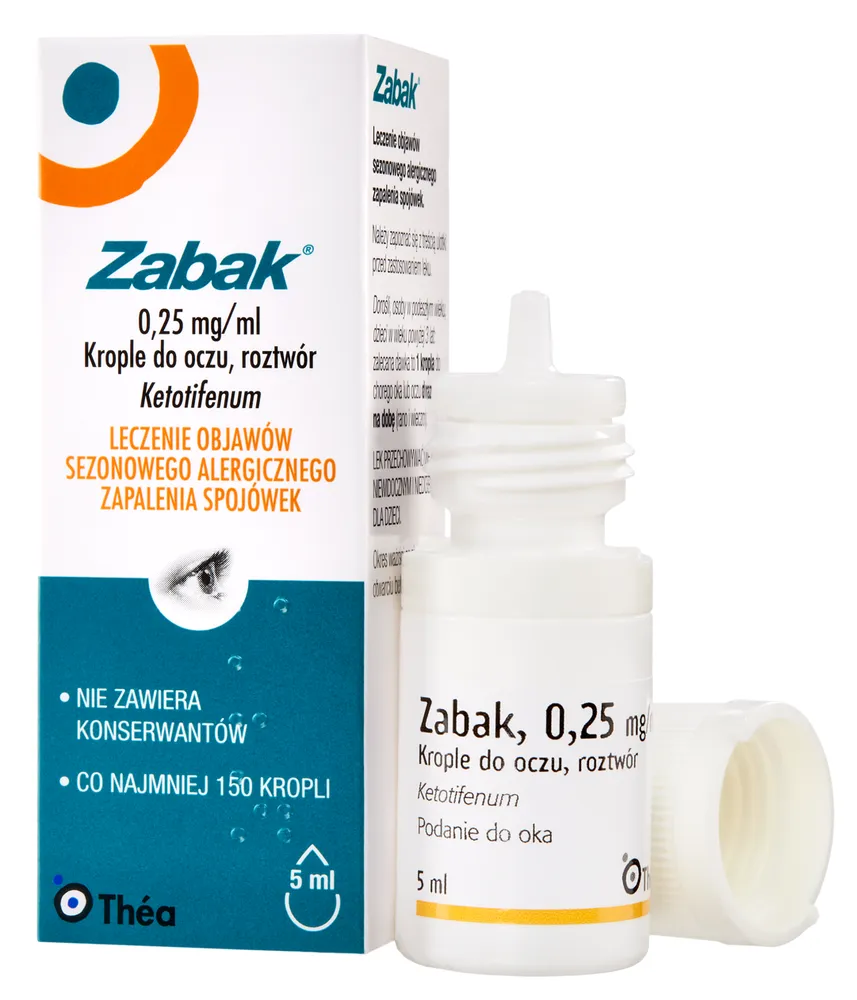
Table of Contents
PACKAGE LEAFLET: INFORMATION FOR THE USER
Warning! Keep the leaflet; information on the immediate packaging is in a foreign language!
ZABAK (Zalerg)
0.25 mg/ml, eye drops, solution
Ketotifen
ZABAK and Zalerg are different trade names for the same medicine.
Please read the entire leaflet carefully before using the medicine, as it contains
important information for the patient.
This medicine should always be used exactly as described in this patient leaflet or as directed by a
physician, pharmacist, or nurse.
- Keep this leaflet for future reference.
- If advice or further information is needed, consult a pharmacist.
- If the patient experiences any adverse reactions, including any not listed in this leaflet, inform a physician, pharmacist, or nurse. See section 4.
- If there is no improvement after 7 days, or if the patient feels worse, consult a physician (see section 2).
Leaflet contents
- What ZABAK is and what it is used for
- Important information before using ZABAK
- How to use ZABAK
- Possible side effects
- How to store ZABAK
- Contents of the pack and other information
1. What ZABAK is and what it is used for
ZABAK is an eye drop solution without preservatives containing ketotifen, which is an
antiallergic agent.
ZABAK is used for the treatment of symptoms of seasonal allergic conjunctivitis.
The most common symptoms of seasonal allergic conjunctivitis include intense itching of both eyes, accompanied by redness, swelling, excessive tearing, eyelid swelling, and light sensitivity. These symptoms are recurrent and begin at the start of the pollen season.
Seasonal allergic conjunctivitis may also be associated with other hay fever symptoms, such as rhinitis.
If there is no improvement after 7 days, or if the patient feels worse, consult a physician (see section 2).
2. Important information before using ZABAK medicine
When not to use ZABAK medicine
- if the patient is allergic (hypersensitive) to ketotifen (the active substance) or to any of the other ingredients of this medicine (listed in section 6).
Warnings and precautions
Before starting to use ZABAK medicine, discuss this with a doctor, pharmacist, or nurse.
If there is no improvement after 7 days, or if the patient feels worse, medical advice should be sought.
The following objective and subjective symptoms are not usually associated with seasonal allergic conjunctivitis:
- purulent discharge,
- visual disturbances,
- morning eyelid adhesion, difficulty opening eyes in the morning,
- swollen lymph nodes near the ears,
- persistent symptoms (symptoms that continue),
- unilateral symptoms.
If any of the above symptoms occur, the patient may have an eye condition other than seasonal allergic conjunctivitis. Medical advice should be sought.
ZABAK medicine and other medicines
If another eye medicine needs to be used at the same time as ZABAK, wait at least 5 minutes between successive instillations.
Inform the doctor or pharmacist about all medicines currently or recently taken, as well as any medicines the patient plans to take. This is particularly important in the case of medicines used to treat:
- depression, anxiety, and sleep disorders,
- allergies (e.g. antihistamines).
ZABAK medicine with food, drink, and alcohol
- the medicine may enhance the effects of alcohol.
Pregnancy and breastfeeding
It is recommended to avoid using ZABAK during pregnancy.
If the patient is pregnant, suspects she may be pregnant, or is planning to become pregnant, she should consult a doctor or pharmacist before using this medicine. ZABAK medicine may be used during breastfeeding.
Driving and operating machinery
ZABAK medicine may cause visual disturbances or drowsiness.
Patients experiencing such symptoms after administration should wait until these symptoms subside before driving or operating mechanical devices.
3. How to use ZABAK
This medicine should always be used exactly as described in this patient information leaflet or as directed by a doctor or pharmacist. If in doubt, consult a doctor or pharmacist.
Dosage
Adults, elderly patients, children aged above 3 years
The recommended dose is 1 drop into the affected eye or eyes twice daily (morning and evening).
Method of administration
Do not inject, do not swallow.
This medicine is intended for ocular administration (instillation into the eye).
Before first use, discard the first 5 drops.
Then, each time the product is used:
Wash hands thoroughly before use.
To avoid contamination of the drops, do not touch the eye, eyelids or any other surface with the tip of the dropper.
Instill 1 drop into the eye(s) while looking upward and gently pulling down the lower eyelid.
Close the eyelid and gently press with the index finger on the inner corner of the eye for 1–2 minutes. This helps prevent the medicine from spreading throughout the body.
After use, close the bottle.
If the effect of ZABAK seems too strong or too weak, or if any adverse reactions occur, consult a doctor or pharmacist.
If there is no improvement or the patient feels worse after 7 days, consult a doctor (see section 2).
Use of more than the recommended dose of ZABAK
There is no danger if the patient accidentally swallows a few drops of ZABAK. Similarly, there is no need for concern if more than one drop is accidentally instilled into the eye.
Missed dose of ZABAK
Instill the drop as soon as possible, then return to the recommended dosing schedule.
Ensure that the drop has been properly administered into the eye. Do not use a double dose to make up for a missed dose.
If there are any further doubts about the use of this medicine, consult a doctor or pharmacist.
4. Possible adverse reactions
Like all medicines, this medicine can cause adverse reactions, although not everyone experiences them.
If the patient experiences allergic reactions, including rash, swelling of the face, lips, tongue, and (or)
throat, which may cause difficulty in breathing or swallowing, or other serious adverse reactions occur,
treatment with Zabak should be discontinued immediately and the patient should contact a doctor or
the nearest hospital Emergency Department without delay.
The following adverse reactions have been reported:
Common (occurring in fewer than 1 in 10 people):
- eye irritation or pain,
- ocular inflammation.
Uncommon (occurring in fewer than 1 in 100 people):
- blurred vision,
- dry eye syndrome,
- eyelid irritation,
- conjunctivitis (inflammation of the eye surface),
- increased sensitivity of the eyes to light,
- visible bleeding in the sclera of the eye,
- headache,
- somnolence,
- rash (which may also be itchy),
- dermatitis (itchy, red, burning rash),
- dry mouth.
Unknown (frequency cannot be estimated from available data):
- allergic reaction (including swelling of the face and eyelids) and worsening of existing allergic conditions such as asthma or eczema – dizziness.
Reporting of adverse reactions
If any adverse reactions occur, including any adverse reactions not listed in this leaflet, inform a doctor, pharmacist, or nurse. Adverse reactions can be reported directly to the Department of Monitoring Adverse Reactions of Medicinal Products at the Office for Registration of Medicinal Products, Medical Devices and Biocidal Products, Al. Jerozolimskie 181C, 02-222 Warsaw
Tel.: +48 22 49 21 301
Fax: +48 22 49 21 309
Website: https://smz.ezdrowie.gov.pl
Adverse reactions can also be reported to the marketing authorization holder.
Reporting adverse reactions enables better monitoring and contributes to improving the safety of the medicine.
5. How to store ZABAK
Keep this medicine out of sight and reach of children.
Do not use this medicine after the expiry date stated on the carton and bottle after: EXP.
The expiry date refers to the last day of the stated month.
Shelf-life after first opening the bottle: 3 months.
Medicines should not be disposed of via wastewater or household waste. Ask your pharmacist
how to dispose of medicines no longer in use. This will help protect the environment.
6. Contents of the package and other information
What ZABAK contains
- The active substance is: ketotifen 0.25 mg/ml (as ketotifen hydrogen fumarate 0.345 mg/ml).
- The other components are: glycerol, sodium hydroxide (for pH adjustment), water for injections.
What ZABAK looks like and contents of the pack
ZABAK is an eye drop solution available in a multidose bottle (patented ABAK® system) with a volume of 5 ml (providing at least 150 drops, preservative-free). It is a clear, colourless to slightly brownish-yellow liquid.
The bottle is equipped with a filtering membrane (0.2 micrometres) that protects the solution from microbiological contamination during use.
For more detailed information, please contact the responsible party or the parallel importer.
Marketing Authorisation Holder in France, the country of export:
Laboratoires Thea
12 Rue Louis Blériot
63017 Clermont Ferrand Cedex 2
France
Manufacturers:
Farmila-Thea Farmaceutici S.p.A.
Via E. Fermi, 50
20019 Settimo Milanese (MI)
Italy
Excelvision
27 Rue de la Lombardière
F-07100 Annonay
France
Laboratoires Thea
12 Rue Louis Blériot
63017 Clermont Ferrand Cedex 2
France
Parallel Importer:
Medezin Sp. z o.o.
ul. Zbąszyńska 3
91-342 Łódź
Poland
Relabelled in:
Medezin Sp. z o.o.
ul. Zbąszyńska 3
91-342 Łódź
Poland
Marketing Authorisation Number in France, the country of export:
34009 492 503 1 8
492 503-1
Parallel Import Authorisation Number: 373/19
This medicinal product is authorised for marketing in the European Economic Area countries under the following names:
Austria ZADITEN OPHTHA ABAK
Italy ZADITEN OFTABAK
Bulgaria, Greece, Poland, Portugal, Romania ZABAK
Denmark, France ZALERG
Belgium, Luxembourg, Netherlands ALTRIABAK