Juvit d3 max
Poland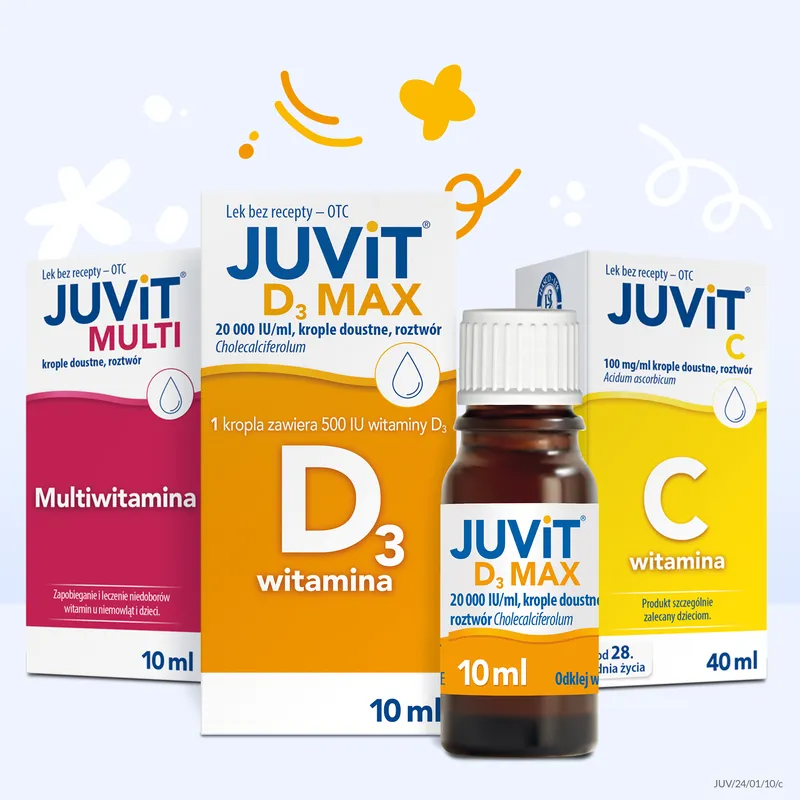
Table of Contents
Package leaflet: Information for the patient
JUVIT D MAX
20,000 IU/ml, oral drops, solution
Cholecalciferolum
Please read all of this leaflet carefully before taking this medicine, because it contains
important information for you.
This medicine should always be taken exactly as described in this patient leaflet or as directed by
your doctor or pharmacist.
- Keep this leaflet so that you can read it again if necessary.
- If you need advice or further information, please contact your pharmacist.
- If you experience any side effects, including any not listed in this leaflet, inform your doctor or pharmacist. See section 4.
- If your condition does not improve or worsens, contact your doctor.
Contents of the leaflet
- What JUVIT D MAX is and what it is used for
- Important information before taking JUVIT D MAX
- How to take JUVIT D MAX
- Possible side effects
- How to store JUVIT D MAX
- Contents of the pack and other information
1. What JUVIT D MAX is and what it is used for
JUVIT D MAX contains vitamin D (cholecalciferol). Vitamin D belongs to the group of D vitamins. In the human body, it is converted into active forms which act as hormones. Cholecalciferol is produced in human skin under the influence of ultraviolet (UV) light. Skin synthesis covers only a small part of the daily requirement. The main source of vitamin D is food (meat, milk, egg yolks).
The primary property of vitamin D metabolites is to enhance the absorption of calcium and phosphates. Vitamin D promotes the synthesis of a specific intestinal protein, thereby facilitating calcium binding and its subsequent transport into the bloodstream. Cholecalciferol also increases the reabsorption of calcium and phosphates in the kidneys. In bones, it enhances the activity of osteoclasts (cells that remove old bone tissue) and promotes osteoclastic osteolysis (the process of bone resorption mediated by osteoclasts). All these actions lead to increased blood calcium levels and support normal bone formation and mineralization.
After oral administration, cholecalciferol is well absorbed in the small intestine. Bile acids play an essential role in this absorption process. Cholecalciferol and its metabolites are stored in the liver, adipose tissue, and muscles, from where they are gradually released. They are excreted mainly via bile, conjugated with glucuronic acid, glycine, and taurine, and to a lesser extent in urine. Small amounts of cholecalciferol pass into breast milk and across the placenta.
JUVIT D MAX is recommended for use in:
- Prevention of vitamin D deficiency and conditions resulting from such deficiency (e.g. rickets, osteomalacia) in adults, adolescents, children, infants, and newborns,
- Adjunctive treatment of osteoporosis in adults,
- Prevention of vitamin D deficiency in women planning pregnancy, during pregnancy, and during breastfeeding, in consultation with a doctor.
The medicine may be used in the treatment of vitamin D deficiency, rickets, and osteomalacia in patients previously diagnosed, as continuation of therapy.
1/5
2. Important information before using JUVIT D MAX
When not to use JUVIT D MAX:
- if the patient is allergic to cholecalciferol or to any of the other ingredients of this medicine (listed in section 6);
- if the patient has: hypercalcaemia (elevated calcium levels in serum), nephrolithiasis (kidney stones), lack of cholecalciferol hydroxylase activity in the liver and kidneys, or severe renal insufficiency.
Warnings and precautions
Before starting treatment with JUVIT D MAX, consult a doctor or pharmacist.
Prophylactic vitamin D dosing in the general population should be individualized according to age, body weight, sun exposure (time of year), diet, and lifestyle. In healthy individuals exposed to sunlight with forearms and lower legs uncovered for at least 15 minutes daily between 10:00 and 15:00, without sunscreen, from May to September, supplementation is not necessary but remains recommended and safe. If these conditions are not met, year-round vitamin D supplementation is recommended, depending on age, body weight, and dietary vitamin D intake.
Vitamin D deficiency is defined as serum 25-hydroxycholecalciferol (25(OH)D) concentration < 20 ng/ml (< 50 nmol/l). The target concentration for optimal vitamin D activity is defined as 30–50 ng/ml (75–125 nmol/l).
If JUVIT D MAX is taken simultaneously with other medicines or food supplements containing vitamin D (e.g. combined vitamin-mineral preparations), this may lead to overdose.
When vitamin D is used long-term or in doses exceeding 1000 IU daily, serum calcium levels should be monitored.
In patients with sarcoidosis, there is a risk of excessive conversion of cholecalciferol into active metabolites. If necessary, doses should be reduced and patients closely monitored for serum and urinary calcium levels.
JUVIT D MAX and other medicines
Inform your doctor or pharmacist about all medicines the patient is currently taking or has recently taken, as well as any medicines planned for future use.
Concomitant use with certain diuretics (e.g. chlorothiazide) increases the risk of hypercalcaemia. Serum calcium levels should be monitored when calcium-containing preparations are used concurrently. Some anticonvulsants (e.g. carbamazepine, phenobarbital, phenytoin, and primidone) may increase vitamin D requirements. Cholestyramine, colestipol, or neomycin may reduce vitamin D absorption. Concomitant administration of vitamin D with cardiac glycosides may enhance their toxic effects (increased risk of cardiac arrhythmias). Glucocorticoids may reduce the effectiveness of vitamin D.
JUVIT D MAX with food and drink
JUVIT D MAX may be taken with food and drink.
Pregnancy and breastfeeding
If the patient is pregnant or breastfeeding, suspects she may be pregnant, or is planning to conceive, she should consult a doctor before using this medicine.
This medicine should be used during pregnancy and breastfeeding only under medical supervision.
Vitamin D and its metabolites pass into breast milk. No cases of overdose have been observed in breastfed infants. Breastfed infants require additional vitamin D supplementation.
Driving and operating machinery
Cholecalciferol is considered a safe medicine that does not impair psycho-physical performance.
JUVIT D MAX does not affect the ability to drive or operate machinery.
3. How to use JUVIT D MAX
This medicine should always be taken exactly as described in this patient leaflet, or as directed by your doctor or pharmacist. If you have any doubts, consult your doctor or pharmacist.
This medicine is intended for oral use.
Prevention of vitamin D deficiency and deficiency-related conditions (e.g. rickets,
osteomalacia) in adults, adolescents, children, infants, and newborns:
In newborns and infants, this medicine should be used under medical supervision.
The most commonly used dosing regimen:
Premature infants: 1–2 drops (500–1000 IU) daily. After reaching 40 weeks of corrected age, the prophylactic dose should be reduced. Dosing must be determined by the attending physician.
Newborns and infants up to 12 months of age: 1 drop (500 IU) daily.
Children aged 1 to 10 years: if sufficient sun exposure is not possible, 1–2 drops (500–1000 IU) daily.
Children aged 11 years, adolescents, and adults: if sufficient sun exposure is not possible, 2–4 drops (1000–2000 IU) daily.
Elderly patients (over 75 years of age): 4–8 drops (2000–4000 IU) daily.
Adjunctive treatment of osteoporosis in adults:
2–4 drops (1000–2000 IU) daily.
Prophylaxis of vitamin D deficiency in women planning pregnancy, during pregnancy, and breastfeeding,
in consultation with a doctor:
The usual dose is 4 drops (2000 IU) daily, unless otherwise advised by a physician. During pregnancy, women should follow the recommendations of their attending physician, as vitamin D requirements may vary depending on individual body stores.
Patients with renal function disorders
In patients with kidney impairment, calcium and phosphate metabolism should be monitored. In case of hypercalcemia or signs of impaired kidney function, the dose should be reduced or treatment discontinued. It is recommended to reduce or discontinue treatment if the daily urinary calcium excretion exceeds 7.5 mmol/24 hours (300 mg/24 hours).
Do not use this medicine long-term or in higher doses without medical supervision. Additionally, do not use other medicines, dietary supplements, or food products containing vitamin D (cholecalciferol), calcitriol, or other vitamin D metabolites and analogs simultaneously without medical supervision.
The medicine can be administered to infants and young children on a spoon mixed with a drink or food.
Due to the risk of overdose, do not administer the medicine directly from the bottle into the patient's mouth.
3/5
Use of a higher than recommended dose of JUVIT D MAX
If you have taken more than the recommended dose, contact your doctor or pharmacist immediately.
Toxicity symptoms are rare and usually occur after ingestion of more than 10,000 IU of vitamin D (0.25 mg) per day. Such doses may cause weakness, hypercalcemia, apathy, loss of appetite, headache, muscle and joint pain, muscle flaccidity, nausea, vomiting, ectopic calcifications in tissues, proteinuria, arterial hypertension, and arrhythmia. Chronic hypercalcemia may lead to calcification of blood vessels and kidneys and a rapid deterioration in kidney function. In such cases, the medicine must be discontinued. Hospitalization may be necessary, along with symptomatic and calcium-lowering treatment. There is no specific antidote.
Missed dose of JUVIT D MAX
Do not take a double dose to make up for a missed dose.
Discontinuation of JUVIT D MAX
If you have any further questions about the use of this medicine, consult your doctor or pharmacist.
4. Possible adverse effects
Like all medicines, this medicinal product may cause adverse effects, although not everybody will experience them.
Adverse effects do not occur when the product is administered at the recommended doses.
Taking vitamin D in higher doses may lead to hypervitaminosis D and hypercalcaemia, and associated symptoms:
Common (from 1 to 10 patients in 100 cases):
- hypercalcaemia, hypercalciuria.
Frequency not known (frequency cannot be estimated from available data):
- myocardial damage, cardiac arrhythmias,
- anaemia, vascular calcification,
- headache, convulsions,
- loss of appetite, abdominal pain, bloating, nausea, vomiting, diarrhoea or constipation,
- kidney damage, polyuria,
- muscle and joint pain,
- ectopic calcifications,
- conjunctivitis,
- hypersensitivity reactions such as skin itching, rash or urticaria.
Reporting of adverse effects
If any adverse effects occur, including any adverse effects not listed in this leaflet, inform a doctor or pharmacist. Adverse effects can be reported directly to the Department of Monitoring of Adverse Drug Reactions at the Office for Registration of Medicinal Products, Medical Devices and Biocidal Products:
Aleje Jerozolimskie 181C, 02-222 Warsaw,
Phone: +48 22 49 21 301, Fax: +48 22 49 21 309,
Website: https://smz.ezdrowie.gov.pl
Adverse effects can also be reported to the Marketing Authorisation Holder.
Reporting adverse effects can help provide more information on the safety of this medicine.
5. How to store the medicine JUVIT D MAX
Keep the medicine out of sight and reach of children.
4/5
There are no special requirements regarding storage temperature. Store in the original packaging to protect from light.
Do not use this medicine after the expiry date stated on the packaging.
The expiry date refers to the last day of the stated month.
An opened bottle should be used within 12 months.
Medicines must not be disposed of via wastewater or household waste. Ask your pharmacist how to dispose of medicines no longer required. This will help protect the environment.
6. Contents of the package and other information
What JUVIT D3 MAX contains
- The active substance is cholecalciferol at a dose of 0.5 mg (20,000 IU) in 1 ml of solution (1 ml of solution contains 40 drops).
- The other ingredients (excipients) are: medium-chain triglycerides.
What JUVIT D3 MAX looks like and contents of the pack
JUVIT D3 MAX is a colourless or slightly yellow, clear solution (opalescence is acceptable), odourless.
The pack consists of a 10 ml amber glass bottle (Type III), closed with a HDPE cap and equipped with a dropper made of LDPE; the bottle is labelled and placed together with the patient leaflet in a cardboard box.
Marketing Authorisation Holder and Manufacturer
"PRZEDSIĘBIORSTWO PRODUKCJI FARMACEUTYCZNEJ HASCO-LEK" S.A.
51-131 Wrocław, ul. Żmigrodzka 242 E
Medical information
tel.: +48 22 742 00 22
e-mail: [email protected]
5/5