Jodek sodium na 131i, solution for injection
Poland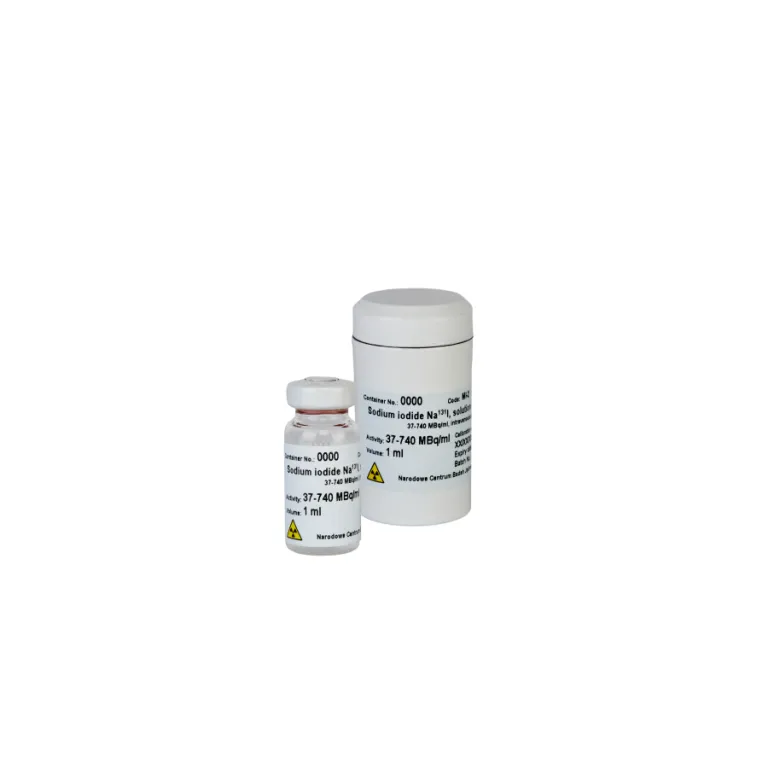
Table of Contents
- PACKAGE LEAFLET: INFORMATION FOR THE USER
- 1. What Sodium Iodide Na I, solution for injection is and what it is used for
- 2. Important information before using Jodek sodu Na 131I, roztwór do wstrzykiwań
- 3. How to use Jodek sodu Na 131I, roztwór do wstrzykiwań
- 4. Possible side effects
- 5. How to store Jodek sodu Na I, solution for injection
- 6. Contents of the pack and other information
- Information intended exclusively for medical professionals:
PACKAGE LEAFLET: INFORMATION FOR THE USER
Sodium Iodide Na I, solution for injection
Solution for injection, 37–740 MBq/ml
Active substance: sodium iodide [I]
Please read carefully this leaflet before the medicine is administered because it contains
important information for the patient.
- Keep this leaflet for future reference.
- If you have any questions, please consult a nuclear medicine specialist physician.
- If you experience any adverse reactions, including any not listed in this leaflet, inform the nuclear medicine specialist physician immediately.
Leaflet contents:
- What Sodium Iodide Na I, solution for injection is and what it is used for
- Important information before administration of Sodium Iodide Na I, solution for injection
- How to use Sodium Iodide Na I, solution for injection
- Possible side effects
- How to store Sodium Iodide Na I, solution for injection
- Contents of the pack and other information
1. What Sodium Iodide Na I, solution for injection is and what it is used for
Sodium Iodide Na I, solution for injection is a medicinal product (radiopharmaceutical) intended for both diagnostic and therapeutic purposes.
Sodium Iodide Na I, solution for injection is administered intravenously and is used for the diagnosis and treatment of thyroid disorders. The medicine is intended for direct administration to patients in doses of varying radioactive activity, depending on the indication.
Sodium Iodide Na I, solution for injection is intended for performing isotopic examinations in thyroid diseases. It is used to evaluate thyroid function disorders (hyperthyroidism and hypothyroidism), to localize the thyroid gland, to assess its size and shape, and to evaluate the function of thyroid lesions: "cold" nodules (which do not accumulate iodine), "warm" nodules (which accumulate iodine to a similar extent as normal thyroid tissue), and "hot" nodules (which accumulate iodine to a greater extent than normal thyroid tissue).
Sodium Iodide Na I, solution for injection may be administered as a test dose to study the behavior of radioiodine in the thyroid. Assessment of thyroid uptake and the half-life of iodine in the thyroid may be used to calculate the required therapeutic activity of radioiodine.
Sodium Iodide Na I, solution for injection is used in patients treated for differentiated thyroid cancer to identify residual thyroid tissue after surgery and for the diagnosis of metastases.
Sodium Iodide Na I is used in the treatment of benign thyroid disorders: nontoxic nodular goiter without thyroid dysfunction, hyperthyroidism in Graves' disease and Basedow's disease, solitary nodules, and multinodular goiter. It is also used in the treatment of differentiated thyroid cancer: following surgical treatment to ablate residual thyroid tissue, to destroy remaining cancer foci, and to treat iodine-avid metastases of thyroid cancer.
Due to the presence of the radioactive isotope iodine-131, use of this medicinal product involves exposure to ionizing radiation. The physician has determined that the benefits derived from the diagnostic examination or therapy outweigh the potential risks associated with ionizing radiation.
2. Important information before using Jodek sodu Na 131I, roztwór do wstrzykiwań
When not to use Jodek sodu Na 131I, roztwór do wstrzykiwań
Do not use Jodek sodu Na 131I, roztwór do wstrzykiwań:
- if the patient is allergic (hypersensitive) to the active substance or to any of the other ingredients of the medicine,
- in women with confirmed or suspected pregnancy (or when pregnancy has not been ruled out),
- in breastfeeding women.
Jodek sodu Na 131I, roztwór do wstrzykiwań should not be used:
- for diagnostic purposes in children under 10 years of age,
- in thyroid scintigraphy, except in cases of thyroid cancer or when iodine-123 or technetium-99m are not available.
Warnings and precautions
Due to the risk of radioactive contamination, caution must be exercised when treating patients with radioactive iodine, particularly in individuals:
- who may not comply with instructions from medical personnel,
- with urinary incontinence.
Some patients receiving high activities of iodine-131 may require hospitalization to comply with radiation protection regulations.
Administration of radiopharmaceuticals poses a risk of external ionizing radiation exposure or contamination from bodily fluids (e.g. urine, vomit) to other individuals. Therefore, basic hygiene principles must be observed.
To reduce radiation dose absorbed by the urinary bladder, it is recommended after administration of the medicinal product to drink a slightly higher than usual amount of fluids (approximately 1–1.5 litres more per day) and to empty the bladder frequently.
Low blood sodium levels have been observed in elderly patients following thyroidectomy. This effect is most likely to occur in women and in patients taking medications that increase water and sodium excretion in urine (diuretics, such as hydrochlorothiazide). If the patient belongs to any of the above groups, the doctor may recommend regular blood tests to monitor electrolyte levels (e.g. sodium).
Before administration of Jodek sodu Na 131I, roztwór do wstrzykiwań, the doctor may recommend:
- a low-iodine diet (particularly limiting consumption of seafood),
- avoiding medications containing iodine (e.g. iodine-containing vitamins, certain antiseptics, certain drugs for cataracts, certain expectorants, amiodarone-containing drugs, certain contrast agents used in radiological examinations),
- temporary discontinuation of natural or synthetic thyroid hormones to increase iodine uptake by thyroid tissue,
- temporary discontinuation of antithyroid drugs, e.g. containing thiamazole or propylthiouracil.
Jodek sodu Na 131I, roztwór do wstrzykiwań and other medicines
Inform the nuclear medicine specialist doctor about all medicines currently or recently taken, including those available without prescription, as well as any medicines the patient plans to take.
Many substances interact with iodides in various ways. They may affect iodide protein binding, their behaviour in the body, or modify the effects of radioactive iodine. This means the doctor must review all medications being taken by the patient and decide whether some should be discontinued prior to administration of sodium [131I] iodide.
Jodek sodu Na 131I, roztwór do wstrzykiwań with food and drink
Before administration of sodium [131I] iodide, the doctor may recommend a low-iodine diet to enhance iodine uptake by thyroid tissue.
Pregnancy and breastfeeding
Jodek sodu Na 131I, roztwór do wstrzykiwań must not be used in pregnant or breastfeeding women.
Before receiving the medicinal product, inform the nuclear medicine specialist if:
- there is suspicion of pregnancy,
- menstruation has not occurred at the expected time,
- the woman is breastfeeding. In case of doubt, consultation with the nuclear medicine specialist supervising the procedure is necessary. If the patient is pregnant, it is important to inform the doctor.
For both sexes, it is recommended to use contraception for at least 4 months after treatment with sodium [131I] iodide. The doctor may also consider recommending contraception for a similar period after administration of higher activities of sodium [131I] iodide for diagnostic purposes in patients with differentiated thyroid cancer.
If administration of sodium [131I] iodide is necessary in a breastfeeding woman, breastfeeding must be discontinued.
Driving and operating machinery
No data available.
Jodek sodu Na 131I, roztwór do wstrzykiwań contains sodium
The medicinal product contains 1.2 to 1.3 mg of sodium per millilitre. This should be taken into account in patients on a low-sodium diet.
3. How to use Jodek sodu Na 131I, roztwór do wstrzykiwań
There are strict regulations regarding the use, transfer, and disposal of radiopharmaceuticals. Jodek sodu Na 131I, roztwór do wstrzykiwań is administered only under appropriate clinical conditions and exclusively by appropriately qualified personnel. These individuals take special precautionary measures to ensure safe use of the medicine and will continuously monitor their actions.
Jodek sodu Na 131I, roztwór do wstrzykiwań is a medicine intended for intravenous administration, with varying levels of radioactive activity.
The activity (dose) of the medicine is determined by a nuclear medicine specialist. This activity should be individually tailored for each patient and represents the minimum dose necessary to achieve the desired therapeutic effect or the required diagnostic information.
Activities used in diagnostics
Depending on the type of examination, the recommended radioactive activity ranges are:
- For isotopic examinations performed in patients with benign thyroid disorders, a dose of 0.15–4 MBq of sodium [131I] iodide is recommended.
- For examinations in patients treated for differentiated thyroid cancer, a dose of 37–240 MBq (typically 37–74 MBq) of sodium [131I] iodide is recommended.
Activities used in therapy
Depending on the type of disease, the typically used radioactive activity ranges are:
- Treatment of hyperthyroidism and non-toxic goitre: 200–800 MBq
- Ablation of residual thyroid tissue after surgery for thyroid cancer: 1850–3700 MBq
- Treatment of metastases of thyroid cancer: 3700–11,100 MBq (MBq = megabecquerel – a unit of radioactivity measurement)
Use in children
The use of Jodek sodu Na 131I, roztwór do wstrzykiwań in children must be carefully evaluated by a nuclear medicine specialist, taking into account clinical indications and a benefit-risk assessment for this patient group. The dose is calculated similarly to that in adults, although dose reduction may be considered depending on the child's age and body weight.
It should be noted that long-term potential adverse effects associated with iodine-131 administration in children (especially under 10 years of age) and adolescents are more likely than in adults.
After administration of Jodek sodu Na 131I, roztwór do wstrzykiwań, the following should be observed:
- To reduce radiation dose absorbed by the urinary bladder, drink slightly more fluids than usual (approximately 1–1.5 litres more),
- Urinate frequently to accelerate elimination of the radiopharmaceutical from the body,
- Use contraception in both sexes for at least 4 months after treatment.
Administration of radiopharmaceuticals poses a risk of external ionizing radiation exposure or contamination from radioactive isotopes present in urine, vomit, sweat, etc., to other individuals. Therefore, after administration of sodium Na 131I iodide, the following should be observed:
- Avoid close contact with other people, especially young children and pregnant women, for the period recommended by the physician,
- Carefully clean up any residual urine, faeces, or sweat for the period recommended by the physician.
Administration of a higher than recommended dose of the medicine
Overdose is almost impossible, as the dose administered to the patient is strictly controlled by the nuclear medicine specialist. The medicine is supplied as a solution of known activity, which facilitates accurate dose control.
In the event of overdose, the physician may administer drugs blocking iodine-131 uptake by the thyroid gland, or induce vomiting, and recommend increased fluid intake and frequent urination to eliminate residual radiopharmaceutical from the body.
If there are any further doubts regarding the use of this medicine, consult a nuclear medicine specialist.
4. Possible side effects
Like all medicines, this medicine can cause side effects, although not everyone experiences them.
Side effects after diagnostic administration of sodium Na 131I iodide have been reported in isolated cases (exact frequency cannot be estimated from available data). Possible side effects include hypersensitivity reactions, nausea, and vomiting.
Exposure to ionizing radiation may increase the risk of cancer or cause hereditary defects. However, current data indicate a low risk of such adverse effects in diagnostic nuclear medicine procedures.
Side effects after therapeutic doses:
Early effects
Very common early adverse effects (observed in more than 1 in 10 patients) occurring within hours or days after administration (especially with high doses) include:
- Radiation-induced thyroiditis (manifesting as discomfort, rarely more severe neck pain; swelling in the neck),
- Radiation-induced sialadenitis (usually presenting as swelling of salivary glands, discomfort, rarely more severe pain in the salivary gland area),
- Dry mouth,
- Nausea, rarely vomiting,
- Tracheal stenosis.
In patients treated for lung metastases of thyroid cancer (usually with repeated, high-activity doses of iodine-131), radiation-induced pneumonitis or pulmonary fibrosis may occur.
Local brain oedema or worsening of pre-existing brain oedema should be considered in patients with metastases of thyroid cancer to the central nervous system.
Late effects
A very common (observed in more than 1 in 10 patients) late consequence of treatment with sodium [131I] iodide for benign thyroid diseases is hypothyroidism, requiring hormone replacement therapy.
All the adverse effects listed below occur with unknown frequency, which cannot be estimated from available data.
In some patients, administration of radioactive iodine leads to an increase in thyroid hormone levels in the blood (usually 7–10 days after treatment). In patients with poorly controlled thyroid function, this may lead to symptoms of hyperthyroidism (similar to the onset of thyroid disease); in extreme cases, life-threatening thyroid storm may occur. In a small proportion of patients with nodular goitre, administration of iodine-131 may trigger symptoms of Graves' disease.
Late effects also include reversible or, in very rare cases (in patients treated with high doses of iodine-131), irreversible bone marrow suppression. This may manifest as a decrease in platelet and/or white blood cell counts, rarely red blood cells.
A rare consequence of iodine-131 treatment in patients with Graves' disease (especially tobacco smokers) may be worsening or new onset of exophthalmos (thyroid eye disease). Similarly, rarely, in patients treated with iodine-131 for thyroid nodules, immune-mediated thyroiditis may occur, usually transient, but potentially causing hyperthyroidism requiring treatment.
Treatment of thyroid cancer with sodium [131I] iodide may cause transient (rarely permanent) impairment of fertility in both women and men.
Administration of sodium [131I] iodide may lead to permanent damage to salivary glands, resulting in dry mouth, taste and smell disturbances (more frequently after repeated administration of iodine-131). Rarely, permanent impairment of tear secretion (dry eye syndrome) or impaired tear drainage from the conjunctiva (due to narrowing of lacrimal ducts) may occur.
In a small number of patients, disturbances in parathyroid function—either hyperparathyroidism or hypoparathyroidism—have been reported after iodine-131 treatment.
Exposure to ionizing radiation may increase the risk of cancer (particularly when high activities of radioactive isotopes are used) or lead to hereditary defects. Epidemiological data indicate an increased incidence of stomach, bladder, breast cancer, and leukaemia in individuals treated with high activities of sodium [131I] iodide.
Reporting of adverse effects
If any adverse effects occur, including any not listed in this leaflet, inform your doctor or pharmacist. Adverse effects can be reported directly to the Department of Monitoring of Adverse Drug Reactions, Office for Registration of Medicinal Products, Medical Devices and Biocidal Products, Al. Jerozolimskie 181C, 02-222 Warsaw, tel.: +48 22 4921301, fax: +48 22 4921309, e-mail: [email protected].
Adverse effects can also be reported to the marketing authorization holder.
Reporting of adverse effects helps to gather more information on the safety of the medicine.
5. How to store Jodek sodu Na I, solution for injection
The patient will not be required to store this medicinal product.
Radiopharmaceuticals must be stored exclusively by authorized personnel, under appropriate conditions, in compliance with regulations concerning radioactive substances.
The following information is intended solely for medical personnel.
Do not use the medicinal product after the expiry date stated on the packaging.
6. Contents of the pack and other information
What Jodek sodu Na I, solution for injection contains
- The active substance is sodium iodide I, with activity [37-740 MBq/ml].
- The other components are: sodium carbonate, sodium hydrogen carbonate, sodium thiosulfate pentahydrate, sodium chloride, water for injections.
What Jodek sodu Na I, solution for injection looks like and contents of the pack
The medicine is supplied as a solution in a vial.
A 10 ml Type I glass vial closed with a rubber stopper and an aluminium cap, placed inside a lead shielding container.
Marketing Authorisation Holder and Manufacturer
National Centre for Nuclear Research
Andrzeja Sołtana 7
05-400 Otwock
Tel: 22 7180700
Fax: 22 7180350
e-mail: [email protected]
For more detailed information, please contact your doctor or the representative of the Marketing Authorisation Holder.
Information intended exclusively for medical professionals:
The radiopharmaceutical product is supplied in a ready-to-use form.
Radiopharmaceuticals must be handled by the user in a manner ensuring appropriate radiological safety and pharmaceutical quality.
Appropriate precautions should be taken to maintain sterility of the medicinal product.
The vial must not be opened before disinfecting the stopper; the solution should be drawn through the stopper using a single-use syringe equipped with an appropriate shield and a single-use needle, or by using an automated injection system.
Do not use the medicinal product if the vial is damaged.
Any unused medicinal product or waste material must be disposed of in accordance with local regulations.