Iodecad potassium serb
Poland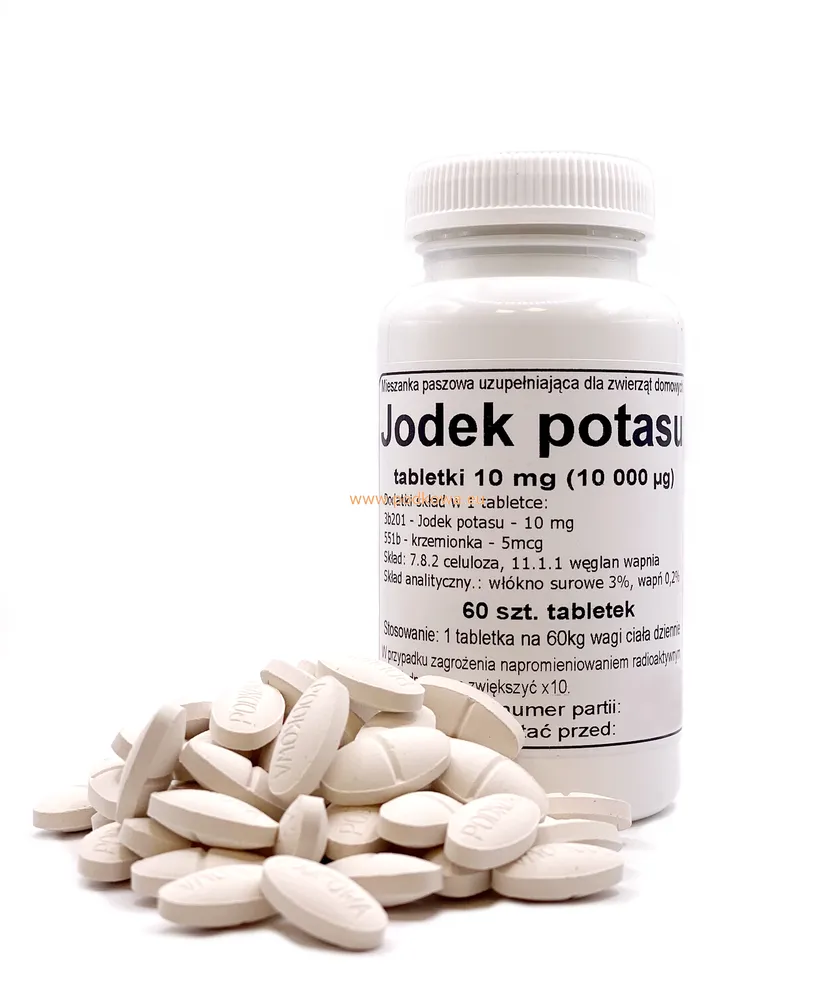
Table of Contents
- Package leaflet: Information for the patient
- 1. What Jodek potasu SERB is and what it is used for
- 2. Important information before taking Jodek potasu SERB
- 3. How to take the medicine Jodek potasu SERB
- 4. Possible adverse effects
- 5. How to store Jodek potasu SERB
- 6. Contents of the packaging and other information
Package leaflet: Information for the patient
Jodek potasu SERB, 65 mg, tablets
Kalii iodidum
Please read carefully the entire leaflet before taking this medicine, as it contains important information for you.
- Keep this leaflet, as you may need to read it again.
- If you have any questions, please consult your doctor or pharmacist.
- This medicine has been prescribed for a specific individual. Do not pass it on to others. The medicine may harm someone else, even if their symptoms are the same.
- If you experience any adverse effects, including any not listed in this leaflet, tell your doctor or pharmacist. See section 4.
Table of contents
- What Jodek potasu SERB is and what it is used for
- Important information before taking Jodek potasu SERB
- How to take Jodek potasu SERB
- Possible side effects
- How to store Jodek potasu SERB
- Contents of the pack and other information
1. What Jodek potasu SERB is and what it is used for
This medicine should be taken only upon explicit instruction from the relevant authorities, in accordance with official national guidelines.
Jodek potasu SERB tablets are intended for use in the general population in the event of release of radioactive iodine into the air following a nuclear accident. The tablets are used to block the uptake of radioactive iodine by the thyroid gland.
In the event of a nuclear accident, information regarding the use of iodine tablets will be communicated by the competent national authorities via media (radio, television, internet).
Uptake of radioactive iodine by the thyroid gland can be blocked by the rapid administration of a high dose of potassium iodide. In such a situation, the thyroid gland becomes saturated with iodine and will not absorb radioactive iodine for 24 hours.
2. Important information before taking Jodek potasu SERB
When not to take Jodek potasu SERB
- if you are allergic to potassium iodide or any of the other ingredients of this medicine (listed in section 6),
- if you have dermatitis herpetiformis (also known as Duhring's disease), a rare skin disorder,
- if you have hypocomplementaemic vasculitis (Mac Duffie syndrome), a rare condition causing inflammation of blood vessels.
Warnings and precautions
This medicine should be taken immediately upon receiving a clear instruction from national authorities.
Delayed intake of potassium iodide tablets (24 hours after exposure) may be harmful, as it may prolong the half-life of radioactive iodine accumulated in the thyroid gland.
Children, adolescents, pregnant and breastfeeding women, as well as individuals living in areas with iodine deficiency, will benefit most from treatment with iodine tablets following exposure to radioactive iodine. Adults over 40 years of age are less likely to benefit from treatment with iodine tablets after exposure to radioactive iodine.
If availability of Jodek potasu SERB is limited, priority should be given to children and young adults, as well as individuals exposed to high levels of radioactive iodine (e.g. emergency workers involved in rescue or cleanup operations), regardless of age.
The tablets do not protect against any other types of radiation from radioactive substances.
Before taking Jodek potasu SERB, consult your doctor or pharmacist if:
- you are being treated for thyroid disorders.
- you are being treated for thyroid cancer or your doctor suspects you may have thyroid cancer.
- you have difficulty breathing or swallowing. Taking Jodek potasu SERB may worsen these conditions due to enlargement of the thyroid gland, goiter (see section 4, "Possible side effects").
Children
- The risk of developing thyroid cancer after exposure to radioactive iodine is higher in younger individuals. Because their thyroid gland is still developing, newborns (from birth up to the end of the first month of life) and children are more sensitive to the harmful effects of radioactive iodine than adults and should therefore be treated with potassium iodide as a priority.
- Repeated administration of potassium iodide in newborns should be avoided to minimize the risk of hypothyroidism.
- In newborns, thyroid function should be monitored by a doctor so that treatment for hypothyroidism (a condition in which the thyroid gland does not produce enough hormones), which may occasionally occur after administration of potassium iodide (see section 4, "Possible side effects"), can be initiated promptly. Hypothyroidism in newborns may affect brain development.
Jodek potasu SERB with other medicines
When used according to the recommended dosage, the risk of drug interactions is low.
Tell your doctor or pharmacist about any other medicines you are currently taking, have recently taken, or might take in the future. This includes medicines obtained without a prescription.
In particular, consult your doctor if you are taking any of the following medicines while taking Jodek potasu SERB:
- angiotensin-converting enzyme (ACE) inhibitors, a group of medicines that help blood vessels widen, making it easier for the heart to pump blood (e.g. captopril, enalapril),
- potassium-sparing diuretics (diuretic tablets that reduce the amount of potassium lost in urine), such as amiloride, triamterene, or aldosterone antagonists,
- lithium, used in the treatment of psychiatric disorders,
- medicines used to treat an overactive thyroid (hyperthyroidism) (e.g. carbimazole, methimazole, propylthiouracil),
- medicines containing iodine (e.g. amiodarone, used to treat irregular heartbeat). Taking Jodek potasu SERB may interfere with radioactive iodine therapy and thyroid function tests.
Jodek potasu SERB with food and drink
Food in the stomach may delay absorption. Therefore, it is best to take the tablet some time after eating.
Pregnancy and breastfeeding
Pregnant women should take potassium iodide to protect both themselves and their unborn child.
Pregnant and breastfeeding women should not take repeated doses.
If you are pregnant or breastfeeding, think you may be pregnant, or are planning to become pregnant, you should consult your doctor or pharmacist before taking this medicine.
Jodek potasu SERB contains lactose.
If you have been previously diagnosed with an intolerance to certain sugars, you should consult your doctor before taking this medicine.
3. How to take the medicine Jodek potasu SERB
This medicine should only be taken following an explicit instruction from state authorities.
Do not make an independent decision to take this medicine.
Always take this medicine exactly as directed by your doctor or pharmacist. If in doubt,
consult your doctor or pharmacist.
The optimal time for administering potassium iodide is less than 24 hours before the expected start
of exposure, and up to a maximum of 2 hours afterwards. Administration of potassium iodide
within a maximum of 8 hours after the estimated start of exposure would also be justified.
A single dose of potassium iodide causes almost complete saturation of the thyroid gland, blocking
the uptake of radioactive iodine by the thyroid gland for the following 24 hours.
This medicine should not be administered more than 24 hours after radiation exposure (see
section 2 "Warnings and precautions").
There is no evidence suggesting the need for dose adjustment in elderly individuals
(over 60 years of age) or in patients with impaired renal or hepatic function. However, there is a risk
of drug accumulation in the body in this age group; therefore, potassium iodide should not
be used for prolonged periods.
The recommended dose is determined according to the patient's age.
| Potassium iodide dose | Number of tablets to be taken | |
| Adults, including pregnant women and breastfeeding women | 130 mg | 2 |
Use in children and adolescents
| Potassium iodide dose | Number of tablets to be taken | |
| Adolescents (over 12 years of age) | 130 mg | 2 |
| Children (3–12 years of age) | 65 mg | 1 |
| Infants (1 month to 3 years of age) | 32 mg | 1/2 |
| Neonates (under 1 month of age) | 16 mg | 1/4 |
Repeated dosing in case of prolonged exposure
In case of prolonged exposure, additional doses may be necessary upon clear instruction from the relevant national authorities.
Newborns (under 1 month of age), pregnant and breastfeeding women, and elderly adults (over 60 years of age) should not receive multiple doses of potassium iodide.
Method of administration
The tablet may be divided into 2 or 4 equal parts to facilitate dosing in children.
The tablet may be chewed, swallowed whole, or crushed and mixed with fruit juice, jam, milk, or a similar substance.
If dissolved, the resulting solution should be taken immediately.
Food in the stomach may delay absorption. Therefore, it is best to take the tablet some time after eating.
Use of higher than recommended dose of Jodek potasu SERB
Taking higher doses of potassium iodide does not increase protective effect. If a patient has taken too high a dose of potassium iodide, contact a physician, hospital, or emergency department for advice.
Symptoms:
- Bitter taste in the mouth, excessive salivation, burning sensation in the mouth, and mouth pain;
- Symptoms resembling allergic rhinitis, swelling and inflammation of the throat and salivary glands. Eye irritation, swelling, and excessive tearing may also occur.
- Pulmonary edema or swelling may occur, causing respiratory disturbances and shortness of breath due to airway constriction.
- Skin reactions include mild acne-like rashes or, less frequently, severe rashes.
Management in case of overdose
In case of overdose, it is recommended to contact the nearest toxicology center.
If there are any further doubts regarding the use of this medicinal product, consult a physician or pharmacist.
4. Possible adverse effects
Like all medicines, this medicine can cause adverse effects, although not everyone will experience them.
The following adverse effects have been reported, listed by frequency of occurrence:
Frequent (may affect up to 1 in 10 people):
- vomiting
- diarrhoea
- stomach pain
- skin rash
Frequency unknown (cannot be estimated from available data):
-
allergic reactions*
-
metallic taste
-
thirst
-
abdominal pain
-
diarrhoea with blood
-
symptoms of hyperthyroidism: increased heart rate, palpitations, fatigue, excessive sweating, changes in appetite, accelerated intestinal transit with diarrhoea, heat intolerance, menstrual disturbances, nervousness, anxiety, irritability, emotional instability, sleep disturbances.
-
symptoms of hypothyroidism: slow heart rate, fatigue, feeling cold, moderate weight gain, constipation, shortness of breath, muscle stiffness, cramps, menstrual disturbances, dry skin, brittle nails and hair, slowing of intellectual functions, hoarse voice, irritability, depression.
-
Enlargement of the thyroid gland (goitre)
*Allergic reactions are very rare. They may include breathing difficulties (bronchospasm), urticaria, subcutaneous swelling, particularly around the eyes and lips (angioedema), skin bleeding or purple spots (purpura) on the skin, fever, joint pain, lymph node swelling (lymphadenopathy), and increased levels of a certain type of white blood cells (eosinophilia).
Additional adverse effects in children
In newborns during the first days of life, a temporary increase in thyroid hormone concentration in the blood has been observed.
Reporting of adverse effects
If any adverse effects occur, including any adverse effects not listed in this leaflet, inform your doctor or pharmacist.
Adverse effects can be reported directly to the Department of Monitoring of Adverse Drug Reactions at the Office for Registration of Medicinal Products, Medical Devices and Biocidal Products, Al. Jerozolimskie 181C, 02-222 Warsaw, tel: +48 22 492 13 01, fax: +48 22 492 13 09, website: https://smz.ezdrowie.gov.pl .
Adverse effects can also be reported to the marketing authorisation holder.
Reporting adverse effects helps to provide more information on the safety of the medicine.
5. How to store Jodek potasu SERB
Keep this medicine out of sight and reach of children.
There are no special storage temperature requirements for this medicine.
Store in the original packaging to protect from light.
Do not use this medicine after the expiry date stated on the carton/blister after: EXP.
The expiry date refers to the last day of the stated month.
During storage, tablets may slightly yellow. This discolouration does not affect the prophylactic efficacy.
Medicines should not be disposed of via wastewater or household waste. Ask your pharmacist how to dispose of medicines no longer in use. This will help protect the environment.
6. Contents of the packaging and other information
What Jodek potasu SERB contains
- The active substance is potassium iodide 65 mg (corresponding to 50 mg iodine).
- The other components are lactose, microcrystalline cellulose, magnesium stearate.
What Jodek potasu SERB looks like and contents of the pack
Jodek potasu SERB 65 mg tablets are white to off-white in colour, round, flat, with bevelled edges and a cross-shaped score line on one side, 9 mm in diameter. The tablet can be divided into two or four equal parts.
The tablets are supplied in cardboard boxes containing 10 or 20 tablets in blisters made of OPA/Aluminium/PVC/Aluminium foil.
Not all pack sizes may be marketed.
Marketing Authorisation Holder and Manufacturer
Marketing Authorisation Holder:
SERB SA
Avenue Louise 480
1050 Brussels
Belgium
Tel. +48 22 307 03 61
Manufacturer:
Astrea Fontaine
Rue Des Pres Potets
21121 Fontaine Les Dijon
France
This medicinal product is authorised in the European Economic Area countries and in the United Kingdom (Northern Ireland) under the following names:
Austria Kaliumjodid SERB
Bulgaria калиев йодид SERB
Czech Republic/Slovakia Jodid draselný SERB
Denmark Kaliumiodid SERB
Estonia Kaliumjodiid SERB
Finland Kaliumjodidi SERB
France Iodure de potassium SERB
Hungary Kálium-jodid SERB
Italy Ioduro di potassio SERB
Latvia Potassium iodide SERB 65 mg tabletes
Lithuania Kalio jodidas SERB
Poland Jodek potasu SERB
Romania Iodură de potasiu SERB
Slovenia Kalijev jodid SERB