Xorox
Poland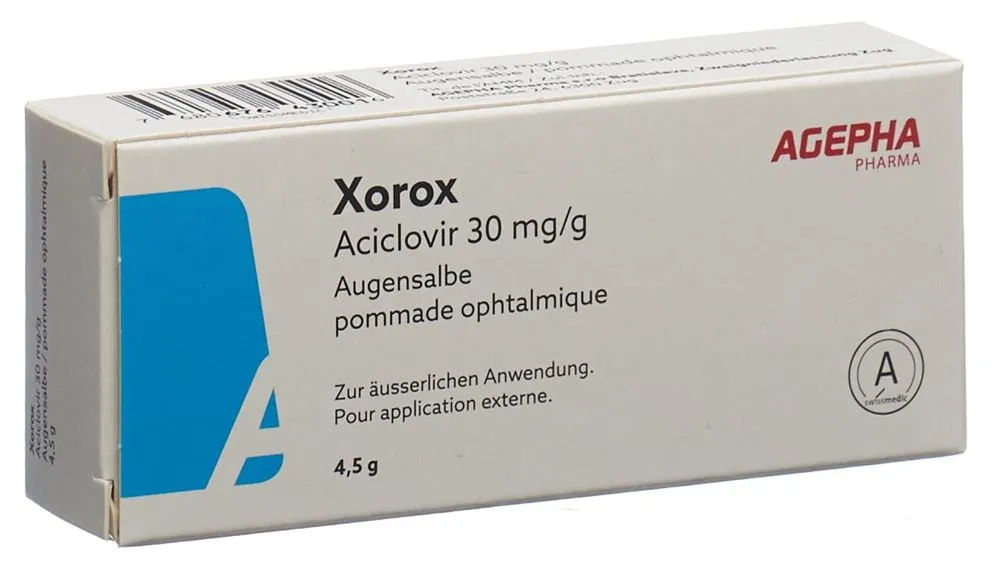
Table of Contents
PACKAGE LEAFLET: INFORMATION FOR THE USER
Xorox, 30 mg/g, ophthalmic ointment
acyclovir
Please read this leaflet carefully before using this medicine, as it contains
important information for the patient.
- Keep this leaflet for future reference.
- If you have any questions, please consult your doctor or pharmacist.
- This medicine has been prescribed for a specific individual. Do not share it with others. The medicine may harm another person, even if their symptoms are the same.
- If you experience any adverse reactions, including any not listed in this leaflet, inform your doctor or pharmacist. See section 4.
Leaflet contents
- What Xorox 30 mg/g ophthalmic ointment is and what it is used for
- Important information before using Xorox 30 mg/g ophthalmic ointment
- How to use Xorox 30 mg/g ophthalmic ointment
- Possible side effects
- How to store Xorox 30 mg/g ophthalmic ointment
- Contents of the pack and other information
1. What Xorox 30 mg/g ophthalmic ointment is and what it is used for
Xorox ophthalmic ointment contains a medicine called acyclovir, which belongs to a group of medicines known as antiviral agents.
It is used in the treatment of eye infections caused by the Herpes simplex virus. Its action consists of killing the virus or inhibiting its development in the anterior part of the eyeball (cornea).
2. Important information before using Xorox 30 mg/g ophthalmic ointment
When not to use Xorox 30 mg/g ophthalmic ointment
- If the patient is allergic to acyclovir or valacyclovir, or to any of the other ingredients of this medicine (listed in section 6).
Warnings and precautions
Before starting treatment with Xorox 30 mg/g ophthalmic ointment, discuss it with your doctor or pharmacist.
- Use Xorox 30 mg/g ophthalmic ointment for the eyes only.
- Immediately after application, a mild burning or stinging sensation may occur.
- If immediate allergic reactions occur, such as sudden swelling of the face, throat, arms, and legs (angioedema), contact your doctor immediately.
- If allergic reactions such as eyelid itching, eye swelling, or redness occur, discontinue use of Xorox 30 mg/g ophthalmic ointment and consult your doctor.
- Seek immediate medical advice if any symptoms worsen or recur.
Do not wear contact lenses during treatment with Xorox 30 mg/g ophthalmic ointment.
Children and adolescents
Recommendations are the same as for adults.
Xorox 30 mg/g ophthalmic ointment and other medicines
Inform your doctor or pharmacist about all medicines currently or recently taken, as well as any medicines you plan to take.
No significant interactions have been observed to date with topical ocular use.
However, there is insufficient information regarding the use of Xorox ophthalmic ointment together with ocular corticosteroid-containing medicines. The suitability of Xorox ophthalmic ointment for a given patient will be assessed by the doctor.
Pregnancy and breastfeeding
If the patient is pregnant or breastfeeding, suspects she may be pregnant, or plans to become pregnant, she should consult her doctor or pharmacist before using this medicine.
Xorox ophthalmic ointment may be used during pregnancy and breastfeeding, as no adverse effects are expected during pregnancy, for the fetus, or for the newborn when used at recommended doses.
Driving and operating machinery
Due to its formulation, this medicine may cause transient visual disturbances. Therefore, exercise particular caution when driving motor vehicles, working at unprotected heights, or operating machinery.
3. How to use Xorox eye ointment 30 mg/g
Instructions for use
For ocular use
This medicine should always be used exactly as your doctor has told you. If you are unsure, consult your doctor or pharmacist.
Unless otherwise directed by your physician, the recommended dosage is as follows:
Place a 1 cm strip of ointment inside the lower conjunctival sac 5 times daily (every 4 hours). The recommended times are: 7:00, 11:00, 15:00, 19:00, and 23:00.
Pull down the lower eyelid and place the strip of ointment inside the lower conjunctival sac. Close the eyelids and rotate the eyeball to distribute the ointment.
The effectiveness of treatment depends on regular application of Xorox eye ointment 30 mg/g throughout the day, every 4 hours. After healing of corneal inflammation, treatment should be continued for at least 3 more days.
Use in children and adolescents
Recommendations are the same as for adults.
Use of a higher than recommended dose of Xorox eye ointment 30 mg/g
If too much Xorox eye ointment is used, consult your doctor or pharmacist.
Xorox eye ointment is intended for ocular use. In case of accidental ingestion, seek advice from a doctor or pharmacist.
Missed dose of Xorox eye ointment 30 mg/g
If you miss a dose of Xorox eye ointment, apply it as soon as possible. However, if it is almost time for the next dose, skip the missed dose. Do not use a double amount to make up for a forgotten dose.
Stopping Xorox eye ointment 30 mg/g
If you have any further questions about the use of this medicine, consult your doctor or pharmacist.
4. Possible adverse reactions
Like all medicines, Xorox eye ointment may cause adverse reactions, although not everyone experiences them.
Immediately after applying the eye ointment, a transient mild burning or stinging sensation may occur. If facial swelling, angioedema, or similar symptoms occur, discontinue use of Xorox eye ointment and consult a doctor immediately.
Allergic reactions – very rare (may affect fewer than 1 in 10,000 people):
If an allergic reaction or acute hypersensitivity reaction occurs, discontinue use of Xorox eye ointment and contact a doctor immediately.
Symptoms may include:
- skin rash, itching, or hives
- swelling of the face, lips, tongue, or other parts of the body
- shortness of breath, wheezing, or difficulty breathing
- unexplained fever (high temperature) and feeling faint, especially when standing up.
Other adverse reactions include:
Very common (may affect more than 1 in 10 people):
burning or irritation, photophobia/light sensitivity, or sensation of a foreign body in the eye (superficial punctate keratitis).
These usually do not require discontinuation of treatment and resolve immediately.
Uncommon (may affect fewer than 1 in 100 people):
transient mild burning or stinging sensation occurring immediately after application,
eye swelling, tearing (conjunctivitis)
Rare (may affect fewer than 1 in 1,000 people):
swollen, red, irritated, itchy eyelids (blepharitis)
If any adverse reactions worsen or if any adverse reactions not listed in this leaflet occur, consult a doctor or pharmacist.
Reporting of adverse reactions
If any adverse effects occur, including any not listed in this leaflet, inform your doctor or pharmacist. Adverse reactions can be reported directly to the Department of Monitoring of Adverse Drug Reactions at the Office for Registration of Medicinal Products, Medical Devices and Biocidal Products
Al. Jerozolimskie 181C
02-222 Warszawa
Tel.: + 48 22 49 21 301
Fax: + 48 22 49 21 309
Website: https://smz.ezdrowie.gov.pl
Adverse reactions may also be reported to the marketing authorization holder.
Reporting adverse reactions helps to provide more information on the safety of this medicine.
5. How to store Xorox 30 mg/g eye ointment
Store below 25°C.
Keep the medicine out of the sight and reach of children.
Do not use the eye ointment after the expiry date stated on the label and carton. The expiry date refers to the last day of the stated month.
Period of use after first opening of the tube: 4 weeks
Medicines must not be disposed of via wastewater or household waste. Ask your pharmacist how to dispose of medicines no longer required. This will help protect the environment.
6. Contents of the pack and other information
What Xorox 30 mg/g eye ointment contains:
- The active substance is aciclovir. 1 g of ointment contains 30 mg of aciclovir.
- The excipient is white soft paraffin.
What Xorox 30 mg/g eye ointment looks like and contents of the pack
1 carton contains one aluminium tube with an internal epoxy-phenolic lacquer coating, fitted with a cannula (nozzle) made of HDPE and a cap made of HDPE, containing 4.5 g of white to off-white ointment.
Marketing Authorisation Holder and Manufacturer
AGEPHA Pharma s.r.o
Diaľničná cesta 5,
903 01 Senec
Slovakia
Tel: +421 226 226 032
This medicinal product is authorised in the Member States of the European Economic Area under the following names:
| Country | Medicinal Product Name |
| Austria | Xorox 30 mg/g eye ointment |
| Belgium | Aciclovir Agepha 30 mg/g oogzalf |
| Croatia | Xorox 30 mg/g mast za oko |
| Cyprus | Xorox 30 mg/g eye ointment |
| Czech Republic | Xorox 30 mg/g oční mast |
| Denmark | Xorox 30 mg/g øjensalve |
| Estonia | Aciclovir Agepha 30 mg/g silma salv |
| Finland | Xorox 30 mg/g silmävoide |
| France | Aciclovir Agepha 30 mg/g pommade ophtalmique |
| Germany | Xorox 30 mg/g Augensalbe |
| Hungary | Aciclovir Agepha 30 mg/g szemkenőcs |
| Iceland | Xorox 30 mg/g augnsmyrsli |
| Ireland | Aciclovir “Agepha” 30 mg/g eye ointment |
| Italy | Xorox 30 mg/g Ophthalmic Ointment |
| Latvia | Xorox 30 mg/g acu ziede |
| Luxembourg | Xorox 30 mg/g Augensalbe |
| Malta | Xorox 30 mg/g eye ointment |
| Norway | Xorox 30 mg/g øyesalve |
| Portugal | Xorox 30 mg/g ophthalmic ointment |
| Romania | Xorox 30 mg/g unguent oftalmic |
| Spain | Xorox 30 mg/g pomada oftálmica |
| Sweden | Xorox 30 mg/g ögonsalva |
| Netherlands | Aciclovir Agepha 30 mg/g oogzalf |
| United Kingdom | Aciclovir Agepha 30 mg/g eye ointment |
| Slovenia | Xorox 30 mg/g mazilo za oko |
| Poland | Xorox 30 mg/g eye ointment |