Xifia
PolandTable of Contents
Package leaflet: information for the user
Xifia, 100 mg/5 mL, granules for oral suspension
Cefiximum
Please read this leaflet carefully before taking this medicine, as it contains
important information for you.
- Keep this leaflet, as you may need to read it again.
- If you have any further questions, please ask your doctor or pharmacist.
- This medicine has been prescribed for a specific individual. Do not pass it on to others. It may harm them even if their symptoms are the same.
- If you experience any adverse reactions, including any not listed in this leaflet, tell your doctor or pharmacist. See section 4.
Contents of the leaflet
- What Xifia is and what it is used for
- Important information before taking Xifia
- How to take Xifia
- Possible side effects
- How to store Xifia
- Contents of the pack and other information
1. What Xifia is and what it is used for
Xifia contains an active substance called cefixime. It belongs to a group of antibiotics known as cephalosporins, which are used to treat bacterial infections. Xifia is used to treat:
- middle ear infection
- sinus infection
- throat infection
- infection causing acute exacerbation of chronic bronchitis
- severe lung infection (pneumonia) acquired outside the hospital
- uncomplicated urinary tract infections, including certain types of kidney infection (pyelonephritis).
Xifia, 100 mg/5 mL, granules for oral suspension, is used in children over 6 months of age, adolescents, and adults.
2. Important information before taking Xifia
When not to take Xifia
- if the patient is allergic to cefixime or any of the other ingredients of this medicine (listed in section 6).
- if the patient is allergic (hypersensitive) to other antibiotics of the cephalosporin group.
- if the patient has ever had a severe allergic reaction to penicillin antibiotics or other beta-lactam antibiotics.
This medicine must not be given to premature infants or full-term newborns.
Do not take this medicine if any of the above conditions apply to the patient. If in doubt, consult a doctor or pharmacist before starting treatment with Xifia.
Warnings and precautions
Before starting treatment with Xifia, discuss with your doctor or pharmacist if:
- the patient has ever had inflammation of the large intestine (colitis)
- the patient has impaired kidney function
- the patient has ever developed haemolytic anaemia (low number of red blood cells, which may cause paleness, weakness or shortness of breath) after taking a cephalosporin antibiotic.
If in doubt whether any of the above situations apply, speak with a doctor or pharmacist before starting treatment with this medicine.
Xifia is not suitable for every patient.
Before starting treatment with Xifia, inform your doctor:
- if the patient is allergic to penicillin antibiotics or other beta-lactam antibiotics. An allergic reaction may include rash, itching, difficulty swallowing or breathing, swelling of the face, lips, throat or tongue. Not all patients allergic to penicillins are also allergic to cephalosporins. However, special caution is required if the patient has ever had an allergic reaction to penicillins, as an allergy to this medicine may also occur. If a severe allergic reaction or anaphylaxis (a serious allergic reaction causing difficulty in breathing or dizziness) occurs after administration of Xifia, treatment must be stopped immediately and appropriate therapy initiated.
- if the patient is taking other medicines known to have harmful effects on the kidneys. Also inform the doctor if the patient has any kidney disease. The doctor may decide that regular tests are necessary to monitor kidney function during treatment.
- if the patient develops severe or persistent diarrhoea, which may be accompanied by stomach pain or cramps – these symptoms may occur during treatment with Xifia or shortly after stopping it. In such case, stop taking this medicine and contact a doctor immediately. Do not take medicines that slow down or stop intestinal motility.
If, during treatment with Xifia, the patient develops a syndrome called drug hypersensitivity syndrome (DRESS), Stevens-Johnson syndrome, or a skin reaction known as toxic epidermal necrolysis (see section 4. "Possible side effects"), stop taking this medicine immediately and contact a doctor without delay.
Treatment with Xifia may temporarily increase the risk of infections caused by other types of bacteria not affected by Xifia. For example, candidiasis (an infection caused by yeast called Candida) may occur.
This medicine may cause vomiting and diarrhoea (see section 4. "Possible side effects").
In such cases, the effectiveness of Xifia and/or other medicines taken by the patient (such as oral contraceptives) may be reduced.
As with all antibiotics of this class (beta-lactam antibiotics), treatment with this medicine may be associated with a risk of encephalopathy, which may present as seizures (epileptic fits), disorientation, disturbances of consciousness or abnormal movements, especially in cases of overdose or impaired kidney function.
If such symptoms occur, contact a doctor or pharmacist immediately (see sections 3 and 4).
Xifia and other medicines
Inform your doctor or pharmacist about all medicines currently taken or recently taken, as well as any medicines the patient plans to take.
In particular, inform your doctor or pharmacist if the patient is taking:
- medicines known to have harmful effects on the kidneys:
- antibiotics, including aminoglycoside antibiotics, colistin, polymyxin and viomycin
- diuretics (medicines that increase urine production), such as ethacrynic acid or furosemide
- nifedipine, a medicine used to treat high blood pressure or heart conditions
- anticoagulants (blood thinners), such as warfarin in some patients. Cefixime may cause disturbances in blood clotting and may prolong blood clotting time.
Effect on laboratory test results
If the patient is undergoing blood or urine tests, inform the doctor about taking Xifia, as cefixime may alter the results of certain tests.
Xifia may affect the results of certain urine tests for glucose (e.g. Benedict's or Fehling's test). If the patient has diabetes and urine glucose is frequently tested, they should inform their doctor, as alternative tests may be needed to monitor diabetes during treatment with this medicine.
Xifia may affect the results of urine tests for ketone bodies. Inform the doctor about taking this medicine, as alternative tests may be required.
Xifia may affect blood tests detecting antibodies, known as the direct Coombs test.
Pregnancy, breastfeeding and fertility
If the patient is pregnant or breastfeeding, suspects she may be pregnant, or is planning to have a baby, she should consult a doctor before using this medicine.
If treatment is necessary during pregnancy or breastfeeding, the doctor will assess and discuss with the patient the benefits and risks associated with treatment.
If the patient's breastfed infant develops gastrointestinal disturbances (diarrhoea, fungal infection) or a rash during breastfeeding, consult a doctor, as these adverse effects require monitoring.
Driving and operating machinery
As with all antibiotics of this class (beta-lactam antibiotics), treatment with this medicine may be associated with a risk of encephalopathy, which may cause seizures (epileptic fits), disorientation, disturbances of consciousness or abnormal movements, especially in cases of overdose or impaired kidney function.
If such symptoms occur, contact a doctor or pharmacist immediately (see sections 3 and 4).
Xifia contains sucrose
This medicine contains 2.52 g of sucrose in 5 mL of reconstituted suspension. This should be taken into account in patients with diabetes. If the patient has previously been diagnosed with intolerance to certain sugars, they should consult a doctor before taking this medicine.
Xifia contains sodium benzoate (E 211)
This medicine contains 2.5 mg of sodium benzoate (E 211) in 5 mL of reconstituted suspension. Sodium benzoate (E 211) may increase the risk of jaundice (yellowing of the skin and whites of the eyes) in newborns (up to 4 weeks of age).
This medicine contains less than 1 mmol of sodium (23 mg) per 5 mL of reconstituted suspension, i.e. the medicine is considered "sodium-free".
3. How to take Xifia
This medicine should always be taken according to the instructions given by your doctor or pharmacist.
If you have any doubts, consult your doctor or pharmacist.
The dose prescribed by the doctor depends on the type and severity of the infection. It also depends on
the patient's kidney function. Detailed information on this can be obtained from your doctor or
pharmacist.
The oral suspension can be taken on an empty stomach or during meals.
1 mL of suspension contains 20 mg of cefixime.
The usual dose is:
Adults and adolescents above 12 years of age
400 mg (= 20 mL of prepared suspension) once daily, as a single dose, or 200 mg (= 10 mL)
twice daily every 12 hours.
For adolescents and adults without swallowing difficulties, cefixime in tablet form is recommended.
Elderly patients
Dosage adjustment is not usually required in elderly patients, provided that kidney function is normal.
Children from 6 months to 12 years of age
8 mg of cefixime/kg body weight per day, given as a single dose or divided into two doses administered every 12 hours.
Dosing recommendations are presented in the table below.
| Body weight | Daily dose [mL] Once daily | Daily dose [mL] Twice daily | Daily dose [mg] |
|---|---|---|---|
| 6.0–9 kg (infants over 6 months of age) | 1 × 2.5 mL | 2 × 1.25 mL | 50 mg |
| 10.0 kg | 4 mL | 2 × 2 mL | 80 mg |
| 12.5 kg | 5 mL | 2 × 2.5 mL | 100 mg |
| 15.0 kg | 6 mL | 2 × 3 mL | 120 mg |
| 17.5 kg | 7 mL | 2 × 3.5 mL | 140 mg |
| 20.0 kg | 8 mL | 2 × 4 mL | 160 mg |
| 22.5 kg | 9 mL | 2 × 4.5 mL | 180 mg |
| 25.0 kg | 10 mL | 2 × 5 mL | 200 mg |
| 27.5 kg | 11 mL | 2 × 5.5 mL | 220 mg |
| 30.0 kg | 12 mL | 2 × 6 mL | 240 mg |
| 37.5 kg | 15 mL | 2 × 7.5 mL | 300 mg |
| >37.5 kg | 20 mL | 2 × 10 mL | 400 mg |
Patients with kidney disease
In patients with kidney disease, a dose reduction of Xifia may be necessary. The doctor will recommend an appropriate dose based on blood or urine test results assessing kidney function.
Preparation of the suspension
60 mL of oral suspension: To prepare the suspension, use the measuring cup provided in the cardboard box. Add a total of 40 mL of purified water in two portions, shaking the bottle after each addition.
100 mL of oral suspension: To prepare the suspension, use the measuring cup provided in the cardboard box. Add a total of 66 mL of purified water in two portions, shaking the bottle after each addition.
The prepared suspension is a viscous liquid ranging in colour from almost white to pale yellow.
Shake the bottle well before each use.
An oral plastic syringe with a graduated scale is provided for measuring the prescribed dose of the suspension. The oral plastic syringe is included in the package.
Instructions for using the oral syringe:
- Shake the bottle well before use, then remove the cap.
- Remove the syringe cap and insert the syringe into the bottle.
- Pull back the plunger until the edge of the plunger aligns with the prescribed dose marked on the plunger.
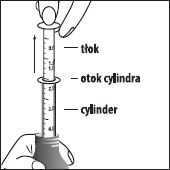
- Remove the syringe from the bottle.
- Place the tip of the syringe inside the cheek of the patient, who should be sitting upright.
- Press the plunger slowly to avoid choking. DO NOT administer the medicine as a forceful stream.
- Repeat steps 2–6 in the same manner until the entire prescribed dose has been administered.
- After administering the dose, replace the cap on the bottle. Disassemble the syringe and wash all parts thoroughly under running water. Allow the plunger and cylinder to air dry.
Duration of treatment
The usual treatment course lasts 7 days. If necessary, this course may be extended up to 14 days.
In cases of acute otitis media (ear infection) and acute bacterial pharyngitis (throat infection), the treatment duration is 7–10 days.
In cases of acute uncomplicated cystitis (bladder infection) in women, the treatment duration is 1–3 days.
Overdose of Xifia
If a patient or a child accidentally takes more than the recommended dose of this medicine, contact a doctor immediately or go to the nearest hospital emergency department.
As with all antibiotics belonging to this class (beta-lactam antibiotics), use of this medicine may carry a risk of encephalopathy, which may cause seizures, confusion, altered consciousness, or abnormal movements, especially in cases of overdose. If such symptoms occur, contact a doctor or pharmacist immediately (see sections 2 and 4).
Missed dose of Xifia
If a dose is missed, take it as soon as remembered. However, if less than 6 hours remain before the next scheduled dose, skip the missed dose and resume the regular dosing schedule. Do not take a double dose to make up for a missed dose.
Stopping Xifia treatment
It is important to continue taking this medicine for the full duration of the prescribed treatment course. Do not stop taking Xifia simply because symptoms improve. Stopping treatment too early may lead to recurrence of infection. Inform the doctor if the patient still feels unwell at the end of the prescribed treatment course, or if symptoms worsen during treatment.
If you have any further questions about the use of this medicine, consult your doctor or pharmacist.
4. Possible adverse reactions
Like all medicines, this medicine can cause adverse reactions, although not everybody will experience them.
The following adverse reactions are serious, and if they occur, immediate action must be taken. You should stop taking Xifia and seek medical help immediately if you experience any of the symptoms listed below:
- Watery, severe diarrhoea, which may also contain blood.
- Sudden, severe allergic reactions (anaphylactic shock), such as skin rash or hives, itching, swelling of the face, lips, tongue or other parts of the body, tightness in the chest, wheezing and collapse.
- Severe skin disease with blistering of the skin, mouth, eyes and genital organs (Stevens-Johnson syndrome, toxic epidermal necrolysis) (see section 2).
- Severe skin rashes, fever, swollen lymph nodes, increased number of white blood cells called eosinophils (DRESS syndrome) (see section 2).
The following adverse reactions have also been reported:
Common (may affect up to 1 in 10 people):
- Diarrhoea.
Uncommon (may affect up to 1 in 100 people):
- Headache
- Nausea
- Vomiting
- Abdominal pain
- Changes in blood test results used to assess liver function
- Skin rash
- Seizures (fits).
Rare (may affect up to 1 in 1,000 people):
- Increased risk of infection caused by microorganisms not affected by cefixime, e.g. fungal infections (e.g. candidiasis)
- Increased number of white blood cells called eosinophils
- Allergic reaction
- Loss of appetite
- Dizziness
- Bloating (gas)
- Itching of the skin
- Inflammation of the mucous membranes of the mouth and (or) other internal surfaces
- Fever
- Changes in blood test results used to assess kidney function
- Dyspepsia (indigestion).
Very rare (may affect up to 1 in 10,000 people):
- Decrease in numbers of various blood cells (symptoms may include fatigue, new infections, increased tendency to bruise or bleed)
- Allergic reaction characterized by skin rashes, fever, joint pain and organ enlargement
- Restlessness and increased activity
- Hives
- Liver function disorders, including jaundice (yellowing of the skin or whites of the eyes)
- Kidney disease (kidney failure)
- Encephalopathy (which may cause seizures, disorientation, altered consciousness or abnormal movements).
Frequency not known (frequency cannot be estimated from available data):
- Increased number of platelets (thrombocytosis)
- Decreased number of a certain type of white blood cells (neutropenia)
- Skin rash or skin lesions with a pink/red ring and pale center, which may be itchy, scaly or filled with fluid. The rash may appear particularly on the palms and soles. These may be symptoms of a severe drug allergy called "erythema multiforme".
Reporting of adverse reactions
If you experience any adverse reactions, including any not listed in this leaflet, tell your doctor or pharmacist.
Adverse reactions can be reported directly to the Department for Monitoring of Adverse Drug Reactions at the Office for Registration of Medicinal Products, Medical Devices and Biocidal Products
Al. Jerozolimskie 181 C
02-222 Warsaw
Phone: +48 22 49 21 301
Fax: +48 22 49 21 309
Website: https://smz.ezdrowie.gov.pl
Adverse reactions can also be reported to the marketing authorization holder.
Reporting adverse reactions helps provide more information on the safety of this medicine.
5. How to store Xifia
Keep this medicine out of sight and reach of children.
Do not use this medicine after the expiry date stated on the cardboard box and bottle after: EXP.
The expiry date refers to the last day of the stated month.
Store the granules below 25°C.
Suspension after reconstitution: the reconstituted suspension may be stored for 14 days
at room temperature (below 25°C) or in the refrigerator (between 2°C and 8°C).
Medicines should not be disposed of via wastewater or household waste. Ask your pharmacist
how to dispose of medicines no longer required. These measures will help protect
the environment.
6. Contents of the packaging and other information
What Xifia contains
- The active substance is cefixime. Each 5 mL of reconstituted oral suspension contains 111.9 mg of cefixime trihydrate, equivalent to 100 mg of cefixime (anhydrous).
- The other components are: sucrose, xanthan gum, sodium benzoate (E 211), orange flavour (Flavour durarome orange) [flavouring substances, corn maltodextrin, sucrose, modified corn starch, acacia gum (gum arabic), mono- and diglycerides of fatty acids esterified with citric acid, silicon dioxide (E 551)].
What Xifia looks like and contents of the pack
Xifia is a granulate for the preparation of an oral suspension, almost white to pale yellow in colour.
The granulate for oral suspension is packed in immediate packaging – bottles
with a capacity of 150 mL made of neutral brown glass (type III), with an aluminium cap
and a polyethylene (PE) seal.
The cardboard box contains one (1) bottle, one plastic measuring scoop made of polypropylene (PP)
intended solely for preparing the suspension, marked with a volume of 40 mL or 66 mL, one
plastic oral syringe (with a polystyrene plunger, low-density polyethylene (LDPE) cylinder,
and protective cap) with a capacity of 5 mL, graduated from 0 mL to 5 mL in 0.25 mL increments,
with markings printed on the plunger for measuring doses, and the package leaflet.
Not all pack sizes may be marketed.
Marketing Authorisation Holder
INN-FARM d.o.o.
Maleševa ulica 14
1000 Ljubljana
Slovenia
Tel.: +386 70 390 711
Fax: +386 5191 116
e-mail: [email protected]
Manufacturer
Alkaloid-INT d.o.o.
Šlandrova ulica 4
1231 Ljubljana-Črnuče
Slovenia
This medicinal product is authorised in the European Economic Area member states under the following names:
Czech Republic: Sorcelif
Poland: Xifia
Medical advice/education
Antibiotics are used to treat bacterial infections. They are ineffective against viral infections.
If your doctor has prescribed an antibiotic, it is needed only for treating the current illness.
Despite the use of antibiotics, some bacteria may survive or continue to multiply.
This phenomenon is called resistance: certain antibiotics become ineffective.
Improper use of antibiotics increases resistance. You may contribute to bacteria becoming resistant, and thus delay recovery or reduce the antibiotic's effectiveness, if you do not follow correctly:
- dosage
- treatment schedule
- duration of treatment.
Therefore, to maintain the effectiveness of this medicine:
1 – Use antibiotics only when prescribed by a doctor.
2 – Strictly follow instructions.
3 – Do not reuse an antibiotic without a doctor's recommendation, even if the treatment is for a similar illness.
4 – Never give your antibiotic to another person; it may not be suitable for another person's illness.
5 – After completing treatment, return any unused medicine to the pharmacy for proper disposal.