Xaloptic
Poland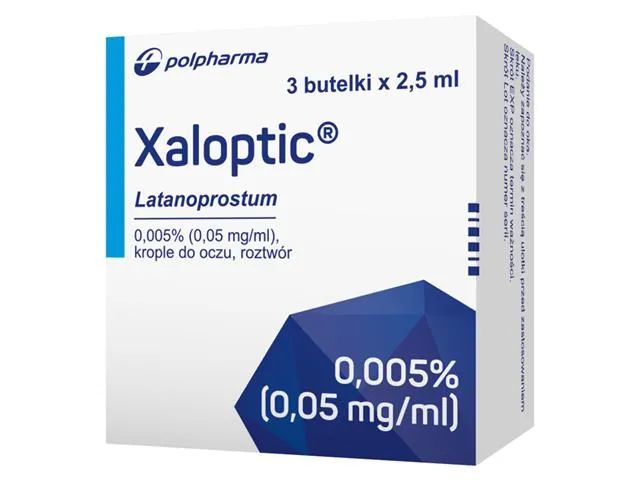
Table of Contents
Patient Information Leaflet
Xaloptic, 0,005% (0,05 mg/ml), eye drops, solution
Latanoprost
Please read carefully the entire leaflet before using the medicine, as it contains
important information for the patient.
- Keep this leaflet, as you may need to read it again.
- If you have any questions, please consult your doctor or pharmacist.
- This medicine has been prescribed for a specific individual. Do not pass it on to others. This medicine may harm other people, even if their symptoms are the same.
- If you experience any adverse reactions, including any not listed in this leaflet, inform your doctor or pharmacist. See section 4.
Table of contents:
- What Xaloptic is and what it is used for
- Important information before using Xaloptic
- How to use Xaloptic
- Possible side effects
- How to store Xaloptic
- Contents of the pack and other information
1. What Xaloptic is and what it is used for
The active substance in Xaloptic belongs to a group of medicines called prostaglandin analogues. These medicines lower intraocular pressure by increasing the natural outflow of fluid from inside the eye into the bloodstream.
Xaloptic is indicated in adults for the treatment of a type of glaucoma called open-angle glaucoma and for the treatment of elevated intraocular pressure. These conditions are associated with increased intraocular pressure and may consequently affect vision.
Xaloptic may also be used in children of any age for the treatment of elevated intraocular pressure and glaucoma.
2. Important information before using Xaloptic
Xaloptic can be used in adults (including elderly patients) and in children from birth up to 18 years of age. Xaloptic has not been studied in preterm newborns (born before completion of week 36 of pregnancy).
When not to use Xaloptic
- if the patient is allergic to latanoprost or any of the other ingredients of this medicine (listed in section 6)
- if the patient is pregnant, suspects she may be pregnant, or is planning a pregnancy
- if the patient is breastfeeding.
Warnings and precautions
Before starting treatment with Xaloptic, discuss this with the physician managing the adult or child patient, or with a pharmacist:
- if the adult or child has severe or uncontrolled asthma
- if the adult or child has undergone eye surgery (including cataract surgery), or if such surgery is planned
- if the adult or child has an eye disease (such as eye pain, ocular surface irritation or inflammation, blurred vision)
- if the adult or child has dry eye
- if the adult or child wears contact lenses. To continue using Xaloptic, follow the instructions for contact lens use (see section 3)
- if the patient has had or currently has a viral eye infection caused by herpes simplex virus (HSV).
Xaloptic and other medicines
Xaloptic may interact with other medicines. Inform the physician or pharmacist about all medicines the patient is currently taking or has recently taken, as well as any medicines the patient plans to use.
Pregnancy and breastfeeding
If the patient is pregnant or breastfeeding, suspects she may be pregnant, or is planning to become pregnant, she should consult her physician before using this medicine.
Xaloptic must not be used in pregnant women or in women who are breastfeeding.
Driving and operating machinery
Using eye drops may cause transient blurred vision. If this adverse effect occurs, the patient should not drive or operate machinery. Exercise caution when driving or operating machinery until the patient knows how they react to the medicine.
Xaloptic contains benzalkonium chloride (as a preservative) and phosphates
The medicine contains 0.2 mg of benzalkonium chloride per millilitre.
Benzalkonium chloride may be absorbed by soft contact lenses and may cause discoloration. Contact lenses must be removed before instillation and at least 15 minutes should be waited before reinserting them. See section 3, "Use of contact lenses".
Benzalkonium chloride may also cause eye irritation, especially in patients with dry eye syndrome or corneal disorders (the transparent layer at the front of the eye). If abnormal sensations in the eye, stinging or eye pain occur after using the medicine, contact a physician.
The medicine contains 6.3 mg of phosphates per millilitre, equivalent to 0.2 mg per drop.
In patients with severe damage to the transparent, front part of the eye (cornea), phosphates may very rarely cause corneal clouding due to calcium deposition during treatment.
3. How to use Xaloptic
This medicine should always be used exactly as prescribed by the doctor treating the adult or child. If in doubt, consult the doctor treating the adult or child, or a pharmacist.
Recommended dosage for adults (including elderly patients) and children:
The recommended dose is 1 drop in the affected eye or both affected eyes once daily, preferably in the evening. It is not recommended to use Xaloptic more than once daily, as this may reduce the effectiveness of treatment.
Xaloptic should always be used for as long as prescribed by the doctor treating the adult or child.
Use of contact lenses:
- Avoid contact with soft contact lenses.
- Remove contact lenses before administering Xaloptic to the eye of an adult or child. Contact lenses may be reinserted 15 minutes after using Xaloptic.
Instructions for using the eye drops
Follow the instructions below to ensure correct use of Xaloptic:
- Wash your hands, then sit or stand comfortably.
- Unscrew the protective cap.
- Gently pull down the lower eyelid of the affected eye using a finger.
- Bring the tip of the dropper as close to the eye as possible without touching it.
- Gently squeeze the bottle so that only one drop enters the eye, then release the lower eyelid.
- Close the eye and press gently with a finger on the corner of the eye closest to the nose. Maintain this pressure for one minute, keeping the eye closed.
- If necessary, apply a drop to the other eye in the same way.
- Screw the cap back on the bottle.
Using Xaloptic with other eye drops
If other eye drops must be used, especially those containing thiomersal, wait at least 5 minutes after using Xaloptic eye drops.
Accidental overdose of Xaloptic
Be careful when squeezing the bottle to ensure only one drop enters the affected eye.
If more drops are administered, moderate eye irritation with redness and tearing may occur. If in doubt, consult the doctor treating the adult or child.
If Xaloptic is accidentally ingested by an adult or child, contact a doctor as soon as possible.
Missed dose of Xaloptic
If a dose is missed at the usual time, wait until the next scheduled dose. Do not use a double dose to make up for a missed dose.
Stopping Xaloptic treatment
If considering stopping Xaloptic, consult the doctor treating the adult or child, or a pharmacist.
If you have any further questions about the use of this medicine, consult the doctor treating the adult or child, or a pharmacist.
4. Possible adverse effects
Like all medicines, this medicine can cause adverse effects, although not everyone will experience them.
The following adverse effects are known:
Very common (occur in more than 1 out of 10 patients):
-
Gradual change in eye colour due to increased amount of brown pigment in the coloured part of the eye called the iris. If the patient has mixed-colour eyes (i.e. blue-brown, grey-brown, yellow-brown or green-brown), such changes are more likely to occur than in patients with eyes of a single colour (blue, grey, green or brown). Changes in eye colour may occur after several years of treatment, but most commonly occur within the first 8 months of treatment. The colour change may be long-lasting and more noticeable when Xaloptic is used in only one eye. Changes in eye colour are not associated with any other pathological changes. Changes in eye colour do not progress after discontinuation of the medicine.
-
Eye redness.
-
Eye irritation (including burning sensation, feeling of sand in the eyes, itching, stinging or sensation of a foreign body in the eye). If eye irritation occurs that is severe enough to cause excessive tearing or desire to discontinue the medicine, medical advice should be sought promptly (within one week) from a doctor, pharmacist or nurse. Re-evaluation of treatment may be necessary to ensure appropriate management for the patient.
-
Gradual change in the appearance of eyelashes of the treated eye and mild eyelid hair growth, most commonly observed in individuals of Japanese origin. These changes include darkening, lengthening, thickening and increased number of eyelashes.
Common (occur in less than 1 out of 10 patients):
- Eye surface irritation or defects, eyelid inflammation, eye pain, light sensitivity (photophobia), conjunctivitis.
Uncommon (occur in less than 1 out of 100 patients):
- Eyelid swelling, dry eyes, inflammation or irritation of the eye surface (keratitis), blurred vision, inflammation of the coloured part of the eye (uveitis), retinal swelling (macular edema).
- Skin rash.
- Chest pain (angina), sensation of heart pounding (palpitations).
- Asthma, shortness of breath (dyspnea).
- Chest pain.
- Headache, dizziness.
- Muscle pain, joint pain.
- Nausea, vomiting.
Rare (occur in less than 1 out of 1,000 patients):
- Iritis, symptoms of swelling or outlining/damage to the eye surface, swelling around the eye (periorbital edema); change in the direction of eyelash growth or development of a double row of eyelashes, scarring on the eye surface, formation of fluid-filled areas in the coloured part of the eye (iris cysts).
- Local skin reactions on the eyelids, darkening of eyelid skin.
- Worsening of asthma.
- Acute skin itching.
- Viral eye infections caused by herpes simplex virus (HSV).
Very rare (occur in less than 1 out of 10,000 patients):
- Worsening of angina symptoms in patients with heart disease, sunken appearance of the eyes (deepening of the eyelid groove).
Adverse effects occurring more frequently in children and adolescents than in adult populations include runny nose and fever.
In very rare cases, in some patients with severe damage to the outer transparent layer of the eyeball (cornea), cloudy spots caused by calcium deposits have appeared on the cornea during treatment.
Reporting of adverse effects
If any adverse effects occur, including any not listed in this leaflet, inform your doctor or pharmacist. Adverse effects can be reported directly to the Department of Monitoring Adverse Drug Reactions of the Office for Registration of Medicinal Products, Medical Devices and Biocidal Products
Al. Jerozolimskie 181C
02-222 Warsaw
Tel.: + 48 22 49 21 301
Fax: + 48 22 49 21 309
Website: https://smz.ezdrowie.gov.pl
Adverse effects can also be reported to the responsible entity.
Reporting adverse effects helps to provide more information on the safety of the medicine.
5. How to store Xaloptic
Keep this medicine out of sight and reach of children.
Do not use this medicine after the expiry date stated on the carton and label.
The expiry date refers to the last day of the stated month.
The marking on the packaging following "EXP" indicates the expiry date, and following "Lot" indicates the batch number.
Before first opening, Xaloptic must be stored and transported under refrigerated conditions (2°C to 8°C) and protected from light. Do not freeze.
After first opening the bottle: Store below 25°C and use within 4 weeks.
Medicines must not be disposed of via wastewater or household waste. Ask your pharmacist how to dispose of medicines no longer in use. This will help protect the environment.
6. Contents of the pack and other information
What Xaloptic contains
- The active substance is latanoprost. Each ml of eye drop solution contains 0.05 mg (50 micrograms) of latanoprost.
- The other ingredients are sodium chloride, benzalkonium chloride, monosodium dihydrogen phosphate monohydrate, disodium phosphate anhydrous, water for injections.
What Xaloptic looks like and contents of the pack
Xaloptic is a colourless, clear solution. 2.5 ml of eye drop solution (the contents of the bottle) contains 125 micrograms of latanoprost.
Pack sizes:
1 bottle x 2.5 ml
3 bottles x 2.5 ml
One bottle contains approximately 82 drops.
Not all pack sizes may be marketed.
Marketing Authorisation Holder and Manufacturer
Marketing Authorisation Holder
POLPHARMA Pharmaceutical Works S.A.
Pelplińska Street 19, 83-200 Starogard Gdański, Poland
tel. +48 22 364 61 01
Manufacturer
POLPHARMA Pharmaceutical Works S.A.
Pelplińska Street 19, 83-200 Starogard Gdański, Poland
FAMAR S.A.
63, Ag. Dimitrou Avenue
174 56 Alimos, Athens, Greece
FARMIGEA S.p.A
VIA G.B. OLIVA, 8 – 56121 PISA (PI)
Italy