Volulyte 6%
Poland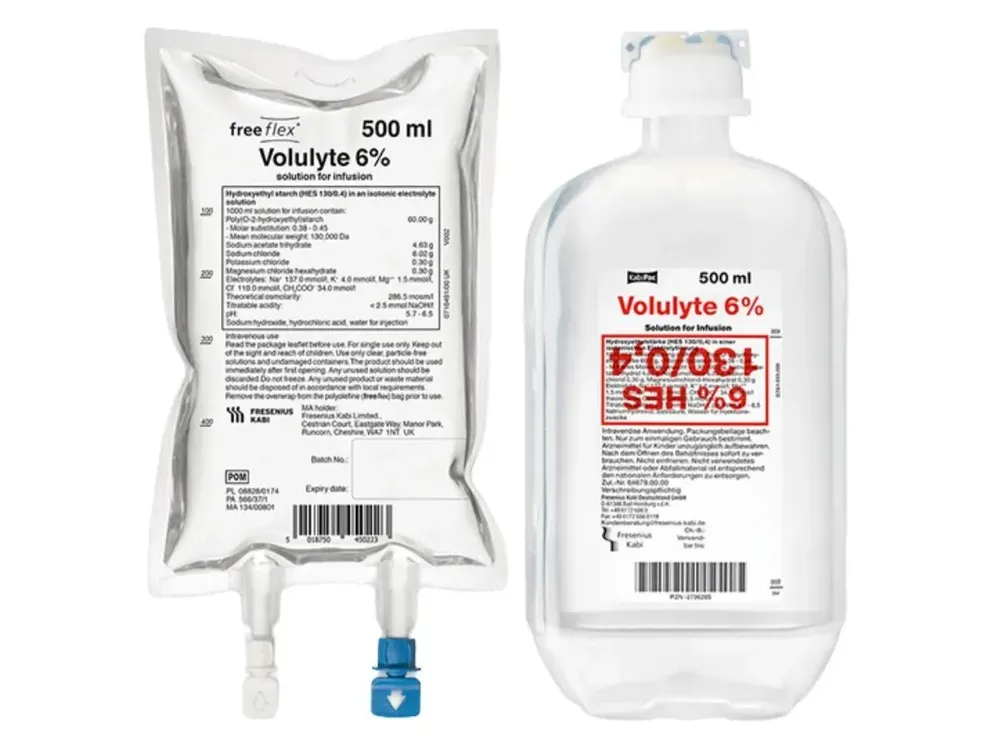
Table of Contents
- Patient Information Leaflet
- 1. What Volulyte 6% is and what it is used for
- 2. Important information before using Volulyte 6%
- 3. How to use Volulyte 6%
- 4. Possible adverse reactions
- 5. How to store Volulyte 6%
- 6. Contents of the pack and other information
- Information intended exclusively for medical professionals:
Patient Information Leaflet
Volulyte 6%, infusion solution
Hydroxyethyl starch (HES 130/0.4) in isotonic electrolyte solution
Warning
Do not use in cases of sepsis (severe systemic infection),
renal dysfunction, or in critically ill patients.
Situations in which this product must never be used are described in section 2.
Please read all of this leaflet carefully before the medicine is administered, as it contains
important information for the patient.
- Keep this leaflet, as you may need to read it again.
- If you have any questions, please consult your doctor, pharmacist, or nurse.
- This medicine has been prescribed for a specific individual. Do not pass it on to others. It may harm someone else, even if their symptoms are the same.
- If you experience any adverse reactions, including any not listed in this leaflet, inform your doctor, pharmacist, or nurse. See section 4.
Table of contents
- What Volulyte 6% is and what it is used for
- Important information before using Volulyte 6%
- How to use Volulyte 6%
- Possible side effects
- How to store Volulyte 6%
- Contents of the pack and other information
1. What Volulyte 6% is and what it is used for
Volulyte 6% is a plasma volume expander used to restore blood volume after blood loss when the use of other products, so-called crystalloids, is considered insufficient.
2. Important information before using Volulyte 6%
When not to use Volulyte 6%:
- if the patient is allergic to any of the active substances or any of the other ingredients of this medicine (listed in section 6);
- in patients with severe systemic infection (sepsis);
- in patients with burns;
- in patients with kidney failure or undergoing dialysis;
- in patients with bleeding in the brain (intracranial or cerebral haemorrhage);
- in critically ill patients (e.g. those admitted to Intensive Care Units);
- in patients who have excess fluid in the body and have been diagnosed with fluid overload;
- in patients with fluid accumulation in the lungs (pulmonary oedema);
- in dehydrated patients;
- in patients with significantly elevated levels of potassium or sodium chloride in the blood;
- in patients with severe liver dysfunction;
- in patients with severe heart failure;
- in patients with severe blood coagulation disorders;
- in patients following organ transplantation.
Warnings and precautions
Before starting treatment with Volulyte 6%, inform the doctor if the patient has:
- liver dysfunction;
- heart or circulatory disorders;
- blood coagulation disorders;
- kidney dysfunction;
- elevated blood levels of potassium, sodium, magnesium, chloride or alkalinity (hyperkalaemia, hypernatraemia, hypermagnesaemia, hyperchloraemia).
Due to the risk of allergic reactions (anaphylactic/anaphylactoid), the doctor will closely monitor the patient for early signs of an allergic reaction after administration of this medicine.
Surgery and trauma:
The doctor will consider whether this medicine is appropriate for the patient.
The doctor will carefully determine the dose of Volulyte 6% to avoid fluid overload, particularly in patients with lung, heart or circulatory diseases.
Nursing staff will also take measures to monitor the patient's fluid balance, blood electrolyte levels and kidney function. Additional medicines may be administered if necessary.
Furthermore, the patient will be ensured adequate fluid supply.
Volulyte 6% is contraindicated in patients with kidney dysfunction or kidney injury requiring dialysis.
If kidney dysfunction occurs during treatment:
If the doctor observes early signs of kidney dysfunction, administration of this medicine will be discontinued. Additionally, monitoring of kidney function may be required for up to 90 days.
If Volulyte 6% is administered repeatedly, the doctor will monitor blood coagulation, bleeding time and other functions. If coagulation disorders occur, the doctor will discontinue administration of this medicine.
The use of this medicine is not recommended in patients undergoing open-heart surgery connected to a cardiopulmonary bypass machine that supports blood circulation during the procedure.
Children
Clinical data on the use of Volulyte 6% in children are limited. The use of hydroxyethyl starch (HES)-containing medicines is not recommended in this age group.
Volulyte 6% and other medicines
Inform the doctor or pharmacist about all medicines the patient is currently taking or has recently taken, as well as any medicines the patient plans to use.
No interactions between Volulyte 6% and other medicines are currently known.
Volulyte 6% with food and drink
There is no available data on negative effects of Volulyte 6% when used with food or drink.
Pregnancy and breastfeeding
There are no clinical data on the safety of Volulyte 6% in pregnant or breastfeeding women.
Volulyte 6% may be administered to pregnant or breastfeeding women only after the doctor has evaluated the potential benefits against the potential risks to the child.
Driving and operating machinery
Volulyte 6% has no influence on the ability to drive or operate machinery.
3. How to use Volulyte 6%
Volulyte 6% is administered by a doctor or under direct medical supervision, who carefully
controls the amount of the medicinal product administered.
Method of administration
The medicinal product is given by intravenous infusion (drip) at a rate and dose determined according to
the specific requirements, the condition being treated, and taking into account the maximum daily
dose.
Dosing
The doctor will decide the appropriate dose to be administered to the patient.
The doctor will use the smallest effective dose and will not administer the Volulyte 6% infusion for
longer than 24 hours.
The maximum daily dose of Volulyte 6% is 30 ml/kg body weight.
Use in children
There is limited experience with the use of this medicinal product in children. Its use is not recommended in children.
Administration of a higher than recommended dose of Volulyte 6%
The doctor will ensure that the patient receives the correct dose of Volulyte 6%. However, different patients may require different doses. In the event of an overdose, the doctor may immediately stop administration of the medicinal product and, if necessary, administer a medicine to remove excess fluid from the body (a diuretic).
If you have any further questions regarding the use of this medicinal product, consult your doctor or pharmacist.
4. Possible adverse reactions
Like all medicines, this medicine can cause adverse reactions, although not everyone will experience them.
Common (may occur in up to 1 in 10 patients):
- itching, which is a known adverse effect of hydroxyethyl starch when administered in higher doses and for prolonged periods;
- other adverse effects related to blood dilution, such as prolonged blood coagulation time, resulting from the use of high doses;
- during administration of hydroxyethyl starch, serum amylase activity may increase, which may interfere with the diagnosis of pancreatitis. However, this should not be misinterpreted as indicating the presence of pancreatitis.
Rare (may occur in up to 1 in 1,000 patients):
- medicinal products containing hydroxyethyl starch may lead to severe allergic reactions (skin redness, swelling of the throat and breathing difficulties, mild flu-like symptoms, low or high heart rate, non-cardiogenic pulmonary edema);
- administration of hydroxyethyl starch may result in dose-dependent coagulation disorders.
Frequency not known (cannot be estimated from available data):
- renal function impairment;
- hepatic function impairment.
Reporting of adverse reactions
If any adverse reactions occur, including any adverse reactions not listed
in this leaflet, inform your doctor, pharmacist or nurse. Adverse reactions
can be reported directly to the Department of Monitoring Adverse Drug Reactions of the Office for Registration of Medicinal Products, Medical Devices and Biocidal Products
Al. Jerozolimskie 181C
02-222 Warsaw
Tel.: +48 22 49 21 301
Fax: +48 22 49 21 309
Website: https://smz.ezdrowie.gov.pl
Adverse reactions can also be reported to the marketing authorization holder.
Reporting adverse reactions allows the collection of further information on the safety of the medicine.
5. How to store Volulyte 6%
- Keep the medicine out of the sight and reach of children.
- No special storage instructions apply.
- Do not freeze.
Do not use Volulyte 6% after the expiry date stated on the label. The expiry date refers to the last day of the stated month.
The doctor or nurse will check that the solution is clear, free from particles, that the packaging is undamaged, and that the outer bag has been removed from the polyolefin bag (free flex) before administration.
The solution should be used immediately after opening and any unused portion of the solution must be discarded. For single use only.
Medicines must not be disposed of via wastewater or household waste. Ask your pharmacist how to dispose of medicines no longer required. Such practices help protect the environment.
6. Contents of the pack and other information
What Volulyte 6% contains
1000 ml of infusion solution contains:
Active substances:
poly(O-2-hydroxyethyl)starch (Ph.Eur.) 60.00 g
- degree of substitution: 0.38 - 0.45
- average molecular weight: 130,000 Da (produced from corn starch)
sodium acetate trihydrate 4.63 g
sodium chloride 6.02 g
potassium chloride 0.30 g
magnesium chloride hexahydrate 0.30 g
Electrolytes:
Na 137.0 mmol/l
K 4.0 mmol/l
Mg 1.5 mmol/l
Cl 110.0 mmol/l
CH~3~COO 34.0 mmol/l
Theoretical osmolarity: 286.5 mOsm/l
Titratable acidity: <2.5 mmol NaOH/l
pH: 5.7 – 6.5
Other ingredients are: sodium hydroxide, hydrochloric acid, water for injections.
What Volulyte 6% looks like and contents of the pack
The medicine is a sterile, clear to slightly opalescent, colourless to slightly yellow solution.
It is available in:
- polyolefin flexible bags of the free*flex* type,
- polyethylene containers (KabiPac).
Each type of packaging is available in 250 ml and 500 ml volumes.
Not all pack sizes may be marketed.
Marketing Authorisation Holder
Fresenius Kabi Deutschland GmbH
D-61346 Bad Homburg v.d.H., Germany
Manufacturer
Fresenius Kabi Deutschland GmbH
61169 Friedberg, Germany
Fresenius Kabi France
6, rue du Rempart
BP 611, 27400 Louviers Cedex, France
Fresenius Kabi Polska Sp. z o.o.
Infusion Solutions Manufacturing Plant
ul. Sienkiewicza 25
99-300 Kutno, Poland
For further information, contact the local representative of the Marketing Authorisation Holder:
Fresenius Kabi Polska Sp. z o.o.
Al. Jerozolimskie 134
02-305 Warsaw, Poland
tel.: +48 22 345 67 89
This medicinal product is authorised in the European Economic Area member states under the following names:
Germany Volulyte 6% Infusionslösung
Poland Volulyte 6%
Romania Volulyte 6%, solutie perfuzabila
Information intended exclusively for medical professionals:
Use of drugs containing hydroxyethyl starch (HES) should be restricted to
the initial phase of intravascular volume resuscitation, with a maximum duration of
administration of up to 24 hours.
The maximum daily dose of Volulyte 6% is 30 ml/kg body weight.
The lowest effective dose should be used. Treatment should be accompanied by continuous
hemodynamic monitoring, so that infusion can be stopped as soon as appropriate hemodynamic
parameters are achieved. The maximum recommended daily dose must not be exceeded.
The initial 10–20 ml should be administered slowly, with close observation of the patient to detect
any anaphylactic or anaphylactoid reaction as early as possible.
The duration of treatment depends on:
- the volume of blood lost by the patient;
- arterial blood pressure;
- hemodilution and blood components (platelets, red blood cells, etc.).
Children and adolescents
There is limited data on the use of HES in children; HES-containing products are not recommended
in this age group.
Due to lack of compatibility studies, this medicinal product must not be mixed with other medicines.
For single use only.
Use immediately after opening the bottle or bag.
Any unused portions or waste material must be disposed of in accordance with local regulations.
Only use a clear solution, free from particulate matter, and with intact packaging.
Before use, remove the outer protective polyolefin bag (free*flex).