Vitreolent
Poland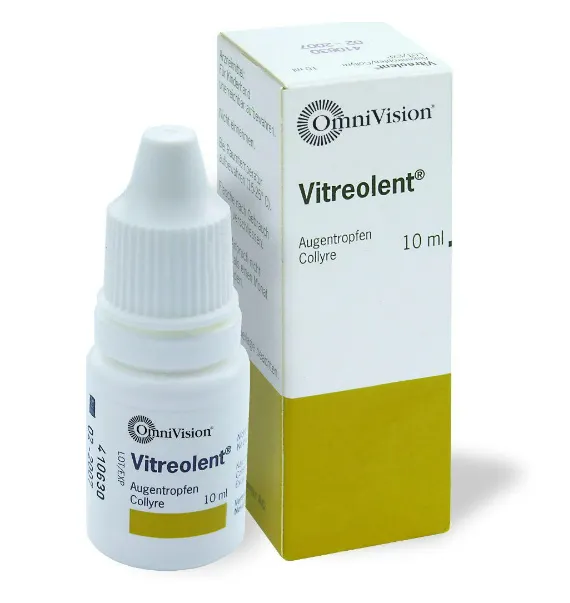
Table of Contents
Package leaflet: Information for the user
VITREOLENT, (3 mg + 3 mg)/ml, eye drops, solution
Potassium iodide + Sodium iodide
Please read this leaflet carefully before using the medicine, as it contains important information for the patient.
- Keep this leaflet so that you can read it again if necessary.
- If you have any questions, please consult your doctor or pharmacist.
- This medicine has been prescribed for a specific individual. Do not pass it on to others. The medicine may harm someone else, even if their symptoms are the same.
- If you experience any adverse reactions, including any not listed in this leaflet, tell your doctor or pharmacist. See section 4.
Leaflet contents:
- What Vitreolent eye drops are and what they are used for
- Important information before using Vitreolent
- How to use Vitreolent
- Possible side effects
- How to store Vitreolent
- Contents of the pack and other information
1. What Vitreolent eye drops are and what they are used for
Vitreolent eye drops are a medicine used in cases of vitreous body opacities and changes following haemorrhages into the vitreous body, which may be caused by: age, hypertension, diabetes, myopia, perivascular changes. It is also used in lens opacities representing the first signs of cataract.
2. Important information before using Vitreolent
When not to use Vitreolent
- If the patient has been diagnosed with thyroid dysfunction
- If the patient is allergic to the active substances (sodium iodide, potassium iodide) or to any of the other ingredients of this medicine (listed in section 6)
If the patient wears contact lenses, they may be reinserted 15 minutes after instilling the medicine. Do not instill the medicine into the eye while wearing a contact lens.
Warnings and precautions
Before starting treatment with Vitreolent, discuss it with your doctor or pharmacist.
Vitreolent and other medicines
Tell your doctor about all medicines you are currently taking or have recently taken, as well as any medicines you plan to use.
Do not use Vitreolent simultaneously with other eye medicines. If other eye medicines need to be used, Vitreolent should be administered at least 5 minutes apart from the other medicine.
Pregnancy and breastfeeding
If the patient is pregnant or breastfeeding, suspects she may be pregnant, or is planning to have a baby, she should consult her doctor or pharmacist before using this medicine.
Driving and operating machinery
Administration of Vitreolent may cause transient visual disturbances such as blurred vision. During this time, do not drive or operate machinery.
3. How to use Vitreolent
This medicine should always be used according to the doctor's or pharmacist's instructions. If in doubt, consult your doctor or pharmacist.
Vitreolent is intended for ocular use only.
The usual dose is 1 drop into the affected eye, administered 1 to 3 times daily.
Use in children
The use of Vitreolent is not recommended in children under 12 years of age.
Instructions for use
Wash your hands before instilling the drops. Then unscrew the cap and hold the bottle between the thumb and index finger. With the index finger of the other hand, gently pull down the lower eyelid. Instill one drop into the conjunctival sac by gently squeezing the bottle. Do not touch the eye with the dropper tip. After instillation, close the eye and gently press with a finger on the inner corner of the eye (near the nose) for 1 to 2 minutes to minimize systemic absorption of the medicine. Close the bottle tightly after use.
4. Possible side effects
Like all medicines, this medicine can cause side effects, although not everybody gets them.
Common side effects (occurring in more than 1 in 100 but less than 1 in 10 patients):
- Transient burning sensation and feeling of "sand" under the eyelids shortly after instillation, thyroid enlargement or acne-like skin changes.
Rare side effects (occurring in more than 1 in 10,000 but less than 1 in 1,000 patients):
- Increased lacrimation (tearing)
Reporting of side effects
If any adverse reactions occur, including any not listed in this leaflet, inform your doctor or pharmacist.
Side effects can be reported directly to the Department of Monitoring of Adverse Drug Reactions, Office for Registration of Medicinal Products, Medical Devices and Biocidal Products
Al. Jerozolimskie 181C
PL-02 222 Warsaw
Tel.: +48 22 49 21 301
Fax: +48 22 49 21 309
e-mail: [email protected]
Reporting side effects helps provide more information on the safety of the medicine.
Side effects can also be reported to the marketing authorization holder.
5. How to store Vitreolent
Keep this medicine out of the sight and reach of children.
Do not use this medicine after the expiry date stated on the cardboard box and label. The expiry date refers to the last day of the specified month.
Store the medicine at a temperature below 25°C.
Shelf life after first opening the bottle: 1 month.
Medicines must not be disposed of via wastewater or household waste. Ask your pharmacist how to dispose of medicines no longer required. These measures help protect the environment.
6. Contents of the packaging and other information
What Vitreolent contains
- The active substances in Vitreolent are sodium iodide and potassium iodide. 1 ml of the medicinal product contains 3 mg of sodium iodide and 3 mg of potassium iodide.
- The other ingredients (excipients) are: chlorhexidine diacetate, sorbitol, α-tocopherol, hypromellose, hydrochloric acid 1M, water for injections.
What Vitreolent looks like and contents of the pack
Vitreolent is a solution for ocular administration (eye drops) in an LDPE dropper bottle with a HDPE cap and a tamper-evident ring, packed in a cardboard box.
The bottle contains 10 ml of the medicinal product.
Marketing Authorisation Holder and Manufacturer
Marketing Authorisation Holder
Pharm Supply Sp. z o.o., ul. Marconich 2/9, 02-954 Warsaw, Poland
Manufacturer
Excelvision, rue de la Lombardiére 27, 07100 Annonay, Cedex, France