Vitaminum b6 teva
Poland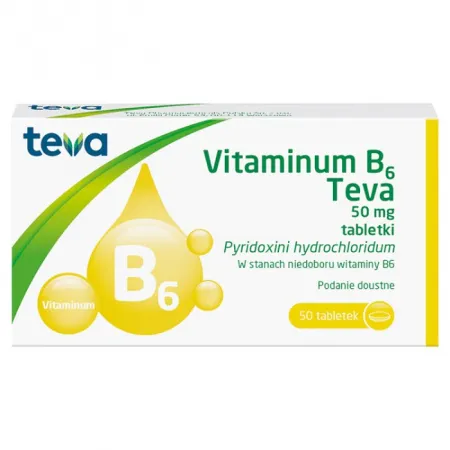
Table of Contents
Patient Information Leaflet
Vitaminum B6 Teva, 50 mg, tablets
Pyridoxini hydrochloridum
Please read all of this leaflet carefully before taking this medicine, because it contains
important information for you.
This medicine should always be taken exactly as described in this patient leaflet or as directed by your
doctor, pharmacist, or nurse.
- Keep this leaflet, as you may need to read it again.
- If you need advice or further information, please consult your pharmacist.
- If you experience any side effects, including any not listed in this leaflet, tell your doctor, pharmacist, or nurse. See section 4.
Table of Contents
- What Vitaminum B6 Teva is and what it is used for
- Important information before taking Vitaminum B6 Teva
- How to take Vitaminum B6 Teva
- Possible side effects
- How to store Vitaminum B6 Teva
- Contents of the pack and other information
1. What Vitaminum B6 Teva is and what it is used for
Vitaminum B6 Teva contains vitamin B6 (pyridoxine), which, after conversion into its active form—pyridoxal phosphate—participates in numerous metabolic processes involving carbohydrates, proteins, and fats. It influences the functions of the nervous system, hematopoietic system, immune system, and supports proper skin function. It alleviates neuromuscular disorders associated with deficiency. In higher doses (up to 300 mg per day), it exhibits central effects (sedative and even sleep-inducing). It relieves nausea and vomiting. It facilitates the absorption of vitamin B1, iron, and magnesium.
Like other B-complex vitamins, the body's stores of pyridoxine are limited, so it must be regularly supplied through diet or dietary supplements. The daily requirement of vitamin B6 in adults is approximately 2 mg/day. The requirement increases during pregnancy and breastfeeding (about 3 mg/day) and in individuals who abuse alcohol.
Vitamin B6 deficiency often occurs alongside deficiencies of other B-complex vitamins. Deficiency states are most commonly caused by inadequate diet. Deficiencies have also been observed in pregnant women, infants, and during treatment with certain medications.
Impaired utilization of vitamin B6 in the body may also result from inherited metabolic disorders.
Pyridoxine is primarily absorbed in the small intestine. It is metabolized in the liver and excreted mainly in urine as metabolites.
Supplementation with vitamin B6 is required in individuals with insufficient dietary intake or increased requirements.
Indications:
- Vitamin B6 deficiency states;
- Diseases and conditions requiring pyridoxine administration:
- Peripheral polyneuropathies (a syndrome characterized by impaired sensation and muscle strength affecting several nerves);
- Prevention of peripheral neuropathy during isoniazid therapy;
- Use of oral contraceptives;
- Malabsorption syndromes, e.g., liver diseases caused by alcoholism;
- Prevention of sunburn and post-burn pigmentation changes (prophylactic use);
- Inflammation of the skin and mucous membranes of the oral cavity (including oral ulcers—acrodynia) and glossitis;
- Exfoliative erythrodermas (erythematous and desquamative skin changes), seborrhea;
- Periodontopathies (periodontal diseases);
- Inherited metabolic disorders (cystathioninuria, homocystinuria—excretion of sulfur-containing amino acids, cystathionine and homocysteine, in urine; hyperoxaluria—excessive excretion of oxalic acid in urine; xanthurenic aciduria—excretion of xanthurenic acid in urine with increased urine pH);
- Isoniazid poisoning;
- Cycloserine poisoning;
As an adjunctive treatment:
- Sideroblastic anemia (caused by impaired intracellular iron utilization for hemoglobin production), leukopenia (decreased number of white blood cells in blood), and agranulocytosis (absence of granulocytes in blood);
- Nausea and vomiting in pregnancy;
- Depressive states;
- Sleep disorders (insomnia);
- Vegetative neurosis (as a mild symptomatic, calming agent);
- Radiation sickness.
2. Information before using Vitaminum B6 Teva
When not to use Vitaminum B6 Teva
- if the patient is allergic to vitamin B6 or any of the other ingredients of this medicine (listed in section 6);
- Parkinson's disease treated with levodopa without a dopa-decarboxylase inhibitor.
Warnings and precautions
There are no special warnings and precautions other than those mentioned in the sections “Contraindications” and “Pregnancy, breastfeeding and fertility”.
The medicine contains lactose. If the patient has previously been diagnosed with an intolerance to certain sugars, the patient should consult a doctor before taking this medicine.
The medicine contains sucrose. If the patient has previously been diagnosed with an intolerance to certain sugars, the patient should consult a doctor before taking this medicine.
Vitaminum B6 Teva and other medicines
Medicines: cycloserine, hydralazine, penicillamine, immunosuppressive drugs, oral contraceptives containing estrogen, and isoniazid increase the requirement for vitamin B6.
Vitamin B6 reduces the effectiveness of levodopa when used without a decarboxylase inhibitor in the treatment of Parkinson's disease.
The medicine may reduce blood levels of phenytoin.
Vitamin B6 facilitates iron absorption as well as the uptake of magnesium and vitamin B12.
When administered concomitantly with amiodarone, it may cause photosensitivity.
Tell your doctor or pharmacist about any other medicines the patient is currently taking, has recently taken, or might take in the future.
Vitaminum B6 Teva with food and drink
The presence of food does not affect the absorption of pyridoxine from the gastrointestinal tract.
Pregnancy, breastfeeding and fertility
If the patient is pregnant or breastfeeding, suspects she may be pregnant, or is planning to become pregnant, she should consult a doctor or pharmacist before using this medicine.
The doctor may recommend vitamin B6 during pregnancy in doses not exceeding 50 mg per day.
Vitamin B6 may be used during pregnancy at recommended doses.
Vitamin B6 passes into breast milk. The doctor may recommend using vitamin B6 during breastfeeding with special caution.
Vitamin B6 may be used during breastfeeding at recommended doses.
Driving and using machines
In high doses (above 300 mg/day), pyridoxine may affect psycho-physical performance due to the possibility of causing sedation and drowsiness.
3. How to use Vitaminum B6 Teva
This medicine should always be taken exactly as described in this patient leaflet or as directed by a doctor, pharmacist, or nurse. If in doubt, consult a doctor, pharmacist, or nurse.
Recommended dosage:
Adults
- Therapeutic use: usually 50 to 100 mg (1 to 2 tablets) three times daily;
- Prevention of peripheral neuropathy during isoniazid treatment: 1 tablet daily;
- Prevention of sunburn and post-inflammatory skin pigmentation changes: 150 to 200 mg as a single dose or in divided doses;
- Metabolic disorders: up to 450 mg daily in 3 divided doses;
- Radiation sickness: 50 to 100 mg daily;
- Adjunctive treatment of insomnia and vegetative neurosis: 50 mg to 300 mg daily, in divided doses.
Children
- Therapeutic use: 25 to 150 mg daily (1/2 to 3 tablets), in 2–3 divided doses.
If you feel the effect of the medicine is too strong or too weak, consult your doctor.
Do not exceed the maximum daily dose.
Use of a higher than recommended dose of Vitaminum B6 Teva
When high doses of vitamin B6 (from 300 mg to several grams) are used for prolonged periods (2 to 4 months), symptoms of severe peripheral neuropathy have been observed, manifesting as numbness and tingling in the limbs, impaired vibration and position sense—especially in the lower limbs—and sleep disturbances. Small children are more sensitive to vitamin B6 overdose.
Although peripheral neuropathy resolves after discontinuation of pyridoxine, a feeling of weakness may persist.
In case of overdose, the doctor will administer symptomatic treatment.
If you have taken more than the recommended dose of the medicine, seek medical advice immediately from a doctor or pharmacist.
Missed dose of Vitaminum B6 Teva
Take the missed dose as soon as possible.
Do not take a double dose to make up for a forgotten dose.
4. Possible adverse reactions
Like all medicines, this medicine can cause adverse reactions, although not everyone will experience them.
High doses of vitamin B used for prolonged periods may cause sleep disturbances. With long-term use of doses significantly exceeding recommended therapeutic doses, there is a possibility of developing sensory peripheral neuropathy.
Rare cases of allergic and photo-sensitivity reactions (hypersensitivity reactions) have been reported, occurring with unknown frequency.
Administration of pyridoxine at a dose of 200 mg for over one month may lead to the development of dependency syndrome.
In some individuals during treatment with Vitaminum B6 Teva, other adverse reactions may occur.
If any adverse effects not listed in this leaflet occur, inform your doctor.
Reporting of adverse reactions
If any adverse reactions occur, including any adverse reactions not listed in this leaflet, inform your doctor, pharmacist, or nurse.
Adverse reactions can be reported directly to the Department of Monitoring Adverse Drug Reactions of the Office for Registration of Medicinal Products, Medical Devices and Biocidal Products
Al. Jerozolimskie 181C
02-222 Warszawa
Tel.: + 48 22 49 21 301
Fax: + 48 22 49 21 309
Website: https://smz.ezdrowie.gov.pl
Adverse reactions can also be reported to the marketing authorization holder.
Reporting adverse reactions enables further information on the safety of the medicine to be collected.
5. How to store Vitaminum B6 Teva
Keep the medicine out of the sight and reach of children.
Store below 25°C. Keep in a dry place and protect from light.
Store in the original packaging.
Do not use Vitaminum B6 Teva after the expiry date stated on the packaging.
The expiry date refers to the last day of the stated month.
Medicines should not be disposed of via wastewater or household waste. Ask your pharmacist how to dispose of medicines no longer required. Such measures help protect the environment.
6. Contents of the pack and other information
What Vitaminum B6 Teva contains
The active substance is 50 mg of pyridoxine hydrochloride.
Other ingredients are: sucrose, monohydrate lactose, potato starch, magnesium stearate,
talc, gelatin.
What the pack contains
The pack contains 50 tablets.
Marketing Authorisation Holder
Teva Pharmaceuticals Polska Sp. z o.o.
Emilii Plater 53 Street
00-113 Warsaw
tel.: (22) 345 93 00
Manufacturer
Teva Operations Poland Sp. z o.o.
Mogilska 80 Street
31-546 Kraków