Vitaminum b compositum
Poland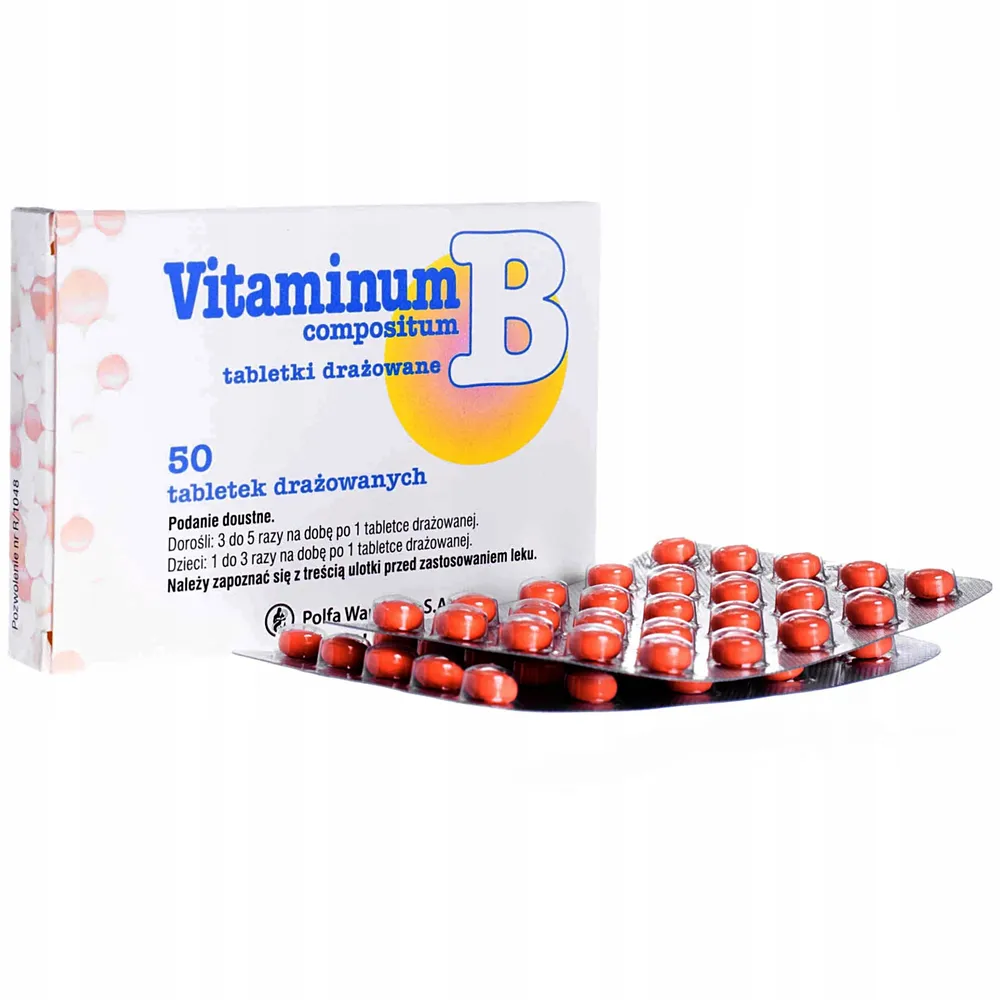
Table of Contents
- Package leaflet: Information for the patient
- 1. What Vitaminum B compositum is and what it is used for
- 2. Important information before using the medicine Vitaminum B compositum
- 3. How to use Vitaminum B compositum
- 4. Possible adverse reactions
- 5. How to store Vitaminum B compositum
- 6. Contents of the packaging and other information
Package leaflet: Information for the patient
VITAMINUM B compositum, coated tablets
Please read this leaflet carefully before using the medicine, as it contains important information for the patient.
This medicine should always be used exactly as described in this patient leaflet or as directed by a physician or pharmacist.
- Keep this leaflet, as you may need to read it again.
- If you need advice or further information, consult your pharmacist.
- If you experience any adverse reactions, including any possible adverse reactions not listed in this leaflet, inform your doctor or pharmacist. See section 4.
- If there is no improvement or if you feel worse, contact your doctor.
Table of contents
- What Vitaminum B compositum is and what it is used for
- Important information before taking Vitaminum B compositum
- How to take Vitaminum B compositum
- Possible side effects
- How to store Vitaminum B compositum
- Contents of the pack and other information
1. What Vitaminum B compositum is and what it is used for
Vitaminum B compositum is a multivitamin preparation containing a combination of B-group vitamins essential for normal metabolic processes. The vitamins in this medicine participate in numerous bodily processes, e.g. tissue respiration and metabolism of mediators in the central nervous system (substances involved in signal transmission). B-complex vitamins are water-soluble and do not accumulate in the body, as excess amounts are excreted in urine.
Vitaminum B compositum is used:
- for the prevention and treatment of combined deficiencies of B-group vitamins during periods of increased demand (febrile states, burns, alcoholism, pregnancy and breastfeeding), chronic and debilitating diseases, convalescence, gastrointestinal disorders associated with impaired vitamin absorption, and digestive disturbances;
- as adjunctive therapy in nervous system disorders, and inflammatory conditions of mucous membranes, e.g. of the lips and oral cavity, as well as in cheilitis and acne.
2. Important information before using the medicine Vitaminum B compositum
When not to use the medicine Vitaminum B compositum
- if the patient is allergic to thiamine nitrate (vitamin B ), riboflavin (vitamin B ), pyridoxine hydrochloride (vitamin B ), nicotinamide (vitamin PP), calcium pantothenate (vitamin B ), or any of the other ingredients of this medicine (listed in section 6).
Warnings and precautions
Before starting treatment with Vitaminum B compositum, discuss this with your doctor or
pharmacist.
Exercise special caution when using Vitaminum B compositum in patients with hypercalcemia
(elevated calcium levels in blood), urinary tract stones, or renal insufficiency.
In patients with significant renal insufficiency, the dose of the medicine should be reduced – see section 3 below.
Vitaminum B compositum and other medicines
Inform your doctor or pharmacist about all medicines currently used or recently used, as well as any medicines you plan to take.
Concomitant use of this medicine with drugs containing levodopa (some medicines used in Parkinson's disease) reduces their effectiveness.
Pregnancy and breastfeeding
If the patient is pregnant or breastfeeding, suspects she may be pregnant, or is planning to have a child, she should consult her doctor or pharmacist before using this medicine.
Driving and operating machinery
The medicine does not impair psycho-physical performance, ability to drive or operate machinery.
Vitaminum B compositum contains lactose, sucrose, and orange quinoline yellow (E 110)
This medicine contains lactose and sucrose; if the patient has previously been diagnosed with intolerance to certain sugars, the patient should consult a doctor before taking this medicine.
Each tablet contains 34.65 mg of monohydrate lactose.
The medicine may cause allergic reactions.
3. How to use Vitaminum B compositum
This medicine should always be taken exactly as described in the patient leaflet or as advised by your doctor or pharmacist. If in doubt, consult your doctor or pharmacist.
Oral administration.
Adults: 1 coated tablet 3 to 5 times daily.
Children: 1 coated tablet 1 to 3 times daily.
In patients with severe renal impairment, the dose should be reduced to 1 coated tablet daily.
Use of a higher than recommended dose of Vitaminum B compositum
Symptoms of overdose are very unlikely to occur, as the medicine contains water-soluble vitamins, which are rapidly excreted from the body.
4. Possible adverse reactions
Like any medicine, this medicine can cause adverse reactions, although they do not occur in everyone.
No adverse reactions have been observed when the recommended doses of the medicine are used.
If the recommended doses are exceeded, the following may occur: skin redness, facial flushing, rash,
urticaria, weakness, headache, irritability, insomnia, increased heart rate, diarrhoea.
During treatment with the medicine, yellow discoloration of urine may occur due to the presence
of vitamin B (riboflavin) – this is a normal phenomenon.
Reporting of adverse reactions
If any adverse reactions occur, including any adverse reactions not listed
in this leaflet, inform your doctor or pharmacist. Adverse reactions can be reported
directly to the Department of Monitoring Adverse Drug Reactions of the Office for Registration of Medicinal Products, Medical Devices and Biocidal Products
Al. Jerozolimskie 181C
02-222 Warsaw
Phone: +48 22 49 21 301
Fax: +48 22 49 21 309
Website: https://smz.ezdrowie.gov.pl
Adverse reactions can also be reported to the Marketing Authorisation Holder.
By reporting adverse reactions, additional information on the safety of the medicine can be collected.
5. How to store Vitaminum B compositum
Store below 25°C. Keep in the original packaging to protect from moisture.
Keep the medicine out of the sight and reach of children.
Note: The container contains a moisture-absorbing agent labeled in English as Do not eat. This substance is not for consumption and should remain in the container throughout the entire period of using the medicine. Keep the container tightly closed to protect from moisture.
Do not use this medicine after the expiry date stated on the packaging. The expiry date refers to the last day of the stated month.
Medicines must not be disposed of via wastewater or household waste. Ask your pharmacist how to dispose of medicines no longer required. Such measures will help protect the environment.
6. Contents of the packaging and other information
- The active substances in the medicine are: thiamine nitrate (vitamin B₁), riboflavin (vitamin B₂), pyridoxine hydrochloride (vitamin B₆), nicotinamide (vitamin PP), calcium pantothenate (vitamin B₅). Each coated tablet contains 3 mg of vitamin B₁, 5 mg of vitamin B₂, 5 mg of vitamin B₆, 40 mg of vitamin PP, and 5 mg of calcium pantothenate.
- Other ingredients are: lactose monohydrate, povidone K-25, talc, magnesium stearate, sucrose, sodium carboxymethylcellulose, povidone K-30, colloidal anhydrous silica, polysorbate 80, titanium dioxide, orange lake (E 110), Capol wax.
What Vitaminum B compositum looks like and contents of the packaging
Vitaminum B compositum is a round, biconvex coated tablet with an orange core and coating.
The packaging contains 50 coated tablets in blisters made of Al/PVC/PVDC foil, packed in a cardboard box, or 50 coated tablets in a polyethylene container with a lid and a desiccant, packed in a cardboard box.
Marketing Authorisation Holder
Zakłady Farmaceutyczne POLPHARMA S.A.
ul. Pelplińska 19, 83-200 Starogard Gdański
tel. +48 22 364 61 01
Manufacturer
Zakłady Farmaceutyczne POLPHARMA S.A.
Production Plant in Nowa Dęba
ul. Metalowca 2, 39-460 Nowa Dęba