Vitalipid n infant
Poland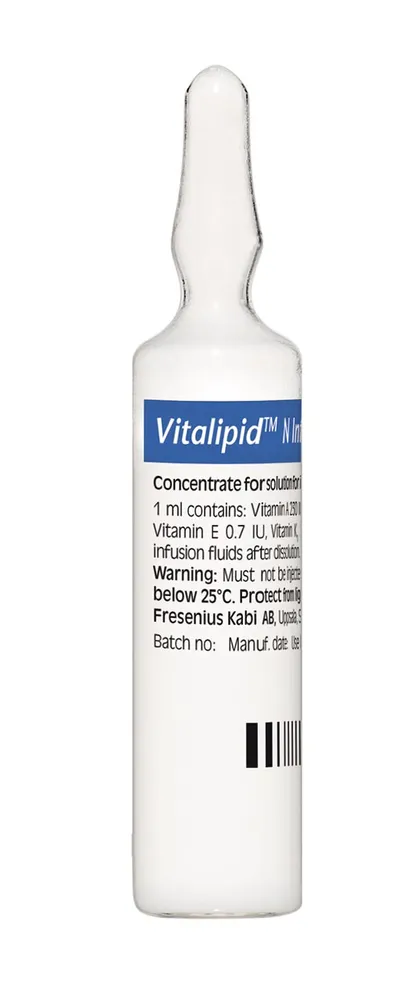
Table of Contents
- Package leaflet: Information for the user
- 1. What Vitalipid N Infant is and what it is used for
- 2. Important information before using Vitalipid N Infant
- 3. How to use Vitalipid N Infant
- 4. Possible adverse reactions
- 5. How to store Vitalipid N Infant
- 6. Contents of the package and other information
- Information intended exclusively for healthcare professionals:
Package leaflet: Information for the user
Warning! Keep the package leaflet! Information on the immediate packaging is in a foreign language.
Vitalipid N Infant
concentrate for preparation of infusion emulsion
Please read the entire leaflet carefully before use, as it contains
important information for the patient.
- Keep this leaflet, as you may need to read it again.
- If you have any questions, please consult your doctor, pharmacist, or nurse.
- This medicine has been prescribed for a specific individual. Do not pass it on to others. This medicine may harm another person, even if their symptoms are the same.
- If any side effects occur in the patient, including any side effects not listed in this leaflet, inform your doctor, pharmacist, or nurse. See section 4.
Table of contents of the leaflet
- What Vitalipid N Infant is and what it is used for
- Important information before using Vitalipid N Infant
- How to use Vitalipid N Infant
- Possible side effects
- How to store Vitalipid N Infant
- Contents of the pack and other information
1. What Vitalipid N Infant is and what it is used for
Vitalipid N Infant is a medicine containing fat-soluble vitamins, administered intravenously to infants and children when oral feeding is not possible. Vitamins are organic substances required in small amounts for the proper functioning of the body. Vitalipid N Infant is indicated for use as a component of parenteral nutrition, together with proteins, fats, carbohydrates, salts, and other vitamins.
2. Important information before using Vitalipid N Infant
When not to use Vitalipid N Infant
Do not use this medicine:
- if the patient is allergic to egg protein, soy, peanuts, the active substances, or any of the other ingredients of this medicine (listed in section 6);
- in its undiluted form. Vitalipid N Infant must be added to another solution, such as Intralipid 10% or Intralipid 20%, before administration to the patient. The physician or nurse is responsible for the proper preparation of the infusion.
Warnings and precautions
Inform the doctor about any medications containing vitamin A currently being administered to the child.
The doctor may order regular blood tests for patients receiving Vitalipid N Infant to monitor their health status.
Vitalipid N Infant and other medicines
Inform the doctor or pharmacist about all medicines currently used or recently used by the child, as well as any medicines the child may take in the future.
Inform the doctor if the patient is taking anticoagulant medicines (blood thinners) or medicines containing vitamin A.
This medicine contains purified soybean oil, purified egg yolk phospholipids, and sodium
Purified soybean oil
Do not use if hypersensitivity to peanuts or soy has been diagnosed. Cross-allergic reactions between soy and peanuts have been observed.
Purified egg yolk phospholipids
This medicine contains purified egg yolk phospholipids, which may rarely cause allergic reactions.
Sodium
This medicine contains less than 1 mmol (23 mg) of sodium per 10 ml, meaning it is considered "sodium-free".
3. How to use Vitalipid N Infant
Vitalipid N Infant is administered by intravenous infusion (intravenous drip).
The dose is determined individually for each patient by the physician.
Dosage
Premature infants and newborns with low birth weight (up to 2.5 kg)
The usual daily dose of Vitalipid N Infant is 4 ml per kilogram of body weight.
Newborns and children up to 11 years of age and with body weight above 2.5 kg
The usual daily dose of Vitalipid N Infant is 10 ml.
Children from 11 years of age and adults
Use of Vitalipid N Adult is recommended.
Administration of a higher than recommended dose of Vitalipid N Infant
The physician or nurse will monitor the patient's health condition during the infusion; therefore, the likelihood of administering a higher than recommended dose is low. However, if the patient believes they have received a higher than recommended dose of Vitalipid N Infant, they should immediately inform the physician or nurse. Symptoms of overdose may include headache, nausea, vomiting, and drowsiness.
If you have any further questions regarding the use of this medicine, consult your doctor or nurse.
4. Possible adverse reactions
No adverse reactions related to the use of Vitalipid N Infant have been reported.
Reporting of adverse reactions
If any adverse reactions occur, including any not listed in this leaflet, inform your doctor, pharmacist or nurse. Adverse reactions can also be reported directly to the Department of Monitoring Adverse Drug Reactions, Office for Registration of Medicinal Products, Medical Devices and Biocidal Products, Al. Jerozolimskie 181C, 02-222 Warsaw, tel.: +48 22 49 21 301, fax: +48 22 49 21 309, website: https://smz.ezdrowie.gov.pl.
Reporting adverse reactions helps provide more information on the safety of the medicine.
5. How to store Vitalipid N Infant
Keep this medicine out of sight and reach of children.
The doctor or nurse is responsible for ensuring appropriate storage, use, and disposal of Vitalipid N Infant.
Store below 25°C. Protect from light. Do not freeze.
Do not use this medicine after the expiry date stated on the container. The expiry date refers to the last day of the month indicated.
Any unused portion of the medicine must not be used.
Medicines must not be disposed of via wastewater or household waste. Ask your pharmacist how to dispose of medicines no longer required. This will help protect the environment.
6. Contents of the package and other information
What Vitalipid N Infant contains
- The active substances are:
1 ml contains:
retinyl palmitate 135.3 μg
(corresponds to retinol) (69 μg)
phytomenadione 20 μg
ergocalciferol 1.0 μg
all-rac-α-tocopherol 0.64 mg
which corresponds to:
vitamin A 69 μg (230 IU)
vitamin D 1.0 μg (40 IU)
vitamin E 0.64 mg (0.7 IU)
vitamin K 20 μg
10 ml contains:
retinyl palmitate 1353 μg
(corresponds to retinol) (690 μg)
phytomenadione 200 μg
ergocalciferol 10 μg
all-rac-α-tocopherol 6.4 mg
which corresponds to:
vitamin A 690 μg (2300 IU)
vitamin D 10 μg (400 IU)
vitamin E 6.4 mg (7 IU)
vitamin K 200 μg
- Other components (excipients) are: purified soybean oil, purified egg yolk phospholipids, glycerol, sodium hydroxide 1 M, and water for injections.
Osmolality: approximately 300 mOsm/kg water, pH: approximately 8.
What Vitalipid N Infant looks like and contents of the pack
Vitalipid N Infant is a sterile concentrate for preparing an oil-in-water emulsion for infusion, containing fat-soluble vitamins in the oil phase.
Each vial contains 10 ml of concentrate for preparing an emulsion for infusion.
Vitalipid N Infant is available in glass vials (Type I glass), packed in cardboard boxes of 10 vials.
For further information, please contact the marketing authorisation holder or the parallel importer.
Marketing authorisation holder in Spain, country of export:
Fresenius Kabi España S.A.U
C/Marina 16-18, 08005 Barcelona, Spain
Manufacturer:
Fresenius Kabi AB
Rapsgatan 7, SE-751 74 Uppsala, Sweden
Parallel importer:
InPharm Sp. z o.o.
ul. Strumykowa 28/11, 03-138 Warsaw
Repackaged by:
InPharm Sp. z o.o. Services sp. k.
ul. Chełmżyńska 249, 04-458 Warsaw
Marketing authorisation number in Spain, country of export: 680397.4
Parallel import authorisation number: 32/20
Information intended exclusively for healthcare professionals:
Warnings and precautions for use
Vitalipid N Infant contains purified soybean oil and purified egg yolk phospholipids, which
may rarely cause allergic reactions. Cross-allergic reactions between soy and peanuts have been observed.
Vitalipid N Infant must not be administered in undiluted form.
Dosage and method of administration
Dosage
The recommended dose to meet requirements in preterm infants and newborns with low birth weight (up to 2.5 kg) is 4 ml/kg body weight/day.
The recommended dose to meet requirements in newborns and children up to 11 years of age and with body weight above 2.5 kg is 10 ml/day.
Method of administration
For instructions on dilution of the medicinal product before administration, see section: Preparation of the medicinal product for administration.
Overdose
Overdose of fat-soluble vitamins may cause symptoms of toxicity; however, there are no data on toxicity associated with the use of Vitalipid N Infant at recommended doses.
Following a single overdose of fat-soluble vitamins, adverse effects are not expected. Specific treatment is not required.
Prolonged infusion of excessive doses of vitamin D may lead to elevated serum concentrations of vitamin D metabolites, which may result in osteopenia.
Infusion of vitamin K in a colloidal aqueous solution at rates exceeding the recommended rate may cause flushing, bronchospasm, tachycardia, and hypotension. Such effects have not been reported with the infusion of Vitalipid N Infant.
Preparation of the medicinal product for administration
Pharmaceutical compatibility and instructions for preparation
Aseptic techniques must be observed when mixing with other medicinal products.
No more than 10 ml (1 ampoule) of Vitalipid N Infant should be added to Intralipid 10% or Intralipid 20%. To ensure homogeneity of the mixture, the container should be gently rotated several times immediately before infusion.
Vitalipid N Infant may be dissolved in SOLUVIT N and administered to children with body weight above 10 kg.
The mixture obtained by dissolving SOLUVIT N in Vitalipid N Infant is not recommended for use in children with body weight below 10 kg due to differences in dosing.
Stability after mixing
Addition of Vitalipid N Infant to Intralipid 10% or Intralipid 20% should be performed within one hour before starting the infusion, and the infusion should be completed within 24 hours after preparation to avoid microbiological contamination. Any unused content of opened bottles/vials/ampoules must be discarded; do not store for later use.
Data on stability and pharmaceutical compatibility with parenteral nutrition products are available upon request from the Marketing Authorization Holder.
Pharmaceutical incompatibilities
Do not mix the medicinal product with other medicinal products except those mentioned in the section: Preparation of the medicinal product for administration.
Storage conditions
Store below 25°C. Protect from light. Do not freeze.
Disposal of unused medicinal product
Any unused portions of the medicinal product or waste material should be disposed of in accordance with local regulations.