Vitakon
Poland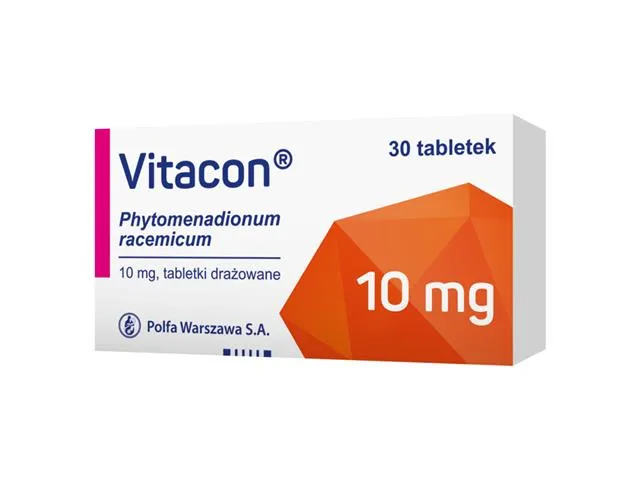
Table of Contents
Package leaflet: information for the patient
VITACON, 10 mg, coated tablets
int-rac-Phytomenadionum
Please read all of this leaflet carefully before taking this medicine, because it contains
important information for the patient.
- Keep this leaflet, as you may need to read it again.
- If you have any further questions, please ask your doctor or pharmacist.
- This medicine has been prescribed for a specific individual. Do not pass it on to others. It may harm them even if their symptoms are the same.
- If you experience any adverse reactions, including any not listed in this leaflet, tell your doctor or pharmacist. See section 4.
Contents of the leaflet
- What Vitacon is and what it is used for
- Important information before taking Vitacon
- How to take Vitacon
- Possible side effects
- How to store Vitacon
- Contents of the pack and other information
1. What Vitacon is and what it is used for
Vitacon contains phytomenadione (vitamin K – fat-soluble), which is involved in the formation of certain blood clotting factors.
Vitacon is used:
- in coagulation disorders caused by oral anticoagulant drugs of the coumarin derivatives group (acenocoumarol, warfarin) and indandione derivatives (phenindione), antibacterial agents destroying the physiological intestinal bacterial flora, antibiotics, sulfonamides, salicylates;
- in prothrombin deficiency (one of the clotting factors) occurring in mechanical jaundice or biliary fistula.
2. Important information before using Vitacon
When not to use Vitacon
- If the patient is allergic to phytomenadione or any of the other ingredients of this medicine (listed in section 6).
Warnings and precautions
Before starting treatment with Vitacon, discuss it with your doctor or pharmacist.
- Use with caution in patients receiving anticoagulant therapy, because administration of vitamin K in these patients may result in recurrence of thromboembolic risk.
- Use with caution in patients with liver diseases associated with coagulation disorders.
- In elderly patients, the doctor may recommend lower doses of the medicine.
- Exercise particular caution in patients with impaired liver function. Increasing the dose of phytomenadione is not recommended in patients with liver disease who have not responded to standard doses of the medicine.
- During treatment, prothrombin time should be monitored periodically.
- The effect of the medicine usually becomes apparent after 6–10 hours; full effect may take up to 24–48 hours.
Vitacon and other medicines
Inform your doctor or pharmacist about all medicines the patient is currently taking or has recently taken, as well as any medicines the patient plans to take.
Administration of phytomenadione may cause transient resistance to oral anticoagulant drugs (coumarin and indandione derivatives).
Pregnancy and breastfeeding
If the patient is pregnant or breastfeeding, suspects she may be pregnant, or is planning to have a child, she should consult her doctor or pharmacist before using this medicine.
This medicine may be used during pregnancy only if, in the opinion of the doctor, the benefit to the mother outweighs the potential risk to the fetus.
Caution should be exercised when using this medicine in breastfeeding women.
Driving and operating machinery
This medicine has no influence on the ability to drive or operate machinery.
Vitacon contains monohydrate lactose, sucrose, quinoline yellow lake (E 104), and sodium
If the patient has previously been diagnosed with intolerance to certain sugars, the patient should consult a doctor before taking this medicine.
This medicine may cause allergic reactions due to the presence of quinoline yellow.
The medicine contains less than 1 mmol (23 mg) of sodium per tablet, i.e. the medicine is considered "sodium-free".
3. How to use Vitacon
This medicine should always be used as directed by a physician. In case of doubt, consult a
physician or pharmacist.
Coagulation disorders in adults caused by oral anticoagulant drugs (coumarin and indandione
derivatives)
The initial dose is usually 10 mg (up to a maximum of 30 mg or exceptionally 50 mg). The frequency
and size of subsequent doses will be determined by the physician based on prothrombin time measurements and the patient's clinical condition.
If, 12 to 48 hours after administration, the prothrombin time has not improved satisfactorily,
the dose may be repeated.
Coagulation disorders in adults caused by other factors
The initial dose is 10 to 30 mg, exceptionally 50 mg. The dose size depends on the patient's condition
and response to treatment.
Basic management should, if possible, involve adjusting the dose of drugs affecting coagulation
mechanisms (antibiotics, salicylates, sulfonamides).
Phytonadione should be used when coagulation disorders are so severe that adjusting the dose
of the administered drug does not ensure sufficiently rapid resolution, or when dose adjustment
is not possible.
Note: Oral administration of vitamin K is justified only when it can be absorbed from the
gastrointestinal tract. If bile secretion into the gastrointestinal tract is insufficient, the physician will
recommend concomitant oral administration of bile acid salts.
Use of a higher than recommended dose of Vitacon
Symptoms of phytonadione toxicity are not known.
Missed dose of Vitacon
Do not take a double dose to make up for a missed dose.
4. Possible adverse reactions
Like all medicines, this medicine can cause adverse reactions, although not everybody will experience them.
No adverse reactions have been observed following administration of phytomenadione in oral tablets.
Reporting of adverse reactions
If any adverse reactions occur, including any adverse reactions not listed in this leaflet, inform a doctor or pharmacist. Adverse reactions can be reported directly to the Department for Monitoring Adverse Drug Reactions of the Office for Registration of Medicinal Products, Medical Devices and Biocidal Products
Al. Jerozolimskie 181C
02-222 Warsaw
Phone: +48 22 49 21 301
Fax: +48 22 49 21 309
Website: https://smz.ezdrowie.gov.pl
Adverse reactions can also be reported to the marketing authorization holder.
Reporting adverse reactions enables continued monitoring of the medicine's safety and helps to provide more information on its safe use.
5. How to store Vitacon
Store below 25 °C. Keep in the original packaging to protect from moisture.
Keep the medicine out of the sight and reach of children.
Do not use this medicine after the expiry date stated on the carton and blister. The expiry date refers to the last day of the stated month.
The marking on the packaging following EXP indicates the expiry date, and following Lot/LOT indicates the batch number.
Medicines should not be disposed of via wastewater or household waste. Ask your pharmacist how to dispose of medicines no longer required. This will help protect the environment.
6. Contents of the pack and other information
What Vitacon contains
- The active substance is all-rac - phytomenadione. Each coated tablet contains 10 mg of all-rac - phytomenadione. The other ingredients are: hydrated colloidal silica; microcrystalline cellulose; sodium croscarmellose; lactose monohydrate; magnesium stearate; povidone K-30; sodium carmellose; sucrose; anhydrous colloidal silica; talc; polysorbate 80; titanium dioxide (E 171); quinoline yellow lake (E 104); Capol wax.
What Vitacon looks like and contents of the pack
Vitacon is yellow, round, biconvex coated tablets.
Vitacon is available in blisters made of Aluminium/PVC foil, packed in a cardboard box.
The pack contains 30 tablets.
Marketing Authorisation Holder
Zakłady Farmaceutyczne POLPHARMA S.A.
Pelplińska 19 Street, 83-200 Starogard Gdański
tel. + 48 22 364 61 01
Manufacturer
Zakłady Farmaceutyczne POLPHARMA S.A.
Production Plant in Nowa Dęba
Metalowca 2 Street, 39-460 Nowa Dęba